
A tale of the Ros River and the Honey Feast
In the heart of Ukraine, where the forest meets the steppe and the little river Ros winds through granite rocks and green meadows, there was once a village of white cottages with gardens full of sunflowers and poppies. On the edge of that village, beside the river, lived a widow named Motria with her seven sons.
Motria’s husband, Ostap, had been a brave and good man. Some years before our tale, raiders had come riding out of the steppe, and Ostap had stood at the ford of the river with a handful of other men and held them back until the women and children could flee to the forest. He had been killed at the ford, with a wooden cross around his neck that he had carved himself. The villagers had brought the cross back to his widow, and she wore it ever after.
Motria raised her seven sons alone. She was not a large woman, nor a loud one, but she had a will like the granite rocks of the Ros, and her sons loved her and obeyed her, even the biggest of them.
The eldest was Ivan, twenty years old, tall and broad as an oak, strong and steady, who had taken his father’s place in the fields. After him came Petro, eighteen, sharp and clever, who could reckon sums in his head faster than the village clerk. Then Pavlo, seventeen, handsome and merry, who played the fiddle at every wedding. Then Yakiv, fifteen, quiet and thoughtful, who helped the priest in church. Then Andrii, fourteen, and Semen, twelve, who were never apart and never still. Last of all came little Tymko, only nine years old, with a round freckled face and a gap in his front teeth, the darling of the whole family.
Every year, on the first day of August, came the feast that the people of Ukraine call Makovii, or the Honey Feast. On that day, the Church remembers the Holy Maccabees, the seven brothers and their mother who were martyred long ago, and it also celebrates the Procession of the Precious Wood of the Holy Cross. In every village, the people carry honey from their hives and poppy seeds from their gardens to church to be blessed, along with great bouquets of poppies and mint and wildflowers, and the priest blesses the water of the rivers and wells. The poppy seed is scattered around the house and the barn to keep evil away, and the blessed honey is eaten with joy, for it is the first honey of the new harvest.
Every year, on the eve of the Honey Feast, Motria gathered her seven sons around the table and told them the story of the Holy Maccabees.
“Long ago,” she said, “before Christ was born, there was a wicked king named Antiochus, who ruled over the land of Israel. He set up an idol in the holy Temple in Jerusalem, and he commanded the people of God to forsake His law and worship the idol, or die. Many were afraid and obeyed. There was a mother, however, whom the Church calls Solomonia, who had seven sons, and they would not obey.”
“The king had the seven brothers brought before him, one after another. He offered them riches and honors if they would break God’s law, and he threatened them with terrible tortures if they would not. One after another, the brothers refused. Their mother stood beside them through it all. She did not weep, and she did not beg the king for mercy. She encouraged her sons, one by one, to be faithful to the end.”
“When only the youngest was left, the king called the mother and begged her to persuade the boy to save himself. She bent down to her youngest son, and in the language of her fathers, so that the king would not understand, she said to him: My son, have pity on me. Look at the heaven and the earth and everything in them, and know that God made them out of nothing. Do not fear this butcher. Be worthy of your brothers, and accept death, so that in God’s mercy I may receive you back again with them.”
“The youngest son was faithful, like his brothers. Last of all, the mother herself died. The Holy Scripture says that she was marvelous above all, and worthy of honorable memory, for she saw her seven sons die in a single day, and she bore it with good courage because of her hope in the Lord.”
Every year, when she finished the story, little Tymko would ask the same question. “Mother, would you have done that? Would you have told us not to be afraid?”
Every year, Motria would answer, “God grant that we are never tested so. If we are, my sons, then yes. Look at the heaven and the earth, and remember who made you.”
In the year when Tymko was nine, far away beyond the great marshes to the north, there lived a lord whom the people called the Black Lord.
No one knew where he had come from. He was a sorcerer, it was said, and he had built himself a great fortress of black stone in the middle of the marshes, where no road led. He had grown rich by raiding and plundering, and he had grown proud beyond all measure. In the great hall of his fortress, he had set up a golden idol, twice the height of a man, and it was an image of himself, with a crown on its head and a scepter in its hand. Everyone who came into his power was brought before the idol and commanded to bow down to it, as the people of Babylon were commanded to bow to the golden image of King Nebuchadnezzar. Those who bowed became his servants and soldiers. Those who refused were thrown into a fiery pit that burned night and day beneath the hall.
That summer, the Black Lord needed more soldiers. So on a moonless night at the end of July, a few days before the Honey Feast, his horsemen came riding down out of the north, silent as shadows, and fell upon the village on the Ros.
They came so suddenly that there was no time to fight. They broke into the cottages and dragged out the young men and boys, bound them with chains, and threw them over their saddles. Motria woke to the sound of screaming and the thunder of hooves, and ran out of the cottage in her nightdress, and saw her seven sons, all seven, from tall Ivan to little Tymko, chained together in a line and being driven away into the dark.
“Mother!” cried Tymko. “Mother!”
Then they were gone.
In the gray dawn, the women of the village stood in the street, weeping and wailing. Their sons and husbands and brothers had been carried off, more than thirty of them, and they knew the stories of the Black Lord. No one who was taken to his fortress in the marshes had ever come back.
Motria did not weep for long.
She went into her cottage, and she dressed herself, and she took down from the shelf the things she had prepared for the Honey Feast: a small clay jar of honey from her hives, and a linen pouch of poppy seed from her garden. She filled a flask with holy water from the jar that stood before the icon corner, which the priest had blessed at Theophany. She took her husband’s wooden cross from around her own neck and kissed it and put it back on. She knelt before the icon of the Savior and prayed.
Then she went to the church, and the old priest, Father Ilarion, blessed the honey and the poppy seed and the water for her, a few days early, and blessed her with the sign of the cross.
“Where are you going, daughter?” he asked, though he already knew.
“After my sons,” said Motria.
“You are one woman,” said the priest. “They are an army. The Black Lord is a sorcerer.”
“Solomonia was one woman,” said Motria, “and Antiochus was a king.” She bowed to the priest, and she walked out of the village alone, following the tracks of the horsemen north across the steppe.
The tracks led north for a day, and then they vanished. The steppe was dry, and the wind had blown the dust over the hoofprints, and, in every direction, there was only tall grass rippling to the horizon. Motria stood in the middle of the grass and did not know which way to go.
Then she heard a humming.
A cloud of bees came flying toward her over the grass, golden in the sunlight, and circled around her head. Motria knew them. They were the wild bees from the old hollow oak at the edge of her garden. Many years before, her neighbors had wanted to smoke out that hive and take the honey, and Motria had forbidden it. “Let them be,” she had said. “God made them too.” Every summer since, the wild bees had come to drink at her flowers.
“Follow us, Motria,” hummed the bees. “We know where your sons have gone. The horsemen passed through the meadows where we gather our nectar, and we followed them.”
The bees flew ahead of her, northward through the tall grass, and Motria followed them.
On the third day, she came to the edge of the great marshes, a vast gray-green country of reeds and black water and mist, with no road, stretching as far as the eye could see. As she stood at the edge of the reeds, she heard a baying of hounds.
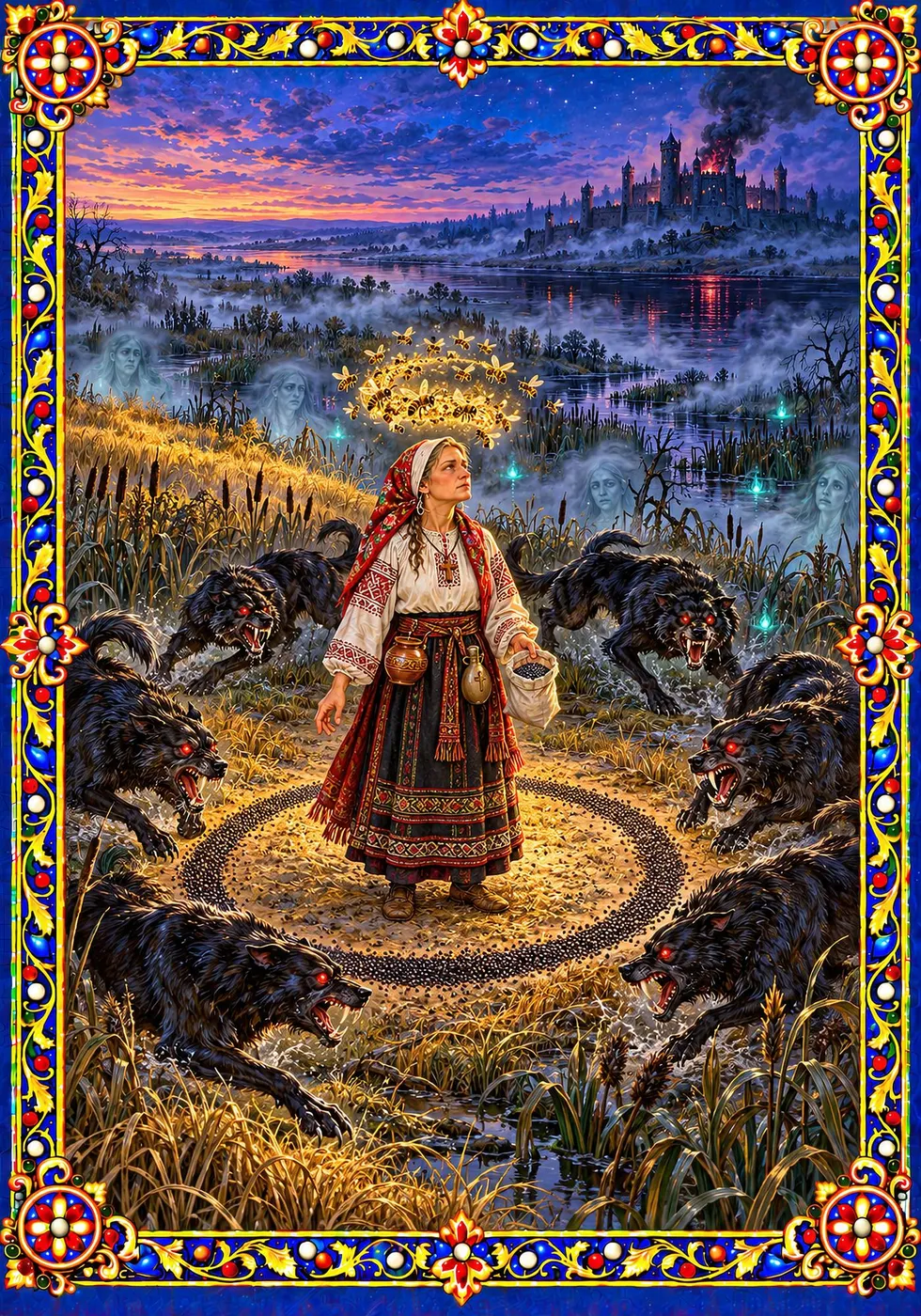
Out of the mist came a pack of great black dogs with red eyes and slavering jaws, the hunting hounds of the Black Lord, who roamed the edges of the marshes to catch anyone who tried to follow. Behind them, among the reeds, flickered strange pale lights, and she heard whispering voices, and she knew that the evil spirits of the marsh were coming too.
Motria did not run. She opened the linen pouch of blessed poppy seed, and she scattered it on the ground in a circle around her, as the women of Ukraine scatter poppy seed around their houses and barns on the Honey Feast to keep evil away.
The black hounds came racing toward her, and when they reached the circle of poppy seed, they stopped as though they had hit a wall. They snarled and howled and ran around and around the circle, but they could not cross it. The pale lights of the marsh came drifting toward her, and they too stopped at the circle, and flickered, and faded. At last, as the moon rose, the hounds lay down outside the circle, and their red eyes grew heavy, and they fell into a deep sleep, for the poppy is the flower of sleep. Motria stepped carefully over them and went on into the marsh.
In the middle of the marshes, a deep black river flowed. On its bank stood a little hut, and beside the hut sat an old ferryman on an upturned boat, groaning. His leg was swollen and black with some terrible sickness of the marsh, and he could not stand.
“Grandfather,” said Motria, “will you carry me across the river? I must go to the fortress of the Black Lord.”
“No one goes to the Black Lord’s fortress willingly,” groaned the old man. “Yet even if I would take you, I cannot stand. My leg is rotting with the marsh fever. I will be dead in a week.”
Motria knelt beside him and took out the flask of holy water. She made the sign of the cross over it, and she poured a little of it over the old man’s swollen leg.
At once, the blackness faded from the leg, and the swelling went down, and the old man stood up on two sound legs, weeping with astonishment.
“Who are you?” he said.
“A mother,” said Motria, “going to find her sons.”
The old ferryman rowed her across the black river in his boat, and he pointed across the marsh toward a great black shape looming out of the mist. “There it is,” he whispered. “God go with you.”
The fortress of the Black Lord was built of black stone, with high walls and iron gates, and smoke rose from its center night and day, from the fiery pit beneath the great hall.
Motria could not enter by the gate. She walked around the walls until she came to the kitchen door, where the servants came out to throw away the scraps. She waited until dark, and then she tied her kerchief low over her face like a servant woman, took a basket of turnips that had been left by the door, and walked into the kitchen as though she belonged there. In the bustle and smoke of the great kitchen, no one noticed one more tired servant woman. She kept her head down, and she carried trays, and she listened.
The next morning, the servants said, the Black Lord would bring the new captives from the village on the Ros before his golden idol. It was the first day of August.
It was the Honey Feast.
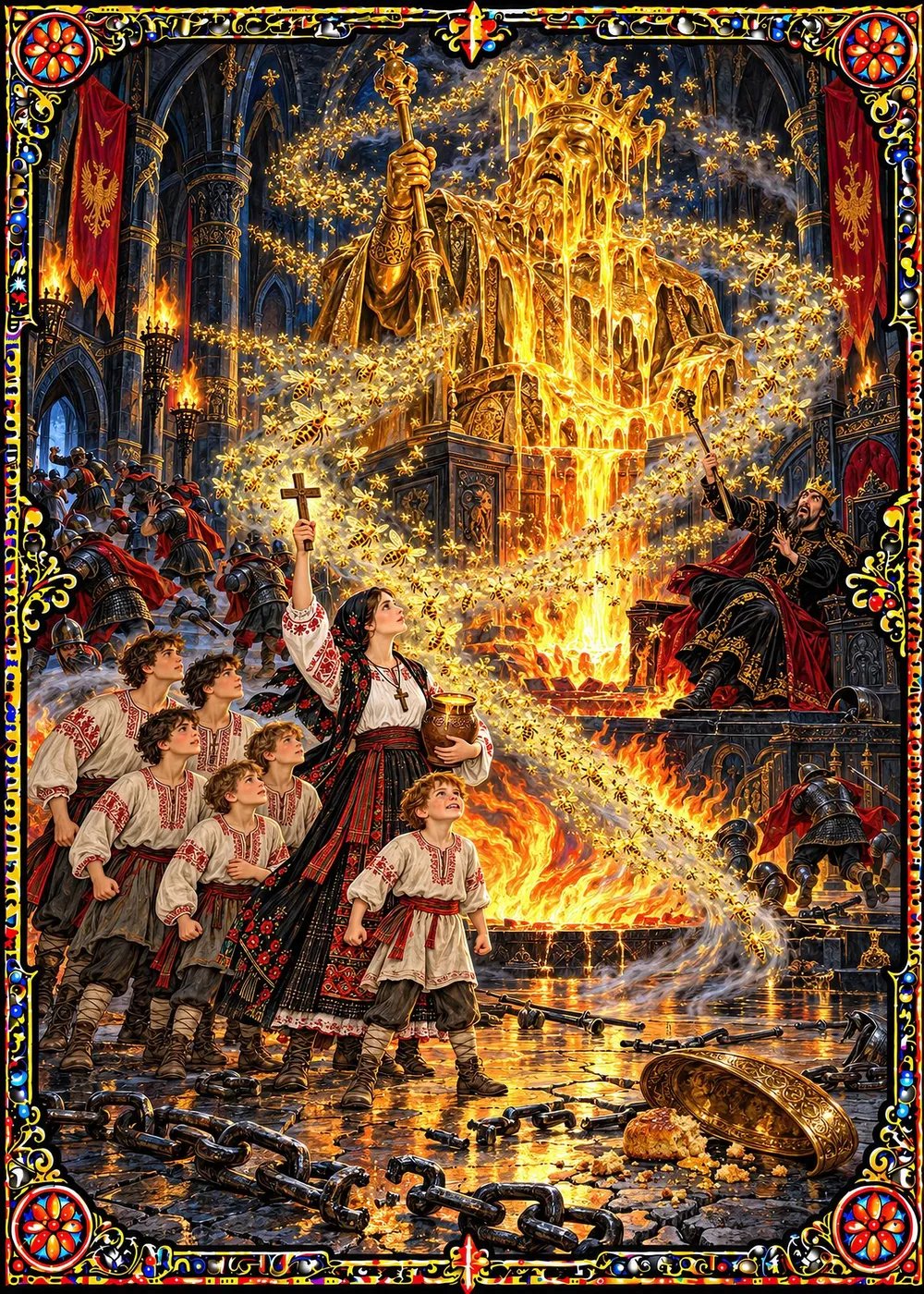
In the morning, the great hall of the fortress was filled with the Black Lord’s soldiers and servants. At one end of the hall stood the golden idol, glittering in the torchlight, twice the height of a man, with its golden crown and its golden scepter and its cruel golden face. Before it, in the floor, was a great square pit, and from the pit rose flames and heat and a terrible roaring, so that the whole hall was as hot as an oven.
* * *
Copyright notice. Introduction and illustration © 2026 Laurent Cleenewerck. All rights reserved. The adapted Orthodox version of this tale is published in Twelve Ukrainian Orthodox Fairy Tales (© 2026 Laurent Cleenewerck). No part of this page may be reproduced without written permission, except for brief quotations with attribution and a link to this page.
Buy the book on AmazonAbout the book