
A tale of Vyshhorod on the Dnieper
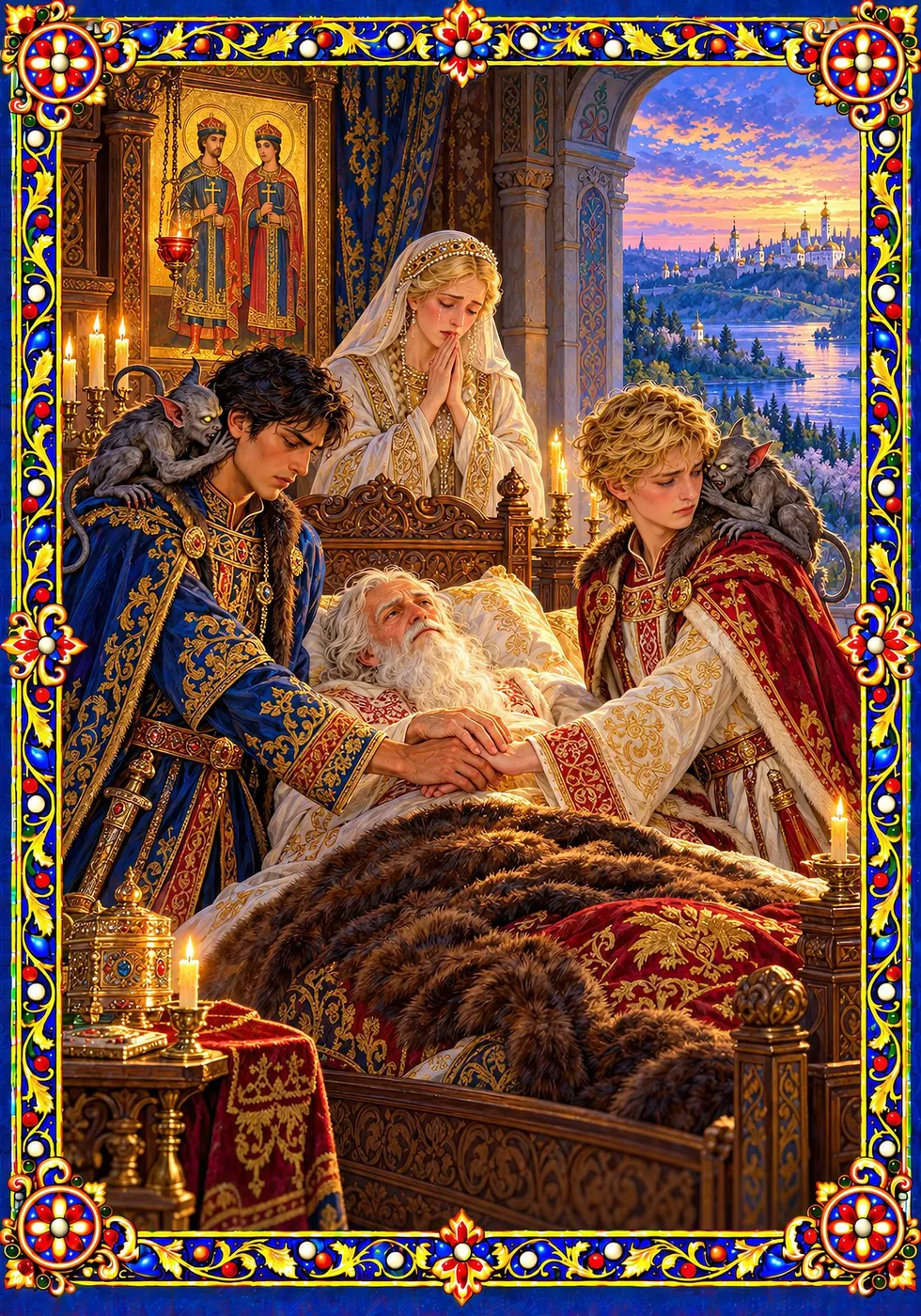
A little way north of Kiev, where the Dnieper flows broad and blue beneath high, steep banks, there stands the old town of Vyshhorod. Its walls stand on the very edge of the heights, and, from them, one can see the river winding away for miles, and the forests on the far bank, and to the south, on a clear day, the golden domes of Kiev.
In Vyshhorod, there is a small stone church that holds a great treasure: the relics of the holy martyr-princes Boris and Gleb. They were the sons of St. Vladimir, who baptized Rus’. When their father died, their elder brother Sviatopolk wanted all the land for himself and sent assassins to kill them. Boris had an army with him, and his soldiers begged him to fight. He refused. “I will not raise my hand against my brother,” he said, and he sent his soldiers away and prayed through the night, and, in the morning, the assassins came and killed him. Gleb, his younger brother, died in the same way on the banks of the Dnieper, praying for the one who had sent the killers. The Church calls them the Passion-bearers, and the people of Rus’ have loved them for a thousand years, because they chose to die rather than shed their brother’s blood.
To the south of Vyshhorod, beyond Kiev, lies the great steppe, the endless sea of grass that stretches all the way to the Black Sea. In the days of our tale, the steppe belonged to the Cumans, horsemen of the grasslands who lived in felt tents and drove great herds of horses across the plains. Sometimes the Cumans raided the lands of Rus’, burning villages and carrying away captives. Sometimes they made peace with the princes of Rus’ and fought beside them against their common enemies. To seal those peaces, the princes of Rus’ often took Cuman princesses as their brides, and many a prince of Rus’ had a Cuman mother or grandmother.
In those days, Vyshhorod was ruled by old Prince Davyd, a just and pious man.
When he was young, Prince Davyd had made peace with the Cumans, and to seal it, he had married the daughter of a Cuman khan. She was a tall, graceful young woman with black hair, dark eyes and bronze skin, and when she came to Vyshhorod, she asked to be baptized, and she took the name Sofiia. She became the most devout woman in the town. She fed the poor at the palace gate, and prayed for hours before the relics of Boris and Gleb, and she learned the language and the hymns of Rus’ so well that the priests marveled. She gave Prince Davyd a son, and they named him Hlib, after the holy Gleb.
When Hlib was eight years old, Princess Sofiia fell ill with fever and died. The whole town wept for her.
After some years, Prince Davyd married again, the daughter of a Kievan boyar, a kind and fair-haired woman named Maryna. She gave him a second son, and they named him Borys, after the holy Boris, so that the two brothers might bear the names of the two holy brothers, and love each other as they had.
Princess Maryna loved Hlib as though he were her own son, and Hlib loved her as a mother. The two boys grew up together in the palace at Vyshhorod, and they were inseparable. They learned to ride together, and to shoot the bow, and to read the holy books. They swam together in the Dnieper in summer and slid on the ice in winter. When Borys was small and afraid of thunder, he would creep into Hlib’s bed at night, and Hlib would hold him until the storm passed.
The two brothers did not look alike. Hlib had his mother’s face: black hair, dark eyes, bronze skin, and the broad cheekbones of the steppe. He was lean and quiet, and he rode a horse better than anyone in Vyshhorod, as though he had been born in the saddle. Borys had his mother’s face: fair hair, blue eyes, pale skin that burned in the summer sun. He was warm-hearted and quick-tempered, and he laughed loudly and wept easily.
When they were boys, they never thought about it. They were brothers, and that was all.
In the year of our tale, Hlib was twenty-two years old, and Borys was nineteen. That winter, old Prince Davyd fell ill, and everyone knew that he would not live until spring.
It was then that the whisperer came to Vyshhorod.
It came in the night, on the cold wind from the marshes, and no one saw it arrive, for no ordinary eye could see it. It was a bis, one of the small demons that the people of Ukraine have always feared: a gray, shriveled creature no bigger than a cat, with bat’s ears, a long thin tail, yellow eyes, and a mouth full of tiny sharp teeth. It had no strength of its own. It could not lift a sword or light a fire. It had only one weapon, its voice, and it used that weapon well.
It crept into the palace and perched on the shoulders of sleeping men and whispered in their ears, and they woke with bitter thoughts they did not understand.
First, it went to Borys.
It crouched on his pillow in the dark and whispered into his ear: Your father is dying. Who will be prince after him? Hlib, because he is the elder. Look at his face, Borys. Look at his eyes and his skin. Is that the face of a true son of Rus’? He has steppe blood in him, raider blood. The Cumans burned your grandfather’s villages. The Cumans carried away the people of Rus’ as slaves. Now a Cuman will sit on the throne of Vyshhorod. He will open the gates to his mother’s people. He will sell your land to the steppe. The throne belongs to you, Borys, a true son of Rus’, with a face like your fathers.
Borys woke in the morning with a cold, sick feeling in his heart. At breakfast, when Hlib smiled at him across the table, Borys did not smile back. For the first time in his life, he found himself staring at his brother’s dark eyes and bronze skin, and thinking, He does not look like me.
Then the bis went to Hlib.
It crouched on his pillow in the dark and whispered into his ear: They have never accepted you, Hlib. Do you think they have? Behind your back, the boyars call you “the Cuman.” The market women whisper about your mother. The priests smile at you, but they wish you were fair like your brother. When your father dies, they will set Borys on the throne, because he has a face like theirs, and they will cast you out, back to the steppe where they think you belong. Take what is yours, Hlib, before they take it from you.
Hlib woke in the morning with a burning in his chest. At breakfast, when Borys did not smile back at him, Hlib saw it, and the whisper in his heart said, You see? Even your brother.
Then the bis went to the boyars, and to the soldiers, and to the townspeople of Vyshhorod. It perched on their shoulders in the market and at the well and in the tavern, and it whispered about outsiders, about steppe blood, about pure blood and foreign faces. It whispered to the boyars who supported Hlib that the fair-haired Borys and his mother’s Kievan family meant to steal the throne. It whispered to the boyars who supported Borys that the dark-faced Hlib was a spy for the Cumans.
The bis grew fat on hatred. Every whisper that took root made it a little larger, a little stronger, and its yellow eyes gleamed.
Little by little, the town of Vyshhorod began to change. People who had known Hlib since he was a baby began to look at him strangely in the street. In the market, someone muttered “Cuman” as he passed. One day, a group of boys threw stones at his horse and shouted words at him that they had heard their fathers say at home. Hlib rode on without looking back, but his face was like stone, and, that night, he did not sleep.
Princess Maryna saw what was happening, and she wept. She went to Borys and said, “My son, what has come over you? He is your brother. He held you in his arms when you were afraid of the thunder.”
Borys did not answer her. The bis was sitting on his shoulder, whispering.
She went to Hlib and said, “My son, do not listen to the fools in the market. You are as dear to me as Borys. Your mother was my friend. She was holier than any of us.”
Hlib kissed her hand, but his eyes were cold. The bis was sitting on his shoulder too.
In the spring, old Prince Davyd died.
On his deathbed, he called both his sons to him and took their hands and put them together. “Love each other,” he said, with his last breath. “Remember whose names you bear.” Then he died, and his sons stood on either side of his bed, holding hands over his body, and they could not look each other in the eye.
After the funeral, Vyshhorod split in two.
Half the boyars declared for Hlib, because he was the elder son and the throne was his by right. Half declared for Borys, and some of them said openly that no son of a Cuman woman should ever rule a town of Rus’. The soldiers of the town took sides. The market divided. Families quarreled at their tables. Neighbors stopped speaking to one another. Over all of it, invisible, the bis flew from shoulder to shoulder, whispering, and grew fatter and fatter.
At last, after a month of bitter quarrels, the two brothers met in the council hall of the palace, with their boyars behind them.
“The throne is mine,” said Hlib, and his voice shook with anger. “I am the elder son. Our father’s law gives it to me.”
“The throne belongs to a son of Rus’,” said Borys, and his face was red. “Not to a son of the steppe.”
The whole hall fell silent. Hlib went white under his bronze skin.
“Then let God decide,” he said very quietly. “Tomorrow morning, on the meadow below the town, you and I will fight, sword against sword, and whoever lives will rule Vyshhorod.”
“So be it,” said Borys.
On the shoulder of each brother, invisible, the gray bis grinned with all its tiny teeth.
The next morning, the whole town came down to the great meadow below Vyshhorod, beside the river. Hlib’s soldiers gathered at one end of the meadow and Borys’s soldiers at the other, with their spears and their banners. The townspeople crowded along the edges, and the boyars stood on the slope above. Princess Maryna stood among the women, weeping, with her face in her hands.
In the middle of the meadow, the two brothers faced each other with drawn swords.
At that moment, a stranger came walking up the river road.
He was an old man, very old, with a long white beard and a long white mustache that hung down past his chin, in a patched gray coat and a sheepskin hat. On his back, he carried a bandura, the great many-stringed instrument of the kobzars, the wandering singers of Ukraine. His eyes were milky white. He was blind, and a small boy of about ten led him by the hand.
In the old days of Ukraine, the kobzars wandered from town to town and village to village, singing the old dumy, the long, sad, heroic songs of the saints and the warriors and the sufferings of the people. Most of them were blind, and they were honored everywhere, for people said that God had taken their sight so that they could see what others could not.
No one in Vyshhorod had ever seen this kobzar before.
The boy led him onto the meadow. The soldiers on both sides stared, and some of them laughed. “Get out of the way, old man!” someone shouted. “There is going to be a fight!”
The old kobzar did not answer. He let the boy lead him straight into the middle of the meadow, between the two brothers with their drawn swords. There he sat down on a large stone, set his bandura on his knees, and turned his blind face first toward Hlib, and then toward Borys, and then toward the empty air between them.
The boy, his guide, went pale. Later, he told people that when the old man turned his blind eyes to that empty place between the brothers, his face grew stern and terrible, as though he saw something there that no one else could see.
* * *
Copyright notice. Introduction and illustration © 2026 Laurent Cleenewerck. All rights reserved. The adapted Orthodox version of this tale is published in Twelve Ukrainian Orthodox Fairy Tales (© 2026 Laurent Cleenewerck). No part of this page may be reproduced without written permission, except for brief quotations with attribution and a link to this page.
Buy the book on AmazonAbout the book