
A tale of Pochaiv in Volhynia
In the land of Volhynia, in the west of Ukraine, where gentle green hills roll away under a wide sky and the villages sit among orchards and fields of wheat, there stands the old castle town of Kremenets on its high hill. A little way from Kremenets rises another hill, higher and steeper, crowned with forest. It is called Pochaiv.
In the days of our tale, there was no great monastery on the hill of Pochaiv, as there is today. There were only a few caves in the hillside where holy hermits lived and prayed, and on the very top of the hill, among the oaks, a great gray rock stood out of the grass like the back of a sleeping ox. The shepherds of the villages around brought their sheep to graze on the slopes, and the hermits sometimes came down to bless them, and that was all.
In the castle of Kremenets lived a prince, and he had one daughter. Her name was Anna, and she was blind.
She had not always been blind. When she was five years old, a terrible fever had come to Kremenets, and Anna had lain for many days burning and tossing in her bed. When the fever left her, the light had left her eyes. The finest physicians of Volhynia and even of Kiev had come to the castle, and they had tried every medicine they knew, but none of them could help her.
In the year of our tale, Anna was eighteen years old. She was beautiful, with long chestnut hair and a gentle face, and her eyes were gray and clear, though they saw nothing. She was kind to everyone. She knew every servant in the castle by the sound of their footsteps, and every bird in the garden by its song. She was sad, however, with a quiet sadness that never left her, for she lived in darkness, and she felt very much alone.
She felt alone partly because of the court.
In those years, the court of the Prince of Kremenets had grown rich and fashionable. The boyars and their ladies dressed in silks and velvets from foreign lands, and they copied the manners of distant courts, and they prided themselves on being refined and modern. In their eyes, the old ways of the countryside were for peasants. They laughed at the village women who bowed to the ground before the icons, and at the shepherds who crossed themselves with great sweeping gestures, and at the old people who prayed aloud in church, calling out to God in the simple words their grandmothers had taught them.
“How vulgar,” the courtiers said, behind their perfumed handkerchiefs. “How loud. God is not deaf, after all. A refined person prays silently, if at all, and makes a small sign of the cross, discreetly, so as not to make a spectacle of himself.”
And so, at the court of Kremenets, no one prayed aloud anymore! In the castle chapel, the boyars stood in their silks with their lips closed, glancing around to see who was watching. When they crossed themselves, it was a tiny, quick gesture, almost hidden, as though they were ashamed of it.
Anna could not see their faces, but she could hear everything. She heard the whispers and the little sniffs of laughter when an old servant prayed aloud. She heard the silence in the chapel, a silence that did not sound to her like reverence, but like people holding their breath so as not to be noticed. Every night, alone in her room, with the door closed, Anna knelt by her bed and prayed aloud to God and to the Theotokos, softly, in the words her old nurse had taught her, the way the village women prayed. She never did it where anyone could hear. She was afraid the court would laugh at her too.
Her father, the prince, loved her dearly, and it grieved him that she was alone. At last, he made a proclamation. He sent heralds throughout all Volhynia to announce that the princes of the land were invited to Kremenets on the Feast of the Dormition of the Theotokos, in the middle of August, to seek the hand of the Princess Anna.
“Perhaps,” the old prince said to himself, “a good husband will bring her some happiness, even if she can never see.”
On the eve of the feast, seven princes came riding up the road to Kremenets.
The first was the Prince of Lutsk, tall and splendid, in a cloak of crimson velvet lined with ermine. The second was the Prince of Volodymyr, with a golden chain across his chest and a sword with a jeweled hilt. The third was the Prince of Dubno, famous for his horsemanship, on a white stallion with silver bells on its bridle. The fourth was the Prince of Zbarazh, a great scholar, who spoke four languages. The fifth was the Prince of Zaslav, the richest of them all. The sixth was the Prince of Rivne, the handsomest young man in Volhynia, with golden curls and a winning smile.
The seventh prince came last, and he came on foot.
His name was Ivan, and he was the prince of a tiny, poor principality in the hills to the south, hardly more than a few villages and a wooden manor house. His parents had died when he was a baby, and he had been raised by the shepherds of his hills, who had taught him to tend sheep and to pray. He had no fine horse, no velvet cloak, no golden chain. He wore a plain linen shirt embroidered by the shepherd women, a sheepskin vest, and dusty boots, and he carried a shepherd’s staff. When he came through the castle gate, the courtiers looked at him and hid their smiles behind their hands.
“Is that a prince or a goatherd?” whispered one lady to another, and they both giggled.
Ivan heard them, and he only smiled, and bowed to them courteously, and walked on.
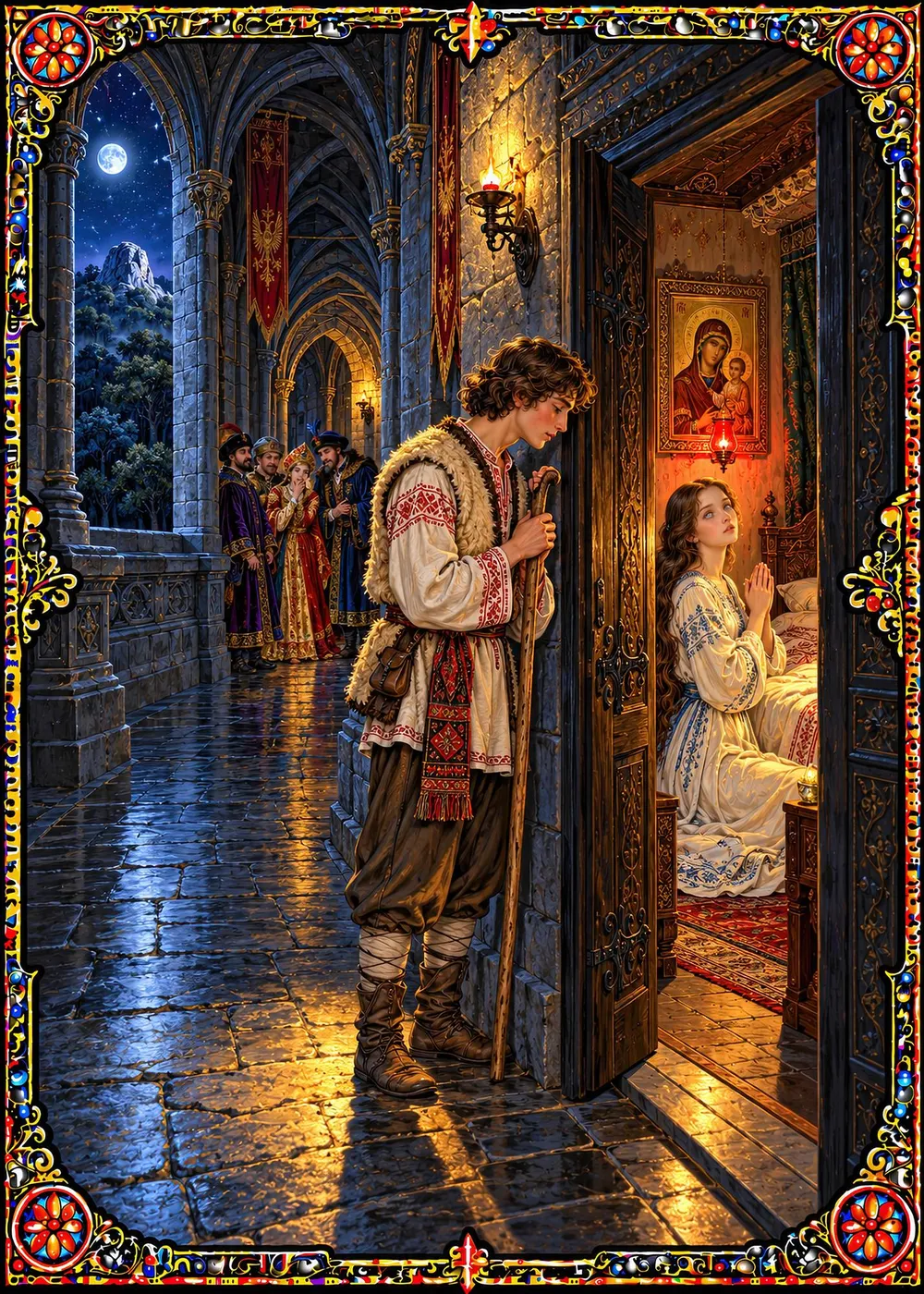
That evening, as the servants were showing the seven princes to their rooms, Ivan was given the smallest room, at the end of a long corridor near the princess’s own chamber. As he passed her door, which was a little open, he heard something that made him stop.
It was a girl’s voice, soft and clear, praying aloud in the dark. “Most Holy Theotokos, save us. Lord, have mercy. Lord Jesus Christ, Son of God, have mercy on me, a sinner.”
It was the Jesus Prayer, the same prayer the shepherds of his hills prayed on the mountainside at night. Ivan stood in the corridor and listened, and his heart was stirred.
Without thinking, he joined in, softly, from the corridor: “Lord Jesus Christ, Son of God, have mercy on me, a sinner.”
The voice inside the room stopped.
“Who is there?” said the girl, frightened.
“Forgive me,” said Ivan. “I did not mean to listen. I am one of the princes who came for the feast. My name is Ivan. I heard you praying, and it sounded like home.”
There was a silence. Then the door opened wider, and Ivan saw a young woman with long chestnut hair and clear gray eyes that did not look at him but past him, into the dark.
“You pray aloud?” said the princess, wonderingly. “A prince? At court, no one prays aloud. They would laugh.”
“In my hills, everyone prays aloud,” said Ivan. “The shepherds say that God likes to hear our voices. They say that the Lord never told anyone to be quiet when they cried out to Him. Only the crowds did that.”
Anna smiled for the first time in a long time. “Tell me about your hills,” she said.
So they talked, the prince standing in the corridor and the princess in her doorway, for a long time. She could not see his dusty boots or his plain shirt or his sheepskin vest. She could only hear his voice, and it was a kind voice, and a strong one, with laughter in it. When at last her old nurse came bustling down the corridor to send him away, Anna went back into her room and knelt down, and prayed aloud to God, and for the first time in years, she was not afraid of being heard.
The next morning was the Feast of the Dormition. After the Liturgy, the Prince of Kremenets assembled the seven princes in the great hall of the castle, before the whole court, to decide how his daughter’s husband should be chosen.
“Let there be a tournament,” said the Prince of Dubno. “Let us ride against each other, and the best horseman win.”
“Let there be a contest of learning,” said the Prince of Zbarazh.
“Let the princess choose the richest,” said the Prince of Zaslav.
At that moment, the doors of the hall opened, and an old monk came in. He was very old, with a long white beard that reached his belt, dressed in a patched black cassock, with a wooden cross on his breast. It was Abbot Ioann, the eldest of the hermits who lived in the caves on the hill of Pochaiv. The whole court knew him, for he had baptized half of them, and even the most fashionable boyars bowed their heads as he passed.
“Prince,” said the old abbot, “may an old monk speak?”
“Speak, Father,” said the Prince of Kremenets.
“Your daughter has been blind for thirteen years,” said Abbot Ioann. “You have sought physicians from every land, and none could heal her. You wish to give her a husband who will make her happy. Let me propose a different trial. On the hill of Pochaiv, near our caves, there is a great rock where the brethren have prayed for many years. Let each of these seven princes climb onto that rock, before the whole court, and pray to God for the healing of the princess. The Lord hears the prayer of the faithful. Let us see which prayer He will hear.”
The court murmured. Some of the boyars smiled. The princes looked at one another uneasily. None of them, however, wished to appear afraid, or impious, in front of the prince and his court.
“Let it be so,” said the Prince of Kremenets.
That afternoon, the whole court rode out from Kremenets to the hill of Pochaiv: the Prince and the Princess Anna, the seven princes, the boyars and their ladies in their silks and velvets, and a great crowd of townspeople and villagers who had heard of the trial and came streaming after them on foot. The shepherds of the hills came too, with their sheep, and gathered on the slopes to watch.
On the top of the hill, among the old oaks, stood the great gray rock. The abbot and the hermits of the caves were waiting beside it. The princess was led to a chair at the foot of the rock, with her father beside her, and the courtiers gathered around in a great circle. It was late afternoon, and the golden light of August lay over the hills.
“Let the Prince of Lutsk begin,” said the abbot.
The Prince of Lutsk climbed onto the rock in his crimson velvet cloak. He stood at the top and looked down at the circle of watching faces, at the boyars and the ladies in their silks, at the other princes, and at the fashionable courtiers with their little smiles. He felt their eyes on him.
He made a small, quick sign of the cross, so small that it could hardly be seen, and he bowed his head, and he moved his lips silently for a few moments. His face grew red. Then he looked up, crossed himself again, very small, and climbed down.
Nothing happened. The princess sat in the darkness as before.
The Prince of Volodymyr climbed onto the rock with his golden chain. He did exactly the same. He glanced around at the court, made a tiny sign of the cross, closed his eyes, and prayed silently for a few moments, his lips barely moving. He thought to himself, God knows what is in my heart. There is no need to make a spectacle. He climbed down.
Nothing happened.
One after another, the Princes of Dubno, and of Zbarazh, and of Zaslav, and of Rivne climbed onto the rock. Each one felt the eyes of the court upon him. Each one heard, or thought he heard, a whisper or a stifled giggle among the ladies. Each one made a small, quick, discreet sign of the cross, bowed his head, prayed silently for a few moments with his lips closed, and climbed down again, red-faced and relieved to be finished. Nothing happened.
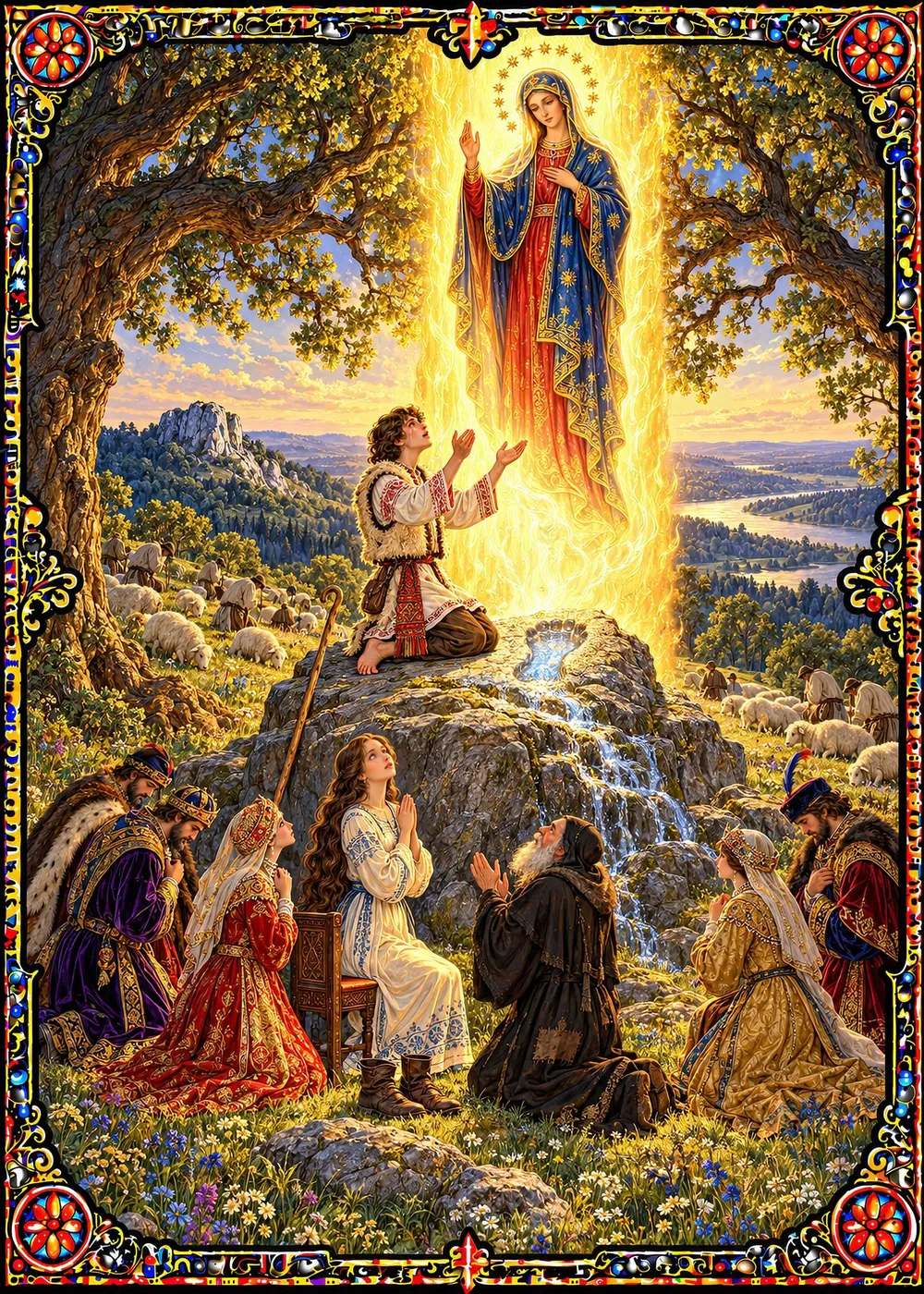
The court began to murmur. The Prince of Kremenets looked sadly at his daughter.
* * *
Copyright notice. Introduction and illustration © 2026 Laurent Cleenewerck. All rights reserved. The adapted Orthodox version of this tale is published in Twelve Ukrainian Orthodox Fairy Tales (© 2026 Laurent Cleenewerck). No part of this page may be reproduced without written permission, except for brief quotations with attribution and a link to this page.
Buy the book on AmazonAbout the book