
A Story of Dečani and the Feast of Saint Nicholas
In the ancient lands of Serbia, where the Bistrica River tumbles cold and white out of the Accursed Mountains into the green plain of Metohija, the holy King Stefan was building a church. Its walls rose in rows of white and rose-red marble, its windows were carved with lions and vines, and the masons said that, when it was finished, it would be the greatest church in all the Serbian lands. The place was called Dečani, and the king came there often to watch the walls go up.
Every child in Metohija knew why the king had built it. When he was a young prince, his own father, the old King Milutin, had believed the lies of jealous men and had ordered that his son be blinded. As the soldiers led the blinded prince away, they stopped for the night at a little church of Saint Nicholas, and there, in the darkness, Stefan saw a light. The holy bishop of Myra stood before him, holding something in the palm of his hand.
“Do not be afraid, Stefan,” said Saint Nicholas. “Your eyes are here in my hand. In God’s time, I will give them back to you.”
For years, the blind prince lived in exile in Constantinople, in the great Monastery of the Pantokrator, praying with the monks and asking nothing for himself. When God’s time came, Saint Nicholas appeared to him once more and touched his eyes, and he saw again. Afterward, he returned home, was reconciled with his father, and became king. In thanksgiving, he was raising the great church at Dečani, and every Serb who heard the story remembered the old proverb: Ko krsno ime slavi, ono mu i pomaže. “Whoever keeps the feast of his saint, the saint will help him.”
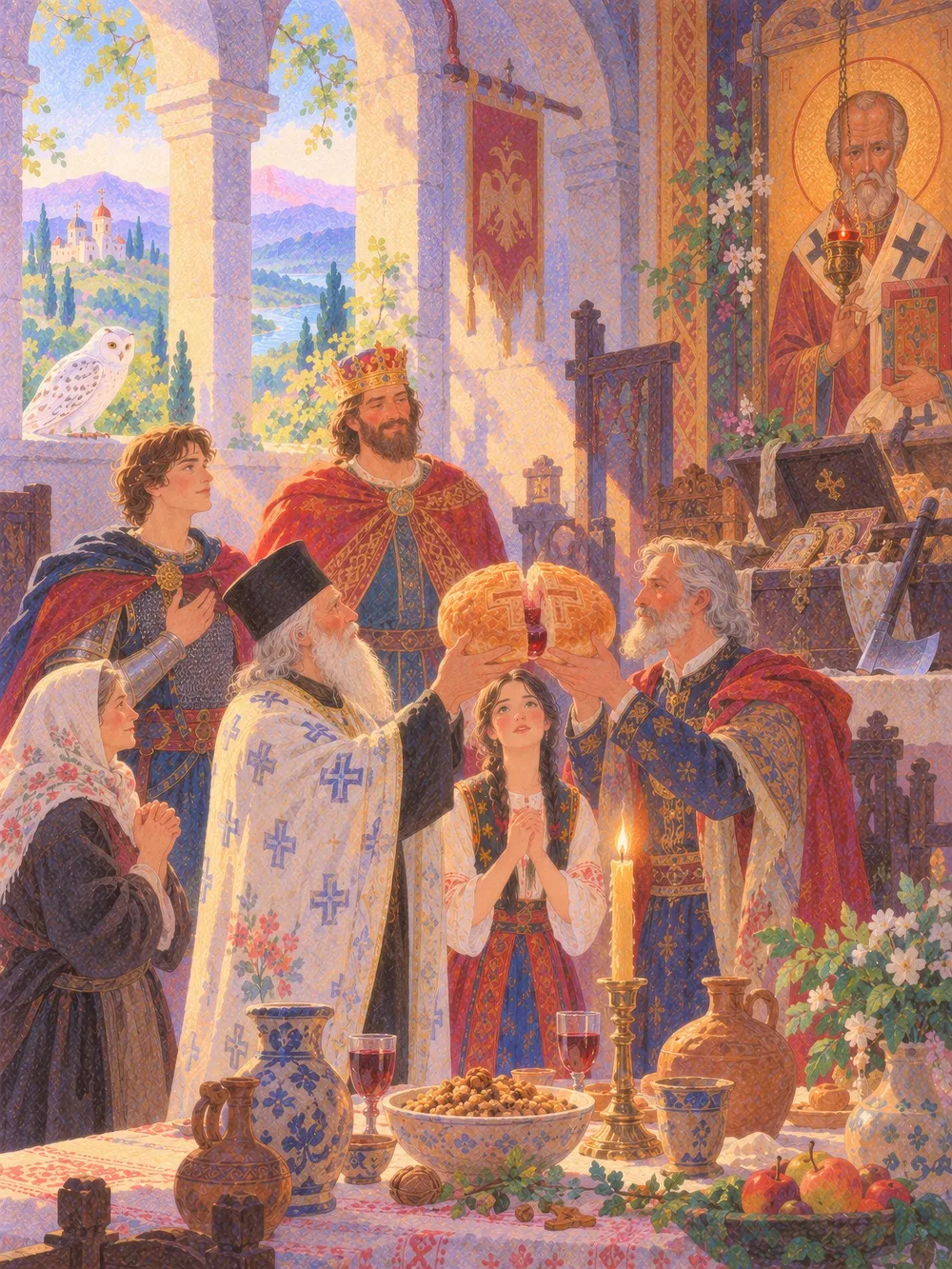
In a stone manor not far from Dečani, among orchards of walnut and plum, lived a vlastelin named Lord Vukoje. For as long as anyone could remember, his family had kept Saint Nicholas as their slava. Each year, on the saint’s feast in winter, the house had blazed with candles and overflowed with guests. The priest from the village came to bless the water, the great slava candle burned all day before the icon, and the lord himself, with the priest beside him, lifted and turned the kolač, the round slava bread, while the whole household sang.
Three winters before our tale, however, Lord Vukoje’s wife, the gentle Lady Jelena, fell ill with a fever in the days before the feast. The household prayed. The priest anointed her. Lord Vukoje knelt all night before the icon of Saint Nicholas and begged the saint to spare her. On the morning of the slava, she died.
Lord Vukoje did not weep. He went into the great hall, took the slava candle from its stand, and broke it over his knee. “The saint did not save her,” he said. “Why should I feast him?” He put the icon of Saint Nicholas face down in a chest, locked the chest, and threw the key into the Bistrica. From that day, no slava was kept in the manor, no candle was lit, and no priest crossed its threshold.
Grief that will not weep grows hard, and a hard heart leaves room for strange guests. That same winter, an old woman named Neda came to the manor. She said she was a healer, and she knew a great many herbs, and she whispered over cups of water in a way that no priest had ever taught. Lord Vukoje let her stay, for she told him what he wished to hear: that candles and bread for a dead bishop were foolishness, that the saints were deaf, and that a strong man needed no one’s help. Little by little, she took charge of the house. The servants who loved the old ways left one by one. The icon lamps went out. The manor grew cold, even in summer.
Lord Vukoje had one child, a daughter of seventeen named Ljubica, whose name means “little violet.” She had her mother’s gray eyes and her mother’s quiet voice, and she had not forgotten the slava. Every Sunday, she rose before dawn and walked alone to Dečani, where the monks served the Liturgy in their old wooden church while the new marble one rose beside it. She always came home before her father woke.
She never walked alone, though. Since she was a little girl, a white owl had lived in the hayloft of the manor’s barn. Lady Jelena had found it as a fledgling, fallen from a nest in a hollow walnut tree, and she and Ljubica had fed it on scraps of meat until it could fly. Now it was full grown, as white as new snow, with eyes like two round moons of gold. Each Sunday before dawn, it flew ahead of Ljubica along the dark road to Dečani, calling softly so that she would not lose her way, and it perched on the scaffolding of the new church until the Liturgy was over.
The masons called it the Owl of Dečani, and they said it was a good sign.
It was at Dečani, one Sunday in autumn, that Ljubica met Radivoj. He was a young knight of the king’s guard, the son of a poor widow from a stone village high in the mountains above the monastery. His family had no lands worth mentioning and no silver at all, yet his father, before he died, had left him a good sword and a straight back. On that Sunday, as the people came out of the church, Ljubica’s prayer rope slipped from her wrist into the mud. Radivoj picked it up, wiped it on his sleeve, and gave it back to her with a bow.
“It was my mother’s,” she said, and her eyes filled with tears.
“Then it is precious,” said Radivoj, “and so, I think, is the one who carries it.”
After that, they spoke every Sunday after the Liturgy, a few minutes at a time, beneath the scaffolding of the new church, while the owl watched them from above. Radivoj told her of his mother and of their little house in the mountains, where they had kept their slava every year even when there was only one candle, one loaf, and a handful of wheat. “Our saint is Saint Nicholas, too,” he told her. “My mother says that the poorer the table, the closer the saint sits to it.”
Ljubica told him about her father, about the broken candle and the locked chest, and about old Neda. “Sometimes,” she whispered, “I think the house itself has forgotten how to be warm.”
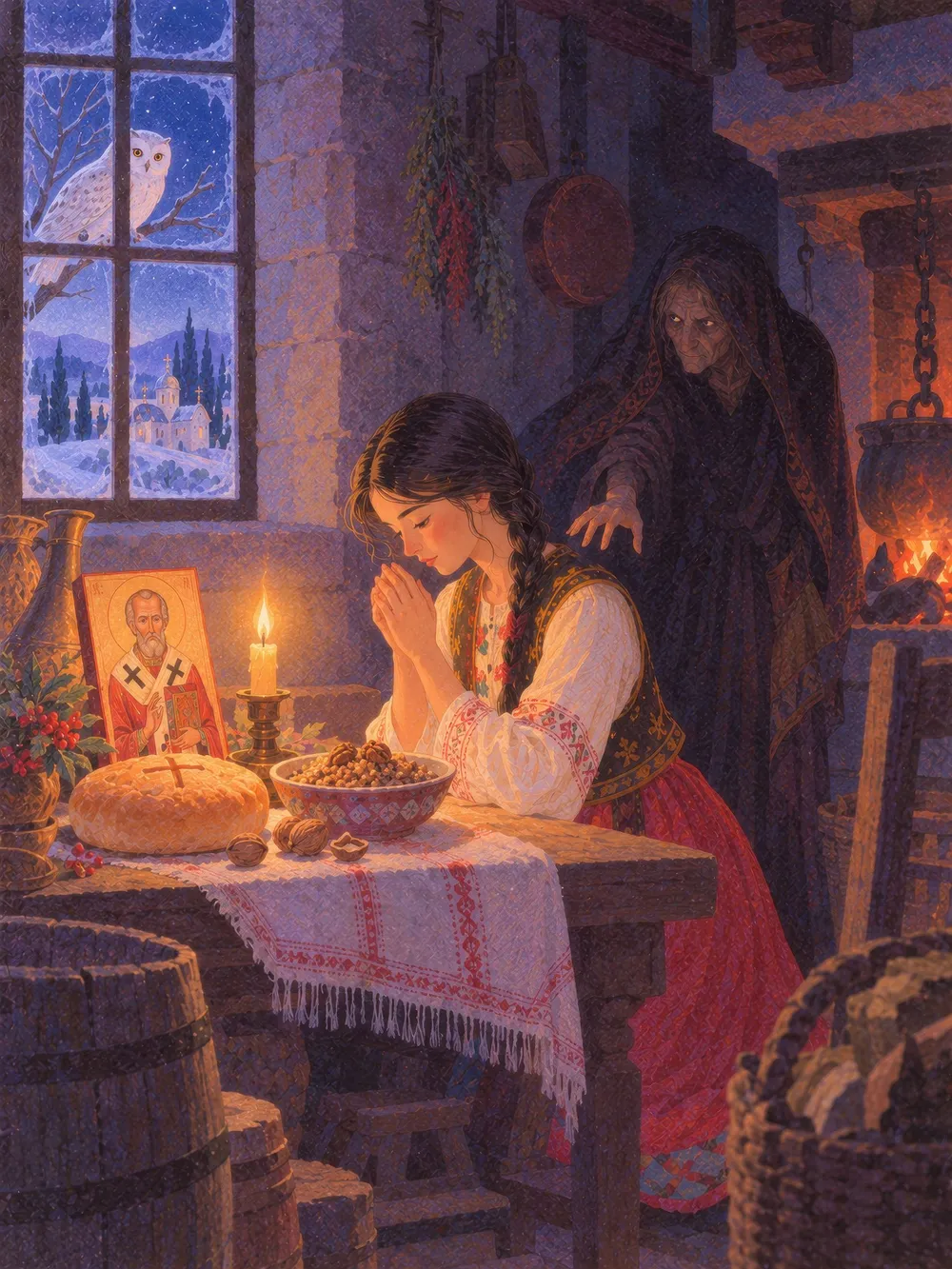
As Saint Nicholas’s day drew near, Ljubica made a secret plan. On the eve of the feast, while her father slept and Neda dozed by the fire, she crept into the kitchen. From a hiding place behind the flour bins, she took out the things she had gathered for weeks: a small beeswax candle she had bought from the monks, a little round kolač she had baked in secret, and a bowl of žito, boiled wheat sweetened with honey, in memory of her mother and of all the departed of her family. She set them on the kitchen table before a little paper icon of Saint Nicholas, and she lit the candle.
“Holy Father Nicholas,” she whispered, “this house has forgotten you, yet I have not. I cannot cut the bread as my father did, for I am not the head of the house. I can only light this candle. Remember my mother, Jelena. Remember my father, Vukoje, who is angry with you because he loved her. Pray for us.”
The kitchen filled with the warm smell of beeswax and honey. For the first time in three years, Ljubica felt that the house was breathing.
Then a cold hand fell on her shoulder.
“So,” said old Neda softly, “the little violet keeps the dead bishop’s feast behind her father’s back.”
Ljubica stood up and faced her. “It is my family’s slava,” she said. “It was my mother’s, and her mother’s before her.”
Neda’s eyes glittered like wet stones. She leaned over the table and blew out the candle with one long breath, and, in the sudden darkness, she took a pinch of ash from the hearth and threw it into Ljubica’s face. “Since you love to look at candles so much,” she hissed, “may you never see another as long as you live.”
The ash stung Ljubica’s eyes like smoke. She rubbed them, and blinked, and rubbed them again. The kitchen did not come back. The red glow of the hearth did not come back. Everything was dark, darker than any night she had ever known.
Her scream woke the whole house. Lord Vukoje came running with a torch, and found his daughter on her knees on the kitchen floor, her hands pressed to her eyes, and old Neda standing over her with the snuffed candle in her hand.
“See, my lord,” said the witch, holding it up. “She lit a candle to your deaf saint, and the saint’s candle has burned out her eyes. That is all the thanks the saints give.”
Lord Vukoje looked at the candle, at the little kolač, at the bowl of žito, at his weeping daughter. His face turned as gray as the ash on the hearth. He swept everything from the table onto the floor, and he did not see that the witch was smiling.
From that night on, Ljubica lived in darkness. She learned to walk the halls of the manor with one hand on the wall, counting her steps. She learned to know the servants by their footsteps and her father by his silence. She could no longer walk to Dečani on Sundays, and no one brought her word of Radivoj. Every night, however, she heard a soft hooting at her window, and she would open the shutters and feel the brush of white feathers against her cheek. The owl would sit on her sill until dawn, and, as long as it was there, she was not afraid.
When Radivoj heard what had happened, he rode straight to the manor and knelt in the courtyard before Lord Vukoje. “My lord,” he said, “I love your daughter. Blind or seeing, I would make her my wife, if you will give your blessing.”
Lord Vukoje laughed a hard laugh. “A penniless boy from the mountains, with a sword and a widowed mother? Get out of my courtyard.”
Neda, standing behind him, said nothing. Her eyes followed the young knight to the gate like a cat’s eyes follow a bird.
Radivoj did not know what to do. So he did what his mother had always taught him to do when he did not know what to do: he went to church. At Dečani, he found the king himself, standing in the half-finished church among the masons, with his hand resting on a block of rose-colored marble. Radivoj fell on his knees before him and told him everything.
The holy king listened. When Radivoj had finished, he was quiet for a long time.
“I, too, was blind,” he said at last. “I know that darkness. Its worst part is not that the eyes see nothing. Its worst part is that the heart begins to believe God has forgotten it. Saint Nicholas held my eyes in his hand for many years, and he gave them back in God’s time, not in mine.” He looked out through the unfinished wall toward the mountains. “This blindness grew out of a forgotten feast. It can only be undone by a feast remembered. The candle must be lit again in that house, and the bread must be broken by the head of that house. Neither you nor I can do it for him.”
* * *
Copyright notice. Introduction and illustration © 2026 Laurent Cleenewerck. All rights reserved. The adapted Orthodox version of this tale is published in Twelve Serbian Orthodox Fairy Tales (© 2026 Laurent Cleenewerck). No part of this page may be reproduced without written permission, except for brief quotations with attribution and a link to this page.
Buy the book on AmazonAbout the book