
A Story of Ras and the Pillars of Saint George, on the Feast of Saint George
In the ancient lands of Serbia, where the Raška River runs green and quick between wooded hills, there stood the old town of Ras, and above it, on the crown of a high hill, rose the Church of Saint George. The people called it Đurđevi Stupovi, the Pillars of Saint George, for its two towers stood against the sky like two pillars holding up the heavens.
The church had been built by the Great Župan Stefan Nemanja, the mightiest lord the Serbs had ever known, and every child of Ras knew why. When Nemanja was a young man, his own brothers, jealous of his strength and of the favor of the people, had thrown him into a cave and rolled a stone across its mouth. There, in chains and in darkness, he had prayed to the holy Great-martyr George, and he had vowed that, if God set him free, he would raise a church in the saint’s honor on the highest hill of Ras. God heard him. Nemanja came out of the cave without lifting a sword, and he kept his vow. So the Pillars stood above the town as a reminder to all who passed below that the chains of the righteous are loosed by prayer.
Beneath that hill, in a castle of gray stone beside the river, lived an old nobleman named Prince Radoš, who had served the Great Župan faithfully all his life. He had three sons and three daughters. The eldest son, Bogdan, was as strong as an ox and nearly as stubborn. The second, Rade, was quick with a sword and quicker with his tongue. The youngest, Vladan, was neither the strongest nor the cleverest of the three, yet he had a gentle way with horses and a habit of listening before he spoke, and the old monks of the Pillars said that he would make a fine monk if he did not make a fine husband first. The three daughters, Mara, Stana, and Jela, were as lovely as the first three days of spring, and their brothers guarded them like the apple of their eye.
Vladan had no thought of becoming a monk. Since the summer he was twelve years old, he had loved Danica, the daughter of the Župan of Zvečan, whose fortress stood on a black rock above the Ibar River. That summer, he had tried to bring her a water lily from the Ibar, had fallen in up to his neck, and had climbed out dripping, with the lily held high and unbroken. Danica had laughed until she cried, and then she had kept the lily pressed in her psalter ever since. Her name means “morning star,” and to Vladan she was exactly that. With the blessing of both fathers, the two had been betrothed in the church of the Pillars, and their wedding was set for the coming spring.
That winter, however, Prince Radoš fell ill, and, by the beginning of Great Lent, the whole household knew that he would not see the spring. One evening, he called his six children to his bedside. The candle before the icon of Saint George flickered on the wall, and the old man’s voice was so weak that his sons had to bend low to hear him.
“My sons,” he said, “hear the last words of your father. First: when men come to ask for your sisters in marriage, give each of them to the first who asks at our door in the name of God, whoever he may be. Do not judge him by the hour or by his face. Second: beneath the old tower there is an iron door sealed with the sign of the cross. Never open it, whatever voice you hear behind it, and do not ask me why, for I will not be here to answer. Third: never set out on any road without first asking a blessing. A road taken without a blessing is a road taken alone.”
Bogdan and Rade promised at once, as young men promise. Vladan promised more slowly, as if he were weighing each word, and then he bent and kissed his father’s hand. The next morning, the Hegumen Jefrem came down from the Pillars with the Holy Gifts, and Prince Radoš received Communion, blessed each of his children in turn, and fell asleep in the Lord. They buried him beside the church on the hill, and all Ras mourned him.
On the third night after the burial, a storm broke over the valley. The wind howled in the chimneys, and the river roared against the castle wall. At midnight, there came a heavy knock at the gate.
“Open, in the name of God!” called a deep voice. “I have come to ask for your eldest sister in marriage.”
Bogdan leaped up from the hearth. “At this hour? In this storm? Whoever knocks at midnight is a thief or worse.”
“Bar the gate,” said Rade, reaching for his sword.
Vladan stood up slowly. “Our father told us to give our sisters to the first who asks in the name of God,” he said, “and not to judge by the hour or by the face. We buried him three days ago. Shall we break his word before the earth on his grave has settled?”
His brothers would not move. So Vladan went alone to the gate and drew back the bolts. The wind blew out every torch in the courtyard, and in the darkness he could see nothing of the visitor but a tall shadow and two eyes that shone like gold. Mara, who had heard her father’s words as clearly as her brothers had, crossed herself, kissed each of them, and stepped out into the storm. A great wing swept across the gateway, and she was gone.
The next night, lightning split the sky, and again a voice called at the gate in the name of God, this time for Stana. Again Bogdan and Rade refused, and again Vladan opened, and Stana went out into the lightning. On the third night, there was no storm at all, only a soft wind from the south that smelled of melting snow, and a gentle voice asked for Jela. Vladan opened the gate a third time, and his youngest sister went out into the moonlight.
Each morning, Vladan found a single feather on the threshold: first a gray eagle’s feather, broad as his hand; then the barred feather of a falcon; and last a feather from a swan, whiter than the snow on the mountains. He kept all three in a little box of carved walnut, together with the cross of his baptism.
“You have given our sisters to the storm,” said Bogdan bitterly.
“I gave them as our father commanded,” Vladan answered. “God knows to whom.”
A year passed, and no word came from the three sisters. When the year of mourning was over, the household of Ras made ready for the wedding of Vladan and Danica on Đurđevdan, the Feast of Saint George, when the whole land turns green.
On the eve of the feast, the girls of Ras went out into the meadows with baskets and gathered wild flowers and young green branches of willow and beech. They put the flowers in great bowls of water and set the bowls out under the open sky all night, so that the dew of Saint George would fall into them. At dawn, everyone in the town washed their faces in the flower water for health and joy, wreaths of green hung over every door, and in every orchard swings were tied to the branches of the trees. Danica came up from Zvečan with her father and his men, riding a white mare, and wearing a wreath of lilies of the valley in her dark hair.
The Hegumen Jefrem crowned them in the church of the Pillars, under the high painted dome, where Saint George on his white horse looked down from the wall. The Great Župan himself could not come, for he was at war in the south, yet he sent a silver cup engraved with a two-headed eagle, and it passed from hand to hand at the feast until the moon was high. The young men danced the kolo in the courtyard, and the old men sang the old songs to the gusle.
Late that night, the bride and groom slipped away to the castle garden. Danica took a dry, flattened flower from her psalter and held it up in the moonlight.
“Do you remember?” she asked.
“I remember that the Ibar was very cold,” said Vladan.
“I remember a boy,” said Danica, “who would rather drown than break a promise.”
The summer that followed was the happiest that the castle of Ras had known for many years. In the heat of one August afternoon, however, Bogdan and Rade rode out to hunt in the hills, and Danica sat in the garden, weaving a little basket of reeds. Vladan went down alone into the cellars beneath the old tower to fetch wine for his brothers’ return.
The passage was cool and dark, and it smelled of earth and old barrels. As Vladan passed the iron door, he heard a voice behind it.
“Water,” it whispered. “For the love of God, a cup of water. I have not had a drop to drink in thirty years.”
Vladan stopped. He looked at the door. It was black with age, and across its middle ran a seal of red wax, stamped with the sign of the cross. He remembered his father’s words, and he took a step back.
“Have pity,” said the voice. It was weak and hoarse, the voice of a very old man. “Is your father’s word harder than the Gospel? Did your Christ not say, ‘I was thirsty, and you gave Me drink’?”
Vladan’s heart was moved. He thought of the hungry and the thirsty whom his father had fed at the castle gate every feast day. He thought that, surely, his father could not have meant that a dying man should be left to thirst. He thought, too, that he might ride up to the Pillars and ask the Hegumen Jefrem what to do. The hill was steep, though, and the day was hot, and the voice was so very weak.
“What harm can one cup of water do?” he said aloud, and he scraped the seal from the iron with his knife.
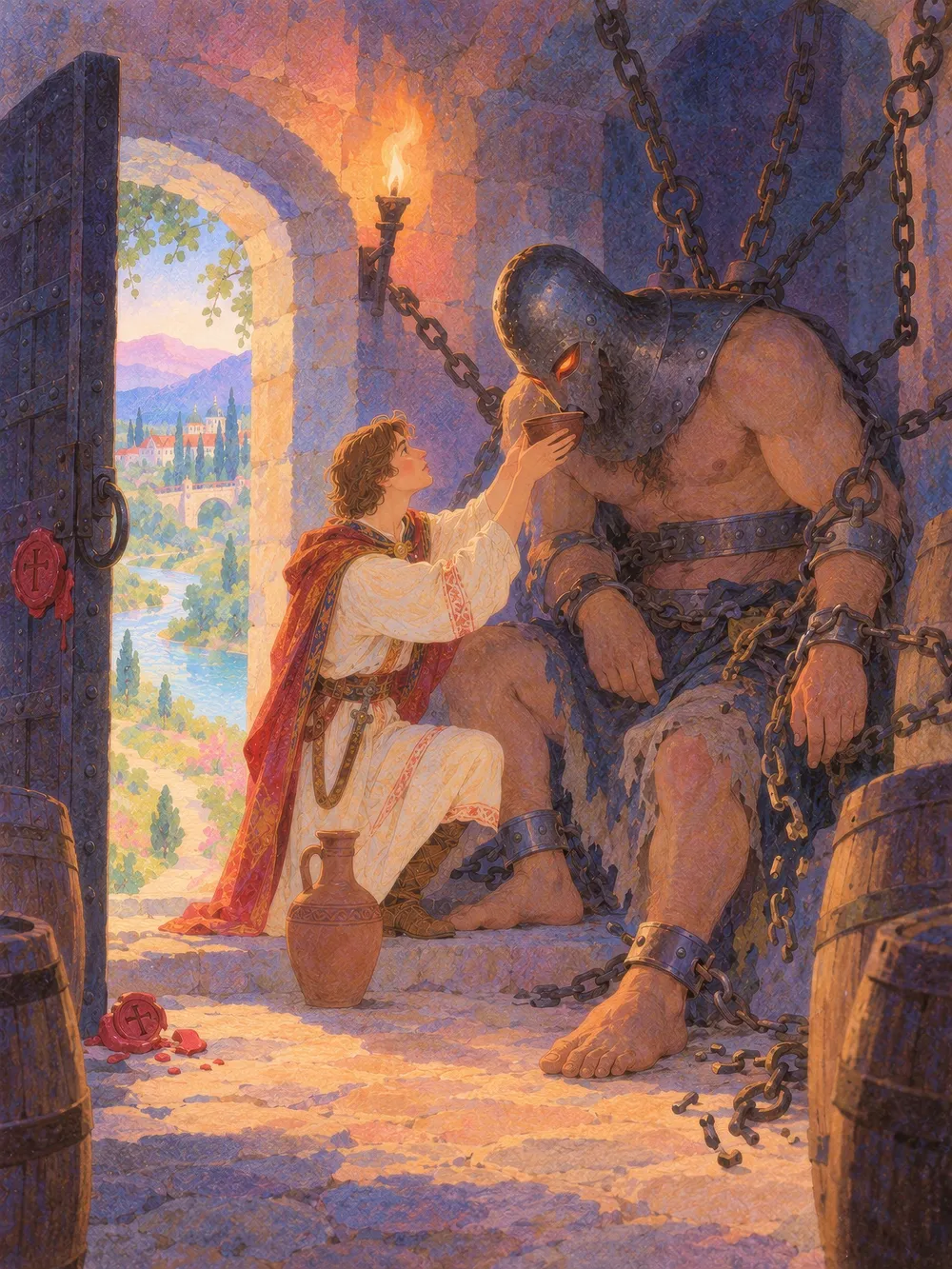
The door groaned open. In the darkness beyond it stood a huge man, chained to the wall by seven chains at his wrists, his ankles, and his waist. His head and shoulders were sheathed in steel, as if a helmet had grown into his very flesh, and his eyes glowed in the shadow like coals in a forge. He was not old at all.
“I am Baš Čelik,” he said, “the Man of Steel. Give me the water, little prince.”
Vladan should have shut the door then. Instead, he filled a cup from a jar at his feet and held it up to the steel lips. Baš Čelik drank, and the chain on his right wrist cracked. “Another,” he said. Vladan, as if in a dream, gave him another cup, and the chain on his left wrist cracked. “One more,” said Baš Čelik softly, “for the love of God.” With the third cup, all seven chains burst at once, and their broken links rang on the stones like falling bells.
Baš Čelik stretched himself until his steel head scraped the ceiling, and he laughed.
“Thank you, little prince,” he said. “Because you gave me three cups of water, I give you three lives. Remember that I said so.” Then he rushed past Vladan and up the stairs like a whirlwind.
Vladan ran after him, but he was too late. When he burst out into the sunlight, a black wind was already tearing through the garden. It snatched up Danica as a storm snatches a leaf. “Vladan!” she cried, and her cry rose higher and higher and grew fainter and fainter, until it was lost among the mountains. On the grass lay her little basket of reeds, half woven.
When Bogdan and Rade came home and heard what had happened, their faces went white with anger.
“You kept one command of our father,” said Rade, “and you broke another. Now see what your pity has cost.”
“We will ride after him at once,” said Bogdan, “and cut him into pieces small enough to feed the crows.”
“Wait,” said Vladan. “Let us first go up to the Pillars and ask a blessing. That was our father’s third command.”
“You are in no position to lecture us about our father’s commands,” said Rade, and he laughed bitterly. The two brothers mounted their horses and galloped away toward the mountains without so much as making the sign of the cross.
Vladan did not follow them. He climbed the hill to the Pillars on foot, as a penitent. He found the Hegumen Jefrem in the church, trimming the lamps before the icons, and he fell at the old man’s feet and told him everything.
The hegumen listened in silence. When Vladan had finished, he sat down heavily on the bench by the wall.
“Thirty years ago,” he said, “that sorcerer laid waste to this valley. He burned the villages, he carried off the young, and no sword could pierce his steel. Your father did not overcome him by strength. Your father fasted for forty days, and I served the Divine Liturgy every morning of those forty days, and the chains were blessed with holy water before they were forged. When at last Baš Čelik was bound, your father sealed the door with the cross, and he never spoke of it again. He forbade you to open it because he knew how a good heart can be moved by pity before it has learned discernment.”
“Was it a sin, then, to give a thirsty man water?” asked Vladan.
“Mercy is holy, my son,” said the old monk. “Mercy without counsel, however, can open doors that God has shut. The voice behind the door quoted the Gospel to you, and the devil himself did the same to our Lord in the wilderness. You had an hour’s ride between you and a spiritual father who could have told you the truth. You did not take it.”
* * *

Copyright notice. Introduction and illustration © 2026 Laurent Cleenewerck. All rights reserved. The adapted Orthodox version of this tale is published in Twelve Serbian Orthodox Fairy Tales (© 2026 Laurent Cleenewerck). No part of this page may be reproduced without written permission, except for brief quotations with attribution and a link to this page.
Buy the book on AmazonAbout the book