
A Story of Kruševac and the Feast of the Nativity
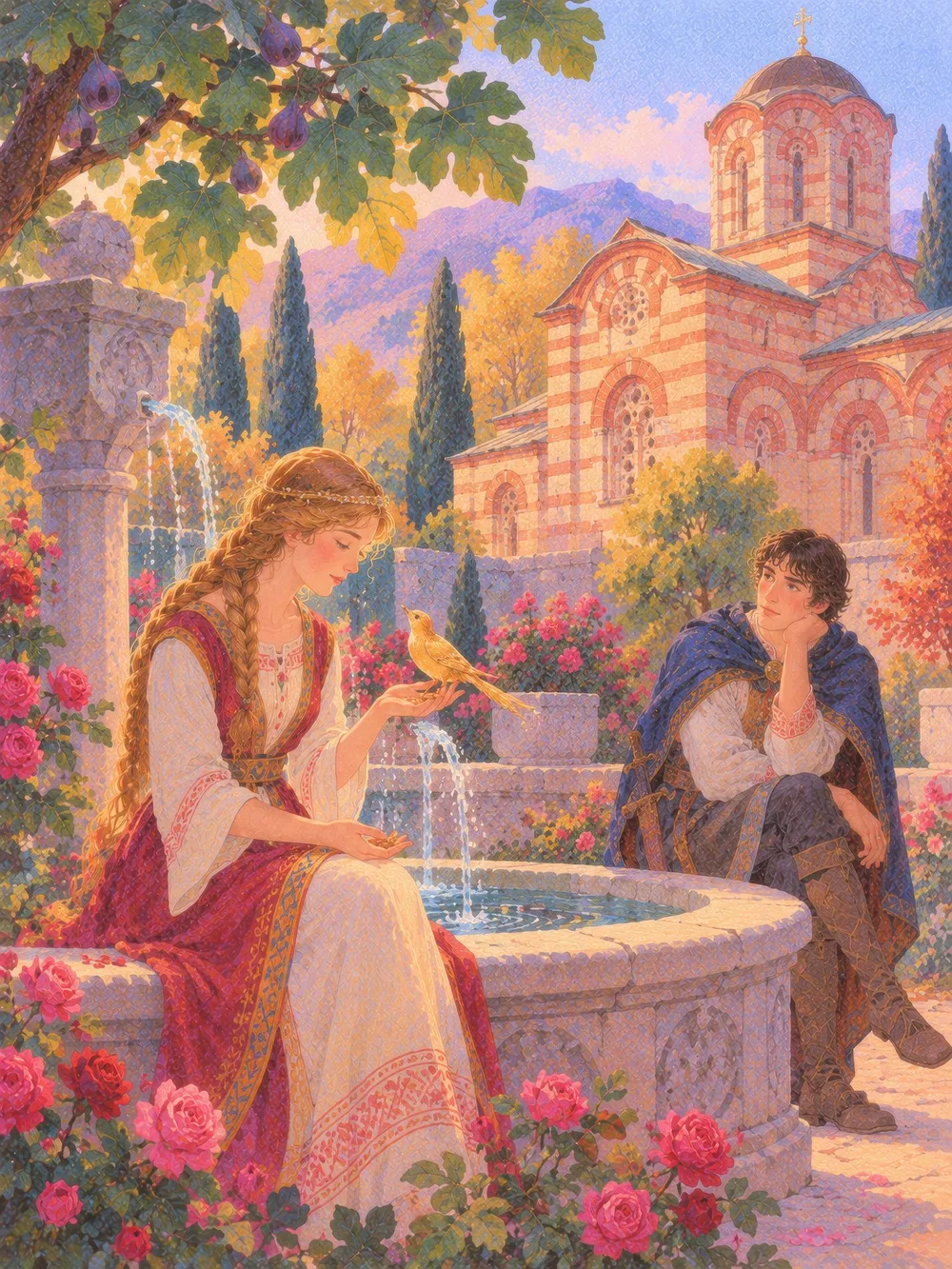
In the ancient lands of Serbia, where the Rasina River winds through oak forests to meet the broad Morava, there stood the white city of Kruševac, the capital of the holy Prince Lazar. Its walls were strong, its towers were high, and within them rose the Prince’s own church, the Lazarica, built of red brick and pale stone laid in bright stripes, with carved rosettes around its windows like flowers frozen in stone. Prince Lazar ruled the Serbian lands from Kruševac with his wife, Princess Milica, and the people said that there had not been such a just and gentle pair upon the throne since the days of Saint Sava.
In the garden of the palace, among the rose bushes and the old fig trees, there lived a golden bird.
It was no larger than a thrush, yet every feather on it shone like beaten gold, and its eyes were as bright as two drops of honey. The old women of Kruševac told the children how such birds had come to be. On the night when Christ was born in Bethlehem, they said, a little brown bird had been sleeping in the rafters of the stable. When the angels sang to the shepherds, “Glory to God in the highest, and on earth peace,” the little bird woke and listened, and it learned the angels’ song by heart. When it sang that song for the first time, its brown feathers turned to gold. Its children and its children’s children had kept the song ever since, and they would sing it only where there was peace.
The golden bird of Kruševac had come to Princess Milica from the monks of the Holy Mountain, as a wedding gift, and every year it sang only once. On the eve of the Nativity, when the badnjak, the Christmas oak, was laid on the fire in the great hall and the flames leaped up, the bird would fly down from the rafters, perch on the mantel, and sing the song of the angels. The whole court would stand in silence to hear it. It was said that a year in which the golden bird sang at Christmas would be a year of peace in the Serbian lands.
That year, the court of Kruševac needed peace more than ever. In the south, the Turks were gathering their armies, and Prince Lazar knew that, sooner or later, they would come north. Against such a foe, the Serbs could stand only if they stood together. Yet, at his own table, two of his greatest lords had not spoken a word to each other in ten years.
They were Lord Ostoja of the Rasina valley and Lord Desimir of the hills of Jastrebac, both of them vojvodas, both brave in battle, both proud as eagles. Ten years before our tale, at a feast in this very hall, Lord Desimir had raised his cup and proposed a toast to Lord Ostoja’s father, who had fallen at the great defeat on the Marica. He had meant it as an honor, more or less, but the wine had loosened his tongue, and he had added, with a laugh, “though they say he fell while running.”
The hall had gone silent. Lord Ostoja had risen white with fury, and before anyone could stop him, he had flung his own cup at Desimir’s feet and spoken a curse:
“May the fire on your hearth never catch on Christmas Eve, as long as you live!”
Lord Desimir, his face burning, had answered with a curse of his own:
“May no bird ever sing for your house again!”
Words spoken in hatred are not empty. They fly out of the mouth like arrows, and they do not always fall where we expect. From that day on, on every Christmas Eve, when Lord Desimir’s household laid the badnjak on the hearth, the oak only smoked and hissed and would not burn, and his family sat in the cold on the holiest night of the year. From that day on, too, no bird would sing near Lord Ostoja’s house. The swallows still nested under his roof, the larks still rose over his fields, and the nightingales still sat in his orchards, yet they were all as silent as stones.
Each lord knew that the other’s curse had struck him. Each lord was too proud to say so.
Now, Lord Desimir had a son named Andrija, a tall, dark-eyed youth of nineteen who served as a squire to Prince Lazar himself. Lord Ostoja had a daughter named Milena, a girl of seventeen with hair the color of ripe wheat, who served as a lady-in-waiting to Princess Milica. The two young people had been forbidden ever to speak to each other, and so, naturally, they had both wondered about each other for years.
They met at last in the palace garden, in the autumn before our tale. Milena was sitting on the rim of the old fountain, holding out a handful of crumbs to the golden bird. All her life, birds had fled from her or fallen silent around her, and she had long since stopped wondering why. The golden bird, however, did not fly away. It hopped onto her palm and ate the crumbs, and then it looked up at her with its honey-colored eyes, as if it were sorry it could not sing.
“It never comes to anyone but the princess,” said a voice behind her.
Milena turned. There stood Andrija, son of Desimir, her father’s enemy.
She should have gone at once. Instead, she said, “No bird has ever sung for me. Not once in my whole life. I think this one knows it.”
Andrija sat down on the other end of the fountain’s rim, as far from her as he could, and said, “In my father’s house, the Christmas fire has not burned for ten years. Every Christmas Eve, we sit in the cold and the smoke, and no one says why.”
They looked at each other for a long moment, and both of them began to understand.
After that, they met in the garden whenever they could, always with the golden bird between them. They talked of the curses and of their fathers’ pride. They talked of the Turks and of the war that was coming. They talked, before long, of everything in the world, and, by the time the first snow fell on Kruševac, each of them knew that there was no one else they would ever wish to marry. They also knew that their fathers would sooner die.
That Christmas, Prince Lazar commanded all his lords to keep the feast with him at Kruševac. “The Turks will not wait for us to forgive one another,” he told Princess Milica. “We must keep Christmas together this year, all of us, at one table.”
On the morning of Christmas Eve, before sunrise, the Prince went out to the forest with his men to cut the badnjak, as the head of every Serbian house does on that day. Andrija went with him. They chose a straight young oak in the woods beyond the Rasina, and the Prince himself struck the first blow with the ax, facing the east, and greeted the tree as if it were a guest: “Good morning, Badnjak, and a blessed Christmas Eve to you.” It fell toward the east, which was a good sign, and they carried it home on their shoulders through the snow.
All day, the palace smelled of baking and of fresh straw. The women spread armfuls of golden straw over the floor of the great hall, in memory of the manger at Bethlehem, and the little children of the court rolled in it and hunted for the walnuts that had been hidden there. The Christmas Eve supper was laid out on the long tables: beans and baked fish, walnuts and dried plums, honey and fresh bread, for it was still a day of fasting. Princess Milica herself kneaded the dough for the česnica, the Christmas bread for the next morning, and hid a silver coin inside it.
At dusk, all the lords and ladies of the court gathered in the great hall. Lord Ostoja stood on one side with his household, and Lord Desimir on the other, and between them, like a river neither would cross, stretched the whole width of the straw-covered floor. Andrija and Milena did not dare to look at each other.
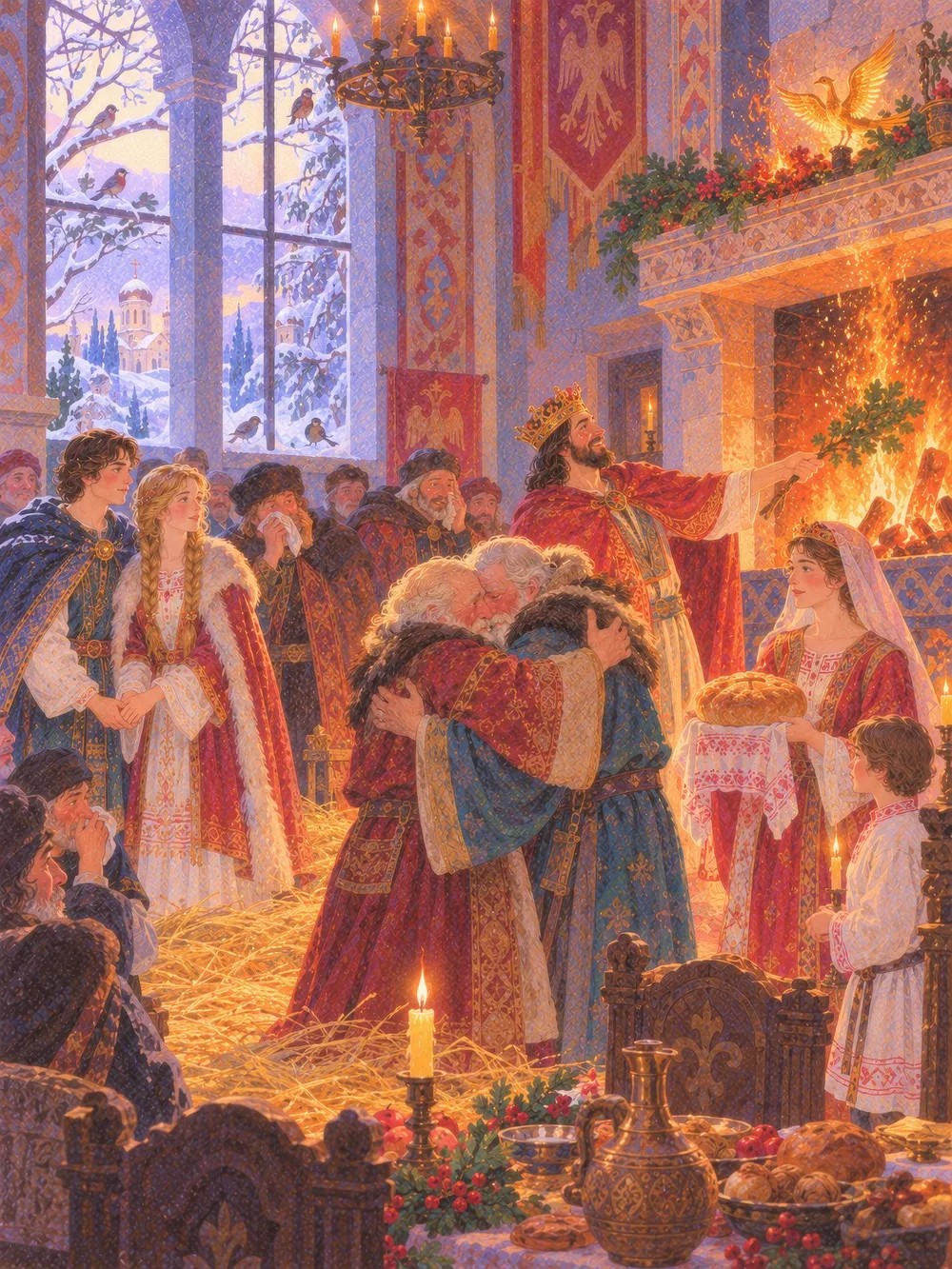
Prince Lazar carried the badnjak in through the door and laid it on the great hearth. “Good evening,” he said, “and a blessed Christmas Eve to all of you.” He sprinkled the oak with wheat and wine, and touched a torch to the kindling beneath it.
The kindling caught. The flames licked up around the oak. Then, as if a cold hand had closed over them, they shrank and died. Thick gray smoke rolled out of the hearth and spread across the ceiling, and people began to cough.
The Prince tried again with a second torch, and then with a third. Each time, the fire flickered and died. The great hall grew colder and darker, and the faces of the guests grew pale.
High in the rafters, the golden bird sat silent, with its feathers puffed up as if against a bitter wind.
“It has never failed before,” whispered Princess Milica.
At that moment, the golden bird spread its wings. It flew once around the smoky hall, over the heads of Lord Ostoja and Lord Desimir, and then it darted out through an open window into the snowy night and was gone.
A cry of dismay went up from the court. “An omen!” someone shouted. “The golden bird has left Kruševac! There will be no peace this year!”
Prince Lazar raised his hand for silence. He looked from one proud lord to the other, and, for the first time that anyone could remember, the gentle Prince looked very tired.
In the confusion, Milena slipped to Princess Milica’s side. “Lady,” she whispered, “let me go after it.”
The Princess looked at her for a long moment. Then she looked across the hall, where Andrija was already making his way toward the door. Princess Milica was a wise woman, and she had eyes in her head. “Go, both of you,” she said softly. “The old women say that the golden bird always flies to wherever peace is. Find out where it has gone. Take my blessing with you, and take this.” She wrapped her own fur cloak around Milena’s shoulders and made the sign of the cross over her.
The two young people ran out into the night together. The snow had stopped, and a sharp, cold moon shone over the white fields. Far ahead, toward the dark forests of Jastrebac, they could see a tiny spark of gold moving through the sky.
They followed it across the frozen Rasina, through the silent orchards, and up into the forest. The snow was deep, and the cold bit through their boots. After an hour, the spark of gold disappeared among the trees, and they stopped, panting, in a clearing where the moonlight could not reach.
* * *
Copyright notice. Introduction and illustration © 2026 Laurent Cleenewerck. All rights reserved. The adapted Orthodox version of this tale is published in Twelve Serbian Orthodox Fairy Tales (© 2026 Laurent Cleenewerck). No part of this page may be reproduced without written permission, except for brief quotations with attribution and a link to this page.
Buy the book on AmazonAbout the book