
A Story of Rostov the Great and the Holy Forty Days
In the ancient lands of Rus’, where the shallow waters of Lake Nero shine like a silver dish beneath the sky, there stands the old city of Rostov the Great. It is one of the most ancient cities of Rus’, crowned with churches and ringed with monasteries, and, not far from it, in the village of Varnitsy, the holy Sergius of Radonezh was born.
On the shore of the lake, a little way beyond the city walls, stood a small monastery of the Holy Savior, with a wooden church, a bell tower, a few cells for the monks, and a garden of apple trees that ran down to the water’s edge. Its abbot was Father Iakov, a white-bearded old man with a face as wrinkled as a winter apple and eyes that twinkled like a child’s.
In that monastery lived an orphan boy named Fedya.
Fedya was ten years old. His father had drowned in the lake when he was a baby, and his mother had died of fever when he was six. The monks had taken him in, and, in return for his bread and a corner by the kitchen stove, he swept the courtyard, fed the chickens, carried water from the lake, and rang the small bell for the services.
Fedya had one great wish. He wanted to learn to read the holy books, as the monks did, and one day to wear the black cassock of a novice. Every evening, he would creep to the door of the abbot’s cell and listen as the old man read aloud from the Psalter, and his heart would ache with longing.
On the Sunday of Forgiveness, the eve of Great Lent, Father Iakov called the boy to him.
“Fedya,” he said, “I have seen you listening at my door. Do you truly want to become a novice?”
“More than anything in the world, Father.”
The old abbot looked at him for a long time. “Then here is my promise. The Great Fast begins tomorrow. If you keep the whole fast faithfully, as the monks keep it, from Clean Monday until the night of Pascha, then, on the night of the Resurrection, I will bless you to wear the cassock, and I will teach you to read with my own hands. The fast is long, however, and the enemy is clever. Keep watch.”
Fedya bowed to the ground. “I will keep it, Father. I promise.”
That night, at Forgiveness Vespers, he bowed before every monk in the monastery and asked their forgiveness, and his heart was full of joy.
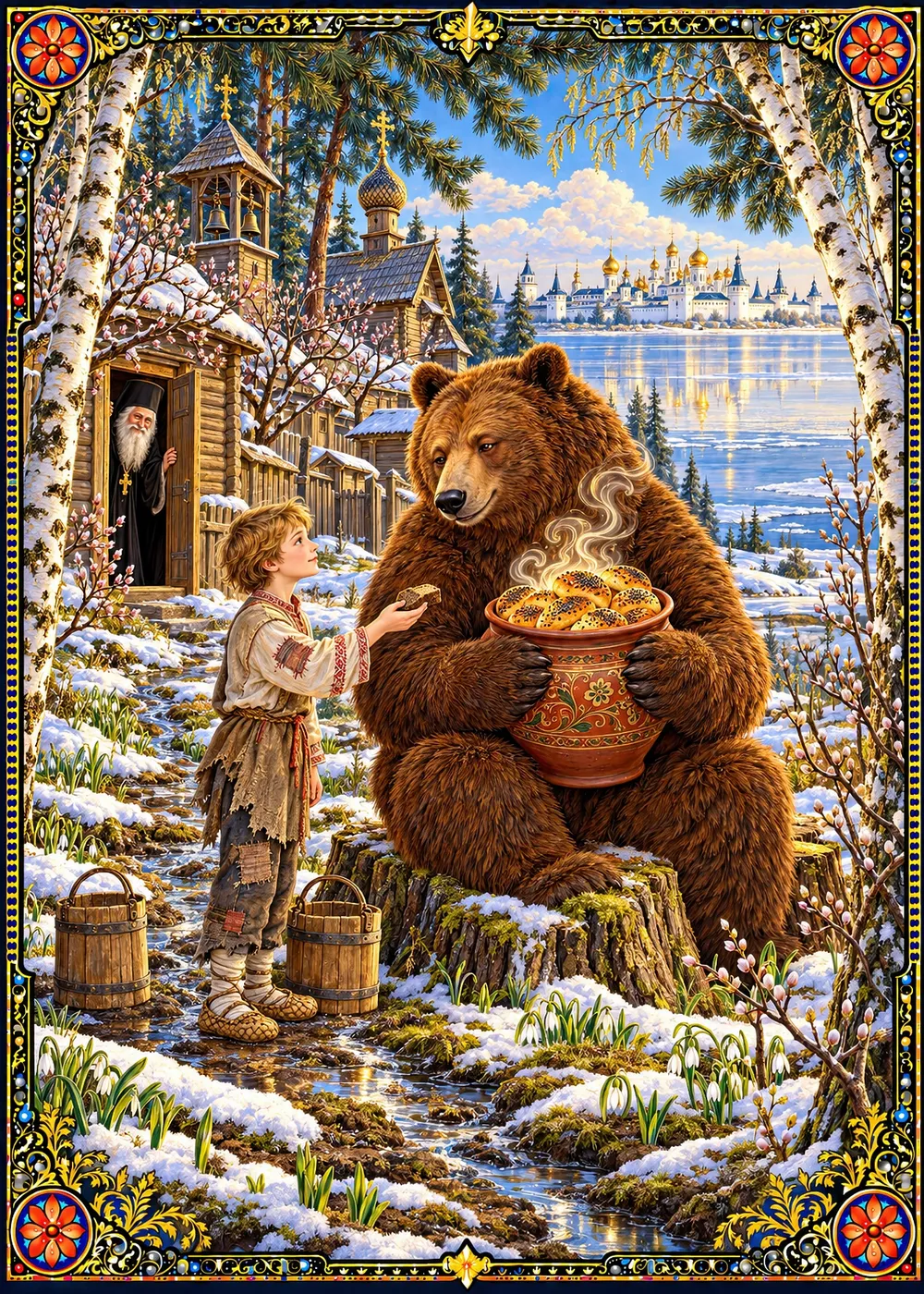
On Clean Monday, the first day of the Great Fast, the monks ate nothing at all until evening, and then only bread and water and a few pickled cabbages. Fedya was very hungry. In the afternoon, while he was carrying water up from the lake, he heard a crackling in the bushes at the edge of the forest.
Out stepped a bear.
He was the biggest bear Fedya had ever seen, with thick brown fur, a broad, friendly face, and small, clever eyes. In his great paws, he carried a clay pot. He sat down on a stump, set the pot on his knee, and smiled a wide bear’s smile.
“Good day to you, young Fedya,” he said, in a voice as deep and warm as a stove on a winter night. “Do not be afraid. My name is Mikhailo Potapych. I am the great-grandson of the very bear who shared bread with the holy Sergius in the forest of Radonezh. Bears of my family have always been friends to holy men and holy boys.”
Fedya put down his buckets, trembling a little. “What is in the pot, Mikhailo Potapych?”
The bear lifted the lid. A smell rose from it that made Fedya’s knees go weak: honey cakes, golden and warm, baked with fresh butter and eggs, glistening with honey and sprinkled with poppy seeds.
“For you,” said the bear. “You look hungry.”
Fedya swallowed hard. “I cannot eat them. It is the Great Fast. Butter and eggs are forbidden until Pascha.”
“Forbidden to monks,” said the bear kindly. “You are not a monk. You are a growing boy. How will you grow if you eat nothing but cabbage and black bread? The fast is not meant for children. God does not want you to be hungry.”
The cakes smelled so good that Fedya’s eyes filled with tears. Then he remembered the prayer that the monks had begun to say that very morning, bowing to the ground, the prayer of holy Ephrem the Syrian: O Lord and Master of my life, take from me the spirit of sloth, despair, lust for power, and idle talk. He also remembered Father Iakov’s words: The enemy is clever. Keep watch.
“Thank you, Mikhailo Potapych,” he said. “You are very kind. I have promised to keep the fast, and I will keep it.”
Then, because the bear looked so disappointed, Fedya reached into his shirt and took out his own crust of black bread, the only food he had for the day. “Here,” he said. “You have brought me a gift. Let me give you one.”
The bear looked at the crust for a long moment with a strange expression in his little eyes. Then he took it gently in his paw and ate it. “Thank you, Fedya,” he said, and he went back into the forest with his pot of cakes.
The next day, and the next, the bear came again, always with something new. One day, it was sweet cheese pastries. Another day, it was a jug of cream. Once, it was a whole roast goose, crackling and golden. Each time, Fedya said no, and, each time, he shared his black bread with the bear. By the end of the first week, he was hungrier than he had ever been in his life, and yet, strangely, he felt light and glad.
On the first Sunday of Lent, the Sunday of Orthodoxy, the monks carried the holy icons in procession around the church. Fedya carried the smallest icon, the image of the Savior Not Made by Hands, and he felt as though the Lord Himself were smiling at him.
In the second and third weeks of the fast, the services grew longer. The monks rose in the dark before dawn to pray, and, in the evenings, they stood for hours as the psalms were read. Fedya’s legs ached, and his eyes closed as he stood.
One cold morning, as the bell rang for Matins in the dark, Fedya stumbled out of the kitchen yawning, and there was Mikhailo Potapych at the gate.
“Poor Fedya,” said the bear. “Look at you, half asleep on your feet. Come with me to my den in the forest. It is warm and soft, lined with moss and dry leaves. You can sleep until noon. The monks will never notice you are gone.”
Fedya’s eyes were so heavy, and the thought of a warm, soft den was so sweet.
“God sees your heart,” the bear went on. “He knows you love Him. He does not need you standing and shivering in a cold church while an old monk mumbles psalms you cannot even read.”
Fedya almost went. He had taken a step toward the forest when he heard the voice of the old abbot inside the church, beginning the psalms: O God, my God, I rise early to seek You. My soul thirsts for You.
He stopped. It was the third Sunday of the fast, the Sunday of the Holy Cross, when the monks brought the Cross out into the middle of the church, covered with flowers, so that the weary might find strength halfway through the fast. He remembered that the Lord had not slept in the Garden of Gethsemane, though His disciples slept.
“Thank you, Mikhailo Potapych,” he said. “I will sleep when the prayers are over.”
He went into the church and stood through the whole long service. When he came out, the bear had gone, and on the step of the church lay a single sprig of green fir, as though someone had left it there for the Cross.
In the fourth week of the fast, trouble came from another direction.
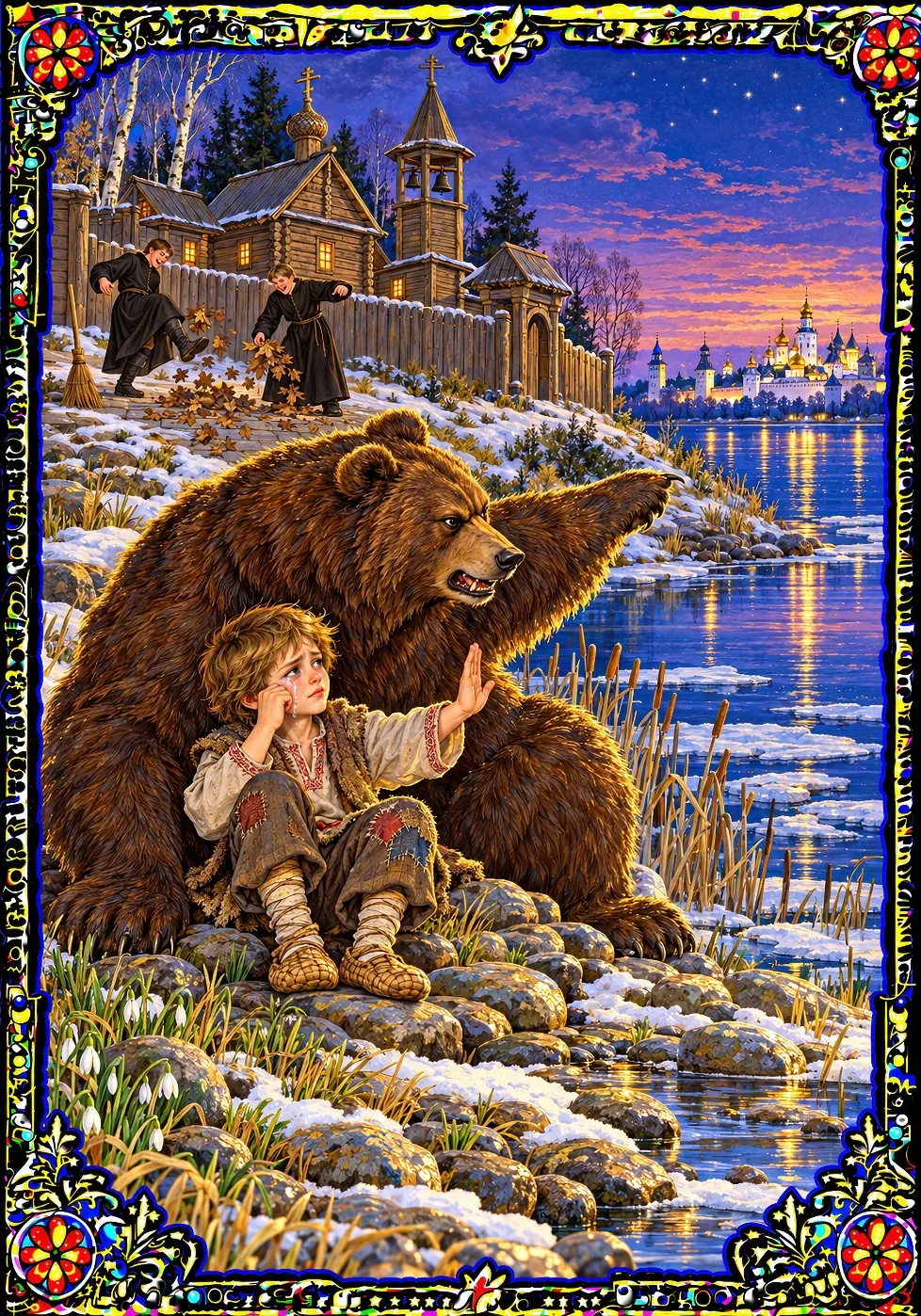
There were two older boys at the monastery, novices named Prokhor and Savka. They were lazy and sly, and they resented Fedya because the abbot was fond of him. When the cook was not looking, they stole Fedya’s bread. When he swept the courtyard, they kicked the leaves back over the clean stones and laughed. One day, they filled his water buckets with mud, and, when the cellarer scolded Fedya for the dirty water, they stood behind the cellarer’s back and grinned.
That evening, Fedya went down to the lake alone and wept.
The bear came out of the forest and sat down beside him. “Those two are wicked boys,” he growled, and his voice was not warm now but low and dangerous. “Say the word, Fedya, and tonight I will come to their cell and roar through the window. I will chase them into the lake. They will never trouble you again.”
For a moment, Fedya’s heart leapt. He imagined Prokhor and Savka running screaming into the cold water, and he almost laughed.
Then he remembered the fourth Sunday of the fast, the Sunday of holy John of the Ladder, and how the abbot had explained that the ladder to heaven has thirty steps, and that one of the highest is meekness, and one of the hardest is to love those who wrong us. He remembered, too, the end of the Prayer of St. Ephrem: Yes, O Lord and King, grant me to see my own faults and not to judge my brother.
* * *
Copyright notice. Introduction and illustration © 2026 Laurent Cleenewerck. All rights reserved. The adapted Orthodox version of this tale is published in Twelve Russian Orthodox Fairy Tales (© 2026 Laurent Cleenewerck). No part of this page may be reproduced without written permission, except for brief quotations with attribution and a link to this page.
Buy the book on AmazonAbout the book