
A Story of Chernigov and the Feast of the Annunciation
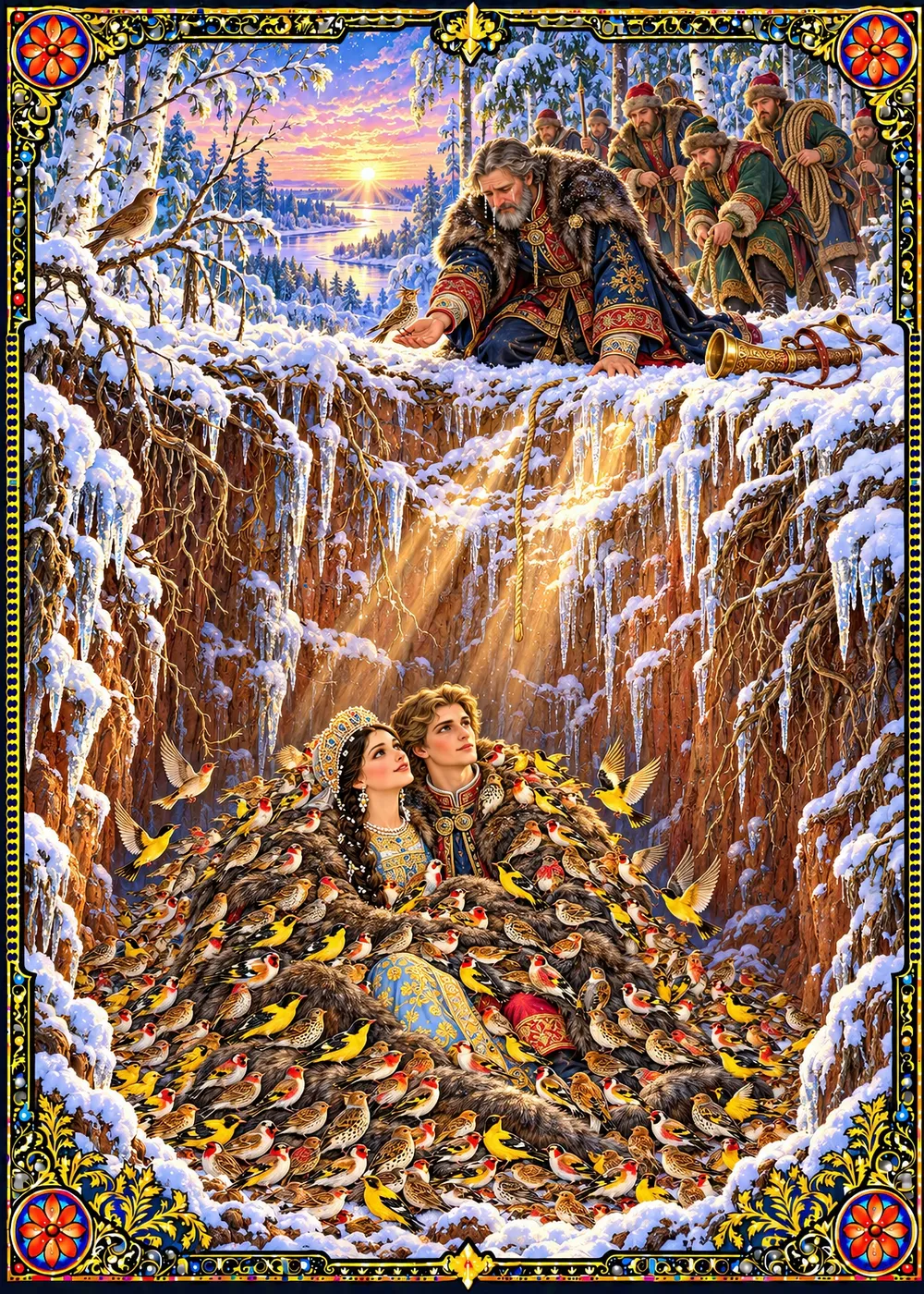
In the ancient lands of Rus’, where the Desna River winds through green meadows beneath high wooded hills, there stands the old city of Chernigov. From its heights, the stone Cathedral of the Transfiguration has looked down over the river for a thousand years, and the swallows nest under its eaves every spring.
In the days of our tale, Chernigov was ruled by Prince Oleg. He had once been a cheerful and generous man, who laughed loudly at feasts and gave alms with an open hand. When his beloved wife, Princess Evdokia, died of a fever while their only child was still small, something in Prince Oleg’s heart closed like the door of a cage. He no longer laughed. He no longer gave alms. He grew hard, and cold, and fond of holding on to things.
The only thing that still brought him any joy was his Bird Hall.
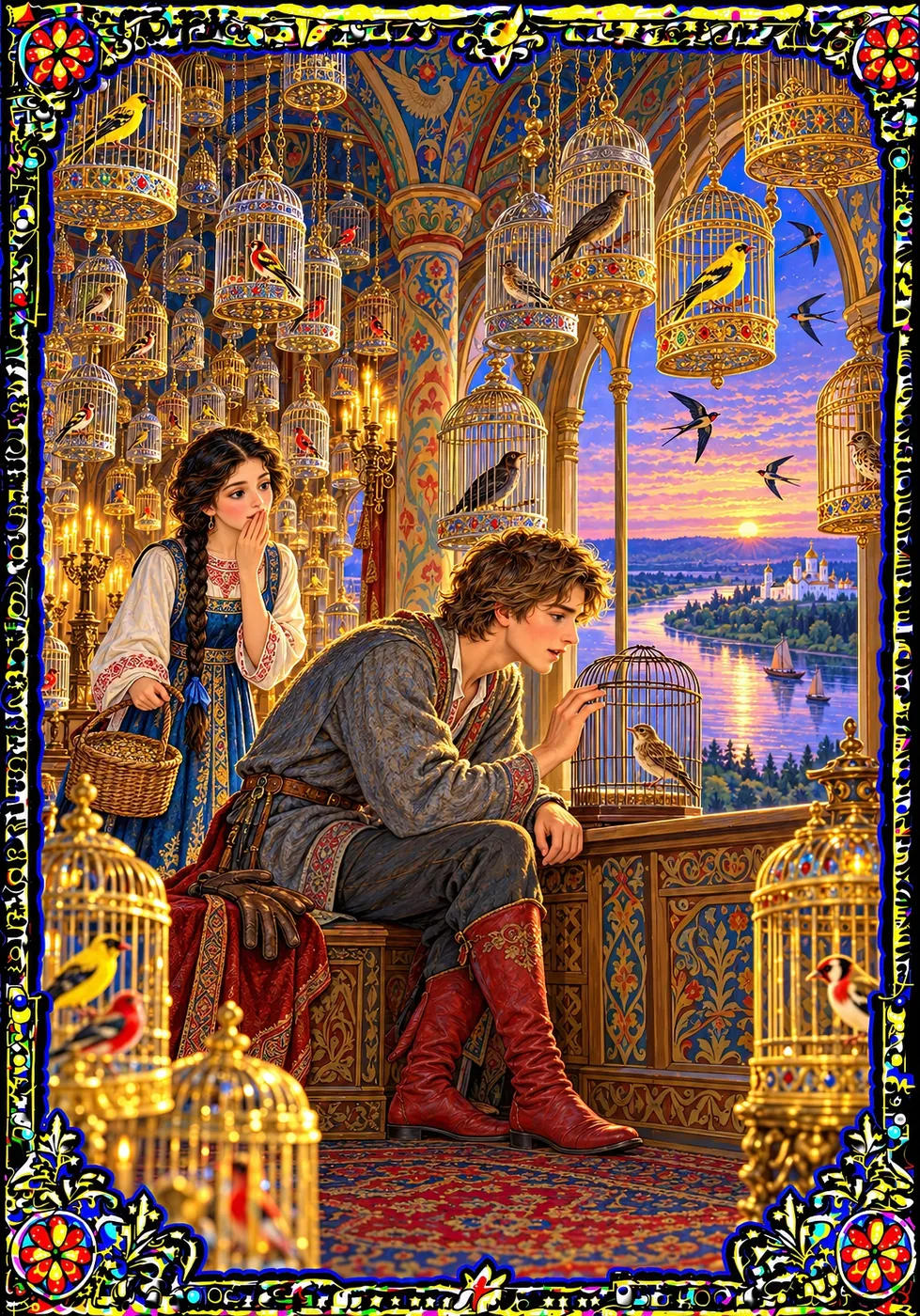
It was a great chamber at the top of his palace, with tall windows facing the river. From its ceiling hung hundreds of cages of gold and silver wire, and in them were hundreds of songbirds: nightingales from the gardens of Kiev, skylarks from the steppe, goldfinches and linnets, orioles yellow as the sun, and thrushes with speckled breasts. The prince’s fowlers trapped new birds for him every spring. He would sit in the Bird Hall for hours in the evening, listening to their songs, and it was the only time his face softened.
He never let a single bird go. “What is mine,” he said, “stays mine.”
He was just as hard with people. When a merchant or a peasant could not pay what he owed to the prince, he was thrown into the dungeon beneath the palace, and there he stayed, sometimes for years, until his family could raise the money or he died.
Prince Oleg had one daughter, Princess Alexandra.
She had been born on the Feast of the Annunciation, the day when the Archangel Gabriel brought the good news to the Virgin in Nazareth. In the year of our tale, she was about to turn sixteen. She had her mother’s dark eyes and her mother’s gentle heart. The people of Chernigov loved her, for she secretly sent bread to the families of the prisoners in her father’s dungeon, and she visited the sick in the poor quarter by the river with her old nurse.
Every morning, Alexandra fed the birds in the Bird Hall, for no one else would do it as carefully. The birds loved her. When she came in, they all began to sing at once. Strangest of all, they spoke to her, and she understood them, though no one else in the palace could. The one who spoke most was a small brown skylark who hung in a plain wire cage by the eastern window.
“Princess,” the skylark would say, “have you ever seen the sky from above the clouds? It is gold in the morning and rose in the evening, and if you fly high enough, you can hear the angels singing. I was born to fly there. Here, I can only look at it through the window.”
Alexandra would weep to hear it.
Among the Orthodox of Rus’, there is an old custom on the Feast of the Annunciation. On that day, the people go to the market, buy caged birds, and set them free, in honor of the good news that frees the whole world from the prison of sin and death. There is a saying about this day: “On the Annunciation, the bird does not build her nest, and the maiden does not braid her hair.” It is a day of rest and freedom for all creation.
Three weeks before the feast, Alexandra went to her father and knelt before him.
“Father,” she said, “on my name day, let me set the birds free, as all Rus’ does on the Annunciation. It is the only gift I want.”
“No,” said Prince Oleg. “What is mine stays mine.”
Two weeks before the feast, she asked him again. “Father, they are not happy in their cages. They were made to fly.”
“No,” said the prince, more sharply.
One week before the feast, she asked him a third time, with tears. “Father, for the sake of my mother, who loved to watch them flying free in her garden, let them go.”
The prince’s face went white with anger and grief. “Do not speak to me of your mother,” he said. “Everything I loved has been taken from me. I will not let anything else go. Never ask me again.”
Alexandra did not ask again.
In those same weeks, a guest came to the court of Chernigov. He was Prince Nikolai of Putivl, a small principality to the east, within the lands of Chernigov, and he had come to pay homage to Prince Oleg as his lord. He was nineteen years old, lean and brown from riding, with a quiet voice and steady gray eyes. His father had died the year before, and he ruled his little city carefully and justly.
Nikolai had a secret gift. When he was a boy, he had spent his summers in the forests along the Seym River with an old hermit, a monk who lived among the beasts in peace, as the holy fathers of the desert once did. The old man had taught him that anyone who listens to God’s creatures with a pure heart and a quiet mind can come to understand them. So Nikolai had learned the language of the birds. He could hear what the swallows said to one another under the eaves, and what the crows argued about in the fields, and what the nightingale sang to the moon. Because he loved them, he would not keep them in cages. Every year on the Annunciation, since he was a small boy, he had bought caged birds at the market in Putivl and set them free.
On his first evening in Chernigov, Nikolai was taken to see the famous Bird Hall. He stood beneath the hundreds of cages, and his heart ached, for he could hear what the birds were saying. The nightingales were singing of the gardens of Kiev they would never see again. The goldfinches were singing of thistle fields. From the plain wire cage by the eastern window, a small skylark was singing of the sky above the clouds.
Nikolai went quietly to the skylark’s cage. “I know, little brother,” he said softly, in the language of the birds. “I know. God has not forgotten you.”
Behind him, someone gasped.
He turned and saw a young woman in a plain blue sarafan, with a basket of seed on her arm, staring at him with wide dark eyes.
“You understood him,” she whispered. “You spoke to him in his own tongue. I thought I was the only one in the world who could hear them.”
That was how Prince Nikolai of Putivl met the Princess Alexandra of Chernigov.
In the days that followed, although they spoke only a few words at a time, and always in the presence of her old nurse, they found that they understood each other as well as they understood the birds. Nikolai saw how Alexandra spoke to the servants, how she slipped bread to the beggars at the cathedral door, and how she prayed before the icon of the Theotokos with her eyes closed. Alexandra saw how the young prince listened more than he spoke, how he gave his own cloak to a shivering beggar at the city gate, and how the swallows came down from the eaves to perch on his shoulder when he walked in the courtyard. Each of them felt that they had found a soul that God had made to fly beside their own.
On the eve of the Annunciation, Alexandra came to him in the courtyard. “Prince Nikolai,” she said quietly, “tomorrow, I am going to do something that will make my father very angry. I wanted to tell someone who would understand.”
Nikolai looked into her eyes and did understand. “God be with you, Princess,” he said. “Whatever happens, I will stand by you.”
That night, he went up alone to the Bird Hall and stood beside the skylark’s cage. “Little brother,” he said, “tomorrow, you will be free. If ever the princess who freed you needs help, come and find me, wherever I am.”
“I will,” sang the skylark. “I promise.”
At dawn on the Feast of the Annunciation, as the bells of Chernigov began to ring for Matins, Alexandra went up alone to the Bird Hall.
She stood for a moment in the gray light, listening to the birds stirring in their cages. Then she crossed herself and said, “Most Holy Theotokos, today the Archangel brought you news of freedom for the whole world. Forgive me if I do wrong. I cannot keep them in prison any longer.”
She threw open the tall windows. Then she went from cage to cage and opened every door.
For a moment, the birds did not move, for they had forgotten what freedom was. Then the little skylark hopped to the edge of its cage, spread its wings, and shot out of the window like an arrow, singing as it rose. After it went the others, all of them: nightingales, goldfinches, linnets, orioles, thrushes, hundreds of them, pouring out of the windows in a great rushing cloud of wings and song, up into the rose-colored sky above the Desna.
The people of Chernigov, walking to Matins, stopped in the street and looked up in wonder, and many of them wept, for it seemed as though the whole sky over the city were singing.
Alexandra did not hide. She went straight down to her father’s chamber, knelt before him, and bowed her head to the floor.
“Father,” she said, “I have opened the cages. The birds are gone. I did it knowing you had forbidden it, and I will accept whatever punishment you give me.”
Prince Oleg ran up the stairs to the Bird Hall and stood in the doorway, looking at the hundreds of empty cages swinging gently in the wind from the open windows. When he came down again, his face was like stone, and his eyes were terrible.
“Everything I loved has left me,” he said in a low, shaking voice. “Your mother left me. Now my birds have left me. You have taken the last joy I had in this world, on your own name day. Since you love the birds more than your father, go and live with them! Go into the forest, and do not come back!”
Alexandra rose slowly. She did not argue. She kissed her father’s hand, though he pulled it away. Then she took her mother’s old gray cloak from its peg, and she walked out of the palace, out through the gate of Chernigov, and down the road toward the forests along the Desna. The guards at the gate were too frightened of the prince to stop her, and they turned their faces away as she passed.
When Nikolai came out of the cathedral after Matins and heard what had happened, he went straight to Prince Oleg. He bowed low, as a vassal must, but his voice was steady.
“My lord,” he said, “you have kept the birds in cages for years, and now you have cast out your only dove. You will regret this for the rest of your life. Let me go and bring her back.”
* * *
Copyright notice. Introduction and illustration © 2026 Laurent Cleenewerck. All rights reserved. The adapted Orthodox version of this tale is published in Twelve Russian Orthodox Fairy Tales (© 2026 Laurent Cleenewerck). No part of this page may be reproduced without written permission, except for brief quotations with attribution and a link to this page.
Buy the book on AmazonAbout the book