
A Story of Pskov and Forgiveness Sunday
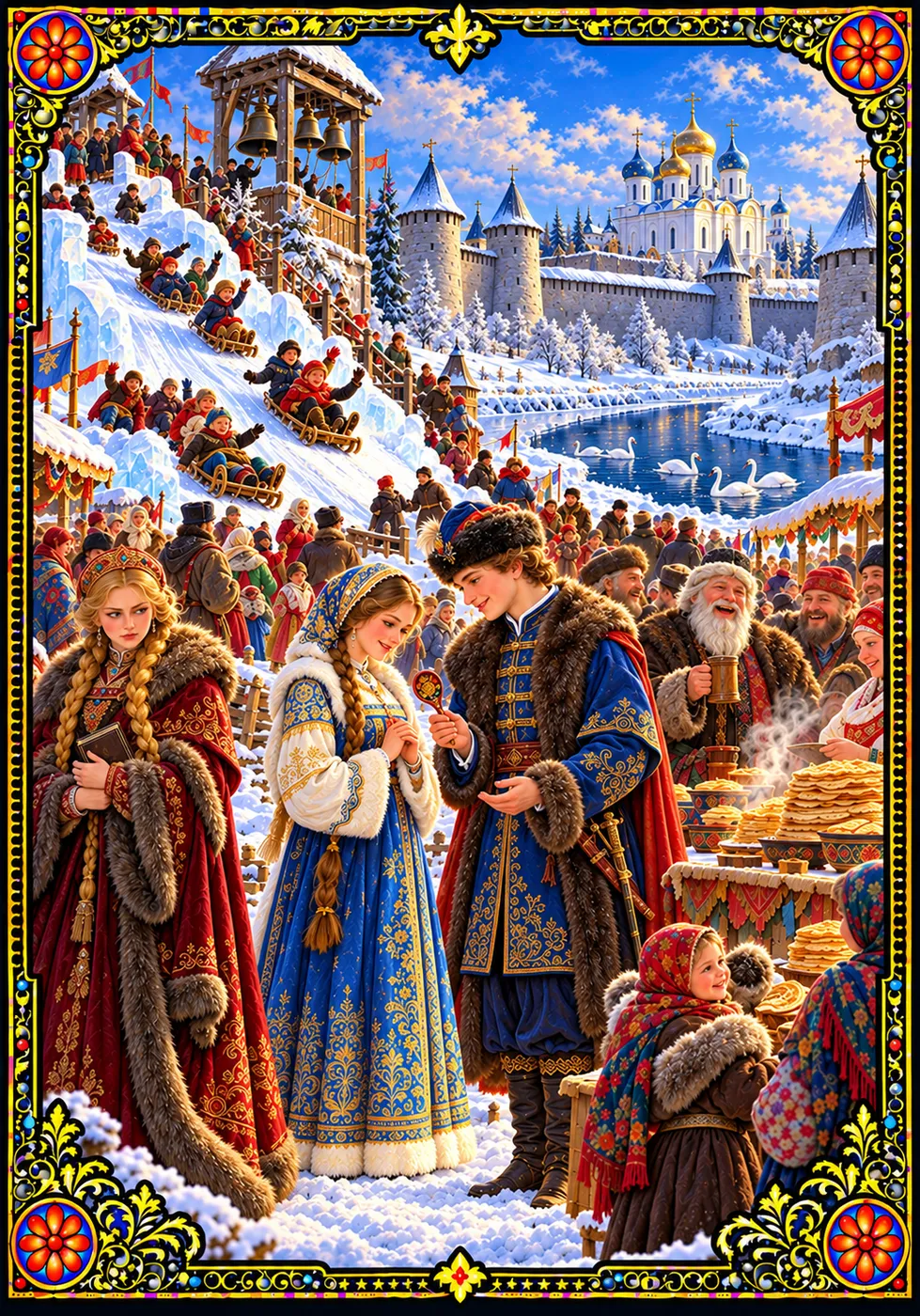
In the ancient lands of Rus’, where the Velikaya River flows broad and gray beneath the walls of Pskov, and the bells of the Trinity Cathedral ring out over marsh and meadow, there lived a noble boyar named Mstislav. He had two daughters, born three years apart, as different from one another as frost from spring rain.
The elder was Zlata, whose name means “golden.” She was tall and striking, with hair the color of ripe wheat and eyes that missed nothing. Her heart, however, was restless and hungry, always measuring what others had against what she lacked.
The younger was Vera, whose name means “faith.” She was gentle and quick to laugh, fond of feeding the swans that nested in the reeds below the kremlin wall. She sang the hymns of the Church as she worked at her embroidery, and the poor of Pskov knew her by the bread she carried to them on feast days.
In the year of our tale, a young boyar named Stanimir came to Pskov from the south, with a fine gray stallion, a cloak trimmed in sable, and a smile that made the maidens of the city whisper behind their sleeves. He was handsome beyond any man they had seen. At the feast of Saint Nicholas, he danced with Vera, and, from that night, he came often to the house of Mstislav, bringing ribbons and honey cakes, and speaking of marriage.
Vera’s heart was stirred, and she was glad. If we are honest, she was more than glad: she was proud, for the handsome stranger had chosen her above her elder sister, and she did not hide her pleasure from Zlata’s eyes. Zlata watched, and envy grew in her like a thorn in the flesh.
Now, in the oldest part of the house, beneath the floor of a storeroom, there lay a chest that no one had opened since the days of the pagan grandmother of Mstislav, a woman who had never fully renounced the old gods. In it was a black book, bound in cracked leather, filled with spells in a script half Slavonic and half something older. The priests had long ago warned the family to burn it. No one had.
On a winter night, while the house slept, Zlata lifted the boards, opened the chest, and read.
On the eve of the betrothal, Vera went down to the river at dusk, as she always did, to scatter grain for the swans. Zlata followed her in silence. At the water’s edge, she spoke the words from the black book, words that tasted of ash and iron, and flung a handful of river mud upon her sister’s back.
Vera cried out, and her cry became the call of a bird. White feathers rushed over her arms. Her neck stretched long and graceful. Where a maiden had stood, a young swan beat her wings upon the ice, bewildered and afraid.
“Fly away, little sister,” Zlata said, and her voice trembled only a little. “The swans will be your family now.”
When Vera did not return, the household searched the riverbank with torches. They found only her embroidered shawl, torn upon the reeds, and Mstislav wept, believing she had fallen through the ice. In the weeks of mourning that followed, Zlata comforted the grieving boyar Stanimir with soft words and golden looks. The black book had one more spell in it, a charm to bend a man’s heart, and she used that as well. Before the snows melted, Stanimir married her in the cathedral, and all of Pskov said how strange and swift it was.
Meanwhile, the swan who had been Vera lived among the reeds and sedges of Lake Pskov. She was cold, and hungry, and lonely beyond words. Each night, she heard the monastery bells across the water and longed to pray, though her swan’s throat could only sigh.
On an island in that lake lived an elder named Hieromonk Savvaty, a hermit of great age, who had come there to pray for the city of Pskov and its sins. Birds came to him as to Saint Francis in the West or Saint Seraphim in later days, and the young swan came, too, drawn by the warmth of his lamp. She laid her head upon his knee.
The old man looked into her dark eyes for a long time. “You are no swan,” he said quietly. “You are a daughter of Christ bound by the spell of the black book. I have seen this darkness before.”
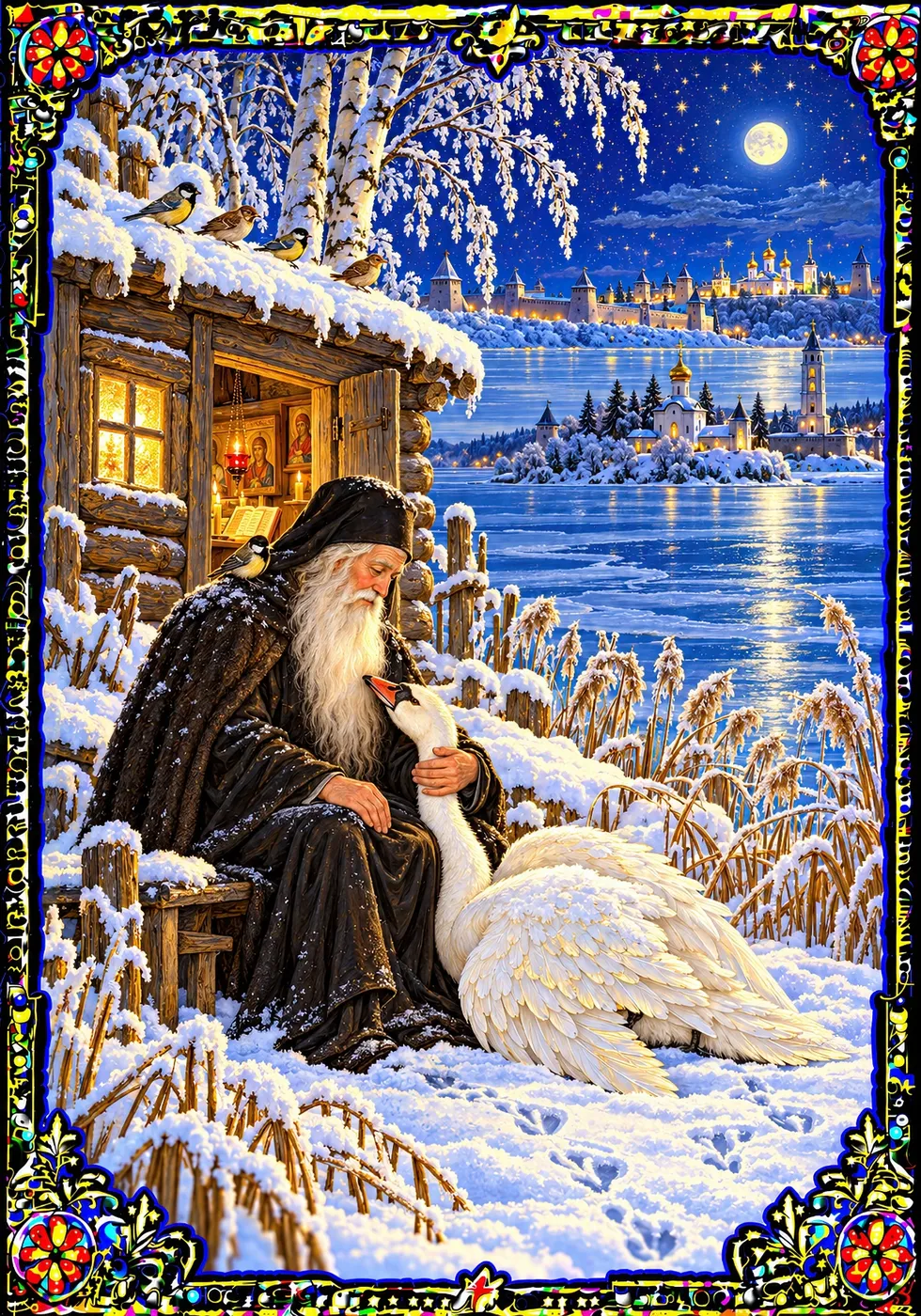
Through some grace of the Holy Spirit, the elder understood her silent grief, and he listened as a father listens. Then he said, “The spell can be broken, my child. Its power is envy, and envy is undone only by humility. On Forgiveness Sunday, when all the Orthodox bow before one another at Vespers and ask pardon before the Great Fast, you must go to the church, bow before the one who has wronged you, and ask her forgiveness.”
The swan drew back, her feathers raised in protest. Why should she ask forgiveness? It was her sister who had sinned against her.
The elder smiled sadly. “Search your heart, child. Were you without fault? When the young boyar chose you, did you not delight in your sister’s shame? Did you not lift your head above her? Her sin is great, and she will answer for it before God. Your sin is small, but it is yours, and you can only repent of your own. Forgiveness is a door that opens from the inside.”
For many days, the swan was silent. Then, slowly, she bowed her long neck before the elder, and he knew she had understood.
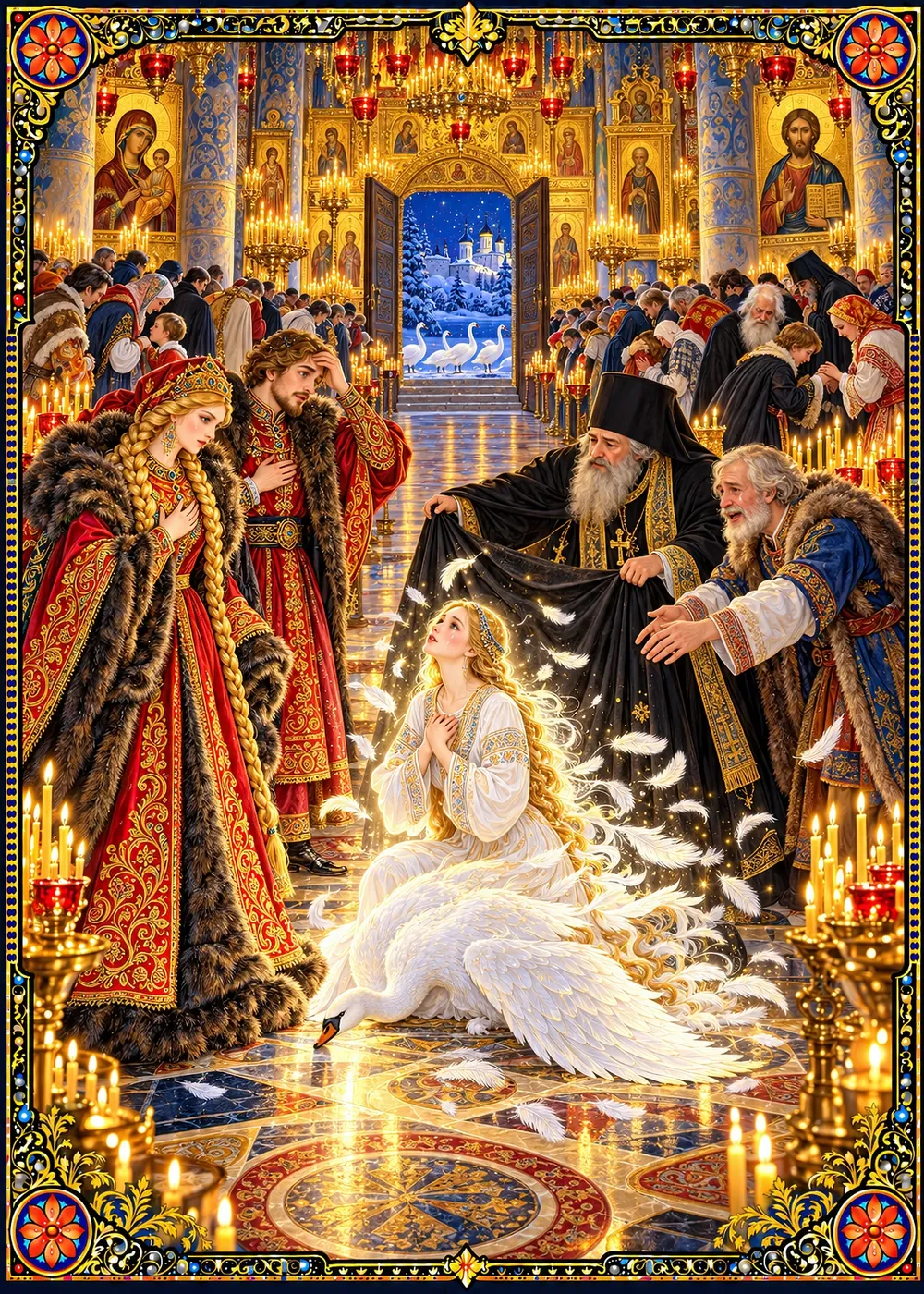
Forgiveness Sunday came, the last day before the Great Fast. In the Trinity Cathedral of Pskov, the lamps flickered before the icons, the choir sang the plaintive Lenten prokeimenon, and the faithful formed a long line to bow before one another, saying, “Forgive me, a sinner,” and answering, “God forgives, and I forgive.”
In the middle of the rite, the great doors of the cathedral swung open in a gust of cold wind, and a white swan walked in upon the stone floor. The people gasped and drew back. The swan passed them by. She walked straight to where Zlata stood in her sable cloak beside her husband, and there she bowed low, her neck and wings touching the floor, in a full prostration.
* * *
Copyright notice. Introduction and illustration © 2026 Laurent Cleenewerck. All rights reserved. The adapted Orthodox version of this tale is published in Twelve Russian Orthodox Fairy Tales (© 2026 Laurent Cleenewerck). No part of this page may be reproduced without written permission, except for brief quotations with attribution and a link to this page.
Buy the book on AmazonAbout the book