
A Story of Ras and Mount Athos, on the Feast of Saint Sava
In the ancient lands of Serbia, where the Raška River runs between dark hills toward the old town of Ras, there once lived the Great Župan Stefan Nemanja, the mightiest lord the Serbs had ever known, and his wife, the Lady Ana. God had given them three sons. The eldest, Vukan, was a warrior. The second, Stefan, was a statesman. The third, the youngest, whom they loved most tenderly of all, was named Rastko.
Rastko was a handsome boy with quick gray eyes and a laugh that filled the palace. He rode well, and he could shoot an arrow as straight as any of his father’s huntsmen, yet he loved two things more than horses or hunting: books and prayer. He would slip away from the feasts to read the lives of the saints by candlelight, and the old priests of Ras said that he knew the Psalter by heart before he was twelve. When his father gave him lands to govern in Hum, near the sea, the young prince governed them justly and gave away so much to the poor that his stewards despaired.
Rastko’s closest friend was Velimir, the son of the captain of Nemanja’s guard. The two boys had been born in the same year, had learned their letters from the same priest, and had been beaten by the same fencing master. Velimir was broad-shouldered and fair-haired, quick to laugh and slow to read, and he would have followed Rastko into fire.
Velimir was in love. Everyone at the court knew it except, perhaps, Velimir himself, who believed that he had kept it a deep secret. The girl was Bojana, an orphan of a noble family whom the Lady Ana had taken into her household, a slender, serious girl with dark braids who embroidered the vestments for the court church and read the Psalms aloud to the old ladies of the palace.
“You should tell her,” Rastko said to him one evening, as they sat on the wall of the citadel watching the swallows. “You stare at her across the hall like a calf staring at a gate.”
“I have no lands,” said Velimir gloomily. “My father has no lands. Her family was noble, and the Lady Ana loves her like a daughter. How can I ask for her?”
“Ask God first,” said Rastko. “He has more lands than anyone.”
It was not long after this that the monks came to Ras.
They came every year from the Holy Mountain, the great peninsula of monasteries in the land of the Greeks, to beg alms for their brotherhoods. That year, among them was an old Russian monk from the Monastery of Saint Panteleimon, a quiet man with a white beard and eyes that seemed to be looking at something far away. Rastko sat with him night after night. The old monk told him of the Holy Mountain: of the cliffs that drop into the sea, of the bells that ring at midnight in twenty monasteries at once, of hermits who live in caves on the bare rock and pray for the whole world, and of the Theotokos, whom the monks call the Abbess of the Holy Mountain.
As Rastko listened, something began to burn in his heart that would not go out.
Velimir saw the change in his friend, though he did not understand it. One evening, as they walked by the river, Rastko stopped and said, without looking at him, “Velimir, if I ever go where you cannot follow, will you forgive me?”
“Where could you go that I could not follow?” laughed Velimir. Rastko only smiled and said nothing more.
The Great Župan and the Lady Ana, meanwhile, had begun to speak of a bride for their youngest son. They looked among the daughters of kings and princes, and the court buzzed with talk of a great wedding.
One morning in late autumn, Rastko asked his father for leave to go hunting in the hills with a few companions. Nemanja gave it gladly. Rastko rode out of the gates of Ras in a cloak of green and gold, with a falcon on his wrist, and waved to his mother at her window. That evening, his companions came back without him. In the forest, they said, the prince had ridden off alone, and they had searched for him until dark.
The next day, it was discovered that the old Russian monk had also left Ras, before dawn, on the road to the south.
The Great Župan understood at once. His face turned dark with grief and fury. The Lady Ana wept, and the whole palace wept with her. Nemanja summoned Velimir to the hall.
“You love my son,” he said. “You know him better than any man alive. Take twenty of my best riders, follow him to the Holy Mountain, and bring him back to me. If you must, bring him back in chains.” Then, more quietly, he added: “I know what you want, Velimir. Bring Rastko home, and I will give you Bojana as your bride, and the lands to keep her as befits a daughter of my house. If you fail, do not come back to Ras at all.”
Velimir bowed to the ground. His heart pounded so hard that he could not speak.
Before he left, he went to find Bojana. She was in the little chapel of the palace, kneeling before the icon of the Theotokos. When she heard his step, she rose, and he saw that she knew everything.
“My lord has promised you to me,” he said, “if I bring Rastko back.”
“I know,” said Bojana. She took a kerchief from her sleeve, white linen embroidered with a small blue cross in the corner, and pressed it into his hand. “Velimir, listen to me. Bring him back, if it is God’s will. If it is not God’s will, do not fight against God. Not for the Great Župan, and not for me.”
Velimir stared at her. “If I fail, I lose you.”
“If you fight against God to win me,” said Bojana, “you will lose much more than that.” Her eyes were full of tears, yet her voice did not shake.
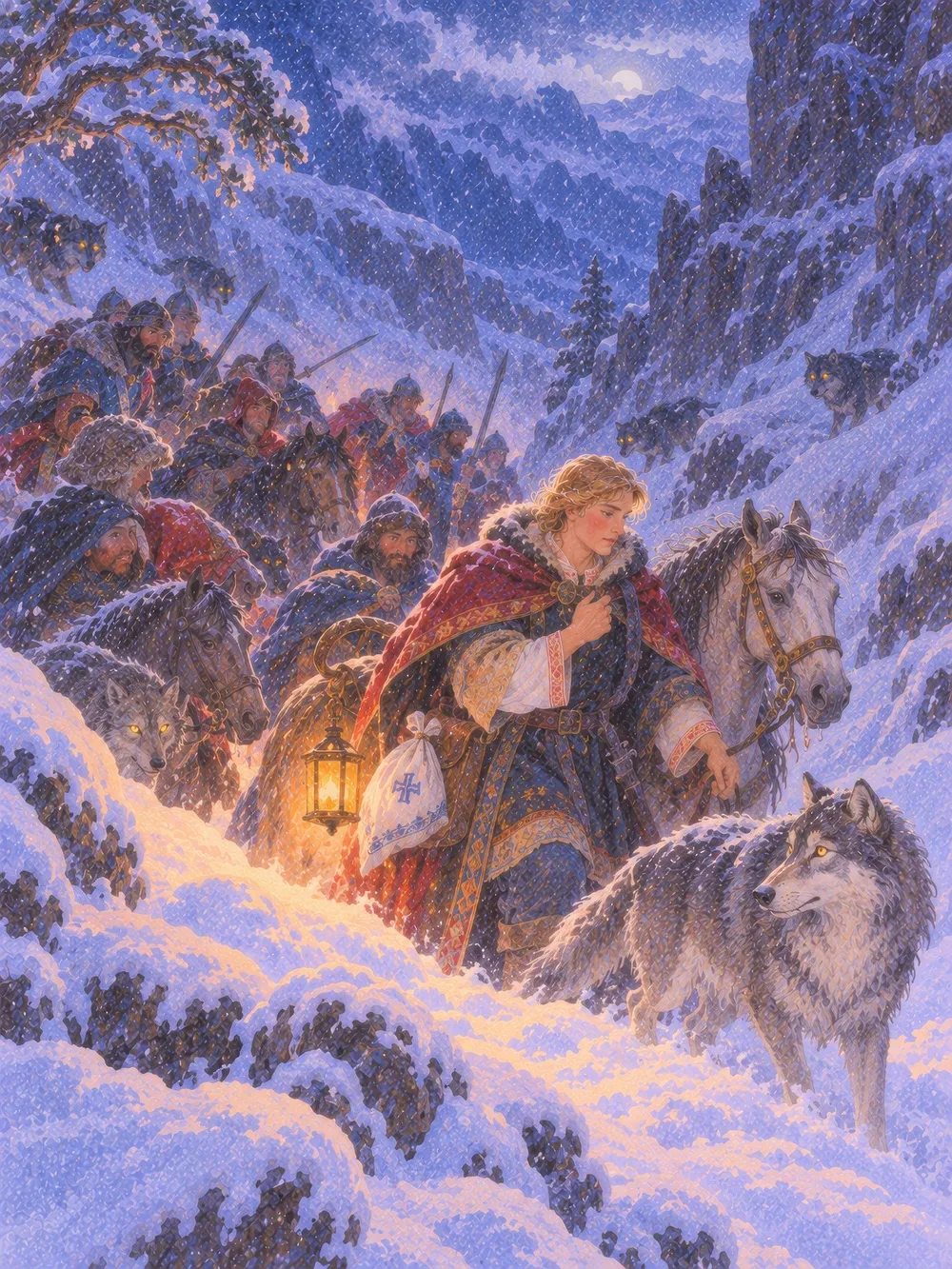
Velimir rode south that same hour with twenty riders. They rode through the mountains of Kosovo and the hills of Macedonia, they changed horses at every town, and they reached the great city of Thessalonica in nine days. There they took ship, and, on the eleventh day, they came to the Holy Mountain.
It was exactly as the old monk had described it. Gray cliffs rose straight out of the blue sea. Dark forests of chestnut and pine climbed toward a high, bare peak. Here and there, on the slopes and on the rocks above the water, monasteries clung like swallows’ nests, and their bells rang across the water as the ship came in. Velimir’s soldiers, rough men who had fought in many battles, fell silent and took off their caps.
At the Monastery of Saint Panteleimon, the hegumen came down to the gate to meet them, an old Russian with a great gray beard. “We know why you have come,” he said kindly. “The young prince is here. He has asked us to receive him as a monk, and we have not yet given him the tonsure. You are welcome. Rest, eat, and stay for the All-Night Vigil. Tomorrow you may speak with him.”
The soldiers were weary to the bone, and the monks’ bread and wine and fish were very good. Velimir alone could not eat. He asked to see Rastko at once, and the hegumen, after looking at him for a long moment, allowed it.
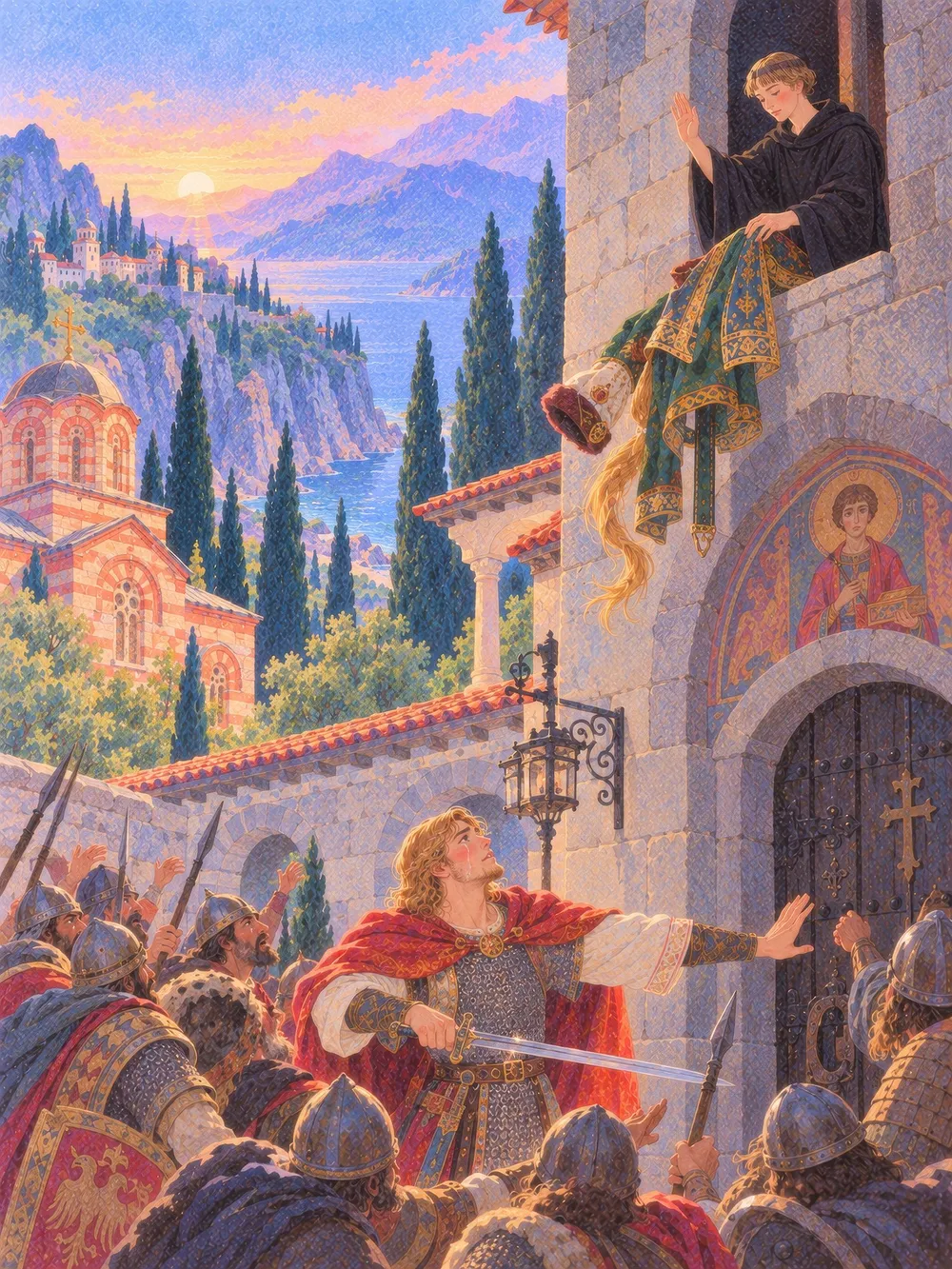
He found his friend in a small cell high up in the monastery’s tower, sitting by the window in his hunting clothes of green and gold, with a book open on his knees. Rastko stood up when he came in, and the two young men embraced.
“I knew it would be you,” said Rastko. “I prayed that it would be you.”
“Your father has sent me to bring you home,” said Velimir. “In chains, if I must.”
“I know.”
“Your mother weeps day and night. Your father’s hair has turned white in a week. Rastko, how could you do this to them?”
Rastko’s eyes filled with tears. “Do you think I do not love them?” he said. “I love them more than my life. My father, however, has two other sons to rule his lands and to fight his wars. Christ has asked for one son, and He has asked for me. I cannot give Him less than all, Velimir. I have tried, and I cannot.”
They talked all through the evening, while the bells rang for the Vigil and the chanting of the monks rose from the church below. Velimir pleaded. He argued. He spoke of the prince’s duty, of his mother’s tears, of the bride who waited for him in some foreign palace. At last, in despair, he told Rastko the truth: that the Great Župan had promised him Bojana, if only he brought the prince home.
Rastko was silent for a long time. Then he took his friend’s hands in his own.
“I would not take her from you for all the world,” he said. “If you must take me by force, then take me. I will not fight you. If you do, however, you will be bringing home a prisoner, and not a son. I would sooner die than be a prince now.”
Velimir looked at his friend’s face, and he saw there something that he had never seen in any face before: a peace so deep and so bright that it seemed to shine from inside, like a lamp behind a window. He thought of Bojana in the chapel, saying, Do not fight against God. His hand had been resting on the hilt of his sword. Slowly, he took it away.
“Do what you must,” he said hoarsely. “I will stand at the door.”
Rastko embraced him once more, and went down the stairs to the church.
That night, as the soldiers slept in the guesthouse, worn out from their long journey and the long Vigil, the hegumen and the old Russian monk led Rastko up into the tower chapel. Velimir stood guard outside its door all night with his sword drawn, so that no one could disturb them. He heard the chanting through the door, and the voice of the hegumen asking the questions of the rite, and Rastko’s clear voice answering each one: “Yes, with God’s help, honorable Father.” He heard the snip of the scissors, once, twice, three times, in the form of a cross. Then he heard the hegumen say, “Our brother Sava is clothed in the garment of righteousness,” and he knew that the Prince Rastko was gone forever.
Velimir laid his forehead against the cold stone of the wall, and he wept.
At dawn, the soldiers woke and came out into the courtyard of the monastery. High above them, at the window of the tower, stood a young monk in a black habit, with his hair shorn. In his hands, he held a bundle: the green and gold hunting clothes of a prince, and a long lock of fair hair. He let them fall, and they floated down through the morning air and landed at the soldiers’ feet.
* * *
Copyright notice. Introduction and illustration © 2026 Laurent Cleenewerck. All rights reserved. The adapted Orthodox version of this tale is published in Twelve Serbian Orthodox Fairy Tales (© 2026 Laurent Cleenewerck). No part of this page may be reproduced without written permission, except for brief quotations with attribution and a link to this page.
Buy the book on AmazonAbout the book