
A Story of Mileševa and Belgrade, on the Feast of the Transfiguration
In the ancient lands of Serbia, where the little Mileševka River runs through a narrow green gorge beneath gray cliffs, there stands the Monastery of Mileševa. It was built by King Vladislav, the nephew of Saint Sava, and, when the holy Archbishop Sava died in a far country, his nephew brought his body home and laid it there. For more than three hundred and fifty years, the relics of Saint Sava rested at Mileševa, and pilgrims came from every corner of the Balkans to pray before them. Serbs came, and Greeks and Bulgarians and Vlachs, and even Muslims and Jews, for the saint was known to heal anyone who came to him in faith.
On the wall of the church at Mileševa, there is a painting of an angel. He sits on the stone that was rolled away from the empty tomb of Christ on the morning of the Resurrection, dressed in a robe so white that it seems to shine, and he points with one hand to the empty grave clothes, as if to say, “He is not here. He is risen.” The people call him the White Angel, and those who see him never forget his face.
By the days of our tale, the Turks had ruled Serbia for more than a hundred years. The old kings and despots were gone. The great lords had died in battle or fled north across the Danube. The people lived quietly under the Sultan, tilled their fields, paid their taxes, and kept their faith as best they could, in the monasteries that were still allowed to stand.
Every few years, the Sultan’s officers came through the Christian villages and took the strongest and cleverest boys away from their families. They carried them off to Constantinople, made them Muslims, and trained them as janissaries, the Sultan’s own soldiers. The mothers of Serbia called it the blood tax, and they wept for their lost sons for the rest of their lives.
In the town of Prijepolje, at the mouth of the Mileševa gorge, lived an old knez named Jovan, the chief of all the Christian villages of the district. He came of an old noble family, though its lands were long gone, and he had one daughter, Anastasija. Her name means “resurrection,” and she had been born on Pascha.
Anastasija was nineteen, tall and grave, with gray eyes and dark hair that she wore in a single braid down her back. She spent half her days at the monastery, helping the monks tend the sick pilgrims who came to the saint’s relics. She loved the White Angel more than any painting in the world, and she would sit before it for hours. In the courtyard of the monastery lived a flock of white doves, and she fed them every morning. The tamest of them, a dove as white as the angel’s robe, would perch on her shoulder while she worked.
In the spring of the year 1594, terrible news came to Mileševa. Far to the north, in the Banat, the Serbs had risen up against the Turks. They had marched into battle under banners that bore the icon of Saint Sava. The uprising had been crushed, and now the great Sinan Pasha, the Sultan’s grand vizier, was furious. “These Serbs fight under the banner of their dead priest,” he said. “Very well. I will burn their dead priest, and we will see how they fight then.”
He sent a company of janissaries to Mileševa to take the relics of Saint Sava and carry them to Belgrade, to be burned.
The captain of that company was a young man named Ahmed. He was twenty-five, tall and lean, with dark eyes and a short black beard, and he was one of the best soldiers in the Sultan’s army. He had been taken from his family as a boy of seven, and he remembered almost nothing of his childhood. He did not know the name of his village. He did not know the name of his mother. Sometimes, at night, he dreamed of a small stone house with a candle burning before a dark painting, and of a woman’s voice singing a song in a language he no longer spoke. When he woke, the dream always slipped away from him, like water through his fingers.
When the janissaries rode into the courtyard of Mileševa, the monks came out of the church and stood before its door, and the people of Prijepolje gathered behind them, silent and pale. Knez Jovan stepped forward, and his daughter stood beside him.
“Captain,” said the old knez, “I beg you. Take our silver. Take our grain. Take my own life, if you must. Leave us our saint.”
Ahmed looked at the old man, and then at his daughter, and then at the white dove on her shoulder. Something stirred in his heart that he did not understand.
“I have my orders,” he said. His voice was harsher than he meant it to be. “Stand aside.”
The monks wept as the janissaries carried the saint’s coffin out of the church and laid it on a cart. Anastasija stood before the cart and would not move. “Then take me, too,” she said. “I will go wherever he goes.”
“It is a long road to Belgrade,” said Ahmed, “and an ugly end at the other side of it. Go home, girl.”
“I will not,” said Anastasija. “Somebody must pray beside him.”
Ahmed looked at her for a long time. Then, to the astonishment of his own men, he shrugged. “Let her walk behind the cart, then,” he said. “She will be tired of it soon enough.”
She was not tired of it. For eleven days, as the cart rolled north through the mountains toward Belgrade, Anastasija walked behind it with her old father and two of the monks, and she prayed. In every village they passed, the people came out to the roadside, men and women and children, and knelt in the dust as the coffin went by, and wept. In the Muslim villages, too, people came out and stood silently with their heads bowed, for they also had prayed to the saint when their children were sick. Every evening, when the company made camp, the white dove from Mileševa came flying down out of the sky and settled on the lid of the coffin, and it stayed there all night.
Every evening, too, Anastasija knelt beside the cart and sang the troparion of Saint Sava, softly, so as not to anger the soldiers:
“You were a guide on the path that leads to life, a first hierarch and a teacher…”
On the fourth night, Ahmed, sitting by the fire with his back to her, suddenly put down his cup. He sat very still. When she had finished, he got up and walked over to her.
“That song,” he said. “Where did you learn it?”
“Every Serbian child learns it,” said Anastasija, “at their mother’s knee.”
Ahmed’s face had gone strange and pale. “My mother sang it,” he said slowly. “I remember now. My mother sang that song, before a candle, in a little stone house.” He pressed his hands to his eyes. “I have not remembered her face for eighteen years. I remember it now.”
Anastasija looked up at him, and she felt a great pity for him.
“What was your name,” she asked gently, “before they gave you this one?”
“I do not know,” said Ahmed. “I have tried to remember a thousand times.” He sat down heavily on a stone. “I only remember that, on the day they took me away, my mother hung something around my neck and told me never to take it off. They took it from me in Constantinople.”
From that night on, he came every evening to listen to her prayers. He did not pray himself. He only sat in the dark at the edge of the firelight and listened, with his face hidden in his hands. Anastasija told him the stories of Saint Sava: of the prince who ran away to the Holy Mountain, of the wolves in the snow, of the schools and churches he had built, of the father and the son who built Hilandar. Ahmed listened to all of them, and the white dove on the coffin listened, too.
On the eleventh day, they came to Belgrade.
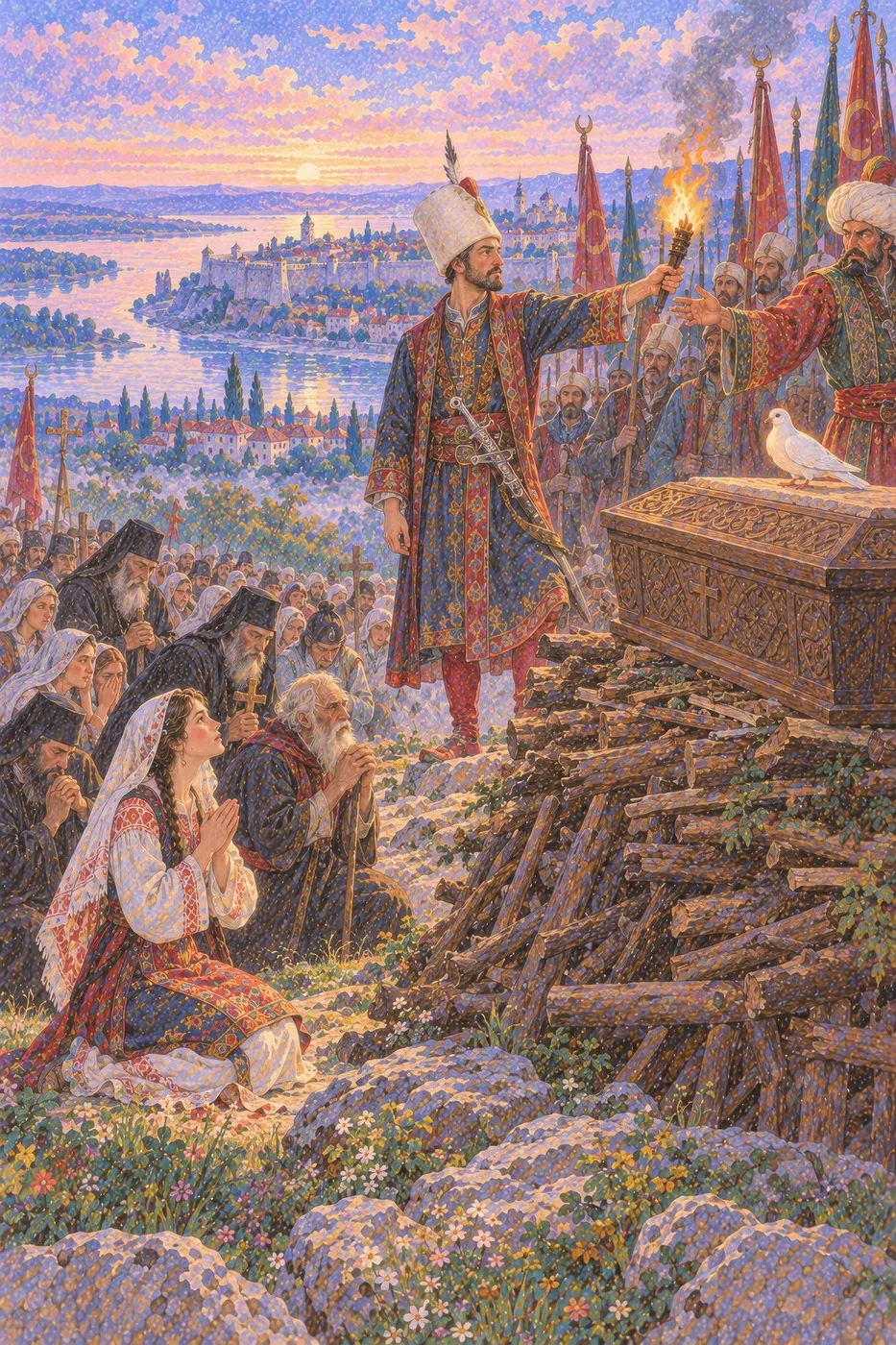
Sinan Pasha had ordered that the relics of Saint Sava be burned on the hill of Vračar, just outside the walls of the city, so that every Serb in Belgrade could see the smoke. A great pile of wood had been built there, and a crowd had gathered: Turkish soldiers and officials, and, behind them, thousands of Serbs, weeping, kneeling, praying aloud.
The janissaries carried the saint’s coffin to the top of the pyre. An officer of the Pasha’s guard handed a burning torch to Ahmed.
“Captain,” he said, “the Pasha orders that the commander of the escort shall light the fire.”
Ahmed took the torch. He looked at the coffin on top of the pyre, with the white dove still sitting on its lid. He looked at the crowd of weeping Serbs, and, among them, at a girl with gray eyes and a single dark braid, kneeling in the dust. He thought of a little stone house, and a candle, and a woman’s voice singing.
He handed the torch back to the officer.
“I will not,” he said.
A murmur ran through the crowd. The officer’s face turned dark with anger. “Do you know what you are saying, Captain? This is disobedience to the Pasha. You will pay for it with your head.”
“Perhaps,” said Ahmed quietly. “Still, I will not light it.”
The officer snatched the torch and thrust it into the wood himself. The janissaries seized Ahmed and dragged him away to the fortress, and the fire roared up around the pyre with a sound like a great wind.
It was the twenty-seventh of April, in the year 1594. The flames climbed high into the spring sky. The smoke rose over Belgrade in a great white column, and the people who saw it said afterward that it did not smell of burning at all, but of incense and roses. As the flames reached their height, the white dove rose from the coffin, untouched by the fire, and circled three times above the pyre, and flew away to the south.
* * *
Copyright notice. Introduction and illustration © 2026 Laurent Cleenewerck. All rights reserved. The adapted Orthodox version of this tale is published in Twelve Serbian Orthodox Fairy Tales (© 2026 Laurent Cleenewerck). No part of this page may be reproduced without written permission, except for brief quotations with attribution and a link to this page.
Buy the book on AmazonAbout the book