
A Story of Hilandar and the Feast of Pascha
In the ancient lands of the Serbs, far to the south, beyond the mountains of Macedonia and across the blue water, there rises from the sea the Holy Mountain of Athos, where only monks may live. On its northern side, in a green valley among olive groves and cypress trees, stands the Serbian Monastery of Hilandar, which Saint Simeon and his son Saint Sava built with their own hands. There, in the great church, beside the place where the body of Saint Simeon was first laid to rest, a grapevine grows out of the stone wall itself. Nobody planted it. It sprang up from the saint’s tomb soon after his death, and it has borne fruit every year for centuries.
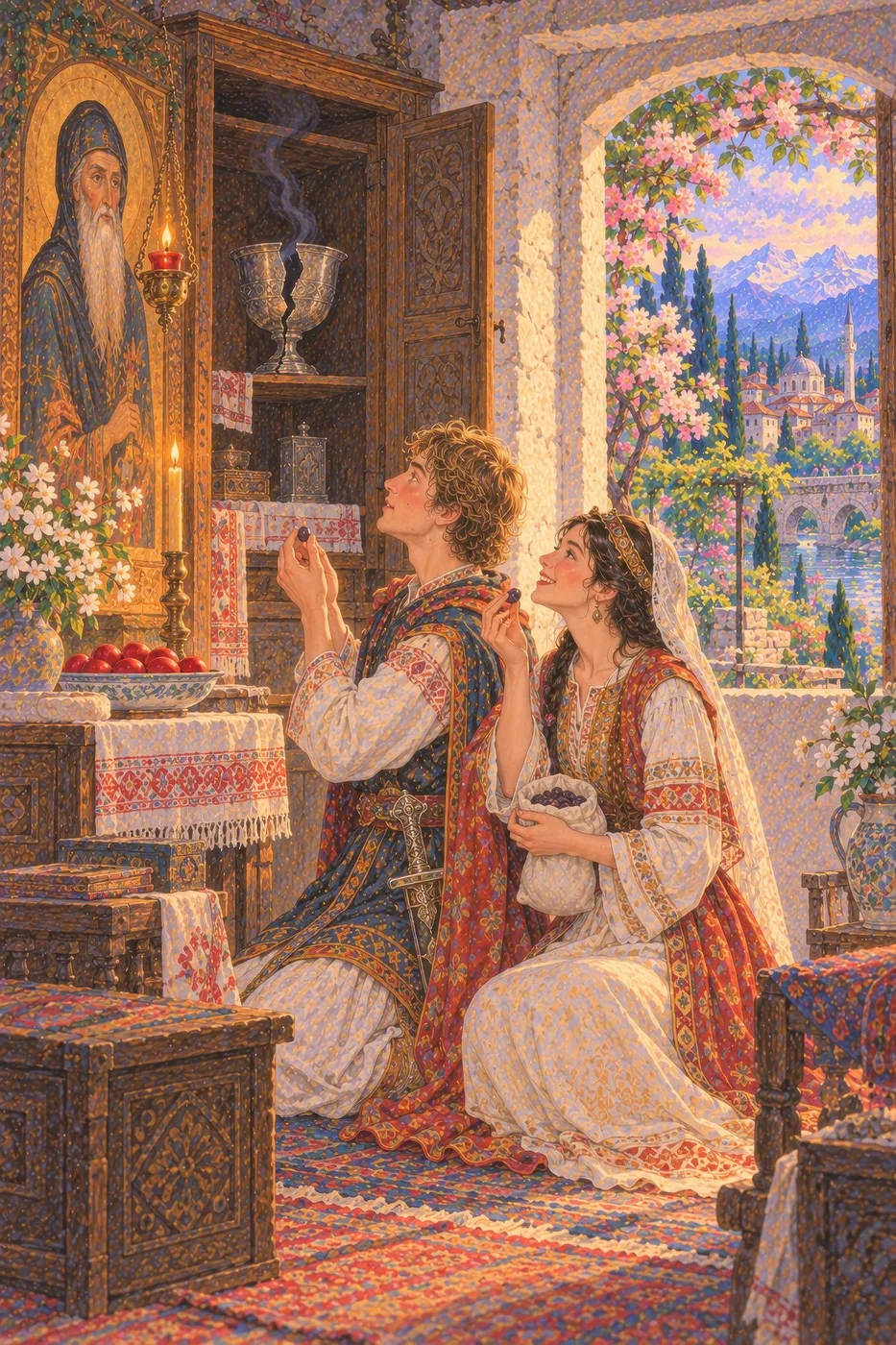
The monks of Hilandar dry its grapes and give them, a few at a time, to husbands and wives who have no children and who come to beg the prayers of Saint Simeon. So many children have been born after those grapes were eaten with faith and prayer that nobody can count them.
Hilandar has another treasure, too. In its church hangs a holy icon of the Theotokos called the Three-Handed. Long ago, when the Turks invaded Serbia, the monks placed that icon on the back of a mule and let it go, praying that God would lead it to safety. The mule walked alone, with no one to guide it, all the way from Serbia to the Holy Mountain, and it stopped at the gate of Hilandar. Since that day, the monks of Hilandar have no human abbot. The Theotokos herself, in her Three-Handed icon, sits in the abbot’s place, and the monks call her their Abbess.
In the days of our tale, in the old city of Prizren, beneath the Šar mountains, there lived a young nobleman named Lord Radoslav and his wife, the Lady Teodora.
They had known each other since they were small children. Every Pascha, when the children of Prizren played the old game of tapping red eggs together, little Teodora had always won, cracking the eggs of every boy in the city with her own, and little Radoslav had always lost. Years later, on the day he asked for her hand, he admitted that he had always lost on purpose. “Every year,” he said, “I wanted to see you laugh.” Teodora laughed so hard that she had to sit down, and she said yes.
They had been married for seven years, and they loved each other dearly. They had a fine house of white stone, with a garden that ran down to the river, and lands in the valley, and a great many friends. God had not given them a child.
There was one person in Prizren who was glad of it. Lord Radoslav’s cousin, Lord Dragić, was next in line to inherit his lands if Radoslav died without a son. Dragić was a smooth, smiling man with soft hands and a hard heart. He came to dinner often, and he always asked, very sweetly, “Still no little one? What a pity, what a pity.” Then he would smile into his wine.
What nobody knew was that, on the night of Radoslav and Teodora’s wedding, Dragić had gone to a witch in the hills above Prizren and paid her to curse their marriage. The witch had muttered over a cup of wine, and Dragić had poured a few drops of it into the wedding cup, the common cup from which the bride and groom drink three times at the end of the crowning. “As long as the drops of that wine remain in them,” the witch had said, “no child will be born to that house.”
In the seventh year of their marriage, a pilgrim came to Prizren from the Holy Mountain, and he told them about the vine of Saint Simeon.
That very night, Radoslav made up his mind. “I will go to Hilandar,” he said, “and beg the prayers of Saint Simeon, and bring home his grapes.”
Teodora’s eyes filled with tears. No woman may set foot on the Holy Mountain, for it belongs to the Theotokos alone. “I cannot go with you,” she said.
“No,” said Radoslav. “We can still go together, though, in another way.” He took her hands. “Great Lent begins next week. Let us keep the fast together, you here and I there, every day, until we meet again at Pascha. When I fast, you will be fasting, too. When you pray, I will be praying, too. We will be apart, yet we will be keeping the same fast and walking toward the same feast.”
So they agreed. On the Monday of the first week of Lent, Clean Monday, Radoslav set out for the south with one servant and a mule, and Teodora stood at the gate and watched him until the road turned behind the hills.
The fast in Serbia, in those days, was kept strictly. There was no meat, no milk, no cheese, no eggs, and, on most days, no oil and no wine. The bread was dark and the beans were plain. Every Wednesday and Friday of the year was a fast day, too, in memory of the day the Lord was betrayed and the day He was crucified, and Great Lent was the longest fast of all, forty days and Holy Week besides. “The body learns to obey,” the old priests said, “so that the soul can learn to pray. We fast, not because food is bad, but because God is better.”
Teodora kept the fast faithfully. She ate her dark bread and her plain beans. With the money she saved by not buying meat and fish, she bought bread for the poor, and every morning there was a line of beggars at her kitchen door. She went to church every morning and every evening, and she said the long prayer of Saint Ephrem the Syrian with all its prostrations: O Lord and Master of my life, give me not a spirit of sloth, despair, lust for power, and idle talk.
Lord Dragić watched all this, and he did not like it.
In the second week of Lent, he arrived at Teodora’s door with a basket. “My dear cousin,” he said, “you are looking so pale! It worries me. Here, I have brought you a roast chicken and a jug of milk. The Church allows the sick to break the fast, you know, and you are surely sick with grief.”
“Thank you, cousin,” said Teodora, “but I am not sick, only hungry, and hunger is part of the fast.” She gave the roast chicken to the poor widow who sat by her gate, who had not eaten meat in a year and who wept for joy, and she thanked Dragić very politely for his kindness.
In the fourth week of Lent, Dragić came again, this time with a sad face and a letter. “My dear cousin,” he said, “I am afraid I have terrible news. A traveler from the south brought this. Radoslav’s ship was wrecked off the coast of Thessalonica, and he was drowned.” He held out the letter. “Your fast is useless now. Come and eat with me tonight, and forget your sorrows.”
Teodora turned white. She took the letter and read it, and her hands shook. Then she looked closely at the handwriting, and she saw that it was not the handwriting of any traveler from the south. It was Dragić’s own.
“Cousin,” she said quietly, “I will keep the fast until Pascha, as I promised my husband. If he is drowned, I will keep it for his soul. If he is alive, I will keep it for both of us. Either way, I will not eat your dinner.”
Dragić’s smile slipped for a moment. Then it came back, smoother than ever, and he bowed and went away.
Meanwhile, far to the south, Radoslav’s journey had been hard. He had crossed the mountains of Macedonia in sleet and snow. He had taken ship at Thessalonica, and there had indeed been a storm, though the ship had not sunk. At last, he had landed on the shore of the Holy Mountain, and he and his servant had set out on foot along the steep forest paths to look for Hilandar.
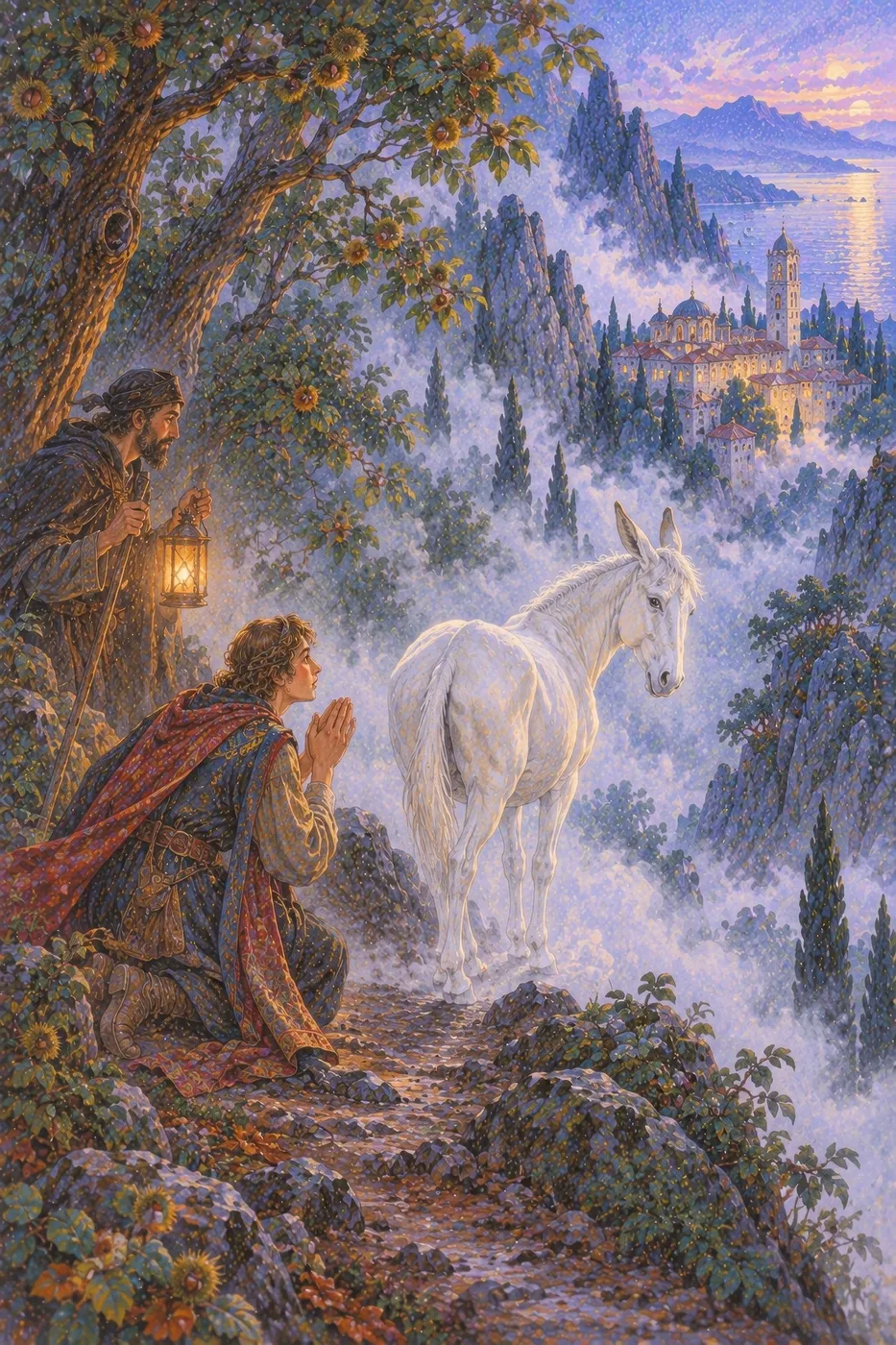
On the second day, a thick white fog came down from the peak. The paths split and wound and doubled back. By evening, Radoslav and his servant were hopelessly lost in a dark ravine full of chestnut trees, wet and cold and hungry, with night falling.
Radoslav knelt down on the wet path. “Holy Theotokos, Abbess of the Holy Mountain,” he prayed, “you guided the mule that carried your icon. Guide us, too.”
Out of the fog came a soft sound of hooves. A white mule stepped onto the path in front of them, with no bridle, no saddle, and no rider. It looked at them with its long-lashed eyes, and it turned and began to walk slowly down the ravine, stopping every few steps to look back.
They followed it all night. At dawn, the fog lifted, and they found themselves standing at the great wooden gate of Hilandar, with its tall tower above them and the bell ringing for Matins. When Radoslav turned to thank the white mule, it was gone.
The old gatekeeper of Hilandar listened to his story without surprise. “That is the Abbess’s mule,” he said. “She sends it for those she means to have here. Come in, my son. You have come in time for the Great Canon.”
Radoslav stayed at Hilandar through the rest of Great Lent and through all of Holy Week. He kept the monks’ fast, which was even stricter than the fast in Prizren. He stood with them through the long night services in the dark church, with its frescoes of the saints glimmering in the candlelight. He made his confession to an old hieromonk named Father Antonije, a little bent man with a white beard and eyes as clear as a child’s. Every day, he went and knelt before the tomb of Saint Simeon, where the vine grew out of the wall, and every day, he knelt before the Three-Handed icon of the Abbess and prayed for Teodora.
* * *
Copyright notice. Introduction and illustration © 2026 Laurent Cleenewerck. All rights reserved. The adapted Orthodox version of this tale is published in Twelve Serbian Orthodox Fairy Tales (© 2026 Laurent Cleenewerck). No part of this page may be reproduced without written permission, except for brief quotations with attribution and a link to this page.
Buy the book on AmazonAbout the book