
A Story of Suceava and Neamts, on the Feast of Pascha
This tale is my Orthodox retelling of the beloved Romanian fairy tale Youth Without Age and Life Without Death, first written down by Petre Ispirescu in the nineteenth century, as published in Twelve Romanian Orthodox Fairy Tales.
In the ancient lands of Moldavia, where beech forests climb the slopes of the Carpathians and the white bell towers of the monasteries rise above the green valleys, there once stood the city of Suceava, with its stone citadel on a hill above the river. In that citadel lived a voivode named Bogdan and his wife, the Lady Maria. They were rich and respected, and they loved God and the poor, yet for many years they had no child.
They prayed in every church of the land. At last, the Lady Maria went on foot, as a humble pilgrim, to the Monastery of Neamts, in the hills to the west, and she knelt before the wonder-working icon of the Theotokos that the monks keep there. From there, she climbed higher still, up the steep paths of Mount Ceahlău, to the cave of an old hermit named Father Ioan, who was said to have prayed alone on the mountain for forty years.
“Pray for me, Father,” she said, “that God may give me a child.”
The old hermit looked at her for a long time with eyes as clear as spring water. “God will give you a son,” he said. “Remember, though, that a child is a gift, not a possession. Do not promise him anything that belongs to God alone.”
Within the year, the Lady Maria was with child, and the whole of Moldavia rejoiced. Yet a strange thing happened. As the time of the birth drew near, the child began to weep in his mother’s womb, and he would not stop. The midwives could not quiet him. The physicians could not explain it. Night after night, the weeping filled the citadel, until the voivode, beside himself, laid his hand on his wife and spoke to the unborn child.
“Hush, my son,” he said. “Do not weep. I will give you anything you wish. I will give you a kingdom. I will give you a bride more beautiful than the dawn.” The child went on weeping. In despair, the voivode said the first words that came into his head, the words of an old song that his nurse had sung to him when he was a boy: “I will give you youth without old age and life without death.”
The weeping stopped at once. The child was born that very night, healthy and strong, and they named him Constantin.
The voivode remembered the hermit’s warning, and he went pale. He had promised his son something that belonged to God alone.
Constantin grew up tall and quick and bright, with dark eyes that seemed always to be looking past the edge of the world. He learned his letters from the monks, and he learned to ride and to fight from his father’s captains, and he learned more in a year than other boys learned in five. The voivode and the Lady Maria loved him more than their own lives, and they hoped that he had forgotten the words spoken before his birth.
He had not. On the morning of his fifteenth birthday, he came before his father’s throne and bowed.
“Father,” he said, “today I am a man. You promised me youth without old age and life without death. I have come to ask for it.”
The voivode bowed his head. “My son,” he said, “forgive me. I spoke in foolishness, to quiet a weeping child. I cannot give you what I promised. No father on earth can give it. I am growing old, and your mother is growing old, and one day we will die, as every man dies.”
“Then I will find it myself,” said Constantin, “wherever it is in the world.”
His mother wept, and his father begged him to stay, but the young prince’s heart was set. That evening, he went down to the stables to choose a horse.
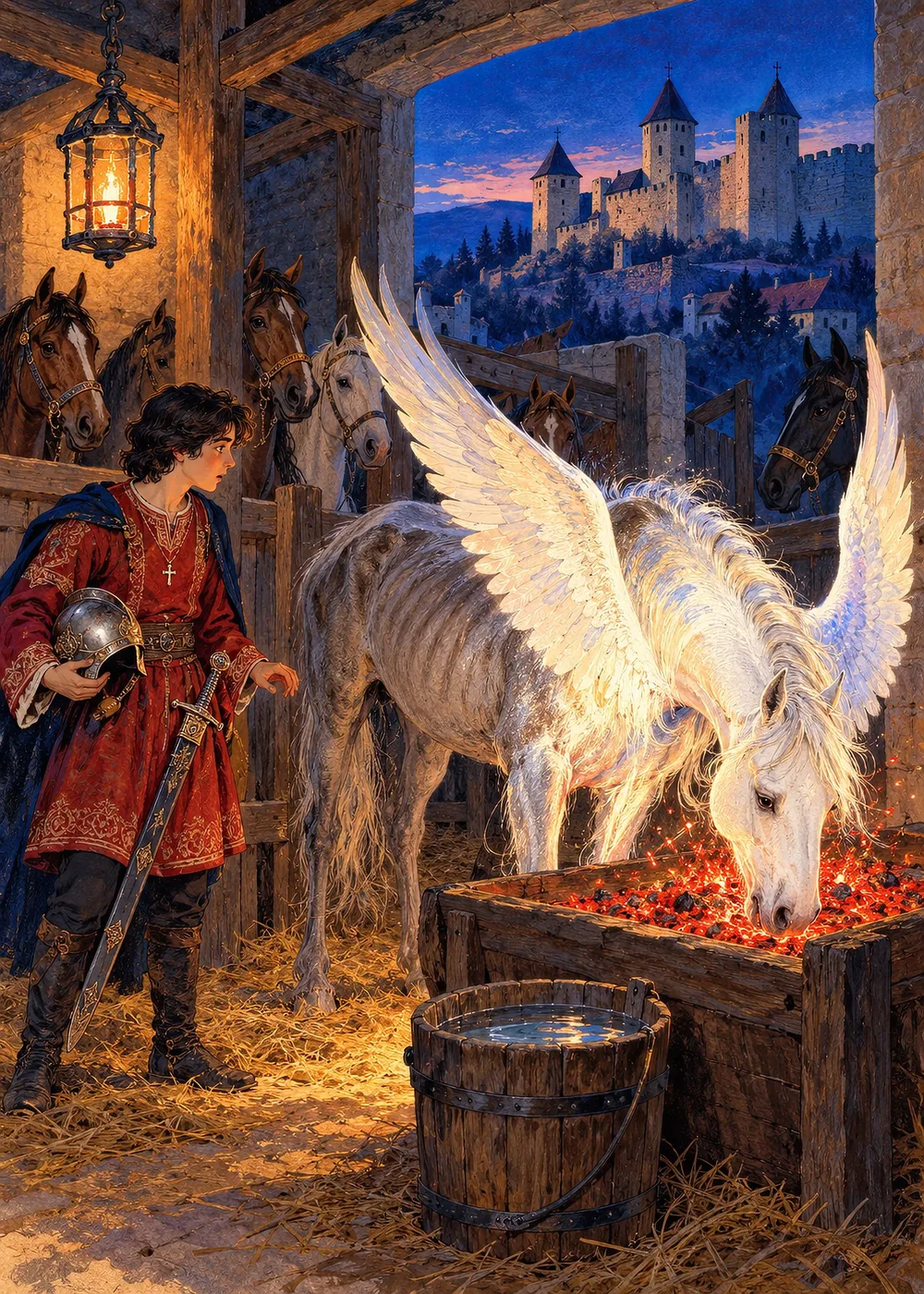
He looked at all the horses in his father’s stables, the fine Arab mares and the tall war stallions, and none of them pleased him. At last, in the farthest stall, he found an old horse, so thin that its ribs showed through its dull gray coat, with a ragged mane and drooping ears. It had been the voivode’s warhorse in his youth, and now it was kept only out of kindness.
When Constantin laid his hand on its neck, the old horse turned its head and looked at him, and it spoke.
“So, you are the prince who wants to live forever,” it said. “I have waited fifteen years for you. If you want me to carry you, do as I tell you. Fill a manger with glowing embers from the forge, and bring me a bucket of clear water from the spring of the monastery. Then take your father’s old armor and his old sword from the chest in the tower, and clean them until they shine.”
Constantin was too astonished to answer. He did all that the horse had told him. When the old horse ate the glowing embers, crunching them like oats, and drank the clear water, it shook itself from head to tail, and its dull coat turned as white as snow and as bright as silver. Two great wings unfolded from its shoulders, and it stood before him as tall and splendid as a horse in an icon.
“Now,” said the horse, “say farewell to your father and mother, and ask their blessing, for we have a long road ahead.”
His father blessed him with tears. His mother hung a small silver cross around his neck. “Wear this always,” she said. “Whatever you find, my son, do not forget where you came from.”
On his way out of Moldavia, the prince rode up Mount Ceahlău to the cave of the old hermit, for his mother had begged him to. Father Ioan was sitting at the mouth of his cave, as if he had been waiting.
“You seek youth without old age and life without death,” said the old man.
“I do, Father.”
“There is only One who can give that gift,” said the hermit, “and He does not give it in the way you think. You will find a land where no one grows old. Do not mistake it for the Kingdom of Heaven.” He made the sign of the cross over the prince and over the horse. “Go with God. When you weep, remember why you are weeping.”
Constantin did not understand, but he bowed, kissed the old man’s hand, and rode away.
They traveled east and then south, past the borders of every land he had ever heard of, for many days and many nights. At last they came to a vast, dark forest, where the trees were so tall that they hid the sun and the ground was covered with the bones of animals.
“This is the forest of the Gheonoaie,” said the horse. “She is a monster, half woman and half woodpecker, with a beak of iron, and she eats whatever enters her forest. Hold tight, and draw your father’s sword.”
Before the words were out of its mouth, there came a sound like a thousand axes striking at once. Through the trees burst the Gheonoaie, a huge, hideous creature with a woman’s face, a woodpecker’s feathers, and a great iron beak that split the trunks of oaks as she came. The horse leaped into the air, high over the trees, and the prince, as they passed over her, struck with his sword. The blade glanced off her iron beak with a shower of sparks, and the monster shrieked and fell back, and the horse carried him over the forest and out the other side.
Beyond the forest lay a desert of red stone, and in it dwelt the Gheonoaie’s sister, the Scorpia, a monster with three heads like a dragon’s, who breathed fire from all three of her mouths. She came at them across the burning sand, and the air shimmered with heat. The horse rose into the sky again, so high that the Scorpia’s flames could not reach them, and the prince held on with all his strength. Below them, the monster roared until the rocks cracked, but they passed over her, and she could not follow.
On the far side of the desert, the air grew suddenly cool and sweet. Before them lay a great meadow, green as an emerald, scattered with flowers of every color, which grew and bloomed all at once, as if it were always May. In the middle of the meadow stood a palace of white crystal, so bright that it hurt the eyes, and around it ran a river as clear as glass.
“This is the land of youth without old age and life without death,” said the horse quietly. “No one here grows old. No one here dies. Here, too, is where my road ends. Go in.”
Three ladies came out of the crystal palace to meet him. The two elder ones were tall and stately, with golden hair and calm, smiling faces that never seemed to change. The third was younger, with dark braids and gray eyes, and, though she smiled like the others, there was something sad in her eyes that the others did not have.
“Welcome, prince,” said the eldest. “We have been expecting you for a long time. Stay with us as long as you wish. Here, there is no winter, no sickness, and no death. Here, you will never grow old.”
So Constantin stayed. Each day was as bright as the day before, and each night as sweet. The fruits of the trees never failed, the flowers never faded, and the river sang all night long. He hunted in the forests and rode on the meadows, and his winged horse grazed in the long grass. Before long, he asked the youngest of the three ladies to be his wife, for he loved her with all his heart. She said yes, and they were married in the great hall of the crystal palace, under a ceiling that shone like the stars.
It was a strange wedding, though. There was no priest, and no crowns, and no Gospel book, and no one sang “Lord, have mercy.” When Constantin asked why, the eldest lady only smiled her unchanging smile. “We have no need of priests here,” she said. “Prayers are for those who die.”
Her name was Ileana, or so the others called her. When Constantin asked her about her life before he came, she could not tell him. “I have always been here,” she said. “I think I have always been here.” Sometimes, though, when she sat by the river in the evening, she would hum a melody that seemed to come from very far away, and stop in the middle, and frown, as if she had forgotten the rest.
* * *
Copyright notice. Introduction and illustration © 2026 Laurent Cleenewerck. All rights reserved. The adapted Orthodox version of this tale is published in Twelve Romanian Orthodox Fairy Tales (© 2026 Laurent Cleenewerck). No part of this page may be reproduced without written permission, except for brief quotations with attribution and a link to this page.
Buy the book on AmazonAbout the book