
A Story of the Homolje Mountains and the Feast of the Prophet Elijah
In the ancient lands of Serbia, where the Mlava River rushes out of a dark gorge in the east and beech forests cover the mountains like a green fleece, there lies the wild country of Homolje. It is a land of caves and springs and sudden storms, of shepherds’ huts high on the summits and villages tucked into the folds of the hills. On the highest peak of all, among the rocks, there stood an old stone church of the Prophet Elijah, and, below it, a spring of cold, clear water bubbled out from under a great flat stone.
The people of Homolje had a legend about that spring. Every year, they said, on the morning of Ilindan, the feast of the Prophet Elijah, a white deer came out of the forest of its own accord and drank from the spring below the church. Wherever it drank, the water rose and overflowed and ran down the mountain in a hundred little streams, and the fields of Homolje were green and full all summer. The shepherds would stand at a distance, with their caps in their hands, and watch the white deer drink. Nobody ever touched it. It belonged to the Prophet.
So it had been for as long as anyone could remember, until three summers before our tale.
The lord of Homolje in those days was Lord Hranislav. He was a rich man, and the richer he grew, the more he wanted. He had the best fields in the valley, the largest flocks on the mountain, and the deepest wells, and still it was not enough. One Ilindan morning, he rode up the mountain with his huntsmen and his nets, and he tried to catch the white deer at the spring. “A white hide like that,” he said, “would look very fine on the floor of my hall.”
The deer leaped away into the forest. The nets caught nothing. From that day on, the white deer never came to the spring again.
That was the first summer of the drought.
Lord Hranislav did not care. His wells were deep, and his fields were still green. When his poor neighbors’ crops withered and their sheep grew thin, he offered to buy their land, a field for a sack of flour, a meadow for a cheese. In the second summer of the drought, he did something worse. He climbed by night to a cave on the far side of the mountain, where there lived an old witch named Smiljka, and he gave her a purse of gold.
“Keep the rain away,” he said, “from every field in Homolje but mine. In another summer, they will all have to sell me their land.”
The witch grinned with her three yellow teeth. She took a long black cord and tied it in seven knots, muttering a spell over each one, and, with every knot she tied, a cloud shrank and vanished from the sky over Homolje. She hung the black cord on a hook at the back of her cave. “There,” she said. “As long as those seven knots hold, not a drop will fall on the mountain.”
So the drought went on into a third summer. The streams dried up. The spring below the church of Saint Elijah dwindled to a trickle. The fields cracked like old pots, and the leaves of the beech trees turned brown in July. One by one, the poor families of Homolje sold their land to Lord Hranislav for bread.
In a little stone house at the edge of the village, below the mountain, lived a widow named Vukosava and her daughter, Ilinka. Ilinka had been born on the feast of Saint Elijah, and she was named after him. She was sixteen, small and quick, with a brown face and bright black eyes, and, though she had not eaten a full meal in weeks, she still sang as she worked.
The widow and her daughter had refused to sell their little field to Lord Hranislav. “Your father is buried in that field’s corner,” Vukosava told Ilinka, “and his father before him. We will not sell our dead for a sack of flour.” So they were poorer than anyone in the village, and, by the third summer, they had almost nothing left.
That summer, a young shepherd came to their door and asked for work. He said his name was Miša, and he had come from the west, and he would watch their two thin goats and mend their roof and carry their water for a crust of bread and a place to sleep in the shed. He was tall, with fair hair and a broken straw hat, and his hands were too soft for a shepherd’s hands, though he worked harder than any shepherd Vukosava had ever known.
What the widow and her daughter did not know was that Miša’s real name was Mihailo, and that he was the only son of Lord Hranislav himself.
Mihailo had been sent away to the court of the Despot at Smederevo when he was a boy of eight, to be raised as a knight. He had not been home in ten years. When strange rumors reached him at court, of a drought on the mountain and of his father buying up the land of the starving, he had asked the Despot’s leave to go home. He had come in disguise, because he wanted to see the truth with his own eyes.
He had seen it. On the very first day, he had gone to his father’s gate in his shepherd’s clothes and asked for a drink of water, and his father’s steward had set the dogs on him. His father, standing in the courtyard, had looked straight at him and had not known him.
Mihailo did not tell the widow and her daughter any of this. He watched their goats, and he mended their roof, and every evening he sat with them by the empty hearth while Ilinka sang the old songs. Before long, he knew that he would rather sit in that poor stone house with Ilinka than in any palace in Serbia.
On the eve of Ilindan, at sunset, an old man came walking down the mountain road.
He was the strangest traveler anyone had ever seen in Homolje. He was very tall and very thin, with a great tangle of white hair and a white beard down to his belt. He wore a rough cloak of sheepskin, tied at the waist with a leather strap, and he leaned on a long staff of almond wood. His eyes were fierce and bright, like the eyes of an eagle, and his feet were bare and dusty.
He went first to the gate of Lord Hranislav’s manor, the biggest house in the valley, and he knocked with his staff.
“Peace to this house,” he said. “I have come a long way. Give me a little water and a piece of bread, for the love of God.”
Lord Hranislav himself came to the gate, for he was in a bad temper that evening. “Water?” he said. “There is a drought, old man, in case you had not noticed. My water is for my fields and my flocks, not for every beggar who comes down the mountain. Be off with you.” Then he set his dogs on the old man.
The dogs ran out barking. When they reached the stranger, however, they stopped short, whimpered, and lay down in the dust at his feet with their tails between their legs. The old man looked at Lord Hranislav for a long moment with his fierce eagle’s eyes, without a word. Then he turned and walked away down the road.
Ilinka saw it all from the well, where she had gone with her bucket, hoping for a little water at the bottom. She ran after the old man and caught his sleeve.
“Grandfather,” she said, “come home with us. We have not much, but you are welcome to share it.”
The old man looked down at her, and his fierce eyes softened. “What is your name, child?”
“Ilinka,” she said. “I was born on the feast of Saint Elijah.”
The old man smiled, a strange, slow smile, and he went home with her.
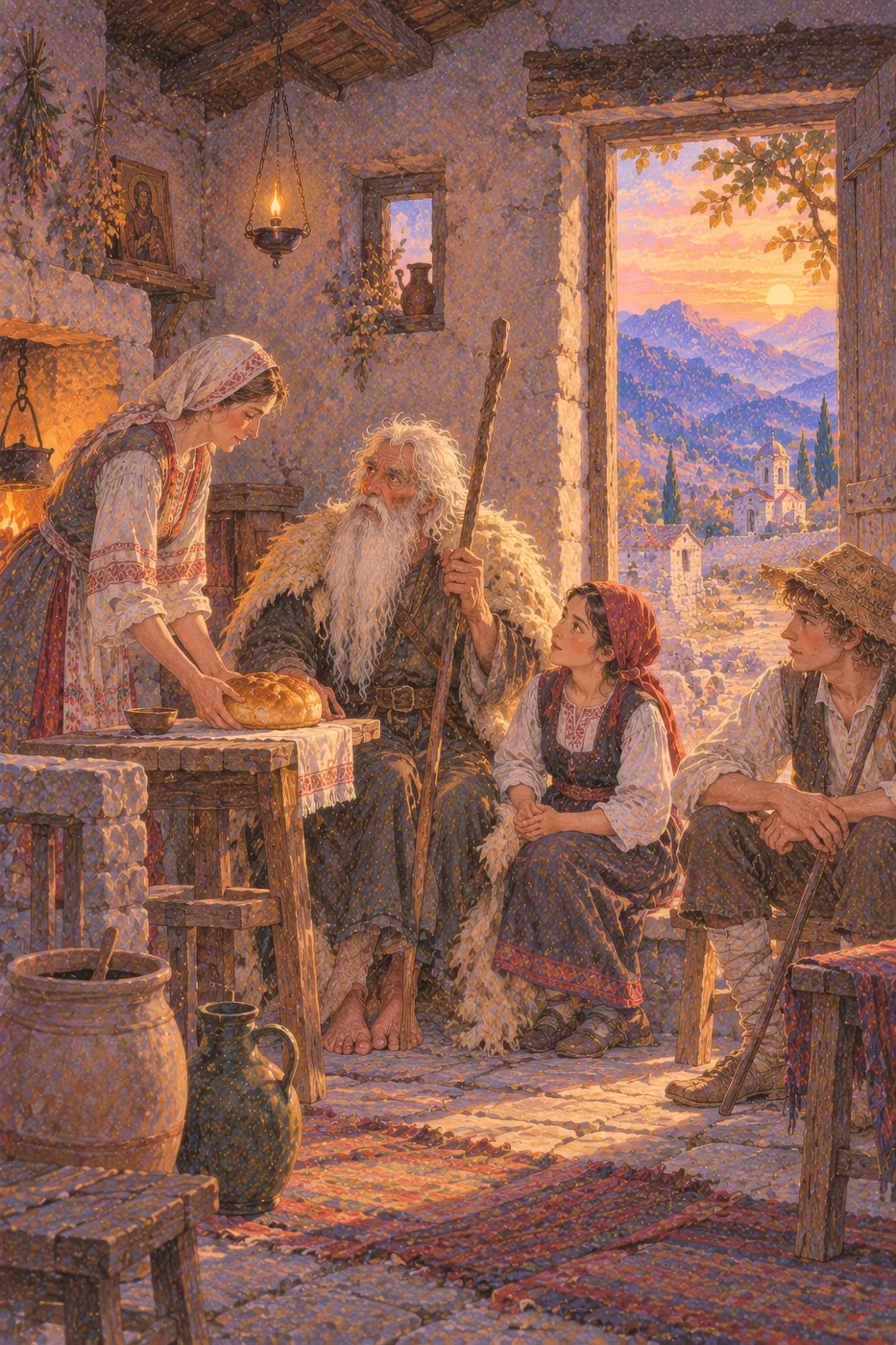
When the widow Vukosava saw the stranger at her door, her heart sank. She took her daughter aside. “Ilinka,” she whispered, “we have only a handful of flour left in the jar, and a little oil at the bottom of the jug. I meant to bake one last loaf tomorrow for the feast, for you and me. After that, there is nothing.”
“Then let us bake it tonight, Mother, for our guest,” said Ilinka. “The Prophet Elijah himself once came to a poor widow in a famine, and she baked her last loaf for him, and God did not let her starve.”
The widow looked at her daughter for a long time. Then she sighed, and she scraped the last handful of flour from the bottom of the jar, and poured the last drops of oil from the jug, and kneaded a small round loaf, and baked it on the hearth. She set it before the stranger with a cup of water from the bottom of the well, and she and Ilinka and the young shepherd sat down hungry beside him.
The old man made the sign of the cross over the bread and broke it. He gave the largest piece to the widow, and the next largest to Ilinka, and the next to Mihailo, and he kept only a crust for himself. It was the strangest thing: the little loaf seemed to go on breaking, piece after piece, and each of them ate until they were full, and still there was bread left on the table.
When they woke in the morning, the old man was sitting on the doorstep in the sunrise, waiting for them. The flour jar in the corner was full to the brim. The oil jug was full to the top. The widow Vukosava stared at them, and then she fell on her knees and wept.
“You were kind to a stranger,” said the old man, “when you had nothing to be kind with. The Lord does not forget such things.” He turned to Ilinka and Mihailo. “Children,” he said, “do you know why there is no rain on this mountain?”
They shook their heads.
“The rain is bound,” said the old man, “by seven knots in a black cord, in the witch’s cave on the far side of the mountain. Greed paid for those knots, and greed holds them tight. No sword can cut them, and no fire can burn them. They can be loosed only by prayer, and by prayer that does not give up.” He stood and leaned on his staff. “Today is the feast of the Prophet. When the white deer comes, follow it. Pray as the Prophet prayed on Mount Carmel. Do not stop until the seventh time.”
* * *
Copyright notice. Introduction and illustration © 2026 Laurent Cleenewerck. All rights reserved. The adapted Orthodox version of this tale is published in Twelve Serbian Orthodox Fairy Tales (© 2026 Laurent Cleenewerck). No part of this page may be reproduced without written permission, except for brief quotations with attribution and a link to this page.
Buy the book on AmazonAbout the book