
A Story of Fruška Gora and the Holy Brankovići
In the ancient lands of Serbia, where the Danube bends north of Belgrade and a long, low mountain rises from the wheat fields of Srem, there is a forest so full of monasteries that the Serbs call it their second Holy Mountain. The mountain is called Fruška Gora. In a quiet valley on its southern slope, among lindens and walnut trees, stands the Monastery of Krušedol, and, in its church, the relics of a whole holy family rest side by side: a blind prince, his wife, and their two sons. The Church remembers them together as the Holy Brankovići.
This is the story of the wife. Her name was Angelina, and her story began far away, in the mountains of Albania.
Angelina was the daughter of Lord Arianit, a great Albanian nobleman who had fought the Turks for many years beside the famous hero Skanderbeg. Her elder sister had married Skanderbeg himself, and Angelina had grown up in her father’s castle among the high mountains, where the eagles nested and the winters were long. She was a tall girl with chestnut hair and quiet, thoughtful eyes. She was kind to every creature and wise beyond her years, and the old servants said that she listened to people as if every word they spoke were a gift.
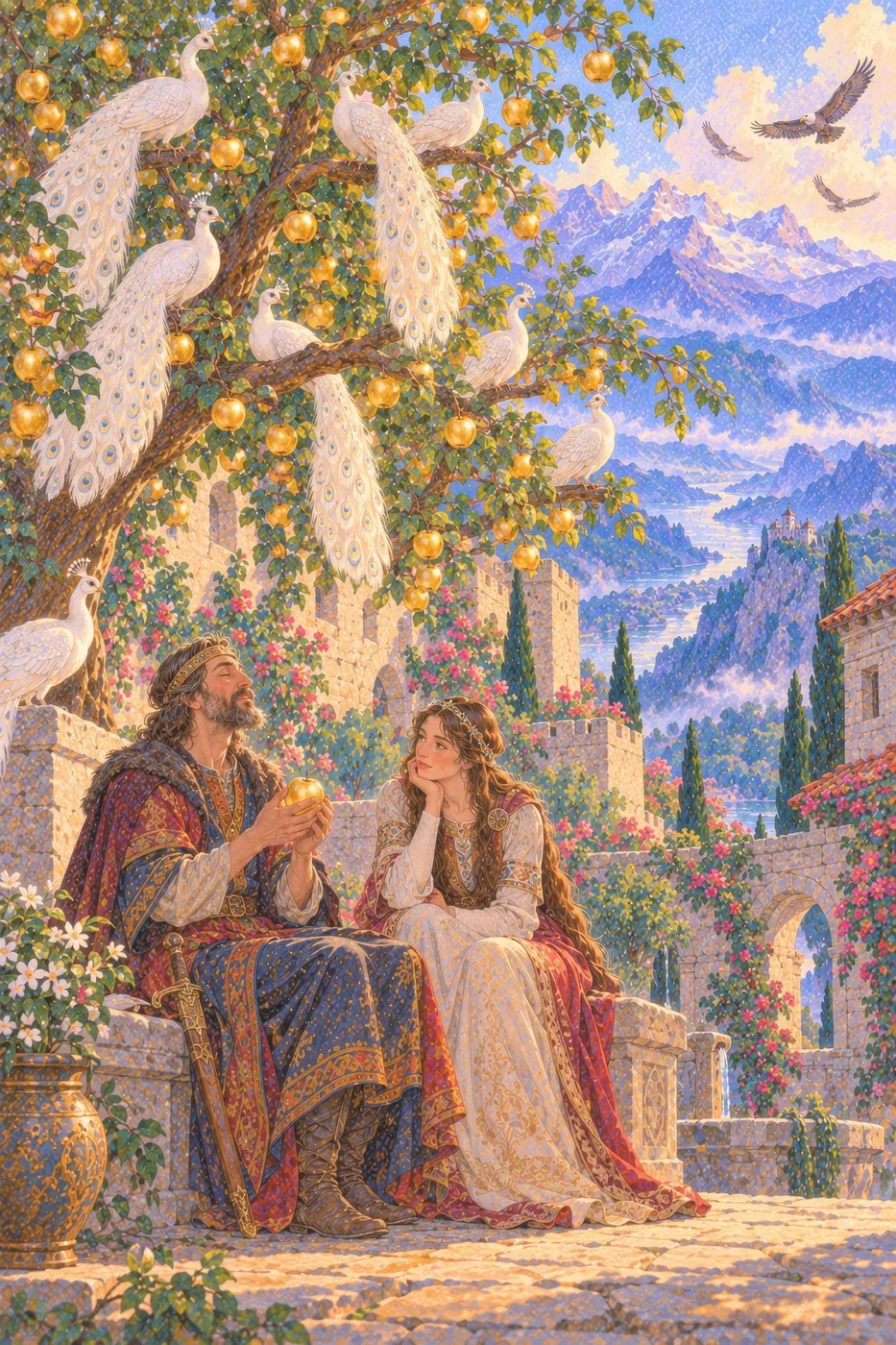
In the courtyard of her father’s castle grew a strange and beautiful tree. It was an apple tree, very old, and once every summer it bore apples of pure gold. Nobody knew where it had come from. Every year, on the morning when the golden apples ripened, nine white peahens came flying down out of the sky at dawn and settled on its branches. They stayed for one day, eating a little of the fruit, and they spread their snowy tails, each feather marked with a pale eye like a pearl. Then, at sunset, they flew away again toward the east.
The servants were afraid of the peahens, and they chased them with brooms. Angelina never did. Every year, she went out at dawn and set out a bowl of fresh water and a dish of grain under the golden tree, and she sat quietly on the bench nearby while the white peahens ate and drank. They were not afraid of her. In time, the eldest of them, the largest and whitest of all, would come and take grain from her hand.
“Where do you come from?” Angelina would ask her. “Where do you go?” The peahen would only look at her with its dark, wise eyes, and say nothing.
In the summer of her twentieth year, a guest came to her father’s castle. He was a Serbian prince, past forty, with gray in his hair, tall and thin, in a worn cloak that had once been fine. His name was Stefan Branković, and he was blind.
The whole household knew his story. He was a son of the Despot of Serbia and a great-grandson of the holy Prince Lazar who had fallen at Kosovo. When he was a young man, the Sultan of the Turks, in his anger against Stefan’s father, had taken Stefan and his brother hostage, and he had put out the light of their eyes. After his father’s death, Stefan had ruled Serbia as Despot for a little while, until his enemies drove him out. Now he had no kingdom, no lands, no money, and no eyes. He wandered from court to court among the Christian lords who still resisted the Turks, with one old servant to lead him by the hand, and he had come at last to the mountains of Albania.
On the morning when the golden apples ripened that year, Angelina went out at dawn to set out the water and the grain, and she found the blind prince sitting alone on the bench beneath the golden tree. The nine white peahens were perched on the branches above him, perfectly still, as if they were listening.
“Forgive me,” said the prince, turning his face toward the sound of her steps. “My servant brought me here to sit in the sun. I hope I am not in anyone’s way.”
“Not at all,” said Angelina. She sat down beside him. “There are nine white peahens in the tree above you. They come only one day a year.”
“I can hear them,” said Stefan, smiling. “They have very soft voices.”
Angelina plucked a golden apple from the lowest branch and put it into his hands. He turned it over and over, feeling its smoothness and its weight, and his face lit up like a child’s. “Gold,” he said. “It is gold, and yet it smells like an apple.”
They sat under the tree all that morning and talked. Stefan told her about Serbia, about the white walls of Belgrade and the Danube in the spring, about his grandmother’s stories of Kosovo, and about the monasteries where his family had prayed for generations. When she asked him how he spent his days, he said, “I pray for my family. I cannot read anymore, so I have learned the names by heart.” Then, very quietly, as if he were in church, he recited them for her: his father and mother, his grandparents, his great-grandparents, back and back, to the holy Prince Lazar and Princess Milica, and further still. “Those are the living and the dead of my house,” he said. “Every night, I say their names to God. Somebody must remember them. I have lost everything else, but I have not lost them.”
Angelina listened, and something happened in her heart that she could not explain. She looked at the blind prince in his worn cloak, with the golden apple in his hands, and she thought that she had never met anyone so rich.
High above them, the eldest white peahen spread her tail like a fan of snow and pearls, and gave a soft cry.
That autumn, Stefan Branković asked Lord Arianit for his daughter’s hand.
Lord Arianit was astonished. He loved Stefan, and pitied him, yet he had other plans for his daughter. A rich Venetian lord had already asked for her, a man with palaces on the Grand Canal and ships in every harbor of the sea. “A blind man with no kingdom,” said Lord Arianit to his wife, “or a lord with a hundred ships? It is no choice at all.”
That night, an old woman came to Angelina’s window. She was a fortune-teller who lived in the marshes below the castle, and the servants whispered that she was a witch. She had a silver mirror in her hand.
“Look, my pretty,” she crooned, holding up the mirror. In it, Angelina saw a palace of white marble on blue water, with gondolas at its steps and gold on every wall, and herself in a gown of crimson silk, with pearls in her hair. “All this can be yours, if you take the Venetian. Why would you waste yourself on a blind beggar? He cannot even see your face. He will never know whether you are beautiful or not.”
Angelina looked at the mirror for a long moment. Then she looked at the old woman.
“He sees more than you think,” she said. “He sees with his heart, and he remembers what others forget. I would rather be poor with a man who remembers than rich with a man who forgets.” She closed the shutters in the witch’s face. Outside, she heard an angry hiss, like water poured on hot coals, and then nothing more.
In the morning, Angelina went to her father and knelt before him. “Father,” she said, “I will marry Prince Stefan, if you will give your blessing. If you will not, I will wait.”
Lord Arianit looked at his daughter, and he saw that her mind was made up. He sighed, and then he smiled, and he raised her up and blessed her.
They were married that winter in the castle chapel, and Skanderbeg himself stood among the guests. As a wedding gift, Lord Arianit gave his daughter a single golden apple from the old tree. “Keep it,” he said. “Your mother’s family says that it shows the way home to those who are lost.”
The years that followed were not easy. The Turks were pressing ever harder on the mountains of Albania, and Stefan and Angelina were forced to flee across the sea to Italy. There, the lords of Venice gave them a small, crumbling castle in the province of Friuli, in a little town that happened to be called Belgrado, after the White City. Stefan laughed when he heard the name. “God has a sense of humor,” he said. “He has given me back Belgrade after all.”
They were poor, yet they were happy. God gave them two sons, Đorđe and Jovan, and two daughters, Mara and Milica. Angelina read to her husband every evening, and she kept their house as a Serbian house, with icons on the walls and a lamp always burning. Every year, they kept their slava. Stefan taught his children their prayers in the Serbian tongue, and, every evening, he gathered them around him and taught them the names of their ancestors, one by one, just as he had once recited them to Angelina under the golden apple tree.
“Why must we learn all these names, Father?” little Jovan once asked. “They are all dead.”
“They are not dead to God,” said Stefan. “He is not the God of the dead, but of the living, for all live to Him. As long as we remember them in our prayers, we are one family with them, on earth and in heaven. A tree that forgets its roots will wither, my son. A family that forgets its dead will forget how to live.”
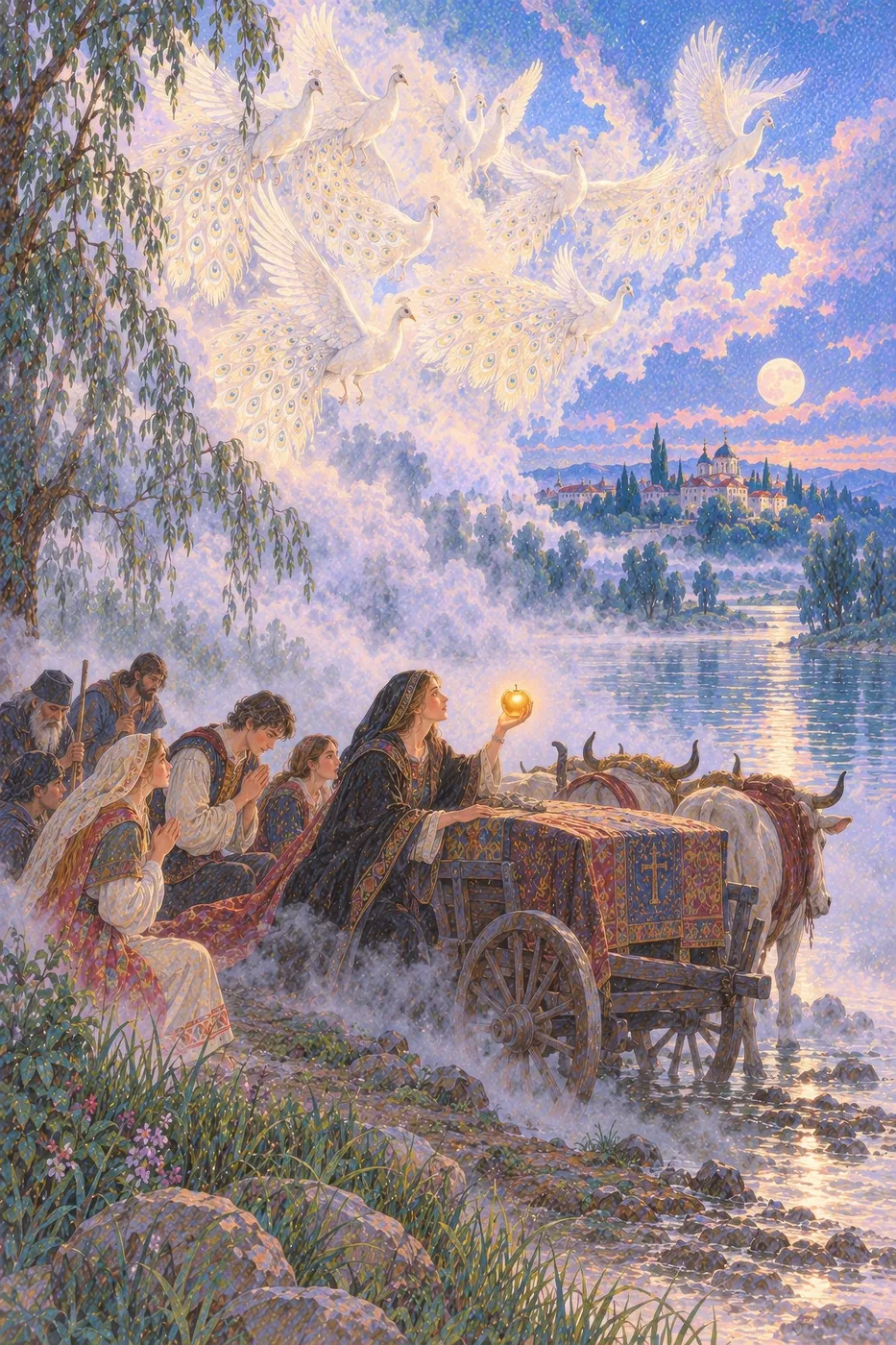
When Jovan was still a boy, Stefan fell ill. On his deathbed, he took Angelina’s hand. “My dear,” he said, “I have one last wish. I do not want to lie in a foreign land. When the time is right, take me home to Serbia, to the land of my fathers.”
* * *
Copyright notice. Introduction and illustration © 2026 Laurent Cleenewerck. All rights reserved. The adapted Orthodox version of this tale is published in Twelve Serbian Orthodox Fairy Tales (© 2026 Laurent Cleenewerck). No part of this page may be reproduced without written permission, except for brief quotations with attribution and a link to this page.
Buy the book on AmazonAbout the book