
A Story of Belgrade and the Feast of the Ascension
In the ancient lands of Serbia, where the broad Danube and the swift Sava meet beneath a high ridge of white stone, there stands the city of Belgrade, whose name means “the White City.” In the days of our tale, its lord was the Despot Stefan, the son of the holy Prince Lazar who fell at Kosovo. He was a knight and a poet, a warrior and a man of prayer, and he loved Belgrade more than any city in the world.
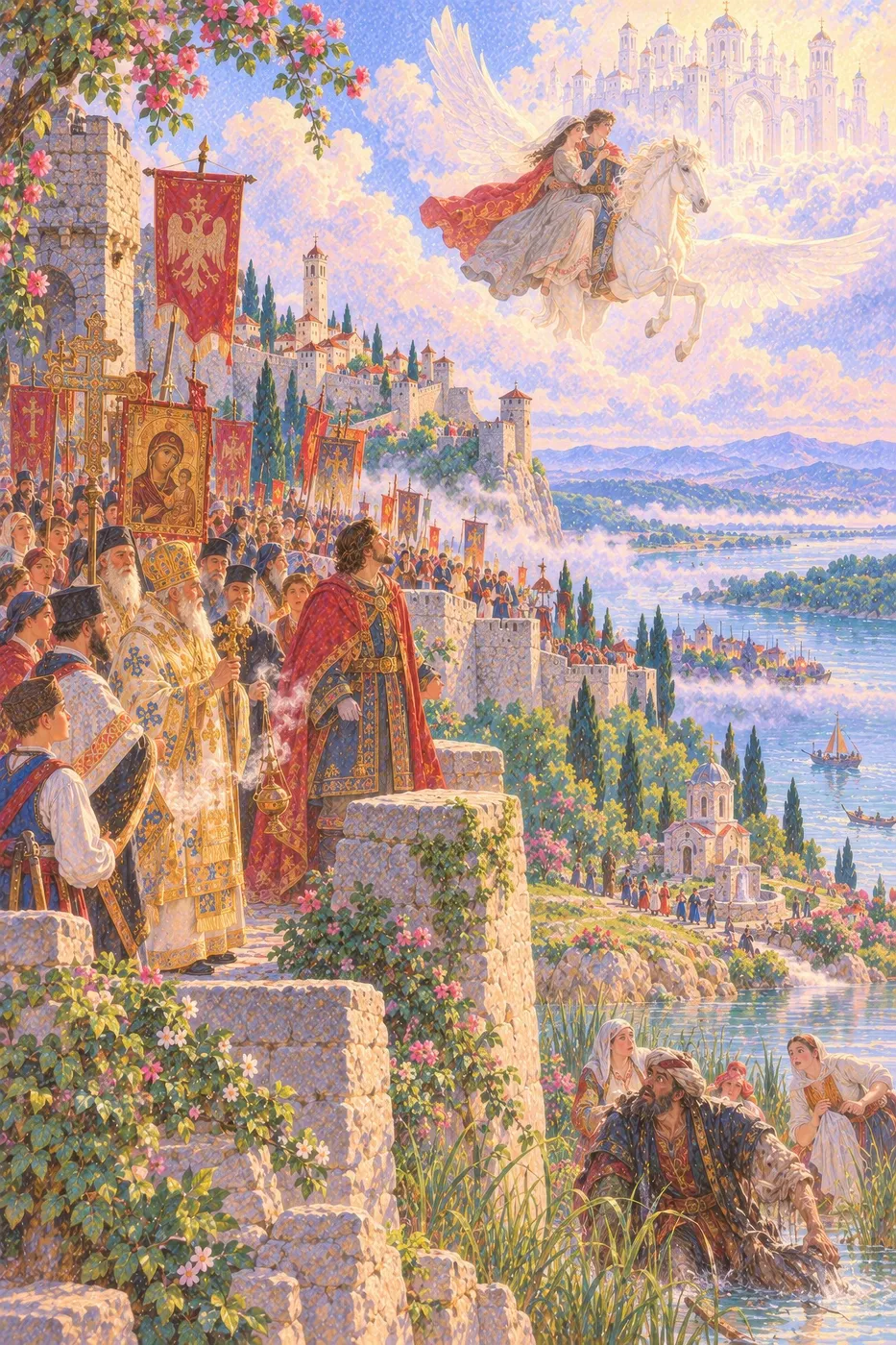
The Despot made Belgrade his capital. He rebuilt its walls and towers on the ridge above the two rivers. He built a palace and filled it with books. He founded a hospital for the sick and the poor, and he wrote a song of reconciliation for his own brother, which he called the Word of Love. He gave the city a patron feast, too, as every Serbian family has its slava: the Feast of the Ascension, which the Serbs call Spasovdan, forty days after Pascha, when the Lord went up into heaven before the eyes of His disciples. On that day, the whole city walked in procession around the walls, behind the cross and the holy icons, singing.
The Despot used to say that a man should build two kinds of houses in his life. “The first,” he said, “is a house to live in, and it lasts as long as he does. The second is a zadužbina, a house built for God and for his neighbor, for the good of his soul. That house, if it is built with love, lasts forever.”
In Belgrade, in those days, there were two men who were building.
The first was Lord Dragoslav, the richest lord in the city. He owned vineyards along the Danube and mills along the Sava and ships that sailed as far as the Black Sea, and his storerooms were full of gold. On the highest point of his lands, he was building a tower of white marble, so tall that it already overtopped the Despot’s palace, and he meant to make it taller still. “When it is finished,” he boasted, “it will be higher than any church in Serbia. It will be the first thing travelers see when they come down the Danube, and the last thing they see when they leave. They will all say: there stands the tower of Dragoslav!”
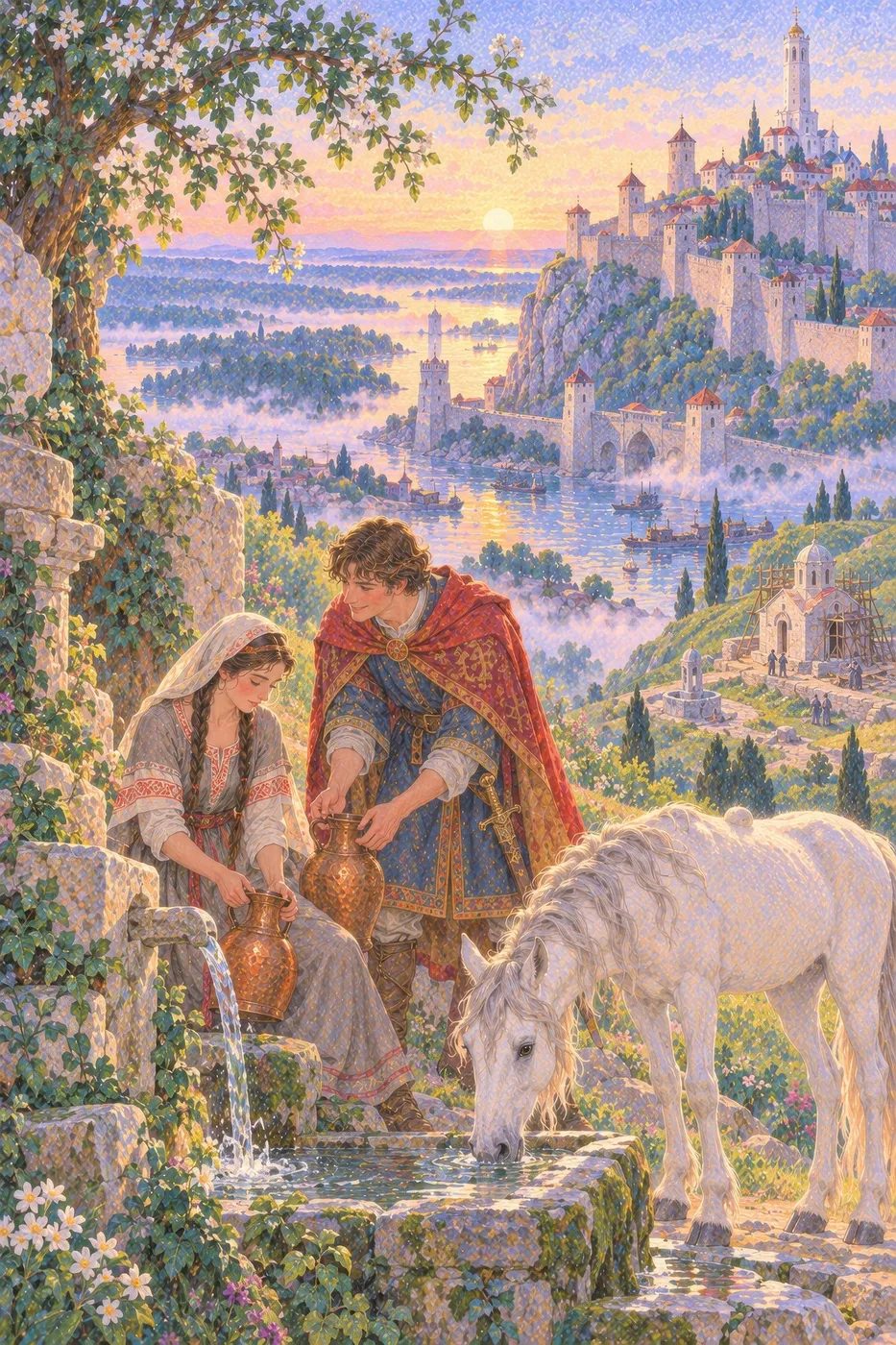
The second was a young knight named Dimitrije. He was poor. His father had left him a sword, a patch of rocky land on the slope above the Sava, and very little else. On that land, with his own hands, Dimitrije was building a little church of the Ascension. He had no money to hire masons, so he quarried the stones himself, carried them up the hill on his back, and laid them one by one. Beside the church, he had dug a well and built a stone fountain, so that the travelers and the washerwomen who climbed the path from the river would have cool water to drink.
The people of Belgrade laughed at both of them, in different ways. They laughed at Dragoslav behind his back, because they were afraid of him. They laughed at Dimitrije to his face, because they were not.
“Your church is so small,” they told him, “that a goat could jump over the roof.”
“It is small,” Dimitrije agreed cheerfully. “Then again, the stable at Bethlehem was small, too.”
Every morning before dawn, Dimitrije went down to the spring of Saint Petka beneath the fortress walls to fill his water jars. The holy relics of Saint Petka rested in Belgrade in those days, and her spring was famous for healing the sick. One morning, in the mist by the spring, Dimitrije found a white foal drinking.
It was the most beautiful creature he had ever seen. Its coat was as white as foam on the Danube, its mane was like silver thread, and its eyes were dark and gentle. It had no bridle, no brand, and no owner, and nobody in Belgrade had ever seen it before. When Dimitrije broke a piece of his bread and held it out, the foal ate from his hand, and, when he climbed back up the hill to his church, the foal followed him.
From then on, the white foal lived with Dimitrije on the slope above the Sava, grazing among the stones of the half-built church. As the weeks went by, it grew into a tall white horse, and Dimitrije noticed something strange: on its back, just behind its shoulders, there were two smooth bumps under the skin, like the buds of something that had not yet grown.
The old monk who served as priest for the poor of the riverside looked at those bumps for a long time. “A horse that comes from the spring of a saint,” he said, “is not an ordinary horse. Take good care of it, my son. God will show you its purpose in His own time.”
The spring of Saint Petka had another visitor in those days. Every morning, a girl in a plain gray dress came down to it with two copper jugs, to carry its water to the sick in the Despot’s hospital. Her name was Vidosava, and Dimitrije supposed at first that she was one of the hospital’s serving girls. It was only after he had met her at the spring every morning for a month, and carried her jugs up the hill for her, and talked with her about everything under the sun, that he learned the truth: she was the Despot’s own niece, the daughter of his sister, who had been raised in the palace since her parents died.
“Why do you carry water like a servant?” he asked her, astonished.
“My uncle says that a princess who has never carried water does not know what water is worth,” said Vidosava, laughing. Then, more seriously, she added, “When I bring the water from the saint’s spring to the sick, they smile. That is worth more to me than all the jewels in the palace.”
After that, she often came up the hill to see Dimitrije’s little church, and she brought wildflowers from the riverbank to lay before the icon of the Ascension that he had hung on its unfinished wall. She would sit on the rim of the fountain and talk with him while he worked, and the white horse would come and lay its head in her lap.
Lord Dragoslav also had his eye on the Despot’s niece. He sent her gifts: a necklace of rubies, a silver mirror, a gown of Venetian silk. She sent them all back. At last, he came to the palace himself and asked the Despot for her hand.
The Despot called Vidosava and put the question to her.
“I thank Lord Dragoslav for the honor,” said Vidosava, “but I cannot marry him. I will marry a man who builds for God, not for himself.”
Lord Dragoslav’s face turned purple. He stormed out of the palace without a word. That night, a terrible storm broke over Belgrade. Thunder rolled up and down the two rivers, and lightning struck the water again and again. In the middle of the storm, Lord Dragoslav climbed to the top of his marble tower, and he shook his fist at the sky.
“I am the richest man in Serbia,” he shouted into the wind, “and they laugh at me! The Despot’s niece prefers a beggar with a pile of stones! Very well. I will build higher than any of them. I will build a castle in the sky itself, where no Despot can rule me and no saint can look down on me! I will bow to no one, not on earth and not in heaven!”
Out of the storm, there answered a voice, low and cold, like wind whistling through a broken window. The Scriptures call the one who spoke it the prince of the power of the air.
“It shall be as you say,” said the voice. “You will have a castle that is neither in heaven nor on earth, and you will bow to no one. Only remember this: it will stand as long as you do not bow.”
With a crack like the splitting of the world, the marble tower tore itself free of the earth. It rose into the stormy sky, higher and higher, with all of Dragoslav’s gold and all of Dragoslav’s pride inside it, until it hung in the air above the meeting of the two rivers, far too high for any arrow to reach, far too low to touch the stars. Black clouds wrapped around its foundations like chains.
At the same moment, a black whirlwind swept down into the garden of the Despot’s hospital, where Vidosava was sitting up late with a sick child. It caught her up as a storm catches a leaf, and carried her, screaming, up into the castle in the air.
In the morning, all Belgrade stood in the streets with their mouths open, staring up at the castle that hung in the sky above the rivers. From one of its high windows, very small and very far away, a girl in a gray dress was waving.
The Despot did everything a ruler could do. He called his best archers, and their arrows fell back into the Danube long before they reached the castle. He called his builders to make ladders, and the tallest ladder in Belgrade reached no higher than the rooftops. He sent for wise men and astrologers, and they shook their heads and said that they had never seen such a thing. The castle simply hung in the air, neither in heaven nor on earth, and Lord Dragoslav looked down from its windows and laughed.
* * *
Copyright notice. Introduction and illustration © 2026 Laurent Cleenewerck. All rights reserved. The adapted Orthodox version of this tale is published in Twelve Serbian Orthodox Fairy Tales (© 2026 Laurent Cleenewerck). No part of this page may be reproduced without written permission, except for brief quotations with attribution and a link to this page.
Buy the book on AmazonAbout the book