
A Story of Montenegro and the Feast of Saint Basil of Ostrog

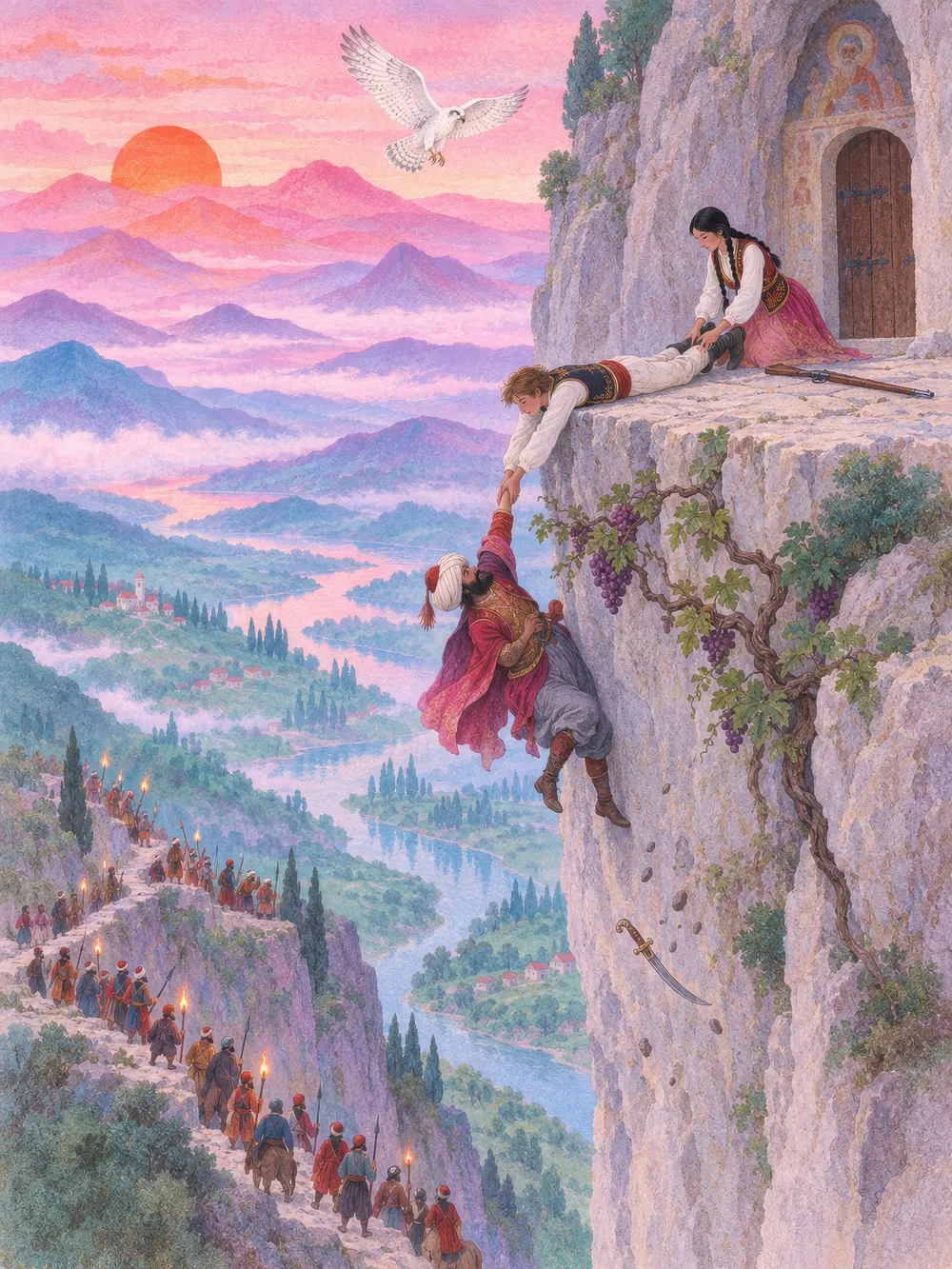
In the ancient lands of the Serbs, where the Black Mountain rises gray and steep above the green valley of the Zeta, there is a cliff so tall and so sheer that the clouds catch on its shoulders. Halfway up that cliff, where no one would think a house could stand, a white church is built right into the rock, like a swallow’s nest under the eaves of the world. It is the Monastery of Ostrog, and there, in a little cave church hollowed out of the mountain, rest the holy relics of Saint Basil.
In his lifetime, Basil had been the bishop of Herzegovina, in the hard years when the Turks ruled the land, burned the churches, and harried the Christians. He had defended his flock like a good shepherd, and, when he was old, he had come to Ostrog to live in a cell in the rock and pray. He had planted a grapevine in a crack of the cliff beside his cell, and, though there was no soil there at all, the vine had grown and flourished, and it still grew green out of the bare stone every spring. When the saint fell asleep in the Lord, his body did not decay. It lay whole and fragrant in the cave church, and so many sick people were healed there that pilgrims came from every land around: Orthodox and Catholics, and even Muslims, who also called him a man of God.
Above the cave church, on a ledge of the cliff that no man could reach, lived a white hawk. The monks said that it had come on the very day that Saint Basil died, and that it had kept watch over his resting place ever since. It was as white as the snow on the high peaks, and it would sit for hours on its ledge, gazing down into the valley with its sharp golden eyes. Whenever danger came near the monastery, it would scream. The monks of Ostrog had learned to listen.
In the valley below the cliff lived the clan of the Bjelopavlići, tough mountain folk who had never bowed to the Turks. Their chief was a vojvoda named Radul, a gray-mustached old warrior with a voice like a rockslide, and his only daughter was named Gorana.
Gorana was as wild as her name, which means “girl of the mountains.” She could climb any rock in Montenegro, ride any horse, and shoot a musket better than half her father’s men. She had black braids and sharp green eyes, and she was not afraid of anything. Every spring, she climbed the goat paths up the cliff behind the monastery, higher than anyone dared to go, and she left scraps of meat on a rock near the white hawk’s ledge. The hawk never came to her hand, yet it would watch her climb down again with what she liked to think was approval.
One spring, a few days before the feast of Saint Basil, a party of pilgrims arrived from the coast. Among them was a young nobleman named Vuk, with his widowed mother. His family had been lords in Trebinje, in Herzegovina, until the Turks drove them out when he was a little boy, and they had lived ever since in a small house by the sea, poor and proud. Vuk was eighteen, slender and pale, with gentle brown eyes and a stammer. When he was frightened, which was often, he could hardly get a word out.
His name, Vuk, means “wolf.” The children of the Bjelopavlići took one look at him and named him “the Lamb.”
Vuk’s mother had brought him to Ostrog to pray before the relics of Saint Basil. “He is a good boy,” she told the hegumen, “the best of sons. He reads, he prays, he is kind to every living thing. Since the night the Turks burned our house, though, he has been afraid. Afraid of the dark, afraid of loud voices, afraid of heights, afraid of his own shadow. Pray to the saint for him, Father.”
Gorana overheard, and she laughed out loud. “Afraid of heights? He has come to the wrong monastery.”
It was true. The path up to Ostrog climbs the cliff in steep zigzags, with a sheer drop on one side, and, halfway up, Vuk turned white and sat down on a rock and could not go on. His mother coaxed him. The other pilgrims passed him by. At last, it was Gorana who came back down the path, with her hands on her hips.
“Well, Lamb?” she said. “Will you sit there all day?”
“I c-c-cannot,” said Vuk, and his face burned with shame. “I am s-sorry. I know what you think of me.”
Gorana looked at him for a moment. His hands were shaking, yet he had not turned back. She held out her hand. “Do not look down,” she said. “Look at the church. That is where we are going. Give me your hand, and look only at the church.”
He took her hand, and, step by step, looking only at the white wall of the church in the cliff above, he climbed to the top.
That night was the vigil of the feast. The little cave church was crowded with pilgrims, and the air was thick with candle smoke and the smell of basil and wax. Vuk knelt for hours before the silver reliquary where the saint lay, and he prayed with all his heart.
“Holy Father Basil,” he whispered, “I am a coward. I know it. Everyone knows it. My father was brave, and he died defending our house. I ran and hid in the stable. I have been running and hiding ever since. Pray to God for me. I do not ask to be strong. I only ask not to run away the next time someone needs me.”
He fell asleep at last on the stone floor, leaning against the wall of the cave, and, as he slept, he dreamed. An old bishop in a faded black cloak came and sat down beside him on the floor, with a bunch of green vine leaves in his hand.
“Vuk,” said the old man, “do you think that brave men are never afraid?”
“Are they n-not?”
The old bishop smiled. “When the Turks came to my church in Herzegovina, my knees shook like the leaves of this vine. A coward runs away from his fear. A brave man takes his fear by the hand and leads it to the church door, and leaves it there, and stands in the doorway instead.” He laid the vine leaves on Vuk’s lap. “When the time comes, my son, stand in the door.”
When Vuk woke, it was nearly dawn, and the vine leaves were gone. The cave church was empty except for a few sleeping pilgrims and the old hegumen, trimming the lamps. Then, from high above the monastery, there came a long, piercing scream.
The white hawk was screaming.
The hegumen dropped his lamp-trimmer. He ran out onto the narrow terrace in front of the church, and Vuk ran after him. Down in the valley, in the gray light of the dawn, they saw them: a band of horsemen, thirty or forty of them, galloping up the road from the south with torches in their hands and steel glinting on their saddles. At the foot of the cliff, they dismounted and began to climb the path on foot.
“Raiders,” said the hegumen, and his old face turned gray. “That is the banner of Hasan Bey. He has sworn to plunder this monastery and burn the saint’s body to ashes. He knows that the men of the Bjelopavlići are away at the border this week.” He turned and looked at Vuk. “There is no one here but old monks, women, children, and pilgrims.”
The pilgrims had woken now, and panic spread among them like fire in dry grass. Some ran back into the cave church and huddled behind the reliquary. Others ran along the cliff toward the path down to the lower monastery, and they slipped and stumbled on the rocks. Women wept. Children screamed. The old monks began to pray aloud.
Then Gorana came running along the terrace, with her father’s musket in her hands and her braids flying.
“Every man of the clan is at the border,” she said. “My father, my uncles, my cousins, all of them. I have sent a boy down the back path to fetch them, but it will take them half a day to come.” She looked at the frightened crowd, and then at the hegumen. “Father, get everyone inside the church, and bar the door. I will stand in front of it.”
“Alone?” said the hegumen.
“Not alone,” said a voice behind them.
They turned. It was Vuk. His face was as white as the wall of the church, and his hands were shaking. Yet he had not run away.
“S-saint Basil told me,” he said. He took a deep breath. “He told me to stand in the door.”
Gorana stared at him. For the first time, she did not laugh.
The hegumen herded the pilgrims and the monks into the cave church, and Vuk’s mother went in last, with tears running down her face. The heavy wooden door swung shut behind them, and they heard the bar fall into place on the inside. Outside, on the narrow terrace between the door and the edge of the cliff, stood Gorana and Vuk, side by side. Above them, the white hawk circled, screaming. Beside them, the saint’s old vine grew out of the bare rock, its new leaves trembling in the morning wind.
Gorana held her father’s musket. Vuk had no weapon at all. He held only the small wooden cross that his father had given him, the one thing he had carried out of their burning house.
“Can you shoot?” whispered Gorana.
“N-no.”
“Then why are you here?”
Vuk swallowed. “Because you are here,” he said. Then he added, more steadily, “Also, because someone has to be.”
Up the path came the raiders, panting from the climb, with Hasan Bey at their head. He was a big man with a black beard and a curved sword in his hand, and his eyes were hard. When he saw who stood before the church door, a girl with a musket and a pale boy with a little wooden cross, he threw back his head and laughed.
* * *
Copyright notice. Introduction and illustration © 2026 Laurent Cleenewerck. All rights reserved. The adapted Orthodox version of this tale is published in Twelve Serbian Orthodox Fairy Tales (© 2026 Laurent Cleenewerck). No part of this page may be reproduced without written permission, except for brief quotations with attribution and a link to this page.
Buy the book on AmazonAbout the book