
A Story of Herzegovina and the Feast of the Annunciation
In the ancient lands of Serbia, where the Neretva River runs as green as an emerald between white mountains of stone, there is a cliff so high that eagles nest halfway up it, and at its foot, out of a dark cave, the river Buna gushes from the heart of the mountain, cold and clear and full of trout. On top of that cliff stood the fortress of Blagaj, and in Blagaj lived Herceg Stefan, the lord of all that land, who called himself the Herceg of Saint Sava, for he loved the Serbian saint above all others. From his title, the whole country came to be called Herzegovina, “the land of the Herceg.”
Among the lords who served the Herceg, there was a good and honest man named Lord Radonja, who lived with his wife, the Lady Stanislava, in a white stone house among the fig trees and pomegranates on the bank of the Neretva. They had everything a noble house could wish for, except the one thing they wished for most. For twenty years, they had prayed for a child, and for twenty years, God had not answered.
Every year, on the Feast of the Annunciation, which the Serbs call Blagovesti, the Lady Stanislava went to the little church of the Annunciation on the riverbank and knelt before the icon of the Archangel Gabriel and the Virgin. On that day, the old women of Herzegovina say, the earth wakes from its winter sleep. The swallows return from the south, the first green comes into the vineyards, and the snakes, which have slept all winter under the stones, come out into the sun.
In the twentieth year of her waiting, the Lady Stanislava came out of the church after the Liturgy with her heart full of bitterness. On the warm stones of the churchyard wall, a little green snake lay coiled in the sun, newly awake from its winter sleep. The Lady looked at it, and she spoke in her bitterness the most foolish words of her life.
“Lord,” she said, “if only You would give me a child, I would take it even if it were a snake!”
Near the churchyard gate, an old woman in black was sitting on a stone, spinning. Her name was Vida, and the whole valley whispered that she was a veštica, a witch. She had once asked the Lady Stanislava for a gold ring and been refused. When she heard the Lady’s words, she smiled a crooked smile, and she muttered something into her spinning, and the thread turned black between her fingers.
The next year, on the very eve of Blagovesti, the Lady Stanislava gave birth. The midwife screamed and dropped her basin. In the cradle, wrapped in fine linen, lay not a baby but a small serpent, as green as the Neretva, with gold flecks on its scales and two dark, gentle eyes.
Lord Radonja wept. The Lady Stanislava hid her face. The servants fled. Then the little serpent opened its mouth and gave a thin, sad cry, exactly like the cry of a newborn child, and the Lady took it into her arms and held it to her heart. “It is my son,” she said, weeping. “God help me, it is my son, and my foolish tongue has done this to him.”
A child must be baptized, and so the priest was sent for. A child being baptized must have a kum, a godfather, to hold him at the font and speak for him. However, when word went around the valley that Lord Radonja’s son was a serpent, not one of his friends would come.
None but one. Damjan was an old knight of the Herceg’s guard, gray-bearded and scarred, who had fought beside Lord Radonja in a dozen battles. He walked into the house, took off his cap, and said, “A soul is a soul. I will be his kum.”
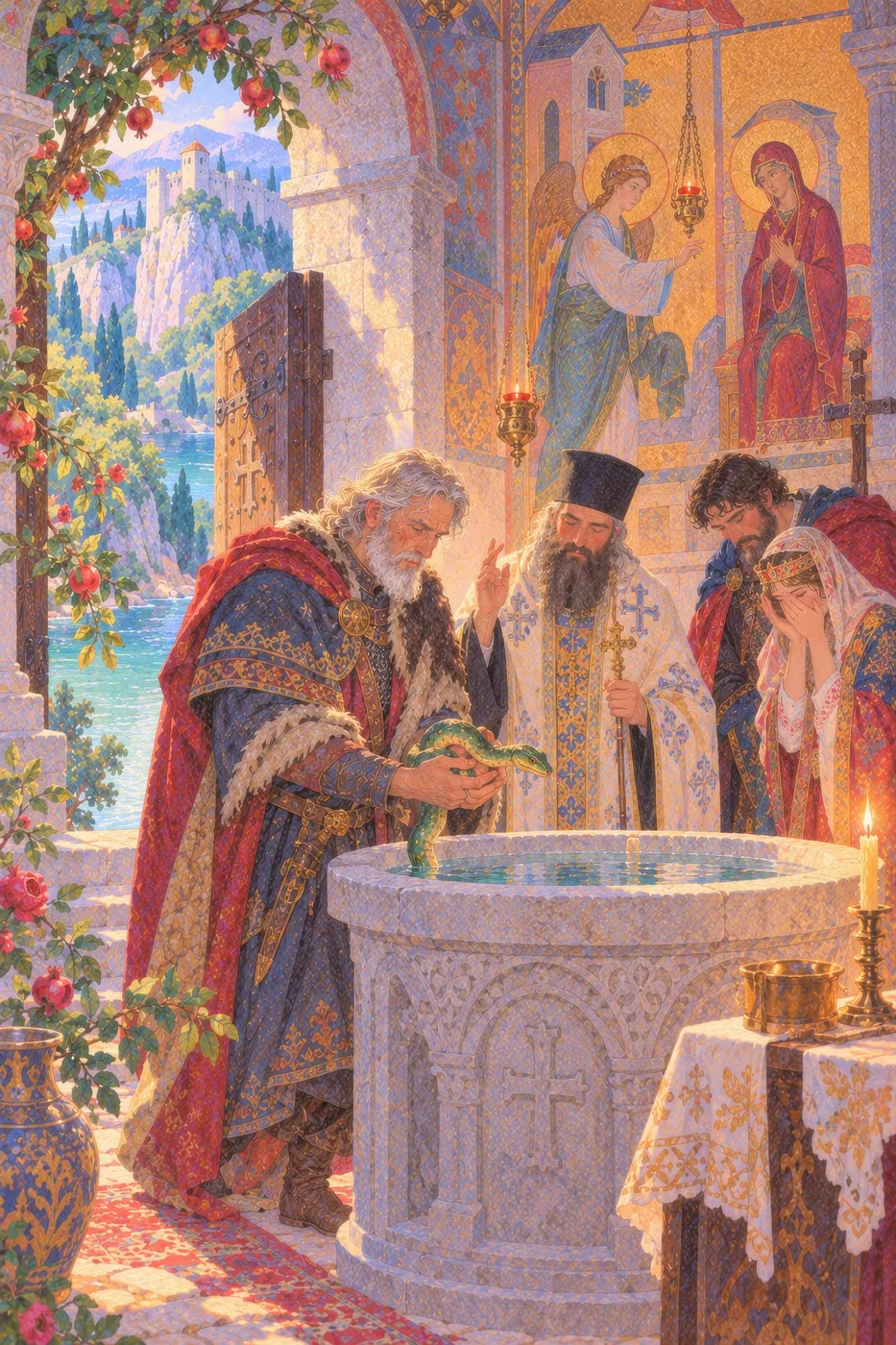
So the old knight held the little serpent in his great scarred hands over the font, and the priest baptized him in the name of the Father and of the Son and of the Holy Spirit, and he named him Gavrilo, after the Archangel Gabriel, since he had been born on the eve of the Annunciation. When the priest anointed him with the holy chrism, the little serpent lay perfectly still, and its dark eyes shone.
“First God, then the kum,” said old Damjan, as he gave the child back to his mother. “As long as I live, this boy will not be alone.”
He kept his word. Gavrilo grew up in a basket by the hearth, and then in the garden among the fig trees, until he was longer than a man is tall. He learned to speak with a human voice, low and gentle. He learned his prayers, and the Psalms, and the lives of the saints, which his kum read to him every Sunday afternoon in the garden. Every Sunday morning, he would glide through the long grass to the little church on the riverbank and coil himself on the warm stone by the door, where he could hear the Liturgy. The people stepped around him and made the sign of the cross, and some of the boys threw stones at him when they thought no one was looking. Old Damjan, if he caught them, boxed their ears.
One person, however, never stepped around him. Her name was Anđelija. She was the niece of the Herceg himself, an orphan girl with black hair and laughing eyes, who had been raised at Blagaj and who came down to the little church on the river every Sunday because she said that the singing there was sweeter than in the Herceg’s chapel. Every Sunday, as she came to the door, she would bow to the green serpent coiled on the stone and say, “Good morning, Gavrilo. God be with you.” Once, on a very hot day, she brought him a cup of cool water from the spring.
Gavrilo did not forget.
When he was twenty years old, Gavrilo came to his parents and said, “Father, Mother, I wish to marry.”
His mother burst into tears. His father put his head in his hands. “My son,” said Lord Radonja, “who would marry a serpent?”
“I wish to marry Anđelija, the niece of the Herceg,” said Gavrilo.
Lord Radonja nearly fell off his chair. Only old Damjan, who was sitting by the fire, did not laugh or weep. He looked at his godson for a long time.
“In our land,” he said at last, “it is the kum who goes to ask for the bride. I will go to Blagaj.”
So the old knight put on his best coat and his silver-hilted sword, and he rode up the steep road to the fortress above the Buna, and he asked to see the Herceg. When he had stated his errand, the whole court burst out laughing. Herceg Stefan, however, did not laugh. He was a just man, and he had known old Damjan for thirty years.
“My niece is not a horse to be sold at market,” said the Herceg. “Your godson must prove himself worthy, as any suitor must. Let him do three things. Tonight, let him build a bridge over the Buna, from my gate to the far bank. Tomorrow night, let him plant the bare hill below my walls with a vineyard, and let the grapes be ripe by morning. On the third night, let him bring me a pearl from the bottom of the sea. If he can do these three things, I will put the question to my niece herself. I will not force her, not for all the pearls in the world.”
Old Damjan bowed and rode home. When he told Gavrilo what the Herceg had said, the young serpent only lowered his head. “I will do my best,” he said, “and God will do the rest.”
That night, Gavrilo glided out into the dark and up to the cave where the Buna flows out of the mountain. There, in a voice that no human ear could hear, he called the serpents of Herzegovina. They came from every rock and every crevice of the white stone country, the green snakes of the meadows and the brown snakes of the walls and the great gray snakes of the mountains, thousands upon thousands of them. They had heard from the trees and the stones and the swallows that Gavrilo was a baptized serpent who prayed, and they had always been a little in awe of him.
When the Herceg looked out of his window at dawn, a bridge of white stone arched over the Buna from his gate to the far bank, as slender and graceful as a new moon. The second night, the bare hill below the fortress was dug and planted, and by morning it was green with vines heavy with purple grapes. On the third night, a sea serpent swam up the Neretva from the sea, as long as a ship, and laid a pearl as big as a pigeon’s egg at the Herceg’s gate.
Herceg Stefan stood looking at the pearl in his hand for a long time. Then he sent for his niece.
“Anđelija,” he said, “I gave my word, and the Herceg of Saint Sava does not break his word. I also said that I would not force you. The son of Lord Radonja asks for your hand. What do you say?”
The whole court held its breath. Anđelija was very pale. She did not answer at once. Instead, she asked for leave to go down to the little church of the Annunciation on the river, and she went there alone and knelt before the icon. There was the Archangel Gabriel, with his wings spread and his hand raised, and there was the young Virgin Mary, with her head bowed and her hand lifted in wonder, hearing the strangest message that any girl had ever heard.
“Holy Theotokos,” whispered Anđelija, “you did not understand everything that the angel told you, and you said yes. I do not understand this, either. I have only seen that he is gentle, and that he prays, and that the boys throw stones at him and he never strikes back. If this is God’s will, let it be to me according to His word.”
She went back up to Blagaj and stood before her uncle. “I will marry him,” she said.
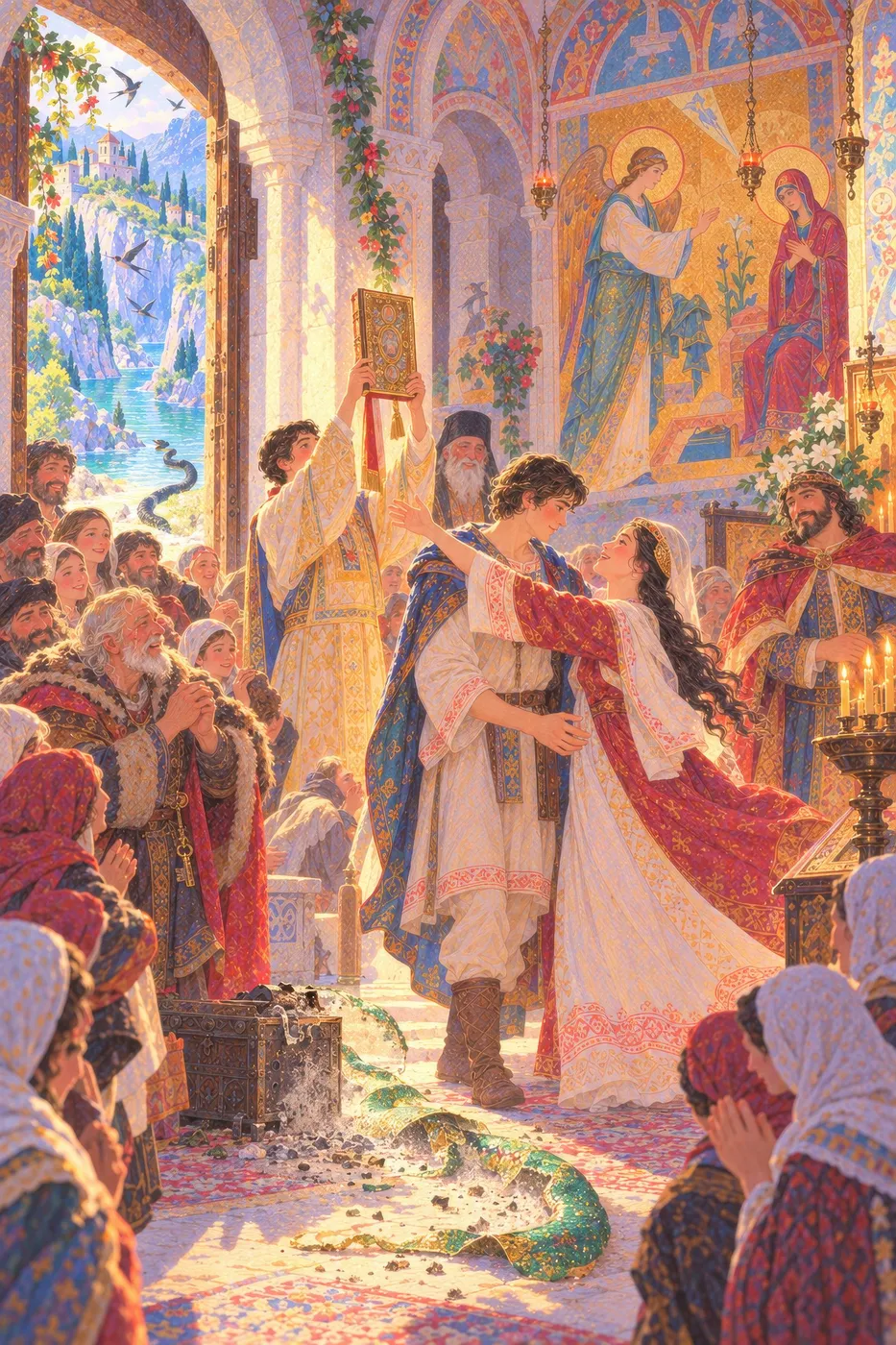
The wedding was the strangest that Herzegovina had ever seen. The guests stood in the church with their mouths open as the priest placed one wedding crown on the head of the Herceg’s niece and laid the other, very carefully, on the coiled green body of the bridegroom. Old Damjan stood beside them as the wedding kum, as straight as a spear, and he glared at anyone who dared to giggle.
That night, when the bride and groom were alone in the room that Lord Radonja had prepared for them, Anđelija sat on the edge of the bed and tried not to tremble. Then she heard a soft sound, like silk being torn. The green serpent shivered, and its skin split from head to tail, and out of it stepped a young man. He was tall, with dark hair and dark, gentle eyes, the same eyes that had looked up at her every Sunday from the stone by the church door.
* * *
Copyright notice. Introduction and illustration © 2026 Laurent Cleenewerck. All rights reserved. The adapted Orthodox version of this tale is published in Twelve Serbian Orthodox Fairy Tales (© 2026 Laurent Cleenewerck). No part of this page may be reproduced without written permission, except for brief quotations with attribution and a link to this page.
Buy the book on AmazonAbout the book