
A Story of Kosovo and the Feast of Saint Lazar
In the ancient lands of Serbia, where the slow Sitnica River winds through a wide green plain ringed with blue mountains, there lies the Field of Kosovo, whose name means “the Field of Blackbirds.” At its edge, among orchards and wheat fields, stands the Monastery of Gračanica, whose five domes rise one above another like a little mountain of stone, so that the people say it looks like heaven coming down to earth.
In the days of the holy Prince Lazar, three young knights knelt together in that church one summer evening, before the icon of the Theotokos. Their names were Miloš, Milan, and Ivan.
Miloš was the son of a poor family from the hills, so tall and broad that he had to stoop to pass through the doors of the church. He was slow to speak, and, when he did speak, he said exactly what he meant. Milan came from the valley of the Toplica River, and he was the gentlest of the three, a young man with a quiet smile who played the gusle and knew all the old songs by heart. Ivan, the son of Kosanac, was the quickest of the three, light on his feet and sharp of eye, the best scout in Prince Lazar’s army.
That evening, the old priest of Gračanica stood before them with a loaf of bread, a dish of salt, and a cup of wine. Each of the three young men broke a piece of the bread, dipped it in the salt, and ate it. Each drank from the same cup. Then they laid their right hands together on the Gospel book, and they made the vow of pobratimstvo, sworn brotherhood:
“Brother to brother, in joy and in sorrow, in peace and in war, faithful until death, and beyond death, in the Kingdom of God.”
From that evening on, they were brothers, closer than if they had been born of the same mother.
Not far from Gračanica, in a white house among the plum trees, lived a girl named Kosara. She was the daughter of an old knight who had fallen in Prince Lazar’s wars, and she lived with her widowed mother, tending the orchards and the bees. She had brown hair that fell to her waist and a laugh like water running over stones, and, when she sang in the choir at Gračanica, the old monks said that even the blackbirds on the field stopped to listen.
Milan of Toplica loved her from the first moment he heard her sing. He courted her for a whole summer with songs on his gusle under her window, while Miloš and Ivan stood behind him in the orchard, trying not to laugh. In the autumn, she said yes. They were to be married after the harvest of the following year. Miloš, as the eldest of the three brothers, was to be the kum at their wedding, and Ivan was to ride beside the bride as her escort, as is the custom.
Kosara had one other friend, of a stranger kind. In the spring of that year, she had found a gray falcon lying under the plum trees with an arrow through its wing. She had drawn out the arrow, bound the wing with linen, and fed the bird on scraps of meat from her own plate until it could fly again. When it was healed, it had looked at her for a long time with its fierce dark eyes, and then it had risen into the sky and flown away toward the south, toward the distant sea and the lands beyond.
“Where do you suppose it went?” Kosara asked Milan, as they watched it disappear.
“Perhaps to Jerusalem,” said Milan, smiling. “The old songs say that the gray falcon comes from Jerusalem.”
The year turned, and dark news came up from the south. The Turks were coming. The Sultan Murad had gathered an army greater than any that the Serbs had ever seen, horsemen and footmen and archers past counting, and he was marching north toward Kosovo. Prince Lazar sent out his call through all the Serbian lands, and the lords came with their warriors from every valley and mountain. In the middle of June, the Serbian army pitched its tents on the Field of Kosovo, and, across the plain, the campfires of the Turks burned like a second sky full of stars.
On the night before the feast of Saint Vitus, which the Serbs call Vidovdan, Prince Lazar held a supper for all his lords in his great tent. The tables were laden, the candles burned, and the Prince sat at the head of the table, looking older and graver than any of them had ever seen him.
Among the lords at that table, there was one who was jealous of Miloš. The old songs remember his name with shame, and we will not repeat it here. In the days before the battle, this lord had whispered into the Prince’s ear that Miloš was a traitor, that he had sent secret messages to the Sultan, and that he meant to go over to the Turks in the morning. He had told the lie so cleverly, and so many times, that the Prince’s heart had grown troubled.
Prince Lazar rose with a golden cup in his hand. “To whom shall I drink this cup?” he said. “If I drink to age, I drink to old Jug Bogdan. If I drink to rank, I drink to my lords. I will drink to Miloš Obilić, my faithful and unfaithful knight, who, they tell me, will betray me in the morning. Drink to my health, Miloš, and take the cup as a gift.”
The tent fell silent. Every eye turned to Miloš.
Miloš rose to his feet, slowly, until his head brushed the roof of the tent. His face was pale, but his voice was steady.
“I thank you for the cup, my Prince,” he said. “I was never unfaithful to you, and I never will be. Tomorrow, on Vidovdan, on the Field of Kosovo, we will see who is faithful and who is not. The faithless man sits beside you at this table, drinking your wine.” He drank the cup to the bottom, and he set it down.
At once, Milan and Ivan stood up beside him, one on either side.
“My Prince,” said Milan, “Miloš is our sworn brother. We ate bread and salt with him before the icon of the Theotokos. Whoever calls him a traitor calls us traitors, too. We will stand beside him tomorrow, wherever he goes.”
“We know his heart,” said Ivan, “as we know our own. A lie may be whispered a thousand times, my Prince, and it is still a lie.”
Prince Lazar looked at the three young men standing shoulder to shoulder, and his eyes filled with tears. “Forgive me, my sons,” he said. “I let a whisper into my heart. God grant that I never do it again.”
The jealous lord said nothing. He looked down into his cup, and his face was gray.
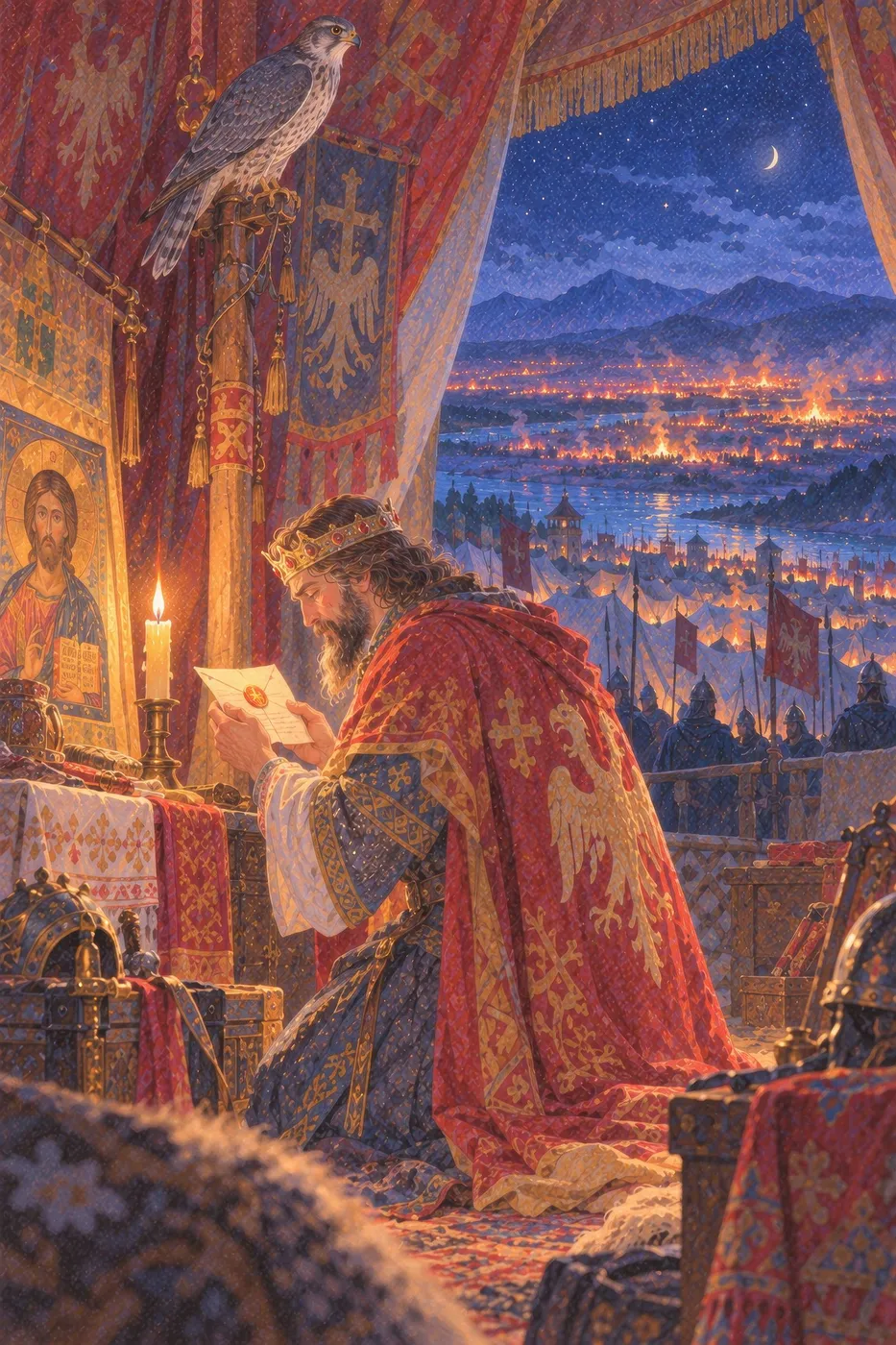
Late that night, when the camp was asleep, Prince Lazar knelt alone in his tent before a little icon of Christ, and he prayed for his army, for his wife and children at Kruševac, and for all the Serbian lands. He prayed, too, for the Turks across the plain, for he was a true Christian, and the Lord commands us to pray for our enemies. “They are men, too, Lord,” he whispered, “and they have mothers. Have mercy on them, and on us.”
As he prayed, there was a rush of wings at the door of the tent, and a gray falcon flew in and landed on the pole above the icon. In its talons, it held a letter, sealed with a seal of light.
The old songs tell it like this:
There flew a falcon, a gray bird,
from the holy city, from Jerusalem,
and it carried in its claws a little swallow.
It was not a falcon, a gray bird:
it was the holy Prophet Elijah.
It carried no swallow in its claws:
it carried a letter from the Theotokos.
The Prince broke the seal with trembling hands. The letter said:
“Prince Lazar, of honorable lineage, which kingdom will you choose? If you choose the earthly kingdom, saddle your horses and tighten their girths, let your knights buckle on their swords, and attack the Turks at once. Then the Turkish army will perish, and you will win. If you choose the heavenly kingdom, build a church on the Field of Kosovo, and let all your army receive Holy Communion. Then your army will perish, and you will perish with it. All will be crowned in heaven.”
Prince Lazar read the letter twice. He thought for a long, long time, while the falcon watched him from the tent pole. At last, he raised his head, and the old songs give his answer:
The earthly kingdom lasts but a little while;
the heavenly kingdom is forever and ever.
He chose the heavenly kingdom.
Before dawn, the priests of the army set up a church on the Field of Kosovo, and every soldier, from the Prince to the youngest squire, confessed his sins and received the Body and Blood of Christ. The three sworn brothers knelt together and received Communion side by side, as they had made their vow side by side. The gray falcon circled once above the army in the brightening sky, and flew away toward the south.
* * *
Copyright notice. Introduction and illustration © 2026 Laurent Cleenewerck. All rights reserved. The adapted Orthodox version of this tale is published in Twelve Serbian Orthodox Fairy Tales (© 2026 Laurent Cleenewerck). No part of this page may be reproduced without written permission, except for brief quotations with attribution and a link to this page.
Buy the book on AmazonAbout the book