
A Story of Smolensk and the Feast of the Hodegetria
In the ancient lands of Rus’, where the upper Dnieper winds among green hills and dark forests, there stands the city of Smolensk. Its walls climb the hills like a crown, and in the midst of them rises the Cathedral of the Dormition, which holds the greatest treasure of the city: the holy icon of the Theotokos called the Hodegetria, “She Who Shows the Way.”
It is said that the holy Evangelist Luke painted that icon with his own hands. For many centuries, it was kept in Constantinople. When the Emperor Constantine Monomachos gave his daughter Anna in marriage to Prince Vsevolod, son of Yaroslav the Wise, he sent the icon with her to Rus’ as his blessing. Their son, the great Prince Vladimir Monomakh, placed it in the cathedral of Smolensk, and there it has watched over the city ever since.
In that icon, the Theotokos holds the Christ Child on her left arm. With her right hand, she points to Him, as if to say to everyone who looks at her, “Here is the Way. Follow Him.” That is why she is called the Hodegetria, the Guide.
Every year, in the heat of high summer, on the twenty-eighth day of July, the people of Smolensk keep the feast of their holy icon. They carry it in procession through the streets and down to the banks of the Dnieper, and pilgrims come from every town and village for a hundred versts around.
In the days of our tale, there lived in the forests west of Smolensk a rich boyar named Gordey.
His name means “proud,” and it suited him. He was clever, quick-tongued, and scornful of anything he could not weigh or count. He owned many villages, fields of rye, a mill, a forge, and wide forests full of timber and game. He went to church at Pascha, because a boyar was expected to, but he laughed at the pilgrims who walked to Smolensk barefoot for the feast of the Hodegetria.
“They kiss painted boards,” he said to his guests at dinner, “and they think the boards will save them. Wood and paint, that is all an icon is. I could have a dozen made for the price of one good horse.”
Gordey’s wife, Pelageya, had been a gentle and devout woman. When she married him, her mother had given her a small copy of the Hodegetria of Smolensk, painted by a holy monk, and Pelageya had kept it in the corner of her chamber all her life, with a lamp always burning before it. When she died of a fever, Gordey was bitter. “Your painted board did not save her,” he said to the icon, and he took it down from the wall.
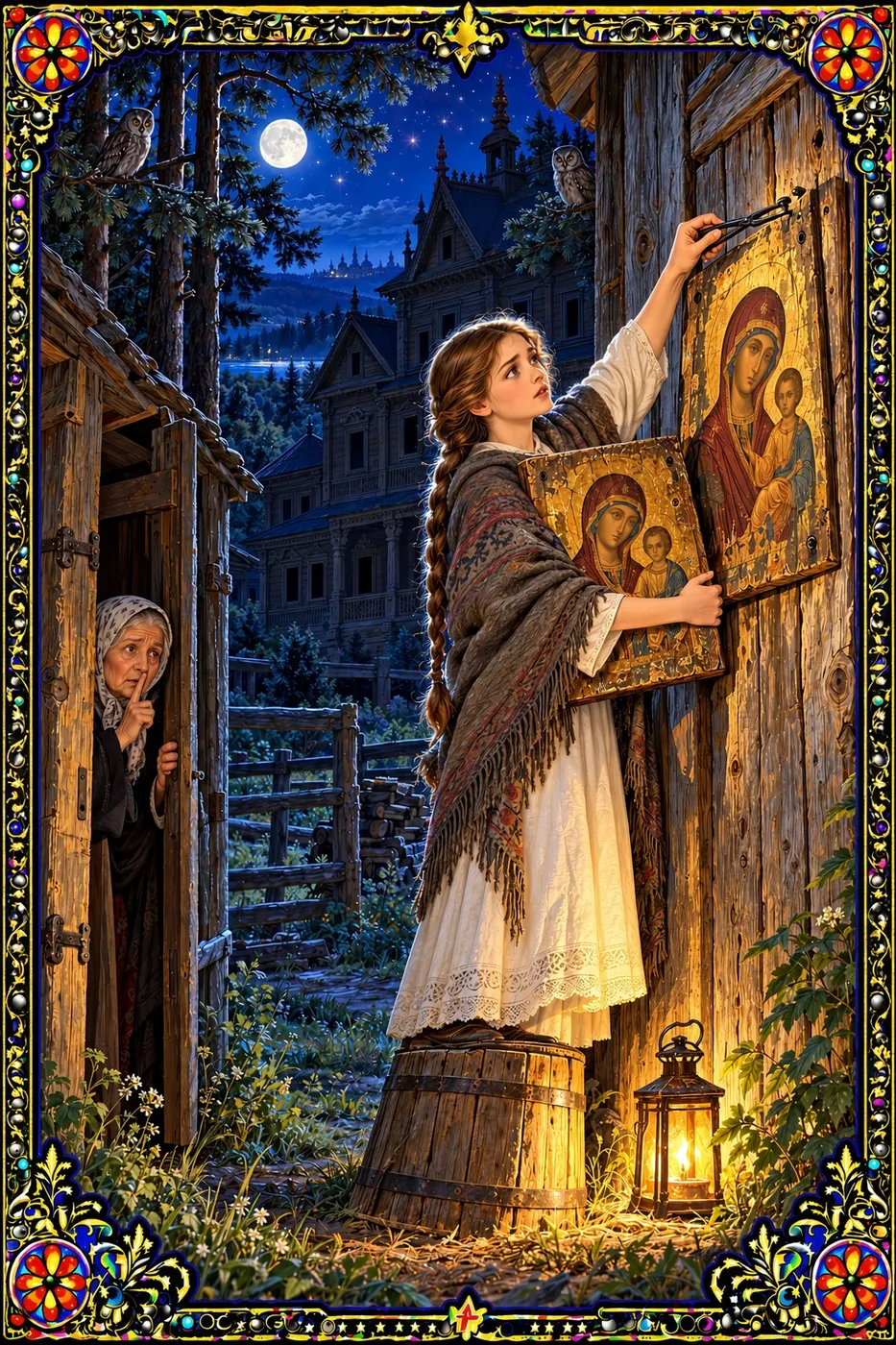
A few days later, a storm broke the shutter of the barn window. Gordey, in his grief and anger, took his wife’s icon and nailed it over the broken window, with the painted face turned outward to the wind and rain. “There,” he said. “Now, at least, it is good for something.”
The servants crossed themselves and looked away. None of them dared to say a word.
Gordey had one daughter, Anastasia. Her name means “resurrection.” In the year of our tale, she was sixteen years old. She had her mother’s gray eyes and her mother’s quiet faith, and her father loved her, in his proud and careless way, more than anything else he owned.
Anastasia could not bear to see her mother’s icon on the barn door. Every evening, after her father had gone to bed, she crept out to the barn with a lantern. She pried out the nails carefully, took down the icon, wiped away the mud and rain with her own sleeve, and knelt before it in the straw to pray. She prayed for her mother’s soul, and, above all, she prayed for her father. Before dawn, she nailed it back in place so that he would not know.
That summer, Gordey decided to build a new chapel on his estate, the finest for fifty versts around. He did not build it for love of God. He built it because the other boyars had chapels, and he meant to have a better one. He sent to Smolensk for an icon painter to cover its walls with saints.
The master of the cathedral workshop was old and ill, so he sent his best apprentice in his place. The young man was named Matvei. He was twenty years old, tall and quiet, with paint on his fingers and gentle brown eyes. Like all true icon painters, he fasted and prayed before he began each image, and he never painted a face of Christ or of His Mother without first going to confession.
Matvei set up his work in the new chapel and began to paint. Gordey came to watch him on the first day, and he laughed. “You fast and pray over your paints, boy? You are very serious for a man who paints boards.”
“My lord,” said Matvei quietly, “the holy Fathers teach that the honor given to an icon passes to the one it shows. When we kiss the icon of Christ, our intent is not to kiss wood. We are kissing Christ. For those who understand, an icon is not just a board. It teaches us that we too are icons of God, created in His image and likeness. Icons teach us that our Lord and Savior Jesus Christ is the icon of the invisible God and Father. An icons is truly a window into a heaven!”
“A window,” said Gordey. “Then I have put your window to good use. I nailed one over my barn.” He laughed again and walked away.
That evening, Matvei went to the barn to see what the boyar meant. When he saw the small icon of the Hodegetria nailed over the window, stained by rain and splashed with mud, with nail holes through the edges of its painted border, he fell to his knees in the dust and wept.
Behind him, he heard a soft step. It was Anastasia, with her lantern.
“It was my mother’s,” she said quietly. “I take it down every night and pray before it. My father must not know.”
Matvei looked up at her, and, in the lantern light, he saw her face, full of sorrow and love, and something in his heart turned over.
“Let me help you,” he said. “I know how to heal icons. I can clean it and mend the gesso where the nails have cracked it. It will take many nights, but I can make it whole again.”
So every night that summer, after the house was asleep, Anastasia and Matvei met in the barn. By the light of a single lantern, Matvei worked on the icon with his fine brushes and his little pots of egg and pigment, and Anastasia held the lamp and handed him what he needed. As they worked, they talked quietly. He told her how icons are painted, with prayer and fasting, in layers from darkness to light, the way God brings a soul from darkness into light. She told him about her mother, and about her father, whom she still loved, though he had become so hard. Sometimes, they did not talk at all, but only prayed together before the icon as the night birds called in the forest.
Each morning before dawn, Matvei put the icon back over the barn window, and Anastasia went back to the house, and, each day, they both counted the hours until evening. Neither of them spoke of what was growing in their hearts, but both of them knew it.
It was a summer of terrible drought. No rain had fallen since the Feast of Pentecost. The rye withered in the fields, the streams dried up, and the forest grew as dry as tinder. The peasants prayed for rain, and the priests led processions through the fields, but the sky stayed hard and blue.
One night, a few days before the Feast of the Hodegetria, Gordey could not sleep for the heat. He walked out into the yard and saw a light in the barn. He crept up to the door and looked in.
He saw his daughter kneeling in the straw, and beside her the young painter from Smolensk, and between them, propped against a bale of hay with a candle burning before it, his wife’s icon, cleaned and mended and shining as it had not shone in years.
Gordey’s face went dark with fury. He burst into the barn, seized the icon from its place, and turned on the young man. “You!” he shouted. “You sneak into my barn at night with my daughter, and you meddle with my property! Get off my land before I set the dogs on you!”
“Father, please!” cried Anastasia. “He has done nothing wrong! He only mended Mother’s icon!”
“Your mother’s icon,” said Gordey, and his voice shook with rage and grief. “Her painted board. It did nothing for her. It will do nothing for you.” He strode across the yard to the forge, where the smith’s fire was banked for the night under glowing coals, and he flung the icon onto the fire.
“No!” cried Anastasia.
As the icon struck the coals, a great shower of sparks leapt up out of the forge, hissing and crackling, straight into Gordey’s face. He cried out and stumbled back with his hands over his eyes.
When he lowered his hands, he could see nothing at all.
“I am blind,” he whispered. “I am blind.”
Anastasia did not run to her father first. She ran to the forge, reached into the fire with her bare hands, and pulled out the icon. It was scorched black at the edges, and the wood was smoking, but when she brushed away the ash, the faces of the Theotokos and the Christ Child were untouched.
Only then did she go to her father, who was groping in the dark yard with his hands outstretched, and take him by the arm.
Some of the servants said that it was the judgment of God. Anastasia would not say so. She said only, “Sometimes God allows us to become blind so that we can learn to be led.”
Matvei, as the boyar had commanded, left the estate that same night and walked back along the forest road toward Smolensk. Anastasia hid the scorched icon in her own room and prayed before it every night. Her father sat in his chamber in the darkness, silent and bitter, and would speak to no one.
* * *
Copyright notice. Introduction and illustration © 2026 Laurent Cleenewerck. All rights reserved. The adapted Orthodox version of this tale is published in Twelve Russian Orthodox Fairy Tales (© 2026 Laurent Cleenewerck). No part of this page may be reproduced without written permission, except for brief quotations with attribution and a link to this page.
Buy the book on AmazonAbout the book