
A tale of the Ukrainian steppe
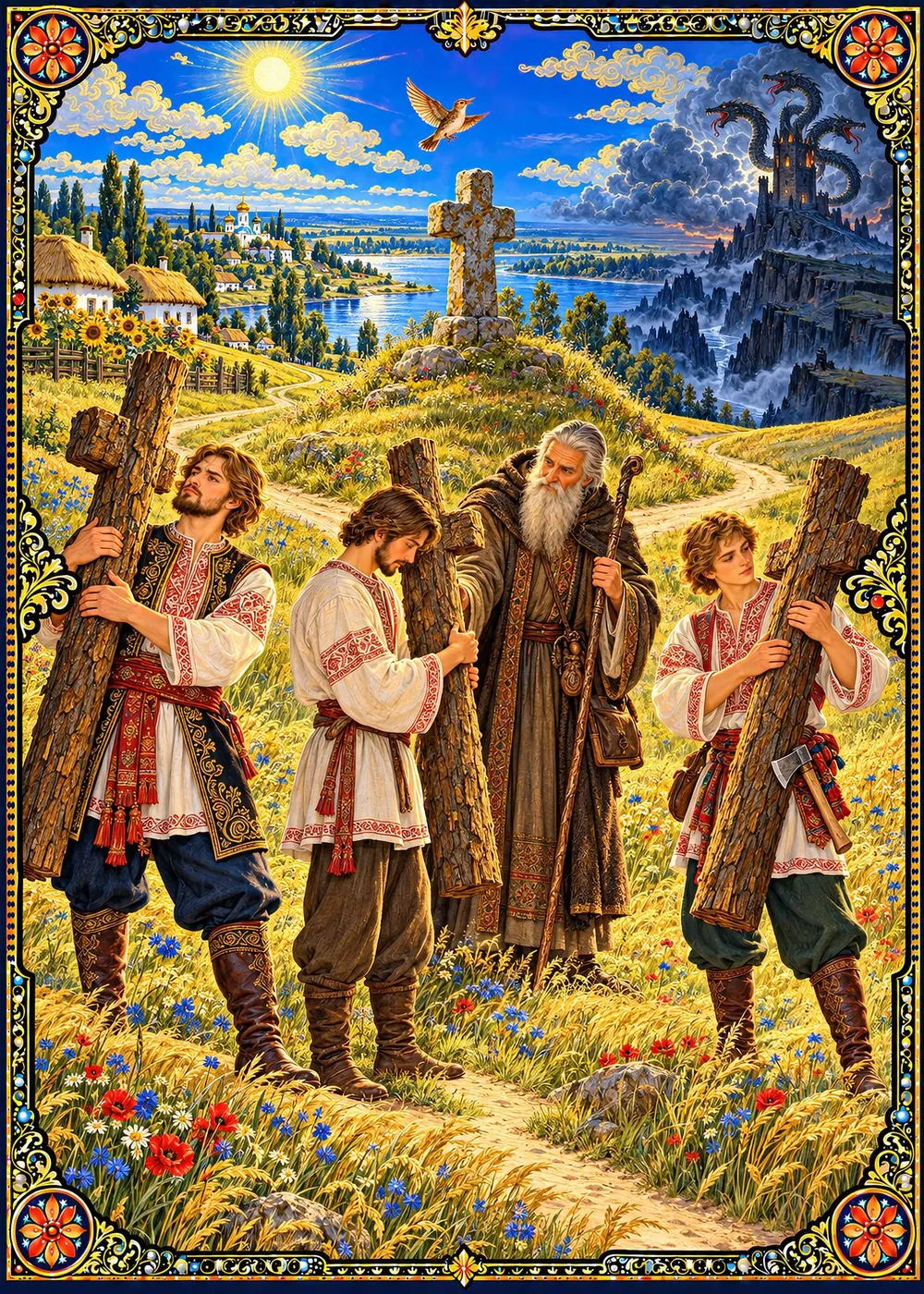
In the old days, when the steppe of Ukraine rolled green and gold to the edge of the sky, and the chumaks drove their creaking ox-carts south to the salt lakes by the sea, there lived in a white-walled cottage on the bank of the Dnieper a chumak named Taras and his wife, Hanna.
God had blessed them with four children. The eldest was Danylo, tall and strong, who loved fine clothes and the jingle of coins. The middle son was Stepan, quiet and steady, who spoke little and worked much. The youngest son was Ivas, quick and clever, who always looked for the easiest way to do anything. Last of all came their little sister, Oksanka, ten years old, with flaxen braids and a voice so sweet that the larks fell silent to hear her sing.
Every spring, Taras yoked his gray oxen and set off with the other chumaks down the long salt road to the south, and every autumn, he came home with his cart loaded with white salt to sell in the markets of Kiev. While he was away, his three sons worked the fields, and Hanna and little Oksanka tended the sunflower garden and the kalyna bush by the door.
In those days, beyond the Wild Field, in the empty lands where no one plowed, there lived a Zmii, a great serpent with three heads and a hide of black iron. He dwelt in a stone tower on a crag across a bottomless chasm, and, from time to time, he flew over the villages of the steppe and carried away whatever pleased him: a golden horse, a church bell, a sack of grain, a child.
One summer evening, while Taras was far away on the salt road, Oksanka sat singing on the doorstep. Her song rose over the sunflowers and drifted far across the steppe. The Zmii heard it in his tower, and he wanted it for himself.
The sky went dark as though a storm was coming. There was a rushing of great wings, a smell of sulfur, and a shadow fell over the cottage. Before her brothers could run out of the fields, the Zmii had seized Oksanka in his claws and had gone into the east. All they heard was her voice crying their names, growing fainter and fainter over the steppe.
Hanna fell weeping in the doorway. The three brothers stood in the yard, pale and shaking.
“We must go after her,” said Stepan.
“Go after a three-headed serpent?” said Danylo. “With what? We are plowmen, not warriors.”
“We could never find the way,” said Ivas. “No one who has gone into the Wild Field has ever come back.”
Still, they could not leave their sister, and so, at dawn, the three brothers set out together toward the east, with bread in their bags and their mother’s blessing on their heads.
At noon on the first day, they came to a crossroads on the steppe where an old stone cross stood on a burial mound. Beneath it sat an old man with a long white beard and a pilgrim’s staff. His robe was dusty from the road, but his eyes were bright and kind.
“Where are you going, children?” he asked.
They told him.
The old man nodded slowly. “The road to the Zmii’s tower is long and hard,” he said. “No one reaches it by his own strength. Each of you must carry a cross.”
He rose and went behind the burial mound, and came back carrying three crosses of oak, each as tall as a man, heavy and rough, with the bark still on them. He gave one to each brother.
“Carry your cross all the way,” he said. “Do not sell it. Do not cut it. Do not lay it down. It will be heavy, and it will hurt you, and you will want to be rid of it. Yet at the end of the road, you will understand why you carried it.”
Then he blessed them with the sign of the cross, and when they turned to thank him, he was gone. Only the old stone cross stood on the burial mound, and a lark sang above it.
The three brothers shouldered their crosses and walked on.
The crosses were heavy. By evening, their shoulders were raw and their backs ached. Danylo grumbled. Ivas complained. Stepan said nothing, but he prayed as he walked, and it seemed to him that the cross grew no lighter but that his strength grew a little greater.
On the second day, they met a merchant on the road, driving a fine cart drawn by two black horses.
“What fools are these,” he laughed, “dragging lumps of oak across the steppe? Sell me those crosses, lads. They are good seasoned oak. I will give you a silver coin for each.”
Danylo looked at his cross, and at his bleeding shoulders, and at the silver in the merchant’s hand. “The old man was mad,” he said. “What good is a piece of wood against a serpent? With silver, at least, I can buy a sword.” So he sold his cross to the merchant, and he walked on with a light step and a jingle in his pocket.
“Brother, you should not have done it,” said Stepan.
“Keep your cross, then,” said Danylo, “and break your back with it.”
On the third day, as they rested under a lone oak, Ivas looked at his cross thoughtfully. “The old man said not to sell it,” he said. “He did not forbid us to make it smaller.” He took his hatchet from his belt and chopped a full arm’s length off the bottom of his cross. It was much lighter now. “There,” he said. “I have kept my cross, and I have kept my back as well. Am I not clever?”
“He said not to cut it,” said Stepan.
“You are too simple, brother,” said Ivas, and laughed.
Stepan carried his cross as it was, and he did not complain.
On the fourth day, the brothers came to a place where a fowler had spread his nets across the reeds of a little stream. In one of the nets, a white dove was tangled and fluttering, its wings caught fast.
“Leave it,” said Danylo. “We have no time.”
Stepan set down his cross carefully, just long enough to kneel and cut the net and free the dove, and then he took up his cross again. The dove flew once around his head and was gone into the sky.
On the fifth day, they heard a pitiful bleating among the thorn bushes and found a young white lamb caught fast in the brambles, its fleece torn and bloody. From the tall grass nearby came the growling of wolves.
“Leave it,” said Ivas. “The wolves will have us too.”
Stepan untangled the lamb from the thorns, heedless of the scratches on his hands. The lamb was too weak to walk, so he lifted it and laid it across the arms of his cross, and carried both the cross and the lamb on his shoulders. It was heavy beyond bearing, and yet he bore it. The wolves watched from the grass, but they did not come near.
On the sixth day, they crossed a dry riverbed where the summer heat had shrunk the water to a single muddy puddle. In the puddle, a silver fish lay gasping.
“Leave it,” said both his brothers together. “It is only a fish.”
Stepan scooped the fish into his hat with a little water, and he carried it, with the lamb and the cross, until he came to a spring, where he set the fish free. The fish flashed its silver tail and swam away. By that same spring, the lamb had grown strong again, and it followed at Stepan’s heels like a dog.
On the seventh day, they came to the edge of the Wild Field, and there the real trials began.
First, they came to the Black Forest. Its trees grew so thick and its darkness was so deep that no sun had ever reached its floor. There was no path. Danylo drew his new sword, bought with the silver, and hacked at the branches, but they grew back as fast as he cut them. Ivas tried to climb a tree to see the way, and fell. The three brothers were lost.
Then there was a flutter of white wings, and the dove that Stepan had freed came down out of the sky and perched on the arm of his cross. It glowed softly in the darkness, like a candle. “Follow me,” it said, and it flew ahead of them from branch to branch, shining, and led them out of the Black Forest by a narrow path.
* * *
Copyright notice. Introduction and illustration © 2026 Laurent Cleenewerck. All rights reserved. The adapted Orthodox version of this tale is published in Twelve Ukrainian Orthodox Fairy Tales (© 2026 Laurent Cleenewerck). No part of this page may be reproduced without written permission, except for brief quotations with attribution and a link to this page.
Buy the book on AmazonAbout the book