
A Story of Polotsk and Vitebsk on the Feast of Pentecost
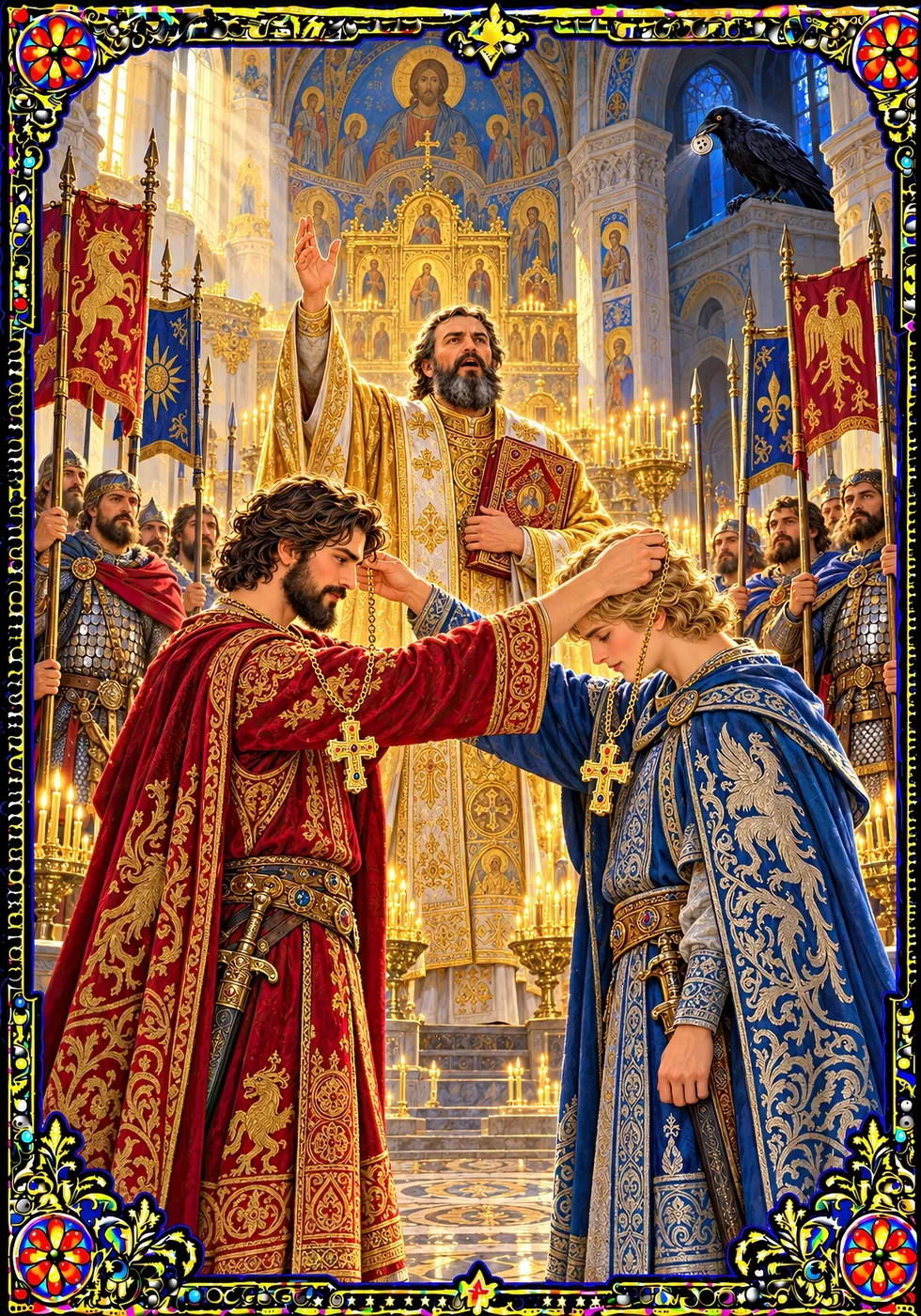
In the ancient lands of Rus’, where the Western Dvina winds through dark forests toward the sea, there stood two cities on its banks, a day’s ride apart: Polotsk, with its great Cathedral of Holy Wisdom, and Vitebsk, with its wooden walls and its bright market by the river. The two cities were ruled by two cousins, Prince Daniil of Polotsk and Prince Roman of Vitebsk. As boys, they had been sworn brothers, baptized in the same font and trained at arms in the same courtyard. As men, they still sent each other gifts at Christmas and hunted together each autumn in the forests between their lands.
Halfway between the two cities, on a wooded hill above the river, stood a small skete of a few log cells and a chapel no larger than a peasant’s barn. There lived an old monk named Kirill. Few people knew that he had once been Bishop Kirill of Polotsk, who had sat for thirty years upon the cathedral throne beneath the golden icon of Holy Wisdom.
For thirty years he had preached. He had preached against greed, and the boyars had grown greedier. He had preached against drunkenness, and the taverns had grown fuller. He had preached peace to princes, and they had nodded politely and gone to war whenever it suited them. His priests quarreled over revenues. His deacons fell asleep during his sermons. In the end, weary to the bone, he laid down his staff and his mitre and went out to the hill above the Dvina.
“I have spoken enough words for one lifetime,” he told the young monk who carried his books. “Words are wind. Men hear what they wish to hear and do what they have already decided to do. Let me be silent now, and let God do what I could not.”
He took a vow of silence. He still prayed, of course, but he prayed without a sound, and even the psalms he read with moving lips and no voice. If we are honest, his silence was not only holiness. There was some bitterness in it, too, the quiet disappointment of an old shepherd who believes his sheep never listened.
In the oak beside the chapel lived a crow.
This was no ordinary crow. It was large and glossy, with a bright, clever eye, and it could speak like a man. No one knew where it had learned. Some said it had belonged to a pagan volkhv in the days before the Baptism of Rus’. Others said it had simply listened too long at too many windows. It loved three things above all: shiny objects, the sound of its own voice, and the attention of important people.
Each morning, the crow would perch on the chapel roof and mock the old bishop. “Silent Kirill, silent Kirill! What good is a tongue that never wags? I talk to princes, old man. Princes feed me meat from silver plates!”
Kirill would look up at it with patient, tired eyes, and say nothing.
It was true. The crow had discovered that the two princes each kept a table where the talking bird was welcome, and that a tale well told earned a scrap of roast goose. At first, its tales were harmless: the price of fish in the market, a boyar’s wife who had fallen off her horse. The more it told, the more it was fed, and the more it was fed, the more it wanted to tell.
One day, in the cold weeks after Pascha, the crow could find no news worth a scrap of goose. So it made some up.
It flew to Polotsk and perched on the arm of Prince Daniil’s chair. “My lord,” it croaked in a low, sorrowful voice, “I hardly dare to say it. In Vitebsk, at his table, your cousin Roman laughed at you. He called you the Prince of Mud, because your lands are marshy. He says the border village of Ulla belongs to Vitebsk by right, and he means to take it before the harvest.”
Daniil frowned. “Roman would never say such things.”
“As you wish, my lord,” said the crow, and it hopped away. Daniil lay awake that night, turning the words over and over.
The next day, the crow flew to Vitebsk and perched on Prince Roman’s windowsill. “My lord,” it whispered, “beware. Your cousin Daniil is envious of your market. He is gathering men. I heard him tell his steward that the Dvina would be better with only one prince upon it.”
Roman laughed at first. The crow, however, was cunning. That same week, it stole Roman’s golden pectoral cross from a table where he had left it after his bath, flew it to Polotsk, and dropped it in the straw of Daniil’s stable. When Roman’s men searched for the cross, the crow whispered to them where to look. When the cross was found in Daniil’s stable, Roman went pale with anger.
Then the crow stole Daniil’s signet ring, flew it to Vitebsk, and dropped it beside a poisoned well where a rat had drowned. When Daniil’s steward found it, the crow was already whispering in Daniil’s ear that Roman’s men had tried to poison the water of Polotsk and had left the ring as an insult.
Lie was built upon lie, and each was believed a little more than the last. Messengers rode between the cities with angry letters. Gifts were returned. Boyars on both sides, who had their own grudges and their own hopes of plunder, fanned the flames. By the week of the Ascension, both princes had summoned their druzhinas. By the eve of Pentecost, two armies were camped on opposite banks of the Dvina at the ford below the hill where the old bishop lived.
The crow flew back and forth over the river, fat and pleased with itself, eating from both tables.
The young monks of the skete came to Kirill in tears. “Father, you were our bishop. The princes still honor your name. Go down and speak to them! Stop this war!”
Kirill looked at them for a long moment. Then he shook his head slowly, took up a stick, and wrote in the dust of the chapel floor: I spoke for thirty years. They did not listen then. They will not listen now.
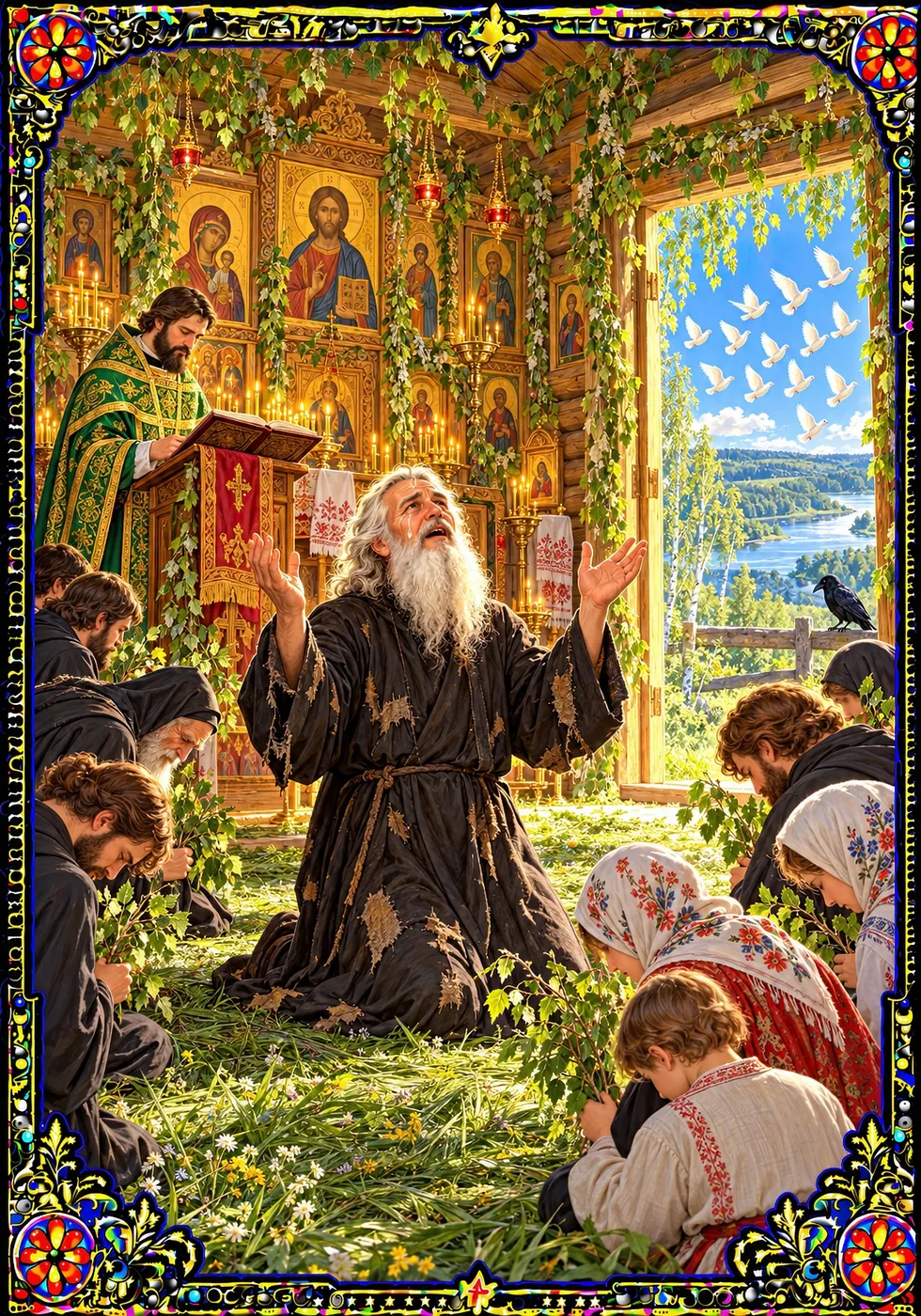
That night he could not sleep. He sat outside his cell and watched the campfires of the two armies flickering on either bank, like two constellations of anger. He could hear the smiths sharpening swords. He could hear the crow, somewhere in the dark, laughing to itself. The next day was Pentecost, which the people of Rus’ also call the Feast of the Holy Trinity. The monks had strewn the chapel floor with fresh grass and hung birch branches on the walls, as was the custom, so that the little church smelled of summer and green life. They served the Divine Liturgy, and the old bishop stood in the corner, silent, while the young hieromonk sang the troparion: Blessed are You, O Christ our God, who made the fishermen all-wise by sending down upon them the Holy Spirit.
Fishermen, Kirill thought. Simple men. Not bishops. Not preachers with thirty years of sermons. The apostles had not converted the world by their own eloquence. They had sat in an upper room and waited for fire.
* * *
Copyright notice. Introduction and illustration © 2026 Laurent Cleenewerck. All rights reserved. The adapted Orthodox version of this tale is published in Twelve Russian Orthodox Fairy Tales (© 2026 Laurent Cleenewerck). No part of this page may be reproduced without written permission, except for brief quotations with attribution and a link to this page.
Buy the book on AmazonAbout the book