
A Story of Dobrogea and the Feast of Saint Andrew
In the ancient lands of Dobrogea, where the Danube spreads out into a thousand channels before it reaches the sea, and the reeds whisper all night long around the great salt lakes, there was a time when the land was ruled by the voivode Mircea the Elder. On a rocky hill above Lake Razim stood the fortress of Enisala, and in that fortress lived a proud old boyar named Stanislav, who kept the road and the lake for the voivode, and his only daughter, the Lady Ana.
Ana was gentle and merry, with hair as black as a crow’s wing and eyes the color of the lake in summer. She loved the fishermen’s children who played below the walls, and she knew the names of all the old women in the village, and on feast days she carried bread down the hill to the poor with her own hands. Her father loved her more than his lands and his horses and his silver, though he was a hard man to everyone else.
Among the young knights whom the voivode sent to guard the fortress was one named Radu. He came from a small house in the hills of Wallachia, with more courage than money, and his sword was the only fine thing he owned. He was brave in battle and quiet at table, and he had a habit that made the other knights laugh at him: he could not bear to see any creature suffer.
One spring, three years before the time of our story, Radu was riding with the other knights through the oak forest of Babadag when they heard a thin howling. They found a wolf cub caught by one paw in a hunter’s iron trap. The knights drew their swords to kill it, laughing, for a wolf is a wolf. Radu leaped from his horse and stood between them and the cub.
“It is only a child,” he said. “Let it go.”
He opened the trap with his bare hands, and the cub limped away into the trees on three legs. At the edge of the forest, it stopped and looked back at him for a long moment with its yellow eyes. The other knights mocked him all the way home. “Radu the shepherd of wolves,” they called him, and the name stuck.
Ana heard the story, and she laughed with the others. That night, however, she thought about it for a long time. A man who would spare a wolf cub, she thought, would surely be kind to a wife. By the time the leaves turned, she and Radu loved each other, though neither had said a word about it.
At last Radu found the courage to go before the old boyar and ask for Ana’s hand. Stanislav frowned at him under his heavy eyebrows. “You have no lands,” he said, “and no gold, and a name that nobody knows outside your own village.” Then he looked at his daughter, and saw her face, and something in his hard heart gave way. “Very well,” he said. “You are brave, and she loves you. You may be betrothed on the Feast of Saint Andrew, when she turns seventeen. You will marry after Theophany, when the fast and the feasts are over.”
Yet as the Feast of Saint Andrew drew near, a strange gloom came over the boyar. He did not sleep. He did not eat. He walked the walls at night, staring into the dark. When the eve of the feast came, he called the whole household together in the great hall, and his face was gray.
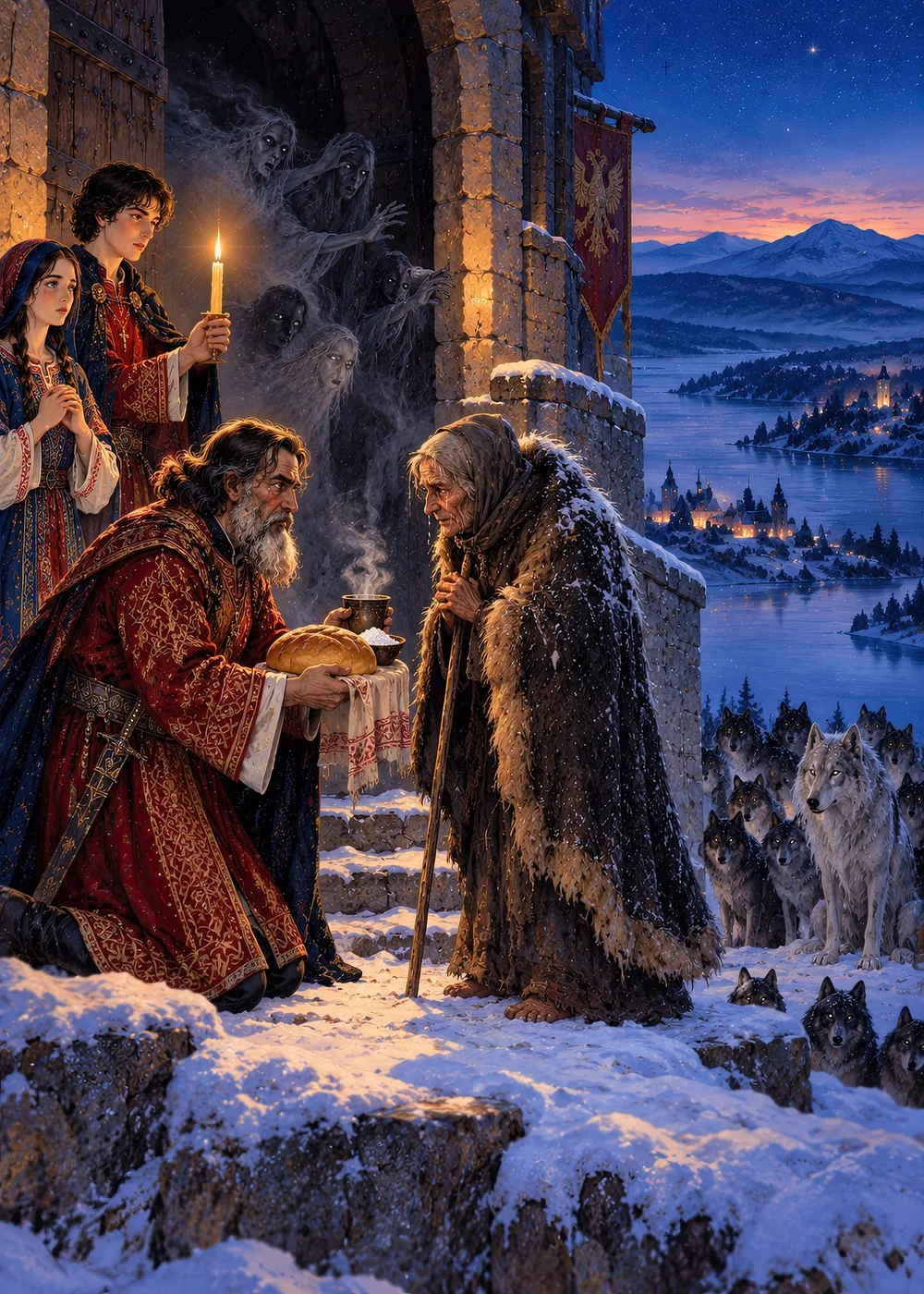
“Seventeen years ago tonight,” he said, “on the Eve of Saint Andrew, my wife lay in childbirth, and I was half mad with fear. In the middle of the night, an old woman came to the gate in the snow, begging for bread. I was angry at the whole world that night. I had her driven away with the dogs. As she went, she turned and cursed me. ‘You have shut your gate on me,’ she said, ‘and so I will open it for others. On the Eve of Saint Andrew, when the child born tonight turns seventeen, the strigoi will come for her, and no garlic and no iron will keep them out.’ My wife died that same night, and my daughter lived. I told myself it was the raving of a madwoman. I have tried to forget it for seventeen years.”
Ana went white. Radu put his hand on his sword.
“Then we will do all that can be done,” said the old boyar’s steward. All that afternoon, the servants rubbed garlic on every door and every window and every keyhole of the fortress. They turned the pots upside down and hid the knives. They lit lamps in every room, and the soldiers stood on the walls with torches.
Radu watched it all with a heavy heart. “Garlic will keep a strigoi from a door,” he said at last, “but a curse is not a door. My lord, there is a cave in the forest to the south, where the holy Apostle Andrew lived and prayed when he brought the Gospel to this land. This is his night. I will ride there and ask him to pray for us.”
“Tonight?” cried the steward. “No one goes into the forest on the Eve of Saint Andrew. It is the night of the strigoi, and the night of the wolves. Everyone knows that on this night the wolves gather, and the saint gives each wolf its share for the winter, and they can speak with the voices of men. Whoever hears them will not live out the year.”
“Then I will hear them,” said Radu.
In those days, on the Eve of Saint Andrew, the girls of the villages used to lay a sprig of basil under their pillows, hoping to dream of the man they would marry. Ana took the sprig of basil that her maid had laid out for her and tucked it into Radu’s cloak.
“I do not need to dream of the man I will marry,” she said. “I know who he is. Come back to me.”
Radu kissed her hand, mounted his horse, and rode out through the gate into the falling snow.
The forest was black and silent. The snow fell softly through the bare branches of the oaks and lay white on the path, and the only sound was the creak of Radu’s saddle and the breathing of his horse. Once, far away, he heard a long howl. Then another answered it, closer, and then another, until the whole forest seemed to be howling.
His horse stopped, trembling, and would go no farther. Radu dismounted, tied it to a tree, and went on alone on foot, with a lantern in his hand.
As he walked, he began to see them: gray shapes slipping between the trees on either side of the path, dozens of them, then hundreds, all moving in the same direction. Their eyes shone green and gold in the light of his lantern. They paid no attention to him. They were going somewhere, and they were in a hurry.
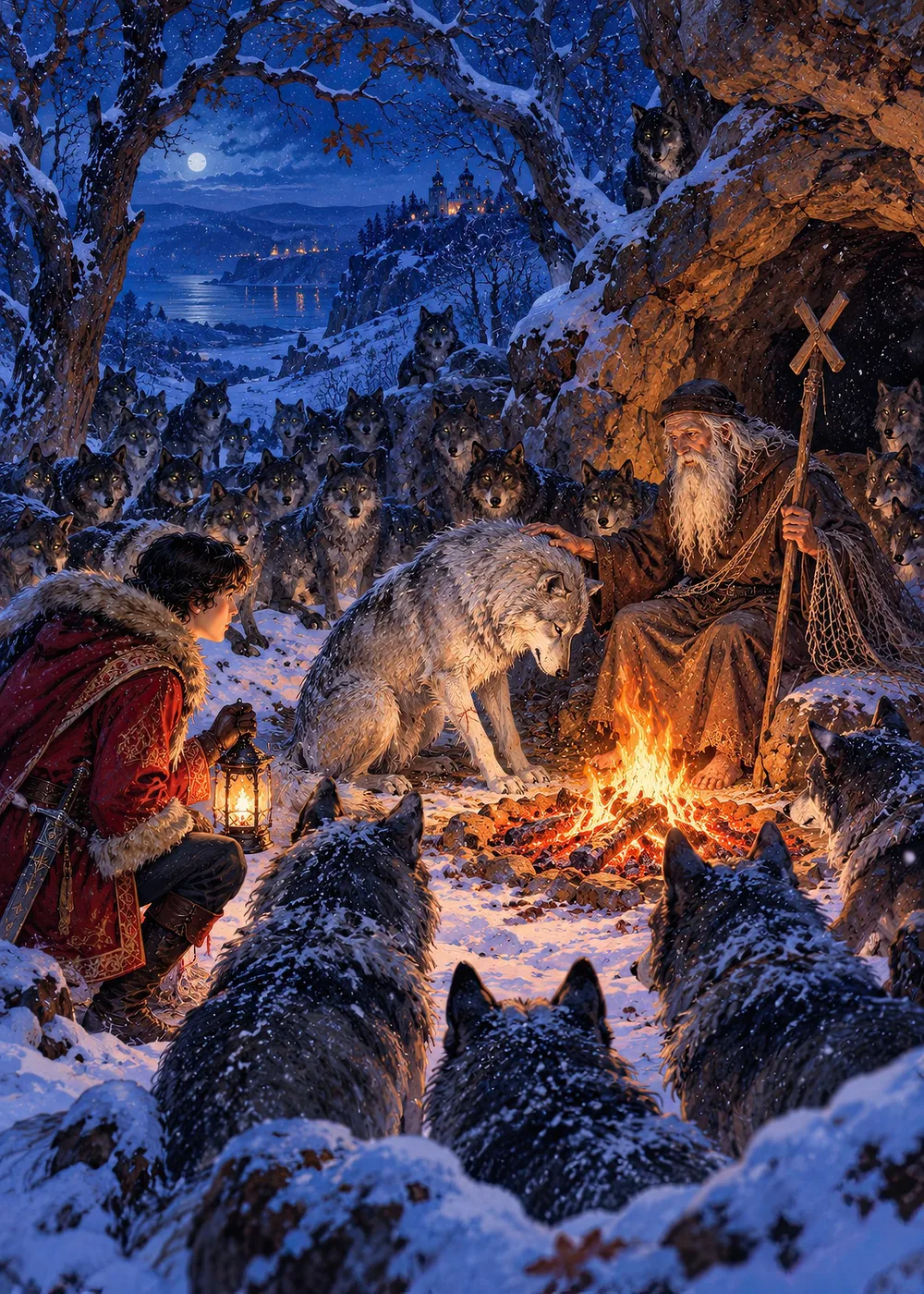
At last the path came out into a clearing at the foot of a rocky hill, and there, in the side of the hill, was the low, dark mouth of a cave. A fire burned in front of it. Around the fire, in a great ring, sat the wolves of all Dobrogea, gray wolves and black wolves, old and young, so many that Radu could not count them. Not one of them was howling now. They sat as still as stones.
Beside the fire sat an old man in a rough brown robe, like a fisherman’s, with a fishing net folded over one shoulder. His beard was white and wild, and his hair was white and thick, and his feet were bare in the snow, yet they did not seem to be cold. In his hand he held a staff, and the top of the staff was a cross, not like other crosses, but shaped like the letter X.
One by one, the wolves came forward and bowed their heads before the old man, and he spoke to each one. Radu crept closer, and he heard what he had been told no man should hear: the wolves were answering him, in the voices of men.
“Old Gray-Back,” said the old man to a great limping wolf, “this winter you may take the stray goats of the rich man of Babadag, who never gives alms. Leave the widow’s goat alone.”
“I will leave it, Father,” said the wolf, in a voice like a rough old shepherd’s.
“Black Ear,” he said to the next, “you will go to the marshes of the delta and eat the fish the fishermen throw away. Do not go near the village.”
“Fish again!” grumbled the wolf. “Very well, Father.”
So it went, wolf after wolf. Radu noticed that the old man gave the wolves only what no poor man would miss, and that no wolf argued with him for long.
Then a great silver-gray wolf, taller than all the others, came forward and bowed. It had a white scar across one foreleg, where an iron trap had once bitten it. Instead of waiting for its share, it turned its head and looked straight at Radu, hiding behind his tree, with its yellow eyes.
“Father,” said the silver wolf, “before you give me my portion, I have something to ask. There is a man here who once saved my life.”
Every wolf in the clearing turned and looked at Radu. His knees shook, but he stepped out from behind the tree and came into the firelight. He knelt in the snow before the old man.
The old man looked at him with eyes as deep as the sea. “Radu the shepherd of wolves,” he said, and he smiled. “I know you. Why have you come to my fire on this of all nights?”
Radu told him everything: the old boyar’s sin, the old woman’s curse, the strigoi, and Ana. When he finished, the old man was quiet for a long time, and the wolves did not move.
“The garlic will keep the strigoi out of the doors and the windows,” the old man said at last, “but your friend is right: a curse is not a door. It is a wound. This one was made by a hard heart and an angry tongue, and garlic does not heal wounds. Only mercy heals them.”
“What must we do, Father?”
* * *
Copyright notice. Introduction and illustration © 2026 Laurent Cleenewerck. All rights reserved. The adapted Orthodox version of this tale is published in Twelve Romanian Orthodox Fairy Tales (© 2026 Laurent Cleenewerck). No part of this page may be reproduced without written permission, except for brief quotations with attribution and a link to this page.
Buy the book on AmazonAbout the book