
A tale of the Dnieper in the days of the Apostles
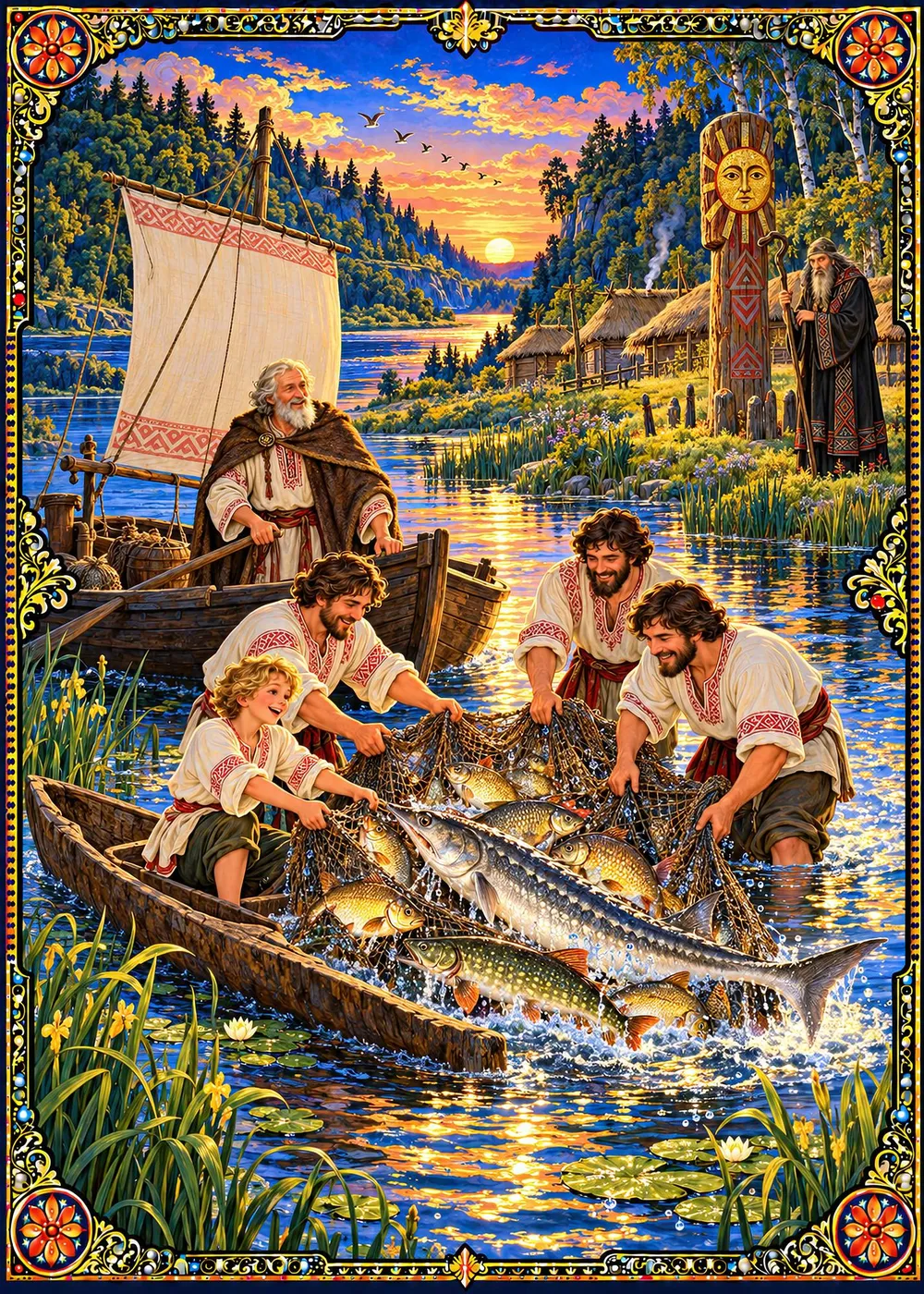
In the days before there was any city on the hills above the Dnieper, before there were walls, or domes, or bells, the great river flowed past wild green heights covered with oak and linden forest. Wolves howled there at night, and eagles nested on the cliffs. At the foot of the hills, on the riverbank, stood a small village of fishermen and hunters, a few dozen huts of clay and reed around a clearing.
In the middle of the clearing stood a tall wooden idol of Dazhbog, the sun god, carved from a single oak, with a round face painted gold and eyes of black paint. Every morning, the villagers bowed to it as the sun rose. Every autumn, they burned grain and honey before it, and the volkhv, the old priest of the idol, danced and chanted and told them what the god wanted.
The volkhv’s name was Chornoslav. He was tall and gaunt, with a beard like gray moss and eyes as sharp as a hawk’s. The villagers feared him more than they loved him, for he could make the chieftain do whatever he pleased, and anyone who displeased him had a way of meeting with misfortune.
In that village lived a boy named Yarko.
He was eleven years old, thin and brown from the sun, with hair the color of river sand. His father had drowned in the Dnieper when he was small, and his mother had died soon after of grief, and so he lived with his grandfather, an old fisherman named Dobromyr, in the smallest hut at the end of the village, closest to the water.
Yarko was not like the other boys. They wrestled and threw stones and chased the village dogs. Yarko liked to sit alone on the riverbank at night, looking up at the stars, and wonder.
“Grandfather,” he would ask, “who made the stars?”
“Dazhbog, the sun,” the old man would answer, because that is what the volkhv said.
“The sun goes down at night,” said Yarko, “and still the stars are there. Who made them?”
“Hush,” said his grandfather, glancing over his shoulder. “Do not let Chornoslav hear you ask such things.”
The other children laughed at Yarko and called him the Dreamer. Even the chieftain, Radim, a big, loud man with a red beard, would shake his head when he passed the old fisherman’s hut. “That grandson of yours will never catch a fish,” he said. “He is too busy counting stars.”
In the year of our tale, there came a hard summer. The Dnieper ran low and warm, and the fish went down into the deep holes and would not come up. For eleven days in a row, Yarko and his grandfather cast their nets from their little dugout boat and drew them up empty. They had nothing left to eat but a handful of dried peas.
On the evening of the eleventh day, as Yarko sat alone in the boat at the river’s edge, sadly folding the empty net, he saw a boat coming up the river from the south.
It was not a dugout like the village boats. It was a real boat, built of planks, with a small square sail, the kind of boat that came up from the sea only once in many years, with traders from the south. In it sat four men. Three were younger, dark-haired and dusty, with the look of travelers from far away. The fourth was an old man with a gray beard, a weathered face burned brown by many suns, and strong, rough hands, the hands of a fisherman. His eyes were the kindest eyes Yarko had ever seen.
The boat drew alongside Yarko’s dugout, and the old man looked down at the empty net.
“Peace be with you, child,” he said, in a strange accent, but in words that Yarko understood. “Have you caught anything today?”
“Nothing,” said Yarko. “Not today, and not for eleven days. The fish have gone down into the deep.”
The old man smiled, as though at a private memory. “Cast your net on the right side of your boat,” he said, “and you will find some.”
Yarko looked at him doubtfully. He had fished these waters all his life, and he knew there was nothing on the right side of his boat but shallow water over sand. Yet something in the old man’s face made him want to obey.
He cast the net on the right side of the boat.
At once, the net grew heavy, so heavy that the little dugout tipped and nearly overturned. Yarko hauled on the rope with all his strength, and the net came up full, bulging, bursting with fish: bream and pike, perch and carp, and a great silver sturgeon longer than Yarko himself, more fish than he and his grandfather had caught in a whole month. The net was so full that it began to tear.
The three younger strangers laughed and jumped into the shallow water to help him drag it to shore.
Yarko stared up at the old man. “Who are you?” he whispered.
“My name is Andrew,” said the old man. “I too was a fisherman, on a lake far away to the south, a lake called Galilee. Once, a long time ago, after my brother and I and our friends had fished all night and caught nothing, a Man stood on the shore at dawn and told us to cast the net on the right side of the boat. We did, and the net was so full that we could not haul it in.” His eyes grew bright. “That Man was my Teacher. Now I go from land to land and tell people about Him.”
That night, old Dobromyr roasted the great sturgeon over the fire in front of his hut, and the whole end of the village came to share it. The strangers sat with them, and Andrew blessed the food in a strange tongue before they ate. The villagers stared at the four travelers with curiosity, but no one dared to ask much, for they saw Chornoslav the volkhv watching from the shadows by the idol with narrowed eyes.
When the feast was over, Andrew turned to Yarko. “Child,” he said, “will you guide me up those hills?”
He pointed to the dark wooded heights rising above the river, black against the stars.
“Now?” said Yarko. “In the night? There are wolves in that forest.”
“The wolves will not trouble us,” said Andrew. “I must pray on the top of those hills before the sun rises.”
So Yarko took a torch and led the old apostle up the steep, winding path through the dark forest, while the three companions followed. The wolves howled in the distance but did not come near. At last, near midnight, they came out onto the summit of the highest hill, a bare, grassy height from which, even in the dark, they could see the great river shining below in the starlight.
There Andrew knelt down on the grass, stretched out his arms, and began to pray.
Yarko sat on a stone and kept watch through the night. He did not understand the old man’s language, but sometimes Andrew spoke in words Yarko could understand, and the boy listened.
Andrew spoke of his Teacher, whose name was Jesus. He told how his Teacher had healed the sick and fed the hungry and loved the poor. He told how evil men had nailed Him to a cross of wood, and He had died, and they had laid Him in a tomb. On the third day, very early in the morning, just as the sun was rising, He had risen from the dead.
“He is the true Light,” said Andrew, half to himself and half to the boy. “The sun that rises every morning is only His creature. He made the sun, and the moon, and all the stars.”
Yarko’s heart leaped. “Then He is the one who made the stars,” he whispered.
Andrew turned and looked at him in the torchlight, and smiled. “Yes, child,” he said. “He is the one who made the stars. He has been waiting for you to ask.”
All through the rest of the night, Yarko sat beside the old man on the hilltop, and Andrew told him everything: about the Father who made the world, about the Son who came down to save it, about the Holy Spirit who fills all things with life. Yarko listened as though he had been thirsty all his life and had finally found water.
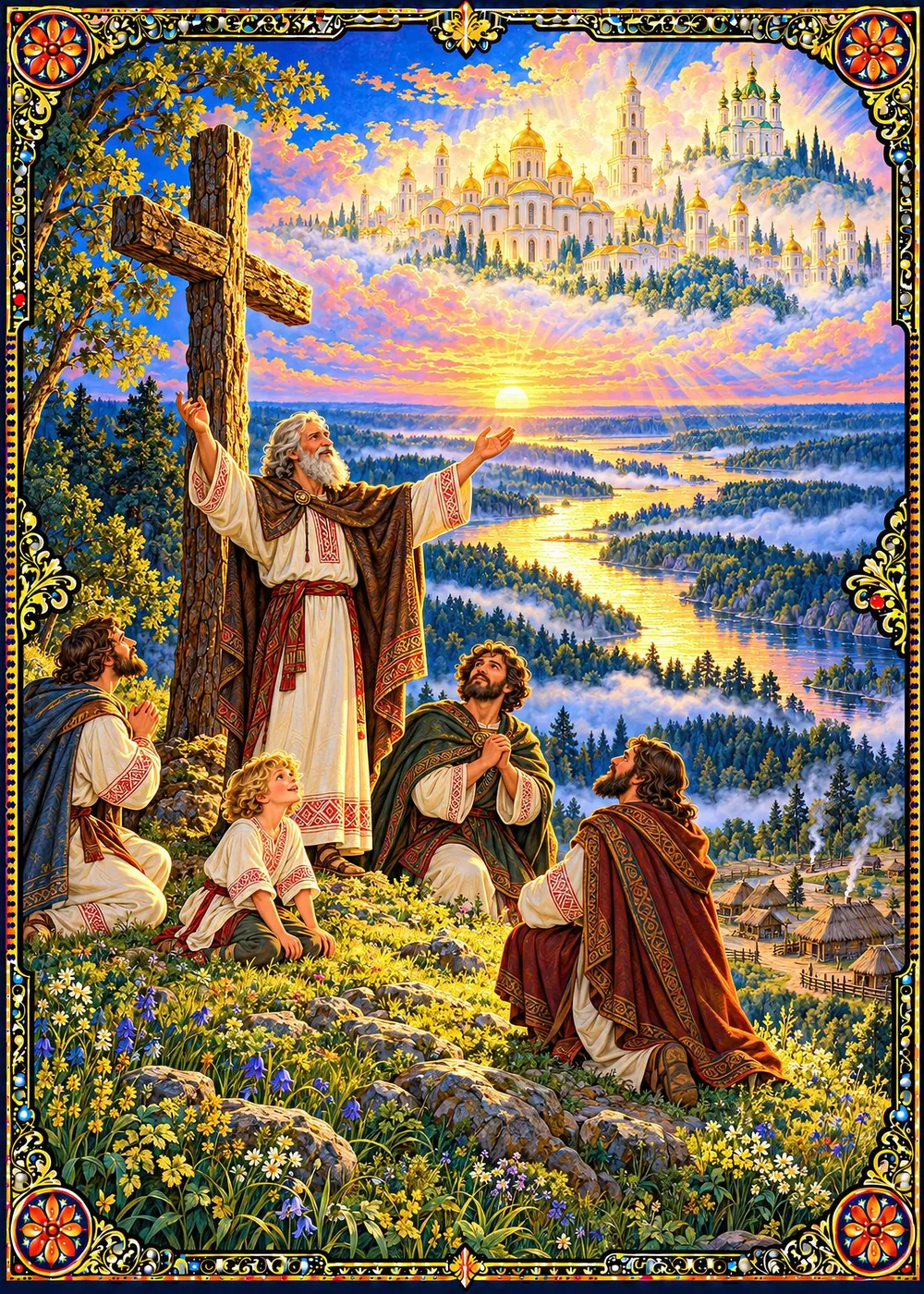
As the sky began to grow pale in the east, Andrew rose from his knees. His three companions came forward carrying a cross they had made during the night from two oak beams, bound with rope. Andrew took it and planted it firmly in the earth on the very summit of the hill, and the four of them together piled stones around its foot.
Then the sun rose over the Dnieper.
It rose red and gold out of the mist on the far bank, and its first rays struck the cross on the hilltop and lit it up like fire. The whole river below turned to gold. Andrew lifted his hands toward the hills, the river, and the green lands beyond, and he spoke in a loud, clear voice, as though he were seeing something that was not yet there:
“Do you see these hills? On these hills, the grace of God will shine. A great city will rise here, and God will raise up many churches in it. Their golden domes will shine in the sun, and their bells will ring out over the river, and, from here, the light of Christ will go out to all the lands of the north.”
Yarko looked out from the hilltop. He saw only forest, and mist, and the wide golden river, and far below, the little cluster of reed huts where his grandfather slept. There was no city. There were no churches. There were no domes.
* * *
Copyright notice. Introduction and illustration © 2026 Laurent Cleenewerck. All rights reserved. The adapted Orthodox version of this tale is published in Twelve Ukrainian Orthodox Fairy Tales (© 2026 Laurent Cleenewerck). No part of this page may be reproduced without written permission, except for brief quotations with attribution and a link to this page.
Buy the book on AmazonAbout the book