
A tale of the Hutsul mountains
High in the Carpathian Mountains of Ukraine, where the peaks are covered with dark fir forests and the meadows in summer are bright with flowers, there live the Hutsuls, a people of shepherds and woodcarvers. They build their churches of wood, with shingled domes like fir cones, and they call to one another across the valleys with the trembita, a wooden horn so long that it rests on the ground when it is played. Its deep voice rolls from peak to peak for miles, announcing births and weddings, deaths and feasts.
In one Hutsul village, beside the rushing Cheremosh River, there lived a girl named Ivanka.
She was fourteen years old, with long dark braids, bright eyes, and quick, clever fingers. Her parents were poor shepherds, and since she was a small child she had lived with her grandmother, old Dokiia, in a little log house on the hillside above the church.
Old Dokiia was the finest writer of pysanky in all the valley.
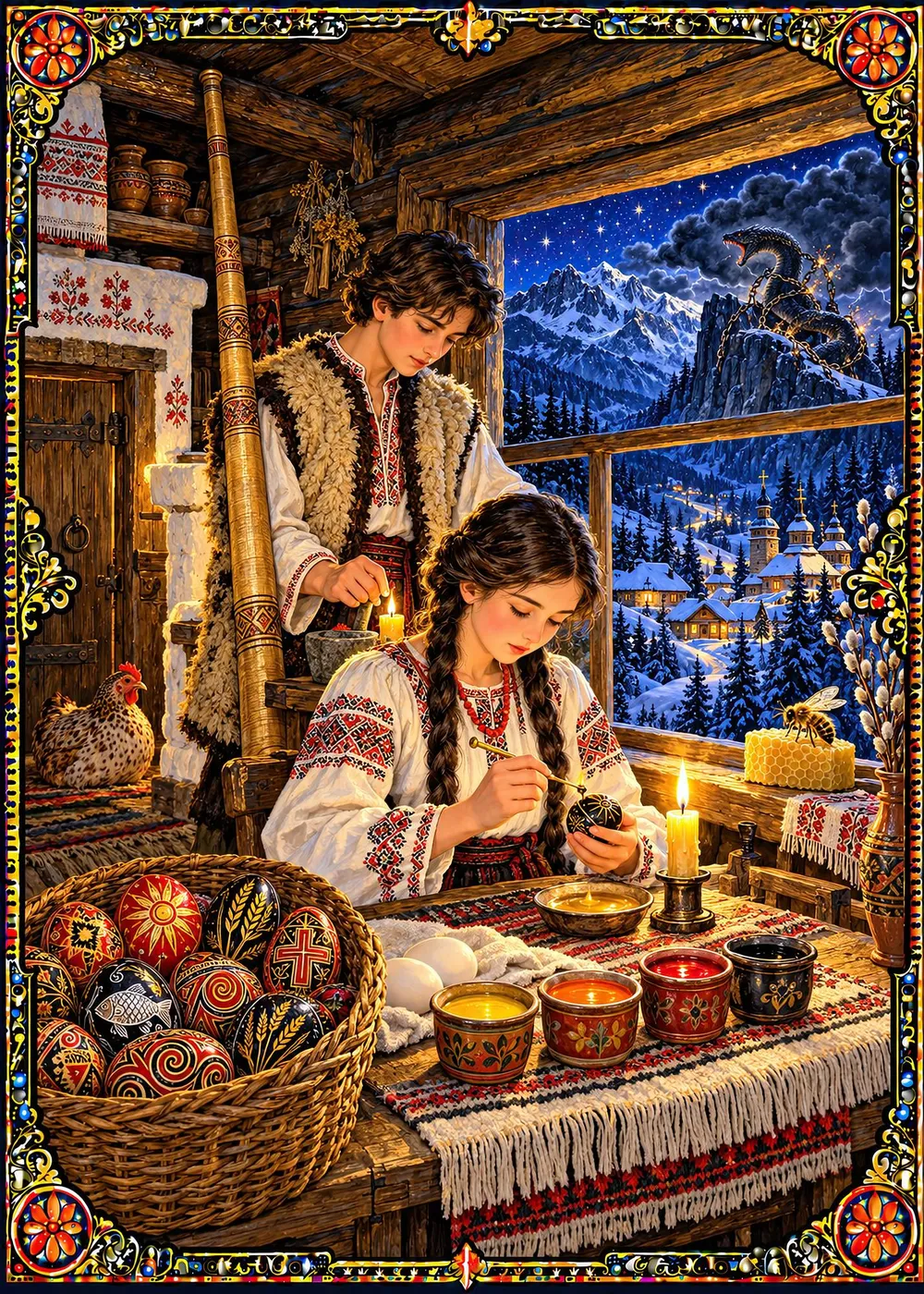
In Ukraine, at Pascha, people give one another eggs decorated with beautiful designs, and these are called pysanky, from the word pysaty, “to write,” for the designs are not painted but written. The writer takes a raw egg and a kistka, a tiny stylus with a funnel of brass, and dips it into melted beeswax, and, with the hot wax, she writes lines and shapes on the egg. Then she dips the egg in dye, first yellow, then orange, then red, then black, and each time she covers with wax the parts that must stay the color they are. At the end, she holds the egg to a candle flame and wipes the wax away, and the whole design appears at once, glowing like stained glass.
Every design means something. The sun means Christ, the Sun of Righteousness. The cross means His victory. The wheat means the harvest and the Bread of Life. The fish means Christ the Savior. The endless line that winds around the egg without beginning or end means eternity. The stars and flowers and little birds mean the joy of Pascha that fills all creation.
From the time Ivanka could hold a stylus, her grandmother had taught her to write pysanky. They worked together every Lent, in the evenings, by candlelight at the little table by the window, and as they worked, the old woman told stories.
“Do you know, Ivanka,” she said one evening, “why we must never stop writing pysanky?”
Ivanka shook her head.
“Far away in these mountains,” said her grandmother, “deeper than any shepherd has ever gone, there is a black cliff, and chained to that cliff with great iron chains is an ancient serpent. He is the old enemy, the one who tempted Adam and Eve in the Garden and has hated all that is good ever since. When Christ rose from the dead, He bound the serpent, as the Scriptures say. The serpent struggles against his chains, however, and, every year, his servants go out into the world and count the pysanky.”
“Why do they count them?” asked Ivanka.
“Because every pysanka is a little witness to the Resurrection,” said her grandmother. “Each one says, Christ is risen, and death is defeated, and the serpent is bound. If many pysanky are written, the chains hold fast for another year. If only a few are written, the chains grow weak, and the serpent’s evil spreads over the world: war and sickness, hatred and despair. That is why the Hutsul women have written pysanky every year for a thousand years. We are holding the chains.”
Ivanka was not sure whether to believe the story, but she loved it.
The winter before our tale, old Dokiia fell ill. On her last night, she called Ivanka to her bed and pressed something into her hand. It was her kistka, her little brass stylus, worn smooth by sixty years of use.
“Never stop writing them,” she whispered. “Not even when everyone else stops. Promise me.”
“I promise, Grandmother,” said Ivanka, and she wept.
The old woman died peacefully before dawn, and the trembita sounded from the mountainside to tell the valley.
Great Lent came, and Ivanka set up her grandmother’s little table by the window, with the candle and the beeswax and the pots of dye, and began to write pysanky as she always had. As the weeks went by, however, strange things began to happen in the village.
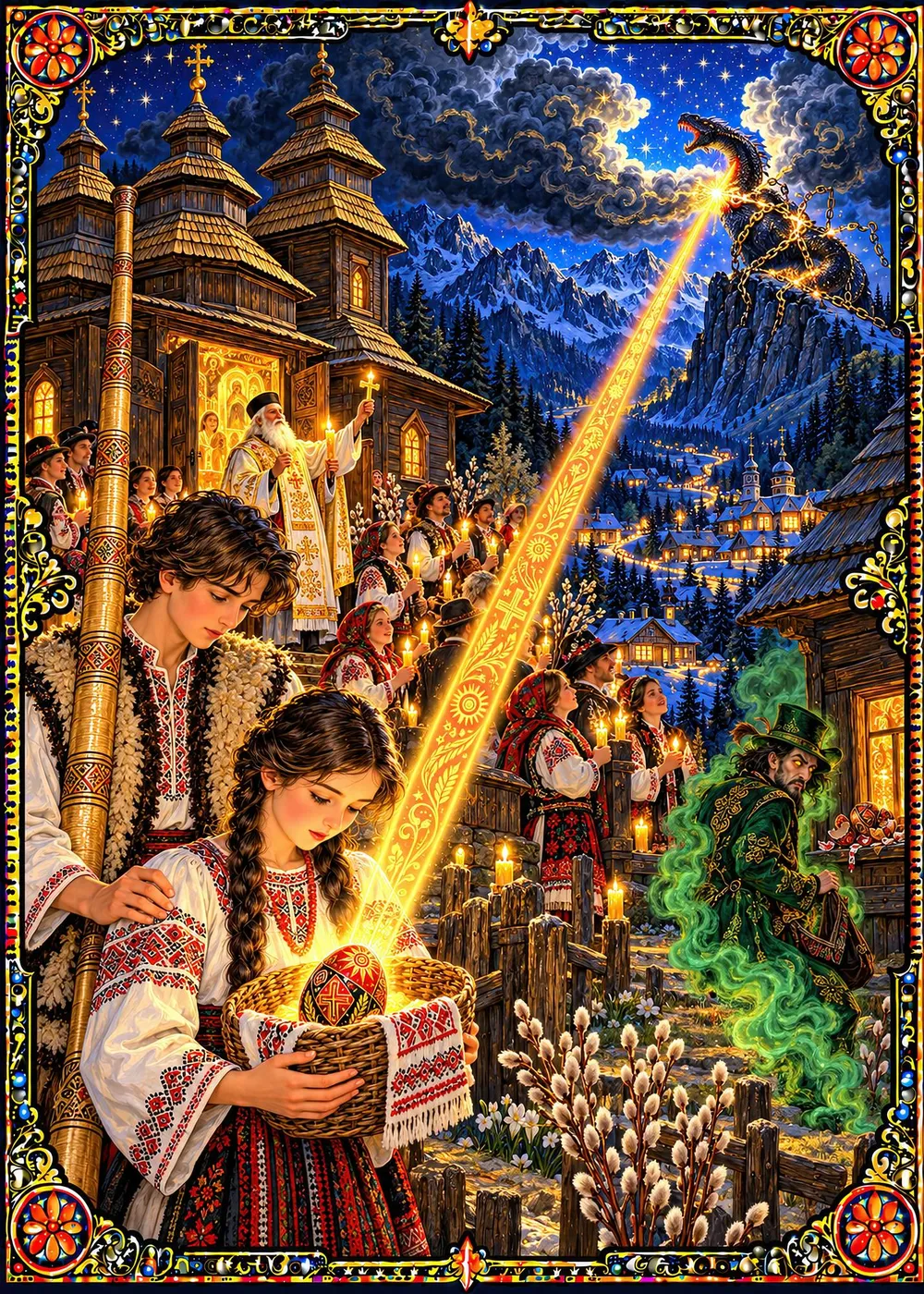
In the second week of Lent, a stranger came up the valley road. He was a peddler with a pack on his back, dressed in a fine green coat that shimmered strangely in the light, like the skin of a lizard. He was tall and thin and smiling, with long, pale fingers and gold-flecked eyes that never seemed to blink.
He set up his pack in the village square beside the church, and, from it, he brought out eggs, hundreds of eggs, carved from wood and painted in bright, shiny colors, red and gold and green and silver, glittering in the sun.
“Why waste your nights over wax and dye and candle smoke?” he called to the village women. “Why burn your fingers and strain your eyes, when a raw egg breaks if you drop it? Look at mine! They are brighter than any pysanka, and they never break. Buy a dozen for a copper coin, and put your styluses away. That old custom is for grandmothers. You are modern women!”
The village women gathered around, admiring the shiny painted eggs. They were very pretty, and very cheap, and the women were tired after the long winter. One by one, they bought the peddler’s eggs, and one by one, they put away their styluses and their pots of dye.
Only Ivanka would not buy.
“They are only painted wood,” she said to the peddler. “They do not say anything. A pysanka is written, not painted. Every line of it is a prayer.”
The peddler smiled at her with his gold-flecked eyes, and something about that smile made Ivanka shiver. “Suit yourself, little girl,” he said. “One girl cannot write enough pysanky for a whole valley. Why bother?”
That night, as Ivanka sat writing by the window, she heard something she had never heard before. From far away, deep in the mountains, came a low, grinding groan, like iron scraping on rock, and the ground trembled under her feet. The candle flame shook. Then all was silent.
In the morning, a rockslide had blocked the valley road.
By Holy Week, not a single woman in the village was writing pysanky except Ivanka. The peddler’s shiny wooden eggs sat on every windowsill. Each night, the groaning in the mountains grew louder. On Monday of Holy Week, a storm came roaring down the valley and tore the shingles off the church roof. On Tuesday, the Cheremosh flooded and swept away the mill. On Wednesday, a sickness came among the sheep on the high meadows, and many of them died. On Thursday, at midday, a strange darkness covered the sun for an hour, and the dogs howled.
The people of the village were frightened, yet none of them understood. “It is a bad spring,” they said. “The weather is strange this year.”
Ivanka understood. Every night, she sat at her grandmother’s table and wrote pysanky until her eyes burned and her fingers blistered from the hot wax.
She was not entirely alone. On the first night of Holy Week, when her beeswax ran out, she went out weeping to the little apiary behind the church, where the priest kept his bees for church candles. As she stood among the hives in the moonlight, a great golden bee flew out of the largest hive and landed on her hand.
“Do not weep, daughter of Dokiia,” it hummed. “Your grandmother always thanked us for our wax. Take what you need.” The next morning, on her windowsill, she found a cake of the purest, sweetest-smelling beeswax she had ever seen, and, every morning after that, there was another.
Her grandmother’s old speckled hen, which had not laid an egg all winter, began laying again, one egg every morning, fresh and white, just when Ivanka needed it.
On Tuesday evening, as Ivanka struggled up the steep path from the spring with her heavy water jugs, a young man came down the hillside and took them from her without a word. He was Dmytro, a shepherd from the high meadows, seventeen years old, tall and quiet, with a sheepskin vest and a trembita slung across his back. Ivanka had seen him at church and had heard his trembita calling from the mountaintops, but she had never spoken to him.
“I have seen your candle burning every night,” he said, “when I come down from the meadow. What are you doing up so late?”
Ivanka told him everything: about her grandmother, and the chained serpent, and the peddler, and the groaning in the mountains.
Dmytro was silent for a long time. Then he said, “My own grandmother told me the same story when I was little. I thought it was only a tale. Yet I have heard the groaning in the mountains too, from the high meadow. It comes from the black cliffs far to the north.” He looked at her with serious gray eyes. “You should not be doing this alone. I cannot write pysanky, but I can fetch your water from the spring, and grind your dyes, and keep your candle burning.”
From that night on, Dmytro came down from the meadow every evening. He carried water from the mountain spring for her dyes. He ground the dried onion skins for yellow and orange, and boiled the bark of the alder and the apple for red, and the husks of walnuts for black. He sat beside her at the little table, keeping the candles lit and handing her each egg as she needed it, and as she wrote, he told her stories of the high meadows, of the sheep and the wolves and the stars. Sometimes, when she was too tired to go on, he played softly for her on a little shepherd’s flute, and her weariness would lift.
Night after night, they worked. By Holy Saturday, Ivanka had written forty pysanky, each more beautiful than the last. She laid them carefully in a willow basket lined with her grandmother’s embroidered cloth, ready to take to the church for the blessing on Pascha.
* * *
Copyright notice. Introduction and illustration © 2026 Laurent Cleenewerck. All rights reserved. The adapted Orthodox version of this tale is published in Twelve Ukrainian Orthodox Fairy Tales (© 2026 Laurent Cleenewerck). No part of this page may be reproduced without written permission, except for brief quotations with attribution and a link to this page.
Buy the book on AmazonAbout the book