
A tale of Kamianets in Podolia
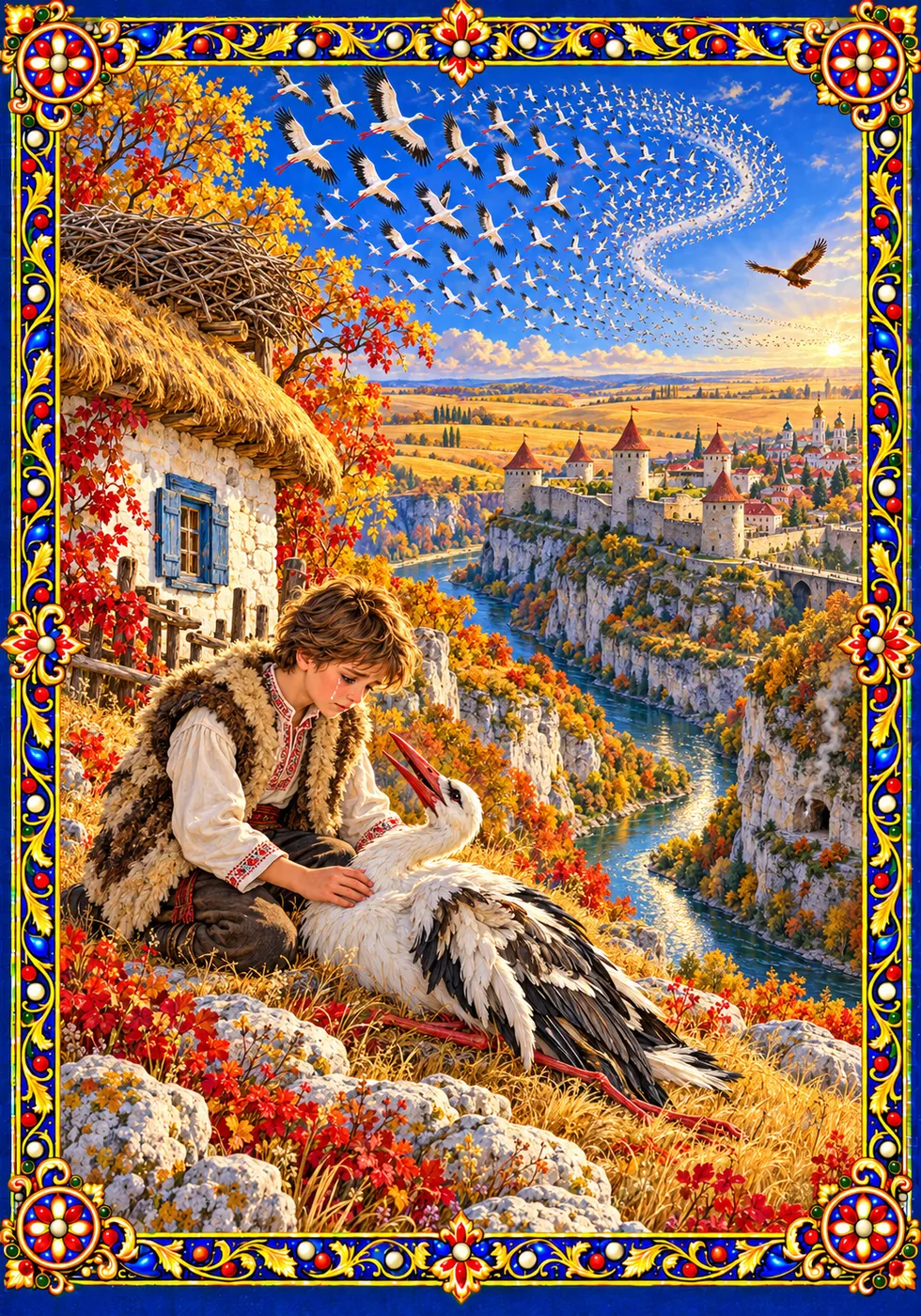
In the land of Podolia, where the wheat fields roll like a golden sea and the rivers have cut deep canyons through the white stone, there stands the old town of Kamianets. It is built on a great rock that rises out of a canyon, and the river Smotrych winds almost all the way around it, deep below, like a moat dug by God Himself. On one side of the rock, guarding the only bridge, stands an ancient castle with round towers and tall pointed roofs, and, from its walls, the soldiers look out over the fields toward the south, from where danger always came.
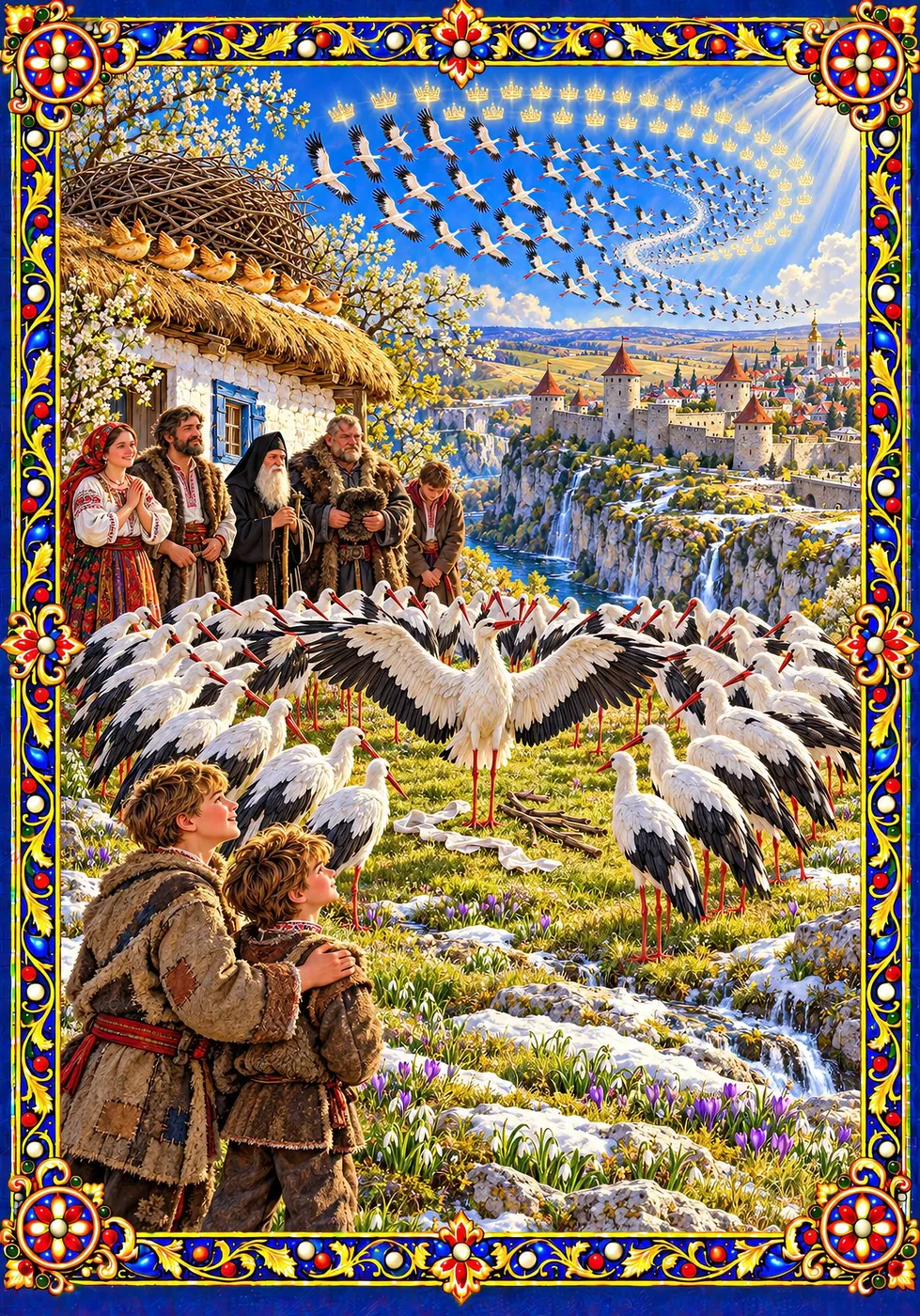
In Ukraine, the stork is a beloved bird. People call him leleka, and they say that a house where the storks choose to nest is a blessed house, and that the storks bring good fortune, health and children to the family beneath their nest. Every autumn, the storks gather in great flocks and fly away south to warm lands beyond the sea, and every spring they return, faithfully, to the very same nest on the very same roof. The old people say that they come back on the Feast of the Forty Martyrs, in early March, and, on that day, the children bake little buns shaped like larks and set them on the rooftops to call the birds home.
On the edge of the canyon, just outside the castle walls, there stood a small cottage of white stone with a thatched roof. In it lived Semen, a stonemason who worked on the castle walls, with his wife, Nastia, and their son, Danko.
Danko was eleven years old, a quiet boy with thick brown hair and serious gray eyes. On the roof of their cottage, for as long as anyone could remember, a pair of storks had built their great untidy nest of sticks, and, every spring, they came back to it and raised their young. Danko loved them more than anything. He would lie on the grass in the evenings and watch them standing on one leg on the nest, or clattering their long red beaks together, or sailing out over the canyon on their great black-and-white wings. The old father stork was so large and so old that Danko called him simply Leleka, the Stork, as though there were no other.
One autumn, when Danko was eleven, the storks of Kamianets began to gather in the fields for their long journey south. Hundreds of them stood in the stubble of the harvested wheat, and then, one bright morning, they rose into the sky together in a great spiral, circling higher and higher over the canyon.
Leleka rose from Danko’s roof to join them.
At that moment, out of the sky, a great golden eagle came diving like an arrow. It struck the old stork in midair and tore at his wing, and Leleka tumbled out of the sky and fell onto the rocks at the edge of the canyon, just beyond the cottage.
The eagle flew away. The flock of storks circled three times over the canyon, calling mournfully. Then, because winter was coming and they could not wait, they turned and flew south, and the old stork was left behind.
Danko ran to the edge of the canyon. Leleka lay among the rocks with one great wing twisted and broken, his beak open, his eye full of pain.
Danko knelt beside him. “Leleka,” he whispered, with tears running down his face. “Leleka, do not die.”
The old stork looked up at him. Then, to Danko’s astonishment, he spoke, in a slow, dry, clattering voice.
“Boy,” he said, “I have nested on your roof for thirty years. I watched you when you were a baby in your mother’s arms. My wing is broken, and my flock has gone. I cannot fly south, and I cannot live through the winter here. It is the end for me.”
“No!” cried Danko. “I will take care of you!”
Down in the canyon, in a cave in the white cliff above the river, there lived an old hermit monk named Father Iov. He had lived there for forty years, praying and fasting, and the people of Kamianets went to him for counsel. That afternoon, Danko carried the old stork carefully down the steep path into the canyon, to the cave.
Father Iov looked at the broken wing for a long time. Then he splinted it with two sticks and strips of linen, and he looked at Danko with his deep, kind eyes.
“He may live,” said the old monk, “if you keep him through the whole winter until the flock returns in the spring. The storks come back on the Feast of the Forty Martyrs. If he is alive on that day, God will do the rest. It will be a long winter, however, and a hard one. There will be days when you want to give up. You must not stop halfway. Remember the Forty Martyrs, and hold on until the end.”
“Who were the Forty Martyrs?” asked Danko.
Father Iov smiled. “Let the stork tell you,” he said. “He has heard their story sung in church every March for thirty years, sitting on your roof.”
So Danko carried Leleka home and made him a bed of straw in the corner of the little barn beside the family’s goat. Semen and Nastia shook their heads. “A stork cannot live through our winter, son,” said his father gently. “It is a bird of summer.”
“I promised,” said Danko.
That winter was the hardest anyone in Kamianets could remember. The snow came early and deep. The frost cracked the stones of the castle walls. The river Smotrych froze solid at the bottom of the canyon, and the wind howled through the rocks like a wolf.
Every day, before dawn, Danko went down the steep, icy path into the canyon with a fishing line and a little axe. He cut a hole in the river ice and fished, his hands numb and bleeding with cold, until he had caught enough small fish to feed the stork. Every day, he climbed back up the icy path with the fish, and carried water from the well through the snow, and changed the straw in Leleka’s bed, and sat with him in the barn.
In the evenings, when his work was done, he sat beside the old stork in the barn by the light of a tallow candle, and Leleka told him the story of the Forty Martyrs, a little each night.
“Long ago,” the stork began, “in the days when the Roman emperors still hated Christ, there was a city called Sebaste, in the land of Armenia, far to the south. In that city, there was a company of soldiers, forty of them, brave men and good friends. They had fought together in many battles and never once turned their backs to the enemy. All forty of them were Christians.”
“One day, the governor commanded all his soldiers to offer sacrifice to the idols. The forty soldiers refused. ’We are soldiers of the emperor,’ they said, ’but first we are soldiers of Christ. We will not deny Him.’”
“The governor was furious. He tried threats, and he tried promises of gold and honor. The forty would not bend. So he thought of a terrible punishment. It was the middle of winter, and, outside the city, there was a lake, frozen over with ice. He commanded the forty soldiers to be stripped of their clothes and made to stand all night on the frozen lake, in the bitter wind, until they either died of cold or denied Christ.”
Danko shivered, thinking of his own hands in the icy river. “What did they do?” he asked.
“That is enough for tonight,” said the stork. “Tomorrow, I will tell you more. Go to sleep, Danko.”
At first, Danko was not alone in his work. His older cousin Ivanko, who was fourteen and lived next door, came to help him. Ivanko was strong and cheerful, and he liked the idea of saving the stork. For the first few weeks, he went down to the river with Danko in the dark mornings and helped him cut the ice and catch the fish.
As the winter grew harder, however, Ivanko grew tired of it. The other boys of the town gathered every evening in the warm tavern by the castle bridge, where the innkeeper let them sit by the great stove and listen to the soldiers’ stories and eat hot pies. They laughed at Ivanko for spending his days on the ice with a baby and an old bird.
One morning, Ivanko did not come.
“I am finished with your stork,” he said, when Danko went to his door. “It will die anyway. Everyone says so. I am not going to freeze my fingers off for a bird. Come to the tavern with me instead, Danko. It is warm there.”
Danko shook his head and went down to the river alone.
That night, Leleka told him the next part of the story.
“All night long, the forty soldiers stood on the frozen lake, in the dark and the bitter wind. Their bodies turned blue with cold. They held on to one another to stay upright, and they prayed together: ’Forty we came to the contest, Lord; let forty of us receive the crown.’”
“On the shore of the lake, to tempt them, the governor had ordered a warm bathhouse to be heated, with its door standing open and steam pouring out into the frosty night. Any soldier who denied Christ could walk off the ice into the warm bath and live.”
“Toward midnight, one of the forty could bear it no longer. He broke away from his brothers and stumbled off the ice toward the warm bathhouse. When he came into the hot water, his frozen body could not bear the sudden heat, and he died on the spot. He gave up at the very end, and he lost everything: both the life he wanted to save and the crown he could have won.”
Danko thought of Ivanko, warm in the tavern, and he was sad.
“Were there only thirty-nine then?” he asked.
“Tomorrow,” said the stork.
In the castle above the canyon, there was a soldier named Kohut, a big, harsh man with a scarred face, who guarded the castle gate. He was the terror of all the boys of Kamianets, for he shouted at them and cuffed them if they came too near the gate. He had a son named Yurko, twelve years old, who was as harsh as his father and the worst bully in the town.
Yurko had heard about Danko and the stork. Every time he met Danko on the path to the river, he mocked him. “There goes the stork nurse!” he would shout. “Did you change its swaddling clothes today? Did you sing it a lullaby?” Once, he knocked Danko’s bucket of fish out of his hands onto the ice and laughed as Danko scrambled to pick them up.
Yet one night, very late, when the moon was full, Yurko was sent by his father on an errand along the canyon path, and he saw something he did not expect. Far below on the frozen river, alone in the moonlight, a small figure was kneeling at a hole in the ice, fishing. It was Danko. The frost was so bitter that night that Yurko’s own face ached in the wind, and he had a thick sheepskin coat. Danko had only a thin, patched jacket.
Yurko stood on the path for a long time, watching. He did not know why, but something in his chest hurt.
The next morning, when Danko came out of the cottage before dawn, he found a bundle of dry firewood on the doorstep, and a small sack of dried fish. There was no sign of who had left them.
The same thing happened the next morning, and the next.
On the fourth morning, Danko woke even earlier than usual and hid behind the barn door. In the gray darkness, a figure came creeping up the lane with a bundle of wood on its back. It was Yurko, the guard’s son.
Danko stepped out of the barn. Yurko froze.
* * *
Copyright notice. Introduction and illustration © 2026 Laurent Cleenewerck. All rights reserved. The adapted Orthodox version of this tale is published in Twelve Ukrainian Orthodox Fairy Tales (© 2026 Laurent Cleenewerck). No part of this page may be reproduced without written permission, except for brief quotations with attribution and a link to this page.
Buy the book on AmazonAbout the book