
A tale of Kupala Night in Polissia
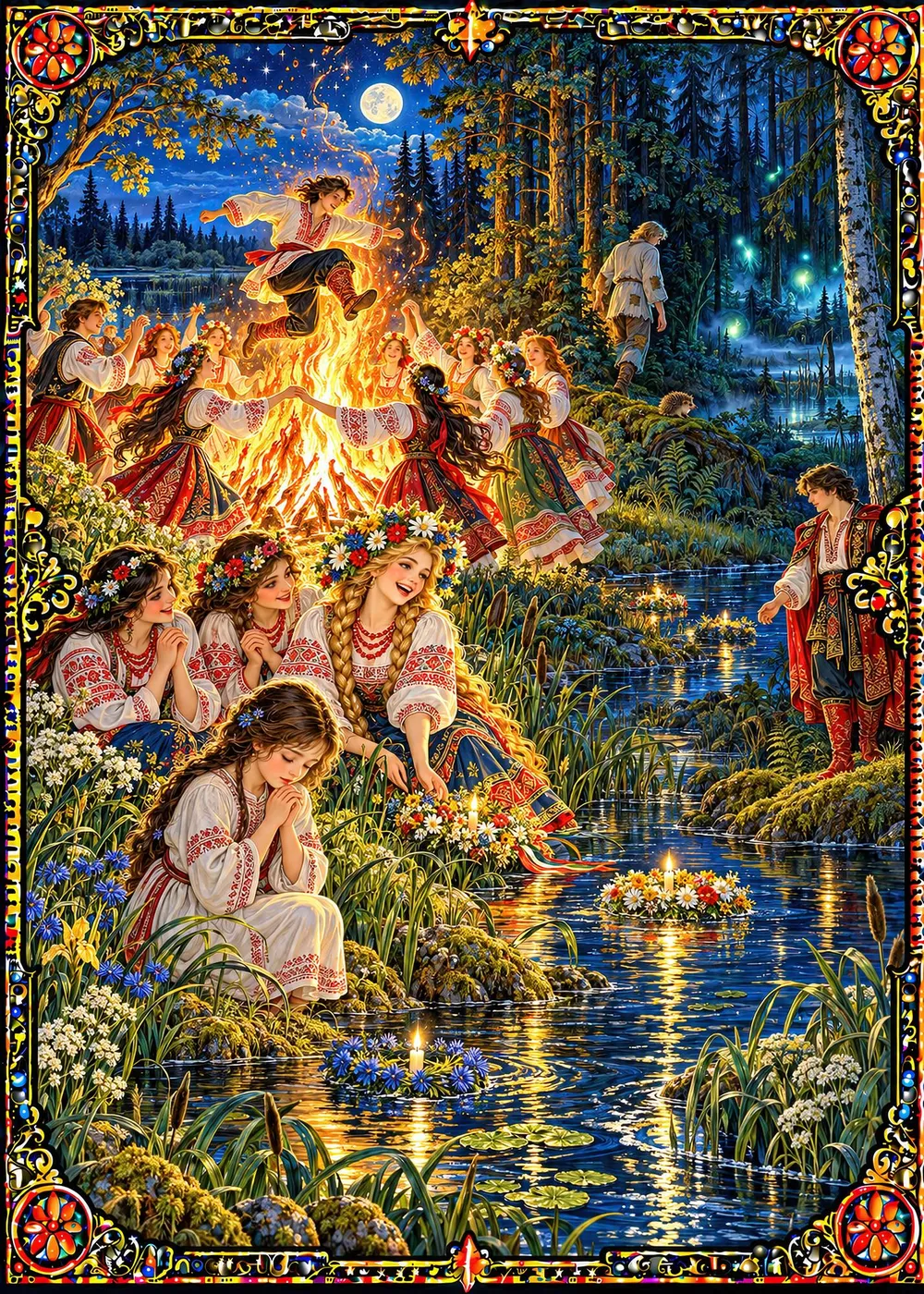
In the north of Ukraine, where the land is flat and green and the rivers wander slowly through endless marshes, there lies a country called Polissia, the land of the forests. There the pines and birches grow so thick that the sun hardly reaches the ground, and the marshes stretch for miles, full of reeds and water lilies, frogs and herons, and strange lights that flicker over the water at night. The people of Polissia live in small villages of log houses on the islands of dry ground between the marshes, and they tell more old stories than anyone else in Ukraine.
The greatest night of the summer in Polissia is Kupala Night, the eve of the Nativity of St. John the Baptist, the Forerunner of Christ. It is the shortest night of the year. On that night, the young people of the village gather on the riverbank and build great bonfires, and the boys leap over the flames. The girls weave wreaths of wildflowers and set them floating down the river with little candles in them, and each girl watches her wreath to see where it goes, for the old people say that it will float toward the one she will marry. In the morning, everyone goes to church for the feast of St. John, who baptized Christ in the Jordan and called all people to repent.
The old people of Polissia also tell another story about Kupala Night.
They say that once a year, at midnight on Kupala Night, somewhere deep in the forest, the fern blooms. On every other night of the year, the fern has no flower at all. On that one night, for one moment, a single fern somewhere in the deep forest bursts into bloom with a flower like a burning coal, red and gold, blazing in the darkness. Whoever finds that flower and picks it, the old people say, will be able to see treasures buried under the earth, and will be rich for the rest of his life.
The flower is guarded, however. Dark voices call to the seeker from the trees, and false lights lead him astray, and whoever looks back, even once, is lost. Many young men have gone into the forest on Kupala Night to seek the fern flower. Few have come back the same, and none has ever come back rich.
In a village on the edge of the great marsh, there lived a young man named Mykyta.
He was nineteen years old, tall and strong, with thick fair hair and blue eyes. His father had died when he was small, and he lived with his mother, a poor widow, in a little log house with a sagging roof at the end of the village. His mother earned their bread by spinning flax, and Mykyta worked as a hired laborer in other men’s fields. They were very poor, and Mykyta hated being poor.
He was bitter about it. When he saw the rich farmers’ sons riding past on fine horses, in red boots and embroidered shirts, his heart burned with envy. When he stood in church and saw the rich families in the front, in their silk and fur, he did not pray. He only thought, Why should they have everything, and I nothing? Little by little, he had stopped praying altogether.
In those days, Mykyta thought he was in love.
The girl he thought he loved was Zinovia, the daughter of the rich miller, whose mill stood on the river at the other end of the village. She was the prettiest girl in the village, everyone said so, with golden braids and pink cheeks and a necklace of red coral beads, and she wore a new embroidered blouse every Sunday. When she walked through the village, all the young men turned to look at her, and Mykyta looked hardest of all.
In truth, he did not love her. He did not know her at all. He had never spoken more than a few words to her. He did not know whether she was kind or cruel, wise or foolish, whether she prayed or whether she cared for anyone but herself. He only knew that she had golden braids and coral beads and was the prettiest girl in the village, and that to win her would mean he was no longer the poor widow’s son. It was the foolish fancy of a young man dazzled by a pretty face and fine ribbons, like a moth dazzled by a candle. Mykyta, however, called it love.
One Sunday after church, he gathered all his courage, went up to Zinovia at the well, and told her that he loved her.
Zinovia looked him up and down, at his patched shirt and his bare feet, and she laughed. It was a pretty laugh, like a little silver bell, and it was the cruelest sound Mykyta had ever heard.
“You?” she said. “The widow’s son? You have not even a pair of boots! Come back when you have gold, Mykyta, and then perhaps I will listen.”
Her friends laughed with her, and Mykyta walked away with his face burning.
That evening, he sat on the doorstep of his mother’s house, staring at the forest with dark eyes. Inside, his mother sat at her spinning wheel, and beside her sat Kylyna.
Kylyna was an orphan girl of seventeen who lived next door with her old aunt. She was small and quiet, with brown hair and brown eyes and a face that nobody in the village called pretty, though it was a kind face. She had no coral beads and no new blouses. Every evening, she came to help Mykyta’s mother with the spinning, and she sang softly as she worked, and she brought them bread when they had none. Mykyta hardly noticed her. She was simply always there, like the stove or the table.
Kylyna had loved Mykyta for years. She had never said a word about it, and she never would.
That night, as she walked home, she saw him sitting on the doorstep, staring at the forest, and she saw the look in his eyes, and her heart grew afraid.
“Mykyta,” she said softly, “what are you thinking of?”
“The fern flower,” said Mykyta. “In three days, it will be Kupala Night. I am going into the forest to find the fern flower, Kylyna. I am going to find the treasure, and then I will never be poor again, and then Zinovia will not laugh at me.”
“Mykyta, no,” whispered Kylyna. “Grandmother always said that the fern flower is the devil’s flower. No one who seeks it comes back rich. Some do not come back at all.”
“Grandmothers’ tales,” said Mykyta, and he turned away.
Three days later came Kupala Night.
At sunset, the young people of the village gathered on the riverbank. The boys built a great bonfire, and it roared up into the twilight, and, one by one, they took a running start and leaped over the flames while the girls cheered. The girls sat by the water weaving wreaths of cornflowers and chamomile and wild roses, and as darkness fell, each girl lit a little candle, set it in her wreath, and floated it out onto the river.
Zinovia floated her wreath, laughing with her friends, and it drifted toward the far bank, where a rich young man named Dorosh, the son of the richest farmer in the next village, stood waiting to catch it. Everyone knew that the miller meant Zinovia to marry him.
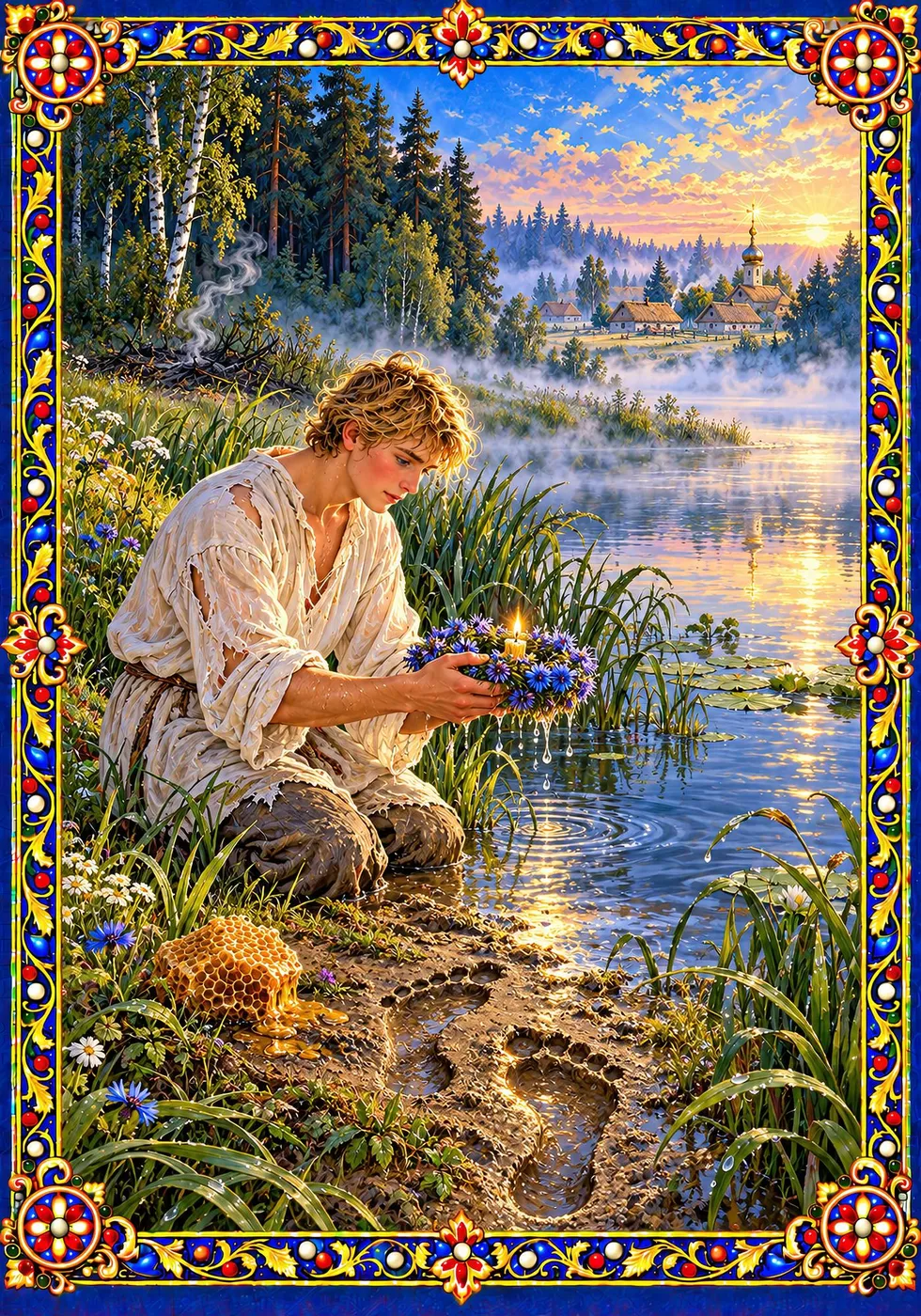
Kylyna floated her wreath alone, a little way down the bank from the others. It was a simple wreath of blue cornflowers, with a small wax candle in the middle. As she set it on the water, she did not look for a young man on the far bank. She closed her eyes and prayed.
“Lord,” she whispered, “keep Mykyta safe tonight. Bring him home. I do not ask that he love me. Only bring him home.”
The little wreath drifted away into the dark with its candle burning.
Mykyta did not leap over the bonfire, and he did not watch the wreaths. As soon as it was dark, he slipped away from the riverbank and went alone into the forest.
The forest of Polissia at night is a strange and frightening place. The pines rose up around him like the pillars of a dark church, and the moon hardly shone between their branches. The ground was soft and wet underfoot, and from every side came the croaking of frogs and the cries of night birds. Mykyta walked deeper and deeper, looking for ferns, and as he went, the path grew narrower and the marsh grew closer.
Then the lights began.
They were small, pale lights, blue and green, flickering among the trees and over the dark water of the marsh. They danced ahead of him, and behind him, and on either side, and they seemed to be beckoning him. This way, they seemed to say. This way to the treasure. Mykyta followed one, and it led him straight toward the black water of a bog, and he stopped just in time.
Then the voices began.
“Mykyta!” called a voice from behind him, and it was his mother’s voice, frightened and weeping. “Mykyta, come back! Come home, my son!”
Mykyta almost turned. Then he remembered: whoever looks back is lost. He clenched his teeth and walked on.
“Mykyta!” called another voice, and, this time, it was Zinovia’s voice, sweet as honey. “Mykyta, I was wrong to laugh at you! Turn around, and look at me!”
Mykyta’s heart leaped, and he almost turned. He did not.
He walked on, his heart pounding, until he nearly stepped on something small and round in the path. He bent down. It was a hedgehog, with its little black nose and its bright black eyes, sitting in the moss.
“Careful!” said the hedgehog in a small, sharp voice. “You nearly trod on me.”
Mykyta stared. “You can talk?”
“On Kupala Night, many creatures can talk,” said the hedgehog. “I have lived in this forest for a long time, and I know every herb and root in Polissia. I know what you are looking for, too, young man. You are looking for the fern flower.”
“Can you show me where it is?”
The hedgehog looked at him for a long moment with its bright little eyes. “I can,” it said. “Before I do, let me tell you one thing, for I have seen many young men come this way on Kupala Night. The fern flower does not give what it promises. Before you pick it, ask what it will cost you.”
Then it trotted off along a tiny path between the ferns, and Mykyta followed it.
At last, just before midnight, they came to a clearing deep in the heart of the forest, where the pines stood around in a black circle and not even the frogs were singing. The clearing was full of ferns, tall and dark and still. The hedgehog stopped at the edge.
“I will go no farther,” it said. “Remember what I told you.”
Mykyta stepped into the clearing.
Far away, faint and small, he heard the bells of the village church begin to ring midnight.
In the middle of the clearing, one fern began to tremble. A bud appeared at its heart, swelling and glowing, red as a coal, and then, with a sound like a small crack of thunder, it burst open into a flower of fire, red and gold and blazing, so bright that it lit up the whole clearing and threw black shadows among the pines.
The fern flower.
Mykyta stepped toward it with his hand outstretched.
“Wait,” said a voice.
Beside the flower, where no one had been standing a moment before, there now stood a tall man in a long black coat. He was handsome and pale, with a thin black mustache and a smile that showed very white teeth. His eyes were black and shining, like the water of the marsh.
“Good evening, Mykyta,” he said pleasantly. “I have been expecting you. Allow me to show you what the flower will give you.”
He waved his hand, and the earth beneath the roots of the fern seemed to open like a window. Mykyta looked down and saw, deep in the ground, a great iron chest, and it was open, and it was full to the brim with gold: gold coins, gold cups, gold chains, golden rings and jewels, blazing in the light of the flower.
“All of it is yours,” said the stranger, smiling. “With this, you will have the finest house in the village, and horses, and fields, and red boots, and silk shirts. The miller will beg you to marry his daughter. Zinovia will never laugh at you again. Everyone who ever looked down on you will bow to you.”
Mykyta’s breath came fast. “What must I do?”
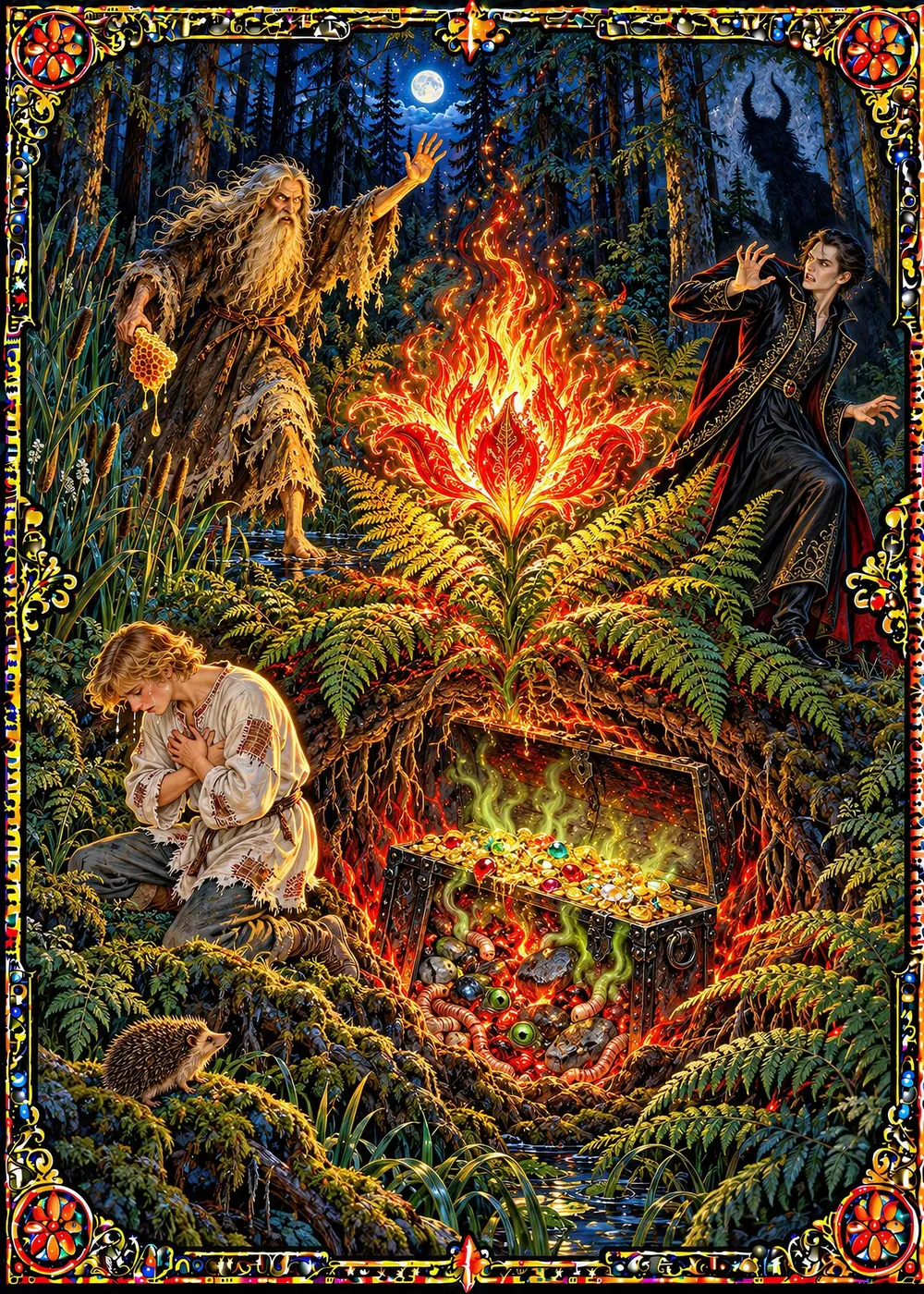
“Only pick the flower,” said the stranger. “There is one small price, of course. There is always a small price.” He smiled more widely. “You must forget your mother. Leave her in her poor hut and never think of her again. You must also forget God. You have almost forgotten Him already, have you not? You have not prayed in months. It is a very small thing. Promise never to pray again, never to cross yourself, never to set foot in church, and the gold is yours.”
* * *
Copyright notice. Introduction and illustration © 2026 Laurent Cleenewerck. All rights reserved. The adapted Orthodox version of this tale is published in Twelve Ukrainian Orthodox Fairy Tales (© 2026 Laurent Cleenewerck). No part of this page may be reproduced without written permission, except for brief quotations with attribution and a link to this page.
Buy the book on AmazonAbout the book