
A tale of Halych and the Day of Rejoicing
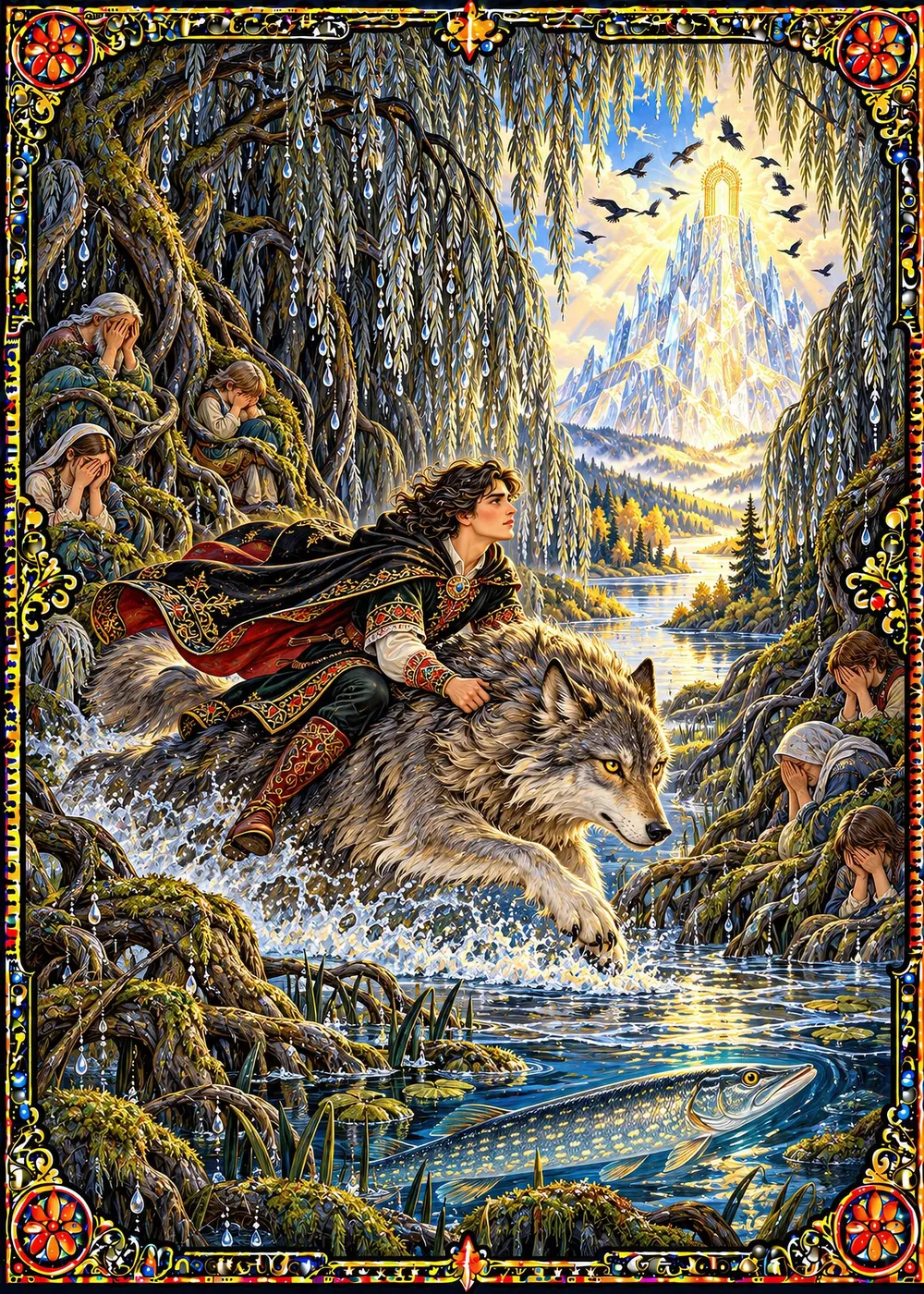
In the western lands of Ukraine, where the Dniester River flows wide and green beneath high wooded banks, there stood the old princely city of Halych. Its castle rose on a hill above the river, and its churches of white stone gleamed among the orchards. On a hill a little way outside the city, among old oaks and lindens, stood the small stone Church of the holy healer Panteleimon, and around it lay the cemetery where the people of Halych buried their dead.
In Ukraine, there is a day in spring called Radonitsa, the Day of Rejoicing. It falls on the Tuesday after Thomas Sunday, nine days after Pascha. On that day, the families of every town and village go out to the cemeteries carrying baskets of red eggs and Paschal bread. They spread embroidered cloths on the graves of their parents and grandparents, their children and friends. The priest goes from grave to grave singing “Christ is risen from the dead,” and the families say to their departed, “Christ is risen!” They roll a red egg on the grave, and they share their food with the poor who come to the cemetery, and with one another. It is not a day of weeping but of joy, for Christ has trampled down death by death, and those who have died in Him are alive.
In the days of our tale, Halych was ruled by a young prince named Myroslav.
He was nineteen years old, tall and dark-haired, with a noble face and gentle brown eyes. His father had died when he was a small boy, and he had been raised by his mother, the Princess Yevpraksia, a wise and holy woman who ruled Halych in his name until he came of age. She taught him to read, to pray, to ride, and to judge fairly. She fed the poor at the palace gate with her own hands, and she visited the sick in the city, and the people loved her. Myroslav loved her more than anyone in the world.
In the winter when he was nineteen, a fever came to Halych, and Princess Yevpraksia fell ill. For seven days, Myroslav sat by her bed and would not leave her. On the seventh night, she took his hand, and she said, “Do not grieve too much for me, my son. I am going to the Lord. Remember that Christ is risen.” Then she closed her eyes, and before dawn she was gone.
She was buried in the cemetery on the hill beside the Church of St. Panteleimon, under a linden tree, and the whole city wept.
After the funeral, something in the young prince broke.
He shut himself in his chambers in the castle and would not come out. He would not eat with his boyars, or ride, or hear the petitions of his people. He sat by the window for hours, staring at the gray sky, and he would not go to church. When the priests came to comfort him, he sent them away.
The castle fell into disorder. The prince’s steward, a greedy man named Vyshata, took charge of the city in his name. He raised the taxes, closed the palace gate to the poor, and filled his own coffers. The people of Halych suffered, but the prince did not see it. He saw nothing but his own grief.
Winter passed, and Lent, and Holy Week. On the night of Pascha, the bells of every church in Halych rang out at midnight, and the whole city poured into the streets with candles, singing, “Christ is risen!” The sound of their singing rose up to the castle windows.
Myroslav sat alone in his dark chamber, with no candle lit, and he put his hands over his ears.
“Christ is risen,” he said bitterly. “If He is risen, then let Him give me back my mother. What good is His Resurrection to me, if she lies in the cold ground under the linden tree?”
A few days after Pascha, an old woman came to the castle gate and asked to see the prince. She was bent and wrinkled, with a basket of herbs on her arm and a gray shawl over her head. The guards would have turned her away, but she would not leave, and at last, out of weariness, the prince let her in.
“Prince,” she said, looking at him with sharp black eyes, “they say you want your mother back.”
“More than anything in the world,” said Myroslav.
“Then listen,” said the old woman. “Far to the east, beyond the edge of the world, there is a garden. It is the garden where the souls of the righteous dwell. In that garden flows a spring of living water. The old stories say that one drop of it can raise the dead. To reach it, you must pass three trials: the Forest of Weeping, the River of Forgetting, and the Mountain of Glass. No living man has ever passed them all.”
Myroslav rose to his feet, and for the first time in months, there was light in his eyes. “Then I will be the first,” he said. “Tell me the way.”
The old woman looked at him for a long moment. “Go east, toward the sunrise,” she said, “and do not turn back. Remember this, however, Prince: what you seek may not be what you find.” Then she took up her basket and went away.
The next morning, before dawn, Prince Myroslav saddled his gray horse and rode out of the castle alone, without telling anyone where he was going. He rode east, toward the sunrise.
For three days, he rode through forests and across meadows, until the lands of Halych were far behind him.
On the first day, as he rode through a thicket, he heard a howl of pain. In a clearing, he found a great gray wolf with its leg caught in a hunter’s iron trap, bleeding and snarling. The prince’s heart was so heavy with his own grief that he almost rode past. Then he thought of his mother, who had never passed by any creature in pain. He climbed down from his horse, and though the wolf snarled at him, he pried open the jaws of the trap with his dagger and freed its leg.
The wolf limped a few steps away, then turned and looked at him with its yellow eyes. “Thank you, Prince,” it said in a rough voice. “I will not forget.” Then it vanished into the trees.
On the second day, as he crossed a stream, he saw a great silver pike lying on the stones where the water had dried up in a side channel, gasping and flapping. He dismounted, lifted the heavy fish in his arms, and carried it back to the deep water.
The pike flicked its tail and looked up at him. “Thank you, Prince,” it said in a voice like bubbling water. “I will not forget.” Then it vanished into the depths.
On the third day, as he rested under a tall oak, he heard a pitiful croaking. On the ground at his feet was a young raven, fallen from its nest high in the oak, too young to fly. The prince climbed the tree, though his arms ached, and set the young raven back in its nest. At once, a great black raven came flapping down and landed on the branch beside him.
“Thank you, Prince,” said the old raven. “You have saved my child. I will not forget.”
On the fourth day, Myroslav came to the Forest of Weeping.
It was a forest of willows, gray and drooping, so tall that their branches hid the sky. From every leaf and twig, tears were dripping, drop by drop, onto the ground, and the ground was a soft, sodden marsh of tears. The air was filled with a sound of sighing and sobbing, as though the trees themselves were weeping, and the sound went straight to the prince’s heart.
His gray horse stopped at the edge of the forest and would not go on. It reared and whinnied in fear, and when Myroslav dismounted, it turned and galloped away toward home.
The prince went into the forest on foot.
As he walked, the willows began to whisper to him. Stay, they whispered. Stay here with us and weep. Your mother is dead. Everyone you love will die. There is no hope, no joy, only grief forever. Sit down among our roots and weep with us. Why go on?
Myroslav’s feet grew heavy. His heart grew heavier still. All around him, among the roots of the willows, he saw people sitting: men and women, old and young, sitting in the marsh of tears with their heads in their hands, weeping. Some of them had been sitting there so long that moss had grown over them and roots had wound around their feet. They did not look up as he passed.
Sit down, whispered the willows. Sit down and weep.
The prince’s knees began to bend. He was so tired, so sad. It would be so easy to sit down among the roots and weep forever.
At that moment, there was a crashing in the undergrowth, and the great gray wolf came bounding through the willows toward him.
“Prince!” it growled. “Do not sit down! Those who sit down in this forest never rise again. Climb on my back, quickly, and hold on tight!”
Myroslav climbed onto the wolf’s back and wound his hands in its thick fur. The wolf ran. It ran faster than any horse, splashing through the marsh of tears, leaping over the roots, dodging the drooping branches, while the willows wailed and whispered around them. It ran so fast that the whispers could not catch the prince’s ears, and before despair could take hold of his heart, they burst out of the far side of the forest into the sunlight.
The wolf set him down on the grass. “The Forest of Weeping holds only those who stop,” it said. “Keep going, Prince.” Then it was gone.
Myroslav walked on, and, after a time, he came to the River of Forgetting.
It was a wide, slow river, clear and cool, flowing between banks of soft green moss. After the long journey and the marsh of tears, the prince was terribly thirsty. His lips were cracked and his throat burned. The water looked so pure, so sweet.
He knelt on the bank and cupped his hands to drink.
Out of the river rose the great silver pike.
“Prince!” it cried. “Do not drink! This is the River of Forgetting. Whoever drinks from it forgets everyone he ever loved. If you drink, you will forget your mother’s face, and her voice, and her love, and you will never remember why you came.”
Myroslav snatched his hands back as though the water were fire.
“Then how shall I cross?” he asked. “There is no bridge and no boat, and if I swim, the water will touch my lips.”
“Climb on my back,” said the pike, “and keep your mouth closed.”
The prince lay on the broad back of the great fish, and the pike carried him across the River of Forgetting, gliding smoothly through the water, and not a single drop touched his lips. On the far bank, the pike slipped back into the depths, and the prince walked on, thirsty but remembering.
At last, he came to the Mountain of Glass.
It rose straight up into the clouds, so tall that he could not see the top. It was made of clear, smooth glass, without a crack or a ledge anywhere, and it shone so brightly in the sun that it hurt his eyes. At its foot lay the broken swords and ropes of those who had tried to climb it and failed.
Myroslav tried to climb. He slid down. He tried again and slid down again. He tried until his hands were bleeding and his strength was gone, and, at last, he lay at the foot of the Mountain of Glass and wept.
Then he heard a great rushing of wings.
Out of the sky came the old black raven, and behind it came a hundred ravens, a thousand ravens, a great black cloud of wings. They came down around the prince and took hold of his cloak and his sleeves and his belt in their claws, and they lifted him into the air. Up and up, they carried him, past the shining glass slopes, through the clouds, until they set him down gently on the very summit of the Mountain of Glass.
“You saved my child,” said the old raven, “and so I have carried you. Go on, Prince. The gate is before you.”
On the summit of the Mountain of Glass stood a gate.
It was a gate of pure light, set in a wall of light, and beyond it lay a garden more beautiful than anything Myroslav had ever imagined. There were trees heavy with fruit and blossom at the same time, and meadows of white flowers, and streams of clear water sparkling in a light that was brighter and gentler than the sun. From the garden came the sound of singing, many voices singing together, and though he could not hear the words, the sound filled his heart with a joy so deep that it almost hurt.
* * *

Copyright notice. Introduction and illustration © 2026 Laurent Cleenewerck. All rights reserved. The adapted Orthodox version of this tale is published in Twelve Ukrainian Orthodox Fairy Tales (© 2026 Laurent Cleenewerck). No part of this page may be reproduced without written permission, except for brief quotations with attribution and a link to this page.
Buy the book on AmazonAbout the book