
A tale of Generous Evening in Volhynia
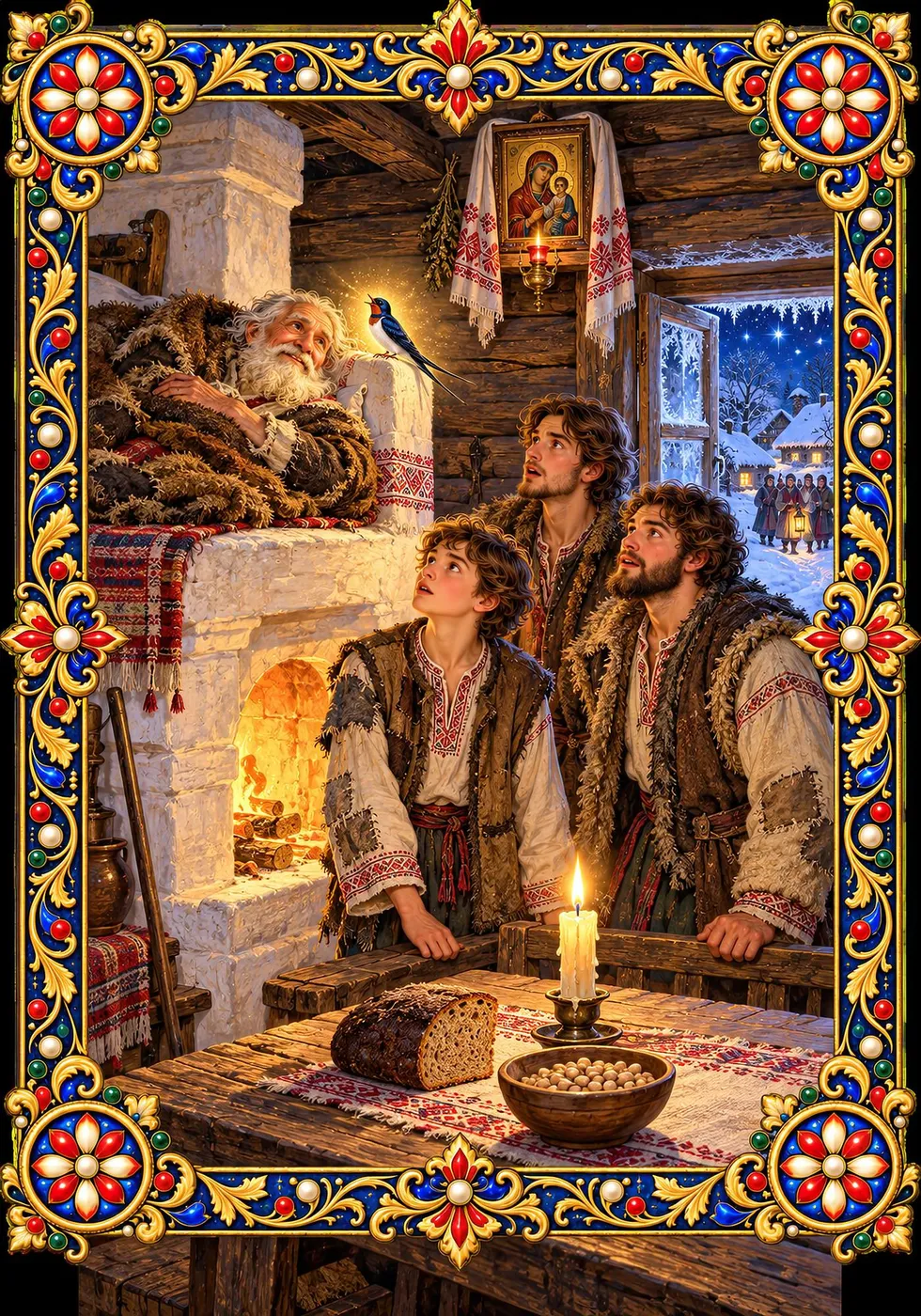
In the land of Volhynia, where dark pine forests stand beside quiet lakes and rivers wind slowly through the marshes, there was once a poor village of low wooden cottages with thatched roofs. In one of those cottages, the poorest of them all, lived an old widowed farmer named Matvii with his three sons.
Matvii had worked hard all his life, but his field was small and his luck was poor. One year, the rain rotted his rye, the next year the hail flattened his wheat, and, the year after that, the wolves took his only cow. Now he was old and ill, and he lay on the warm top of the stove wrapped in a patched sheepskin, coughing, while the wind whistled through the cracks in the walls.
His eldest son was Oleksa, tall and handsome, who spoke often of money. “If only we had gold,” he would say, “we could buy a new cow, and a horse, and medicine for Father, and fine clothes for ourselves besides.”
His middle son was Grigory, broad and strong, who spoke often of land. “If only we had more fields,” he would say, “and herds of cattle and flocks of sheep, then we would be rich like the landlord.”
His youngest son was Vasyl, named for the holy Basil the Great, on whose feast he had been born. He was fifteen years old, slight and quiet, with a thoughtful face and clear brown eyes. Vasyl did not speak of gold or land. He wished only that his father would get well. Every evening, when the family sat down to their supper of black bread and water, it was Vasyl alone who made the sign of the cross over it and said, “Glory to God for all things.”
His brothers laughed at him. “Glory to God for black bread?” said Oleksa. “Glory to God for a leaking roof and an empty barn?”
“It is bread,” said Vasyl simply. “Some have none.”
In the year of our tale, the winter was the hardest anyone could remember. By the eve of the New Year, which the people of Ukraine call Generous Evening, the eve of the Feast of St. Basil, the family had nothing left but half a loaf of bread and a handful of dried peas.
On Generous Evening, the young people of the village go from house to house singing shchedrivky, the New Year songs, wishing each family a rich and generous year. The families give them sweets and coins and sausages in return. That evening, the carolers came singing down the lane, laughing and stamping their feet in the snow, and they stopped at every cottage except Matvii’s. Everyone knew there was nothing to give in that house.
Vasyl stood at the frosty window and listened to the singing grow fainter down the lane. Behind him, his father coughed on the stove.
“Glory to God for all things,” Vasyl whispered, though his heart was heavy.
At that moment, something tapped at the window.
Vasyl looked and could hardly believe his eyes. On the windowsill, in the middle of winter, when all the swallows had long since flown south to warmer lands, sat a little swallow, with a dark blue back and a white breast and a red throat, fluffed up against the cold.
Vasyl opened the window, and the swallow flew in. It circled the room three times and landed on the edge of the stove, beside the old man’s head. Then it began to sing.
It sang the oldest and most beloved of all the New Year songs, the one that every child in Ukraine knows, the song of Shchedryk. It sang in a clear, bright voice, like a little bell:
Shchedryk, shchedryk, the New Year’s song,
a little swallow has flown in,
she has come to call the master out:
“Come out, come out, good master,
and look into your sheepfold:
your ewes have borne you little lambs.
Your goods are fine, your coins are good,
and you will have a dark-browed bride.
Shchedryk, shchedryk, the New Year’s song.”
The old man opened his eyes and stared at the swallow. The three brothers stood frozen in the middle of the room.
When the swallow finished its song, it turned its bright black eyes on the three brothers, and it spoke to them in a small, clear voice.
“All the blessings of the song are real,” it said. “The flocks, the harvest, the good fortune, the dark-browed bride. They are waiting for this house. They lie far away, however, beyond three forests and three rivers, at the foot of the great oak at the end of the world. Whoever goes to find them must go tonight. Will you come? I will show you the way.”
Oleksa’s eyes lit up. “Riches!” he cried. “Beyond three forests! Of course, we will come!”
“Flocks and fields!” said Grigory. “I am ready.”
Vasyl looked at his father on the stove. “Father,” he said, “will you be well while we are gone?”
The old man smiled weakly. “Go, my sons,” he said. “The swallow sings of blessings, and I have prayed for blessings on this house all my life. Go with God. Vasyl, give thanks for everything on the road, as you do at home. It will keep you safe.”
And so, the three brothers wrapped themselves in their patched coats, took the last half loaf of bread, which Vasyl tucked inside his shirt, and followed the swallow out of the cottage into the snowy night.
The swallow flew ahead of them over the fields, and though it was dark, a soft light seemed to shine around it, so that they could always see it. They walked for what seemed a very long time, until at last they came to the edge of the first forest.
It was the Copper Forest.
Every tree in that forest was made of copper, from its roots to its topmost twigs. The trunks glowed red-brown in the starlight, and the leaves were thin copper plates that rang against one another in the wind like a thousand tiny bells. The ground was covered with fallen copper leaves, heaped up like autumn leaves in a village lane.
Grigory stared with wide eyes. “Copper!” he gasped. “A whole forest of copper! With all this, I could buy fields and cattle enough for a lifetime!”
He dropped to his knees and began to scoop the copper leaves into his sack.
“Brother,” said the swallow, “the riches of the song are not here. Do not stop.”
Grigory did not listen. The copper leaves rang, and the ringing seemed to fill his ears and his mind, and it seemed to him that the forest was whispering, Stay, stay. All this is yours. Why go on? Stay here, and take all you want. Grigory filled one sack, and then another, and then he took off his coat and filled that too, and all the time the forest whispered to him, until he forgot his father, and his brothers, and his home, and the swallow.
“Grigory!” cried Vasyl, shaking his shoulder. “Come on! We must go!”
“Go on without me,” said Grigory, without looking up. “I will follow you later.”
Vasyl and Oleksa walked on, and when they looked back from the edge of the forest, they saw their brother still kneeling among the copper trees, heaping leaves into his sacks, with a strange, dazed look on his face.
Beyond the Copper Forest lay the first river, the Black River. It was wide and black, and it was frozen over with a thin sheet of ice, so clear and dark that they could see the water rushing beneath it. As they stepped out onto the ice, it creaked and cracked under their feet.
“It will break!” cried Oleksa. “We will drown!”
Vasyl knelt down on the ice. “O Lord,” he said, “thank You for this ice. Thank You that the river is frozen at all, so that we may cross. Glory to God for all things.”
At once, the ice beneath them grew thick and white and solid, as solid as stone, and the two brothers walked across the Black River in safety. When they reached the far bank and looked back, the ice had turned thin and black again.
Beyond the Black River lay the second forest. It was the Silver Forest.
Every tree in that forest was made of silver, and the leaves shone like moonlight on water. The silver branches glittered so brightly that the forest was almost as bright as day, and the silver leaves made a soft, sweet music in the wind, like harps.
Oleksa’s breath caught in his throat. “Silver!” he whispered. “Silver enough to buy a palace, with servants and horses and fine clothes. Vasyl, look!”
He threw himself down among the silver leaves and began to gather them with both hands.
“Brother,” said the swallow, “the riches of the song are not here. Do not stop.”
Oleksa did not listen. The silver leaves sang to him like harps, and the forest whispered to him, Stay, stay. All this is yours. What is a sick old father and a leaking cottage, compared with this? He filled his pockets and his hat and his shirt, and he forgot his father, and his brothers, and his home, and the swallow.
Vasyl begged him to come, but Oleksa only waved him away. “Go on, little brother,” he said. “Go and find your riches at the end of the world. I have found mine here.”
So Vasyl walked on alone behind the swallow, with a heavy heart.
Beyond the Silver Forest lay the second river, the Silver River, wide and swift, rushing and foaming between steep banks. There was no ice here and no bridge. At the edge of the water, a small boat was drawn up on the bank, and in it sat an old ferryman with a long gray beard and a patched cap.
“Grandfather,” said Vasyl, “will you carry me across? I have no money to pay you. I have only half a loaf of bread, and I must keep it for the road.”
“Get in, lad,” said the old ferryman.
He rowed Vasyl across the swift river, pulling hard against the current, and set him down safely on the far bank. When Vasyl climbed out, he turned and bowed low to the old man.
“Thank you, grandfather,” he said. “May God reward you for your kindness. Glory to God for all things.”
The old ferryman looked at him for a long time with his faded blue eyes. “Forty years I have rowed this river,” he said. “Thousands have crossed in my boat. Most of them cursed the water, or cursed the price, or cursed me for being slow. You are the first who ever thanked me.” He smiled. “Go on, lad. You will find what you are looking for.”
Beyond the Silver River lay the third forest. It was the Golden Forest.
It was more beautiful than anything Vasyl had ever imagined. Every tree was made of pure gold, gleaming and glowing, and the golden leaves shone like the sun at noon, so that the whole forest was full of warm golden light, though it was the middle of the night. The golden leaves made no sound at all. The forest was perfectly still and silent, and so beautiful that Vasyl’s eyes filled with tears.
The forest whispered to him as it had whispered to his brothers: Stay, stay. All this is yours. Take as much as you want. You will never be poor again.
Vasyl stood still for a moment. He thought of his father coughing on the stove, and of the empty barn, and of the leaking roof. A single golden leaf would buy a new cow. A handful would buy a whole farm.
Then he took off his cap, and he bowed to the golden trees.
“O Lord,” he said, “thank You for making this forest so beautiful. Thank You for letting me see it. I have never seen anything so lovely. Glory to God for all things.” Then he put his cap back on, and he walked on through the forest without picking up a single leaf.
As he walked, the golden trees bowed their branches to him on either side, as though in honor.
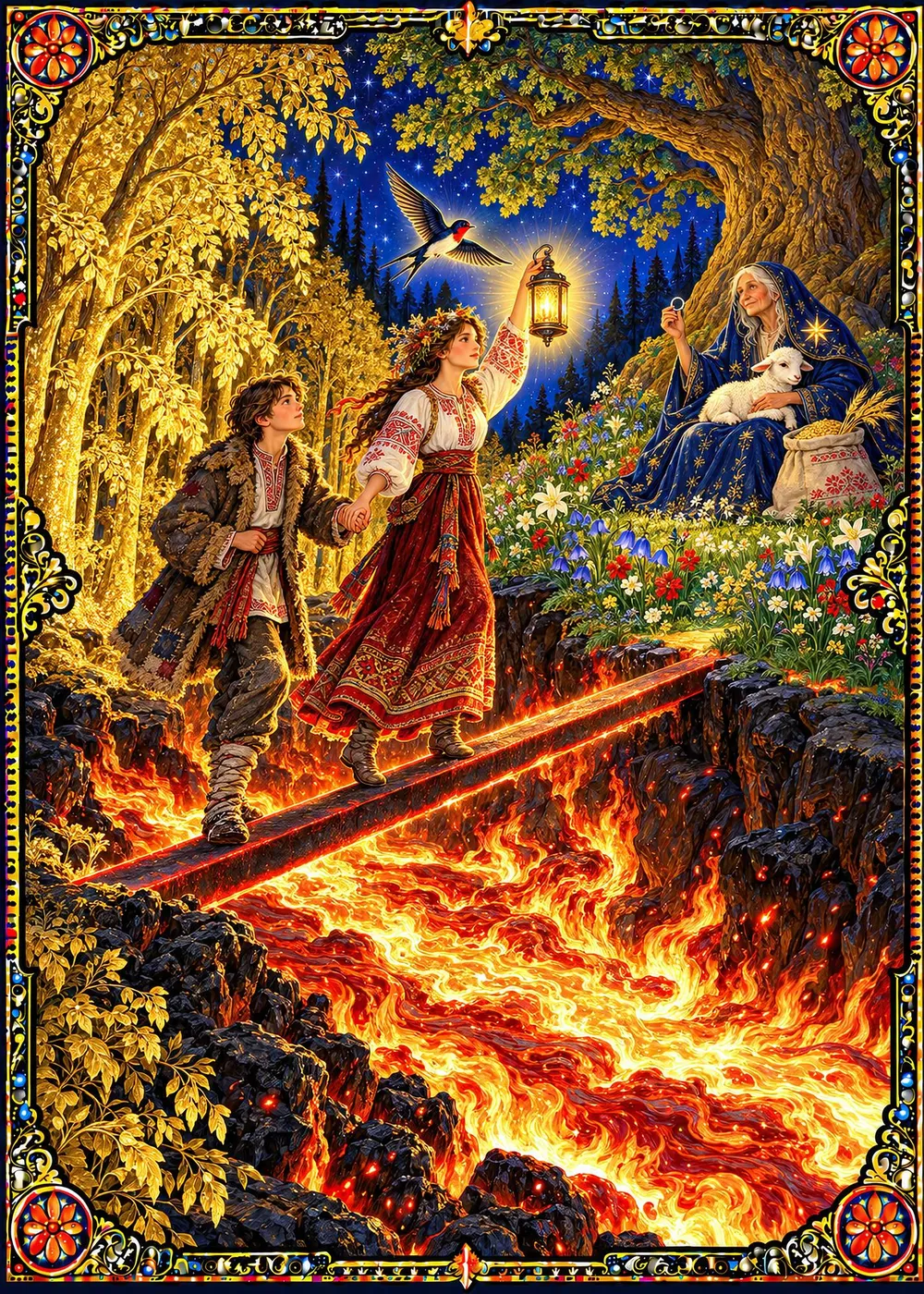
Beyond the Golden Forest lay the third river. It was the River of Fire.
It was not water that flowed in that river, but flames, red and orange and white, roaring and leaping between banks of black rock, and the heat of it scorched Vasyl’s face from twenty paces away. Across it, there was only one bridge: a narrow beam of iron, no wider than a man’s hand, glowing red-hot in the heat of the flames.
* * *
Copyright notice. Introduction and illustration © 2026 Laurent Cleenewerck. All rights reserved. The adapted Orthodox version of this tale is published in Twelve Ukrainian Orthodox Fairy Tales (© 2026 Laurent Cleenewerck). No part of this page may be reproduced without written permission, except for brief quotations with attribution and a link to this page.
Buy the book on AmazonAbout the book