
A tale of the city of lions
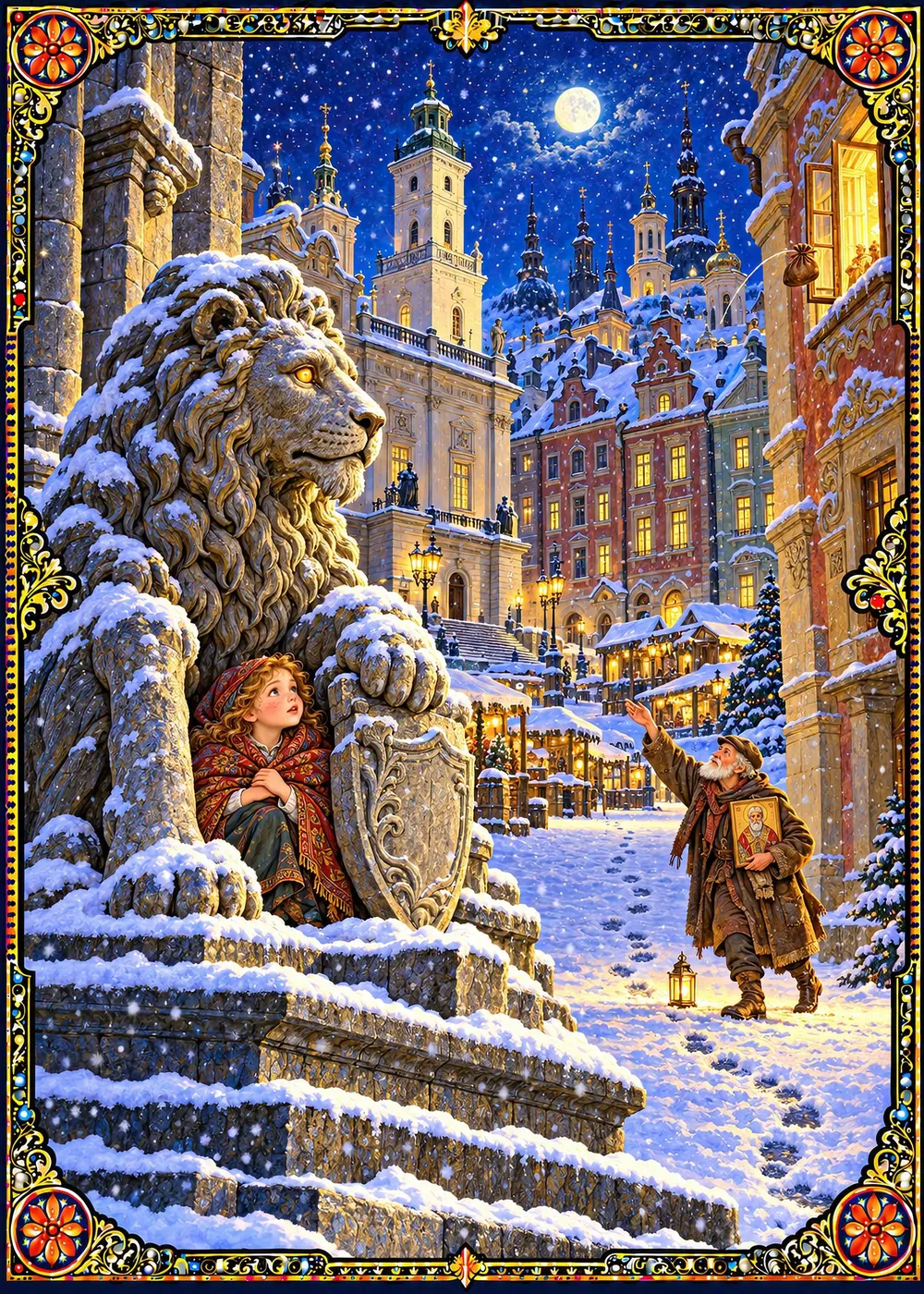
In the western lands of Ukraine, among green hills and old beech forests, there stands the city of Lviv. It was founded long ago by the good King Danylo of Halych, who named it after his son Lev, whose name means “lion.” Ever since, the lion has been the guardian of the city. Stone lions sit beside its gates and doorways, lions hold up its balconies, lions spout water into its fountains, and lions look down from the roofs of its churches with wise stone eyes.
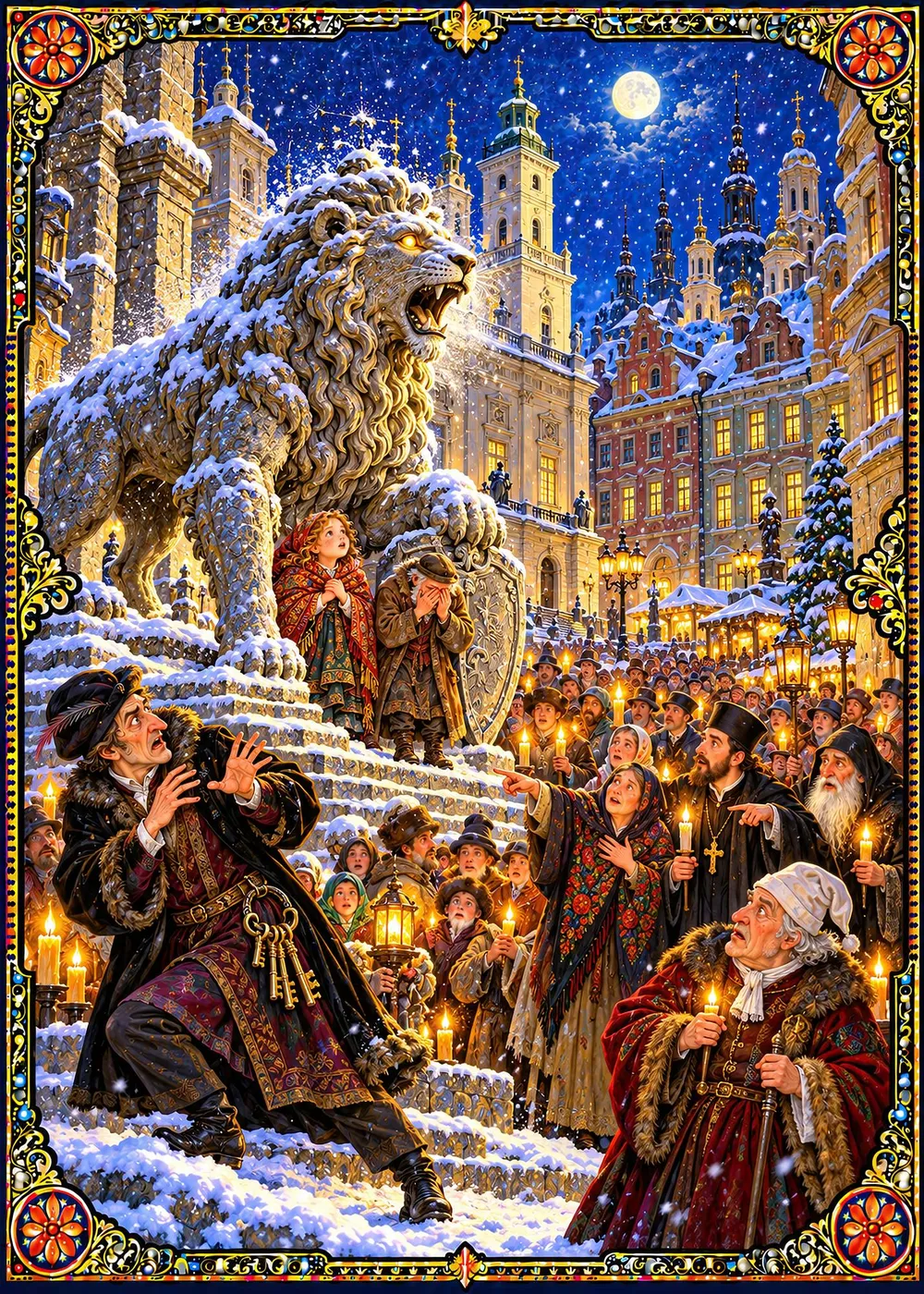
The oldest lion of all sits on the steps of the town hall in the great market square. He is gray with age, his mane worn smooth by centuries of rain, and one of his front paws rests on a stone shield bearing the arms of the city. The old people of Lviv say that he has watched over the city since the days of King Danylo, and that he sees everything that happens in the square, by day and by night.
In the days of our tale, there lived on the market square a merchant named Ivan. He had once been one of the richest men in Lviv. His ships had carried amber and furs down the rivers to the Black Sea and brought back silk and spices from Constantinople. Then, in a single terrible autumn, a great storm at sea sank all three of his ships with all their cargo, and Ivan was ruined.
To buy those ships, he had borrowed a great sum from a moneylender named Shkurko.
Shkurko was a thin, sallow man with long fingers and small, damp eyes, who lived in a tall, narrow house at the corner of the square with iron bars on every window. He lent money to anyone in trouble and charged interest so cruel that no one who borrowed from him ever got free again. The people of Lviv said that he would skin a flea for its hide.
When Shkurko heard that Ivan’s ships had sunk, he came at once to the merchant’s house with a paper in his hand.
“You owe me three hundred gold ducats,” he said, “and the time for payment ends on the last day of the month. If you cannot pay, the law is on my side. I will take your house and everything in it, and I will take your three daughters into my house as servants for seven years, to work off your debt.”
Ivan went pale. He had three daughters, and he loved them more than all his lost ships.
The eldest was Olena, eighteen years old, tall and serious, who kept the household since their mother died. The second was Khrystia, fifteen, merry and quick, who sang at her spinning wheel. The youngest was Marusia, nine years old, small and bright-eyed, with a round face full of freckles and a heart as soft as fresh bread.
The merchant sold everything he could. He sold his furniture, his wife’s jewels, his silver cups, even his warm winter coat, but when he had sold it all, he still had nothing like three hundred ducats. He sat at his empty table with his head in his hands.
Olena held him and said nothing. Khrystia stopped singing. Only little Marusia did not understand how bad it was, and she slipped out of the house in the evening, as she often did, and went to sit on the steps of the town hall beside the old stone lion.
She had been talking to him for as long as she could remember. When she was sad, she would sit against his worn stone side and tell him her troubles, and somehow she always felt better afterward. The other children laughed at her for talking to a statue, but Marusia did not mind.
That night, she sat beside him in the cold and told him everything. “If Father cannot pay,” she said, “Shkurko will take us all to his house for seven years. Olena says he beats his servants and gives them only crusts. I am afraid, Lion.”
The bells of the churches of Lviv began to ring midnight. As the last stroke died away over the rooftops, the stone lion turned his great head and looked down at her.
“Do not be afraid, little one,” he said.
His voice was deep and rough, like stones grinding in a riverbed. Marusia gasped and nearly fell off the step.
“You can talk!” she whispered.
“I can,” said the lion. “Only after midnight, and only to children who are pure of heart. I have been listening to you for years, Marusia. I know your troubles. Go home to bed now, and do not lose hope. Help often comes to Lviv by night.”
Marusia ran home and lay awake in her little bed, wondering if she had dreamed it all.
In the morning, she was awakened by a shout. Her father stood in the middle of the kitchen, holding a leather purse in his trembling hands. The window was open, and the purse had been lying on the floor beneath it when he came down at dawn. Inside it were exactly one hundred gold ducats.
“Someone threw it through the window in the night,” said Ivan, his voice shaking. “There is no name, no letter, nothing. It is enough to pay a third of the debt. Enough to free Olena.”
Olena burst into tears.
By noon, the whole market square was talking about it. Who could have done such a thing? The women at the well guessed that it was one of the rich boyars. The men at the tavern guessed that it was the bishop, or the abbot of the monastery, or some secret admirer of Olena’s. The children made up stories about a mysterious knight on a black horse.
Marusia said nothing. That night, she went back to the lion.
“Lion,” she whispered as the bells rang midnight, “was it you?”
The lion’s stone mouth curved in what might have been a smile. “Stone lions have no gold, little one,” he said. “Wait and see.”
On the second morning, a second purse lay beneath the open window, with another hundred ducats in it. Now Khrystia was free too, and she danced around the kitchen, laughing and weeping at once. The whole city buzzed like a hive of bees.
One person in the city was not pleased. Shkurko the moneylender had been looking forward to having three young servants in his house for seven years. When he heard that Ivan could now pay two thirds of the debt, he gnashed his teeth and swore to find out who was ruining his plans.
Everyone in Lviv had a guess about the secret giver, yet no one guessed Old Yakiv.
Old Yakiv was a shoemaker who lived in a tiny workshop in a crooked lane behind the Dominican church. He was bent and gray and had worked at his last from dawn to dark for fifty years. He wore the same patched brown coat winter and summer. He ate black bread and onions and drank water. He never went to the tavern, never bought a new hat, and never gave a single coin to the beggars at the church door, at least as far as anyone could see. When people passed his shop, they shook their heads.
“There goes Yakiv the Miser,” they said. “He has been cobbling shoes for fifty years and never spent a penny. He must have a mountain of gold under his floor. What good will it do him in his grave?”
The children of the lane sang a rhyme about him: Yakiv the Miser, counting his gold, the richer he gets, the meaner and cold. Old Yakiv only smiled a little sadly and bent over his shoes.
On the third night, the eve of the Feast of St. Nicholas, Marusia could not sleep for curiosity. She wrapped herself in her shawl and crept out to the lion before midnight, and she hid in the deep shadow between his great stone paws.
“You want to see who it is,” said the lion, as the bells rang twelve.
“Yes,” said Marusia. “Please.”
“Then watch,” said the lion, “and be very quiet. Whatever you see, do not call out.”
They waited. The square was dark and empty, and snow was beginning to fall. Then, out of a crooked lane behind the Dominican church, a small bent figure came limping across the square, with a patched brown coat and a lantern shielded under its cloak.
It was Old Yakiv the shoemaker.
He stopped outside the merchant’s window, set his lantern on the ground, and took something from beneath his coat. It was a small, worn icon of St. Nicholas, the holy bishop of Myra, with his white beard and his book of the Gospels. Yakiv kissed it and crossed himself.
“Holy Father Nicholas,” he whispered, so softly that Marusia could barely hear him, “you once threw three purses of gold through the window of a poor man in Myra, so that his three daughters would not be sold. You did it in secret, so that no one would thank you but God. Help me to do the same. Let no one ever know.”
Then he drew out a third purse, heavier than the other two, and tossed it gently through the open window. It landed on the kitchen floor with a soft clink. Yakiv picked up his lantern and limped away across the square, back into his crooked lane, and the falling snow covered his footprints behind him.
Marusia sat frozen between the lion’s paws with her mouth open.
“Old Yakiv?” she whispered at last. “Yakiv the Miser?”
“Yakiv the Miser,” said the lion quietly. “For forty years, I have watched him cross this square at night. He works from dawn to dark, and he eats black bread and onions, and he wears the same coat for twenty winters, and he gives away everything else he earns. The widow on Ruthenian Street, whose roof was mended by an unknown hand, and the orphans at the monastery, whose bread never runs out, and the poor student who found his university fees paid, and a hundred others: all of it was Yakiv. No one has ever thanked him. He has never wanted anyone to.”
“Why does he let them call him a miser?” asked Marusia, with tears in her eyes.
“Because our Lord said, ’When you give alms, do not let your left hand know what your right hand is doing, so that your alms may be in secret; and your Father who sees in secret will reward you,’” said the lion. “Yakiv would rather be mocked by men than lose his reward from God.”
He turned his great stone eyes on her. “Now you know his secret, Marusia. You must keep it. If you tell anyone, you will take his reward away from him. Will you promise?”
“I promise,” whispered Marusia.
In the morning, Ivan found the third purse beneath the window. It held a hundred ducats, and a little more besides. The merchant fell on his knees and thanked God, and then he went straight across the square to Shkurko’s narrow house and paid his debt in full, every last ducat.
* * *
Copyright notice. Introduction and illustration © 2026 Laurent Cleenewerck. All rights reserved. The adapted Orthodox version of this tale is published in Twelve Ukrainian Orthodox Fairy Tales (© 2026 Laurent Cleenewerck). No part of this page may be reproduced without written permission, except for brief quotations with attribution and a link to this page.
Buy the book on AmazonAbout the book