
A Story of Ryazan and the Feast of Saint George
In the ancient lands of Rus’, where the Oka River flows wide and slow along the edge of the great steppe, there stood the old city of Ryazan on its high earthen ramparts. Its churches looked south over the endless grasslands, and from those grasslands, for as long as anyone could remember, trouble had come riding.
In the villages around Ryazan, the greatest feast of spring was the Feast of the holy Great-Martyr George, whom the people called Yegory the Brave. On that day, called Yuriev Day, the herds were driven out to pasture for the first time after the long winter. At dawn, the shepherds touched each cow and sheep with a branch of pussy willow saved from Palm Sunday, and they prayed to holy George, the protector of flocks, who is also, as the old people say, the master of the wolves, the one who tells them where they may hunt and where they may not.
In a village by the Oka, not far from the city, there lived a young shepherd named Yegor.
He was seventeen years old, the only son of a poor widow, and he tended the village herd from spring until the first snow. He was kind and gentle with the animals and good with his hands, and he could play the shepherd’s horn so sweetly that the cows came running at the sound. Yegor, however, was afraid of almost everything. He was afraid of thunder, afraid of the dark forest, afraid of the boyars’ sons who rode through the village and laughed at him. Most of all, he was afraid of wolves.
Once, two summers before, a wolf had come out of the forest at dusk and taken a lamb from Yegor’s flock. Yegor had climbed a tree and stayed there, shaking, until morning. The whole village knew it. The boyars’ sons, when they rode by, would call out, “Look! It is Yegor the Brave, named for the bravest saint in heaven, who hides in trees from wolves!” Then they would laugh until they nearly fell out of their saddles.
Only once had anyone stood up for him. On a market day in Ryazan, when the boyars’ sons were mocking him in the square, a young woman in a blue cloak had stepped between them and said sharply, “Shame on you. He is a shepherd who works while you do nothing. Has any one of you ever fed anyone?” The young men had gone red and ridden away. The young woman had given Yegor a kind smile and a coin for his mother, and then she had gone on her way with her maid.
Afterward, Yegor had learned who she was. She was Darya, the only daughter of Prince Svyatoslav of Ryazan. He had never forgotten her face, though he knew that a princess could never be anything to a shepherd.
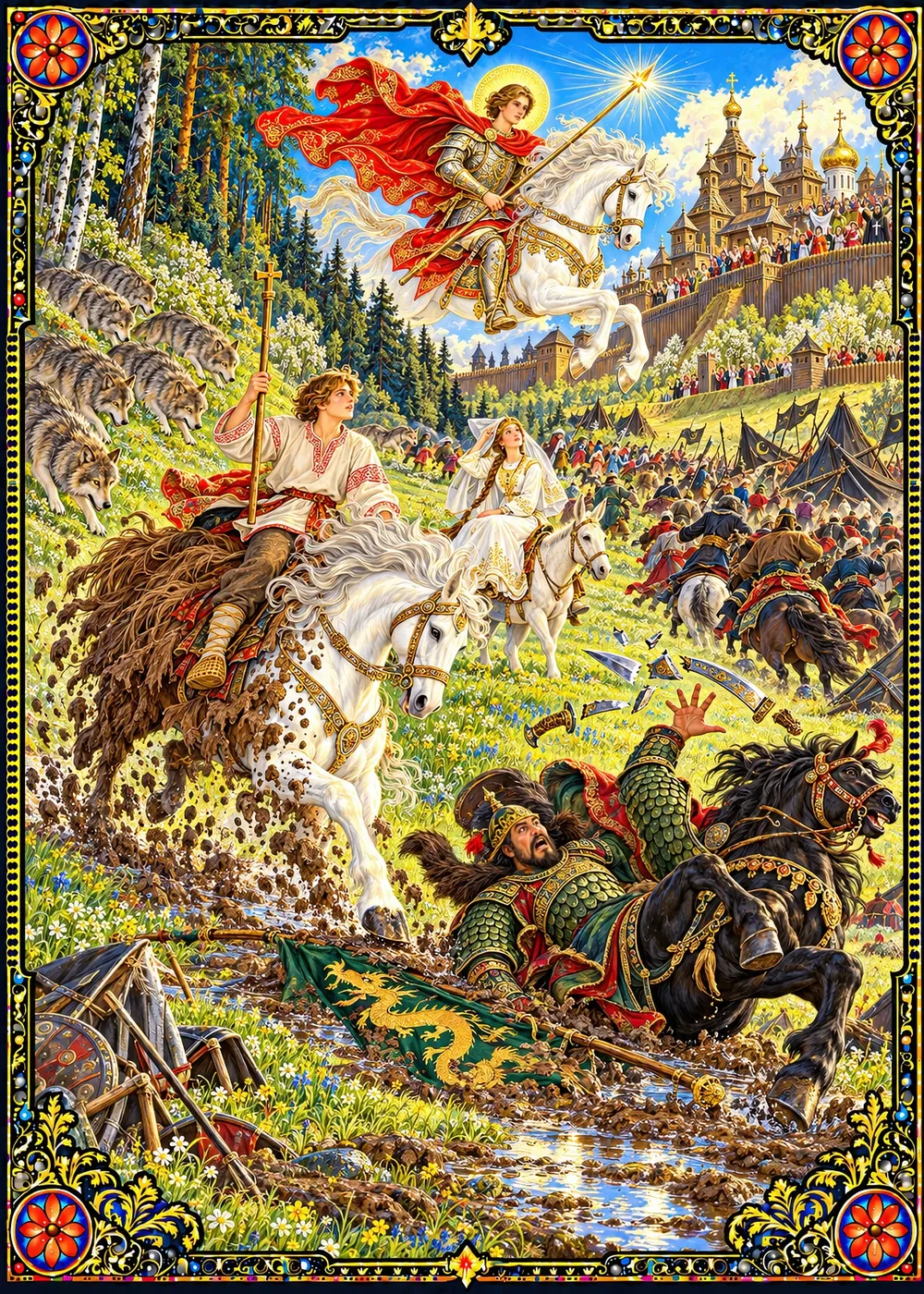
In those years, a terrible enemy rode out of the steppe. He was a warlord named Tugar, whom the people called the Serpent, for he carried a great banner embroidered with a green dragon, and he was as cold and cruel as a snake. Each spring, he came with his horsemen and plundered the villages of Ryazan, burning the huts, stealing the herds, and carrying away the young men as slaves. The old prince had sent his three sons against him, one after another, and all three had fallen in battle. Now the prince was old and grieving, and his warriors were too afraid to fight.
In the year of our tale, Tugar sent a messenger to Ryazan with a demand.
“The Serpent is tired of small tribute,” the messenger said, standing before the old prince with his hand on his sword. “He wants a wife. On the day your people call Yuriev Day, you will send your daughter to his camp on the meadow below the city. If she comes, he will leave your villages in peace for seven years. If she does not come, he will burn Ryazan to the ground and carry away everyone in it.”
The old prince wept and tore his beard. The boyars looked at the floor.
It was Princess Darya herself who spoke. “Father,” she said, and her voice shook only a little, “I will go. I cannot let the whole city burn for my sake. Holy George once saved a princess from a dragon. Perhaps God will send someone to save me. If not, I will die with a clean conscience.”
So it was decided. On the Feast of holy George, the princess would be given to the Serpent.
On the eve of the feast, a great spring storm broke over the Oka, and, in the storm, one of the village heifers broke loose and ran into the forest. Yegor, trembling, went after it with a lantern, for he was the shepherd, and the heifer was his responsibility. He searched for hours in the rain and the dark until he was hopelessly lost. At last, soaked and frightened, he saw a light among the trees and stumbled toward it.
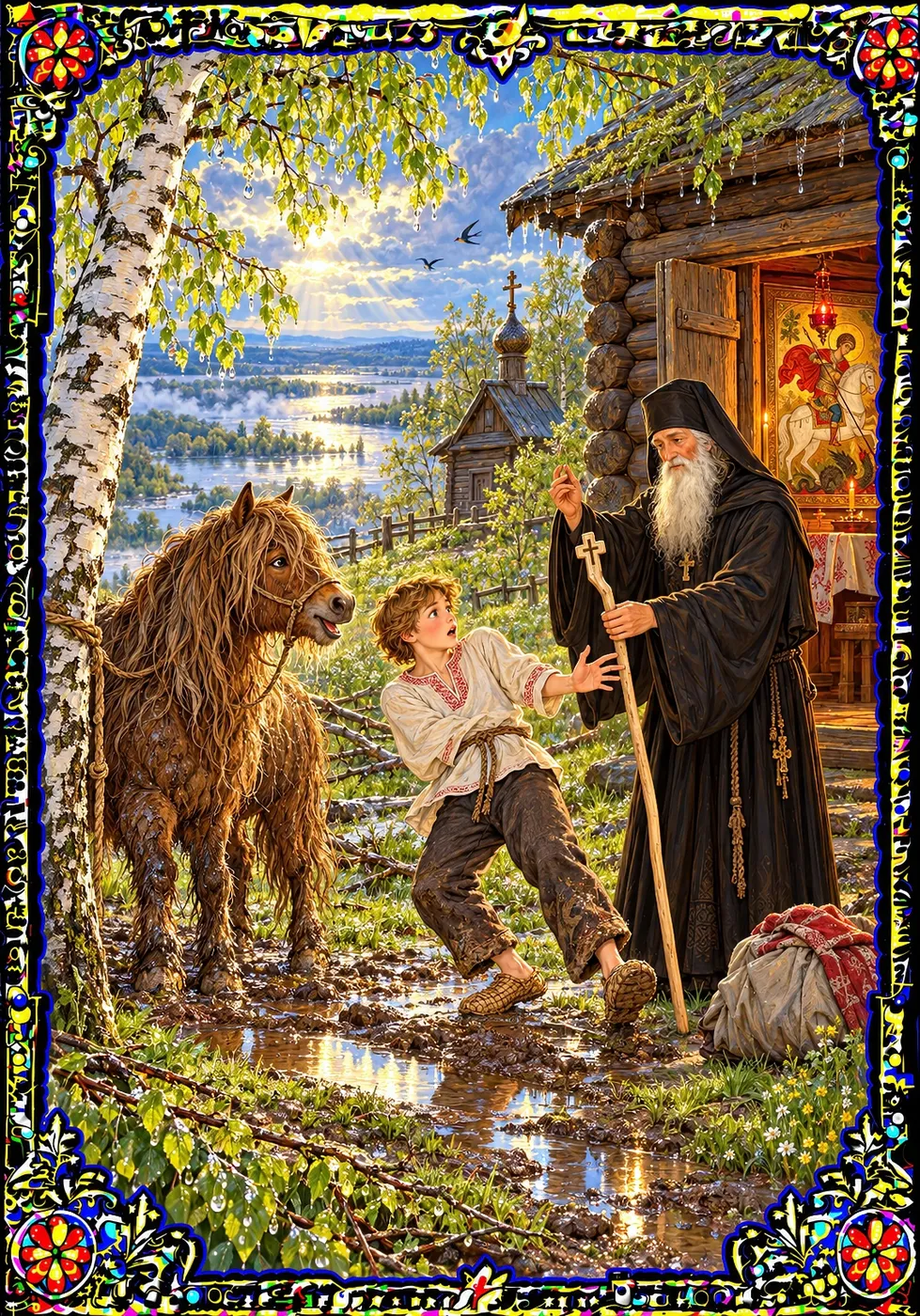
It was a hermitage: a small log cell and a tiny chapel with a wooden dome, on a hill above the flooded river. At the door stood an old monk with a long white beard, holding a lamp.
“Come in, Yegor,” said the old man. “I have been waiting for you.”
Yegor was too tired to ask how the old man knew his name. The monk, whose name was Father Pafnuty, gave him dry clothes, a bowl of hot soup, and a place by the stove. In the corner of the cell, before an old icon of holy George on a white horse slaying the dragon, a lamp was burning.
“Tomorrow is the feast of your patron,” said Father Pafnuty. “Do you know what is to happen on the meadow below the city?”
“Yes, Father,” said Yegor, and he hung his head. “The princess is to be given to the Serpent. Everyone knows it. No one will fight for her. Our warriors are afraid.” He hesitated. “I am afraid, too. I am afraid of everything.”
“I know,” said the elder gently. “Fear is not a sin, my son. The question is not whether you are afraid. The question is whom you trust when you are afraid.”
In the morning, when the storm had passed, the elder led Yegor out behind the cell. There, tied to a birch tree, stood a horse.
It was not much to look at. It was small and shaggy, covered with thick brown fur caked with mud, with a tangled mane that hung over its eyes. It looked more like a peasant’s plow horse than a warrior’s steed.
“This is Burka,” said Father Pafnuty. “He is yours now.”
The horse turned his shaggy head, looked at Yegor through his tangled mane, and said, in a deep, calm voice, “Good morning, Yegor. Christ is risen.”
Yegor nearly fell over.
“Truly He is risen,” he stammered at last, for it was still the Paschal season.
“There is one rule,” said the elder, “and you must keep it no matter what happens. Never strike him. Never spur him, never whip him, never pull hard on the reins. Let him lead you, and trust him, even when you are afraid. Especially when you are afraid. If you strike him even once, he will leave you, and you will be alone.”
“Where will he take me?” asked Yegor.
“Where you need to go,” said the old monk. He made the sign of the cross over the young shepherd, and he gave him his own walking staff, a plain shepherd’s staff of ash wood with a small cross carved into the top. “Take this. It is all the weapon you will need.”
Yegor mounted the shaggy horse, and the horse set off at a steady walk down the hill.
Yegor had assumed that the horse would carry him home to his village, where he could find the lost heifer and hide in his mother’s hut until the terrible day was over. Instead, Burka turned the other way, straight into the darkest part of the forest.
“Not that way!” cried Yegor. “That is the wolves’ forest!”
“Yes,” said Burka calmly, and he walked on.
Yegor’s right hand went to the little whip he carried for the cattle, stuck in his belt. His fingers closed around it. Then he remembered the elder’s words, and he let go. He clutched the horse’s mane instead, and he began to whisper the Jesus Prayer, as his mother had taught him: Lord Jesus Christ, Son of God, have mercy on me.
As they rode, the horse spoke to him.
“Do you know the story of the one whose name you bear?” Burka asked.
“A little,” said Yegor. “He killed a dragon.”
“He was a soldier,” said the horse, “a young officer in the army of the Roman emperor Diocletian, handsome and brave and much honored. When the emperor commanded all his soldiers to sacrifice to idols, George stood up before the whole court and said, ’I am a Christian.’ They tortured him for many days, with wheels and swords and quicklime, but he did not deny Christ, and, at last, they cut off his head. He was braver in his death than any soldier on any battlefield. That is why the Church calls him the Great-Martyr and the Trophy-bearer.”
“What about the dragon?” asked Yegor.
“There is a story,” said the horse, “of a city by a lake where a dragon lived, and the people fed it their sheep, and, when the sheep ran out, they fed it their children, chosen by lot. At last, the lot fell on the king’s own daughter. She was led out to the lake in her wedding dress to be devoured. Holy George came riding by on his white horse, and he made the sign of the cross, and he pierced the dragon with his spear, and he led it into the city on the princess’s own sash, as tame as a dog. The whole city was baptized that day.”
Yegor was silent for a long time. “I am not like him,” he said at last. “He was a soldier. I am a shepherd who hides in trees.”
“He was not brave because he had no fear,” said the horse. “He was brave because he trusted God more than he feared the emperor. Hold on.”
At that moment, they came out into a clearing, and Yegor’s blood ran cold.
In the clearing sat a pack of wolves, a dozen of them, gray and lean from the winter, with yellow eyes. They rose to their feet as the horse came out of the trees.
Yegor’s hand flew to the whip again. Every part of him wanted to lash the horse, to turn him, to flee. He gripped the whip so hard that his knuckles turned white.
Then he let go of it, and he threw it into the grass.
Burka walked straight across the clearing, toward the wolves, at the same calm pace. The biggest wolf, the leader, came forward and looked up at the horse and at the trembling boy on his back. Then, to Yegor’s astonishment, the wolf lowered its head, and all the wolves drew back to the edge of the clearing and lay down in the grass, as dogs lie down before their master.
* * *
Copyright notice. Introduction and illustration © 2026 Laurent Cleenewerck. All rights reserved. The adapted Orthodox version of this tale is published in Twelve Russian Orthodox Fairy Tales (© 2026 Laurent Cleenewerck). No part of this page may be reproduced without written permission, except for brief quotations with attribution and a link to this page.
Buy the book on AmazonAbout the book