
A Story of Vladimir and the Feast of Holy Pascha
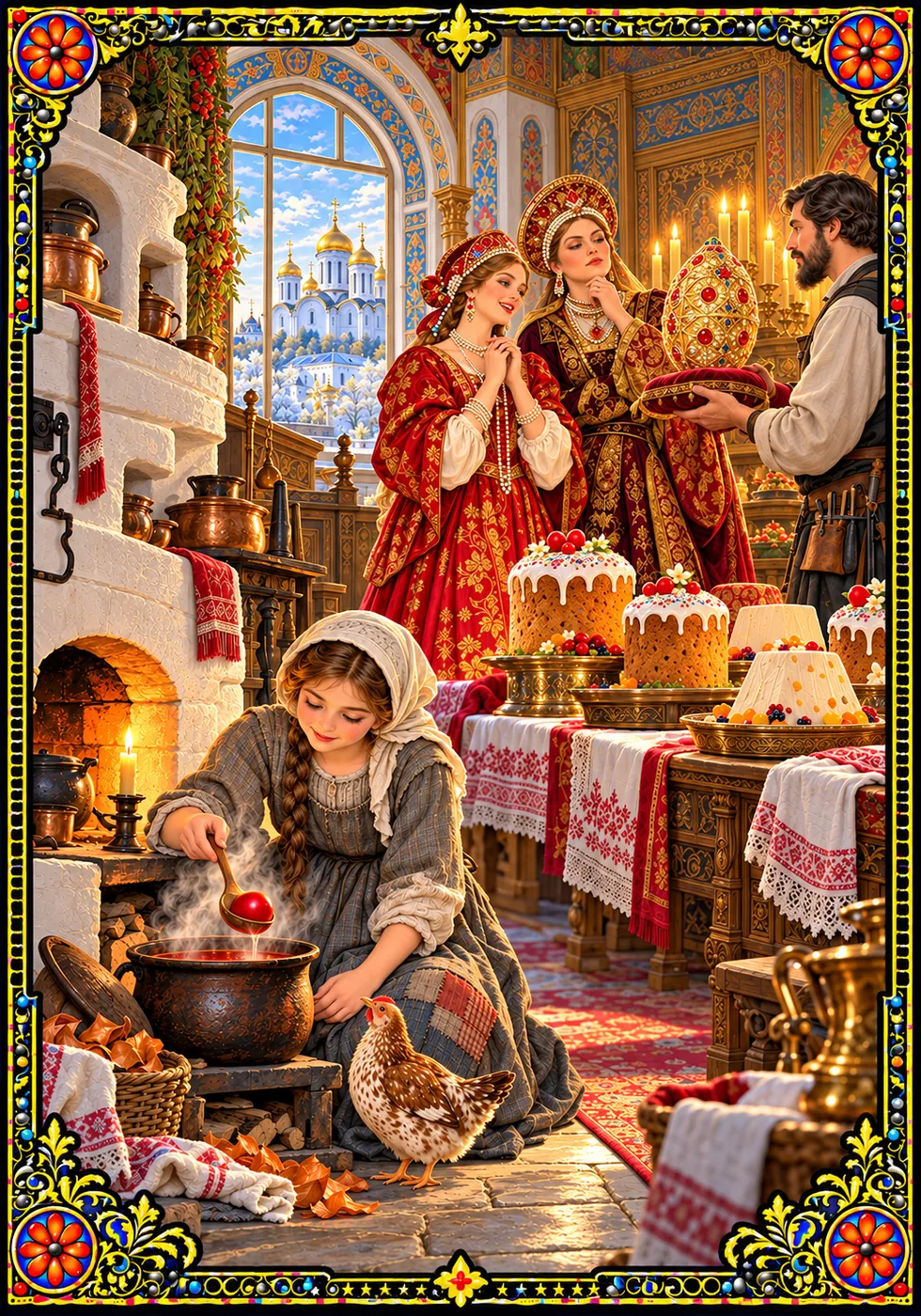
In the ancient lands of Rus’, where the Klyazma River winds through green meadows beneath a high bluff, there stands the city of Vladimir. Its white-stone Cathedral of the Dormition shines on the hilltop like a lamp, and its Golden Gate, with gilded doors and a small church above the arch, welcomes travelers from every road of Rus’.
In Vladimir, as in all the lands of Rus’, the greatest feast of the year is Holy Pascha, the Resurrection of Christ. On that night, the whole city stays awake. The bells ring until dawn, and the people greet one another with the words “Christ is risen!” and “Truly He is risen!” exchanging three kisses and red eggs dyed with onion skins.
Behind the custom of the red egg lies an old story. It is said that after the Resurrection, holy Mary Magdalene traveled all the way to Rome to preach to the Emperor Tiberius. As was the custom when visiting an emperor, she brought a gift, and, since she was poor, her gift was a single egg. She held it out and said, “Christ is risen!” The emperor laughed. “A man can no more rise from the dead,” he said, “than that egg in your hand can turn red.” At that very moment, the egg in Mary Magdalene’s hand turned bright red. Ever since, the Orthodox have given red eggs at Pascha, in memory of her witness.
In the days of our tale, there lived in Vladimir a poor orphan girl named Irina.
Her father had been an icon painter, a quiet and holy man who had painted the faces of the saints in many churches of the city, and her mother had been the daughter of a village priest. Both had died in the same winter of fever, when Irina was ten years old, and they had left her nothing but a small icon of the Resurrection that her father had painted, and a speckled hen named Ryaba.
Irina’s mother had named the hen after the one in the old tale that every child in Rus’ knows: the story of Ryaba, the little speckled hen who laid a golden egg. In that tale, the old man and the old woman beat and beat the golden egg but could not break it, until a little mouse ran by, swished her tail, and the egg fell and shattered. The old couple wept, and the hen said, “Do not cry. I will lay you another egg, not golden, but a plain one.” Irina’s mother had always said that it was the wisest tale in all Rus’.
After her parents died, Irina was taken in as a servant by the wife of a rich merchant of Vladimir named Kuzma. The merchant’s wife, Fekla, was sharp-tongued and hard-hearted. She made Irina scrub the floors, carry the water, bake the bread, and wash the linen from before dawn until after dark, and she paid her with scraps from the kitchen and a pallet of straw in the corner of the henhouse, where Irina slept beside her beloved Ryaba.
The merchant had one daughter, Milava. She was a year older than Irina, and she was pretty, and she knew it. She dressed in silk and wore rings on every finger, and she never did a stroke of work. She liked to watch Irina scrubbing the floors, and to walk across the wet boards in her muddy shoes.
Irina bore it all without complaint. Each night, before she lay down on her straw, she knelt before her father’s little icon of the Resurrection and prayed for her mistress, for Milava, for the merchant, and for the souls of her parents.
In that year, the young Prince Dmitri of Vladimir had just come of age. His father had died, and the boyars were eager for him to marry. They paraded their daughters before him at every feast, dressed in brocade and jewels, and the maidens flattered him, laughed at his jokes, and praised his horsemanship and his fine new boots.
Dmitri was weary of it. “They love my crown, not me,” he said to his old tutor, a monk of the Dormition Cathedral. “How can I find a bride who has a true heart?”
“The heart is shown in giving, my prince,” said the old monk. “Watch how they give, and you will know them.”
So Prince Dmitri announced that on Bright Monday, the day after Pascha, he would sit at the Golden Gate and receive Paschal eggs from the maidens of Vladimir. The maiden who brought him the most beautiful egg would be honored with a seat at his table for the whole of Bright Week.
The whole city buzzed with the news. Every family with a daughter began to prepare an egg. Some painted their eggs with flowers and birds. Some carved them from wood and gilded them. The richest families sent to the goldsmiths.
The merchant Kuzma sent to the finest goldsmith in Vladimir and ordered for Milava an egg of solid gold, as big as a goose’s egg, studded with pearls and rubies. It cost him a great sum. “With an egg like that,” said Fekla, “our Milava will be sitting at the prince’s table, and, before the summer, she will be sitting on his throne.”
All through the Great Fast, Irina worked harder than ever. She baked the Paschal breads for the household, the tall kulich and the sweet paskha of cheese. She dyed two hundred eggs with onion skins for the merchant’s family and guests. Yet Fekla would not allow her a single one. “The eggs are for the family,” she said. “Servants eat what they are given.”
Irina said nothing. She only hoped that Ryaba would lay an egg, but, all through the Great Fast, the little speckled hen laid nothing at all.
On Holy Saturday, while the whole house was busy preparing for the feast, Irina went into the henhouse to fetch her pallet, and there, in the straw beside Ryaba, lay a single egg.
It was not golden. It was an ordinary brown egg, small and plain, with a few speckles like its mother. Irina picked it up with tears of joy. “Thank you, Ryaba,” she whispered. “Now I will have an egg for Pascha, like everyone else.”
That night, when the kitchen was empty, she boiled the egg in the last of the onion skins, and it came out a deep reddish brown. She wrapped it in a clean cloth and hid it inside her blouse, next to her heart.
At midnight, the bells of the Dormition Cathedral began to ring, and all the people of Vladimir poured into the streets with candles. The merchant’s family went to the cathedral in their best clothes, and Irina followed behind, carrying Milava’s cloak. The procession went three times around the cathedral in the dark, singing, and then the doors were flung open, and the priest cried out, “Christ is risen!” and the whole crowd thundered back, “Truly He is risen!” The bells rang so loudly that the ground shook.
When the long, joyful Liturgy was over and the sky was turning gray, the people came out onto the cathedral steps, kissing one another three times and exchanging red eggs.
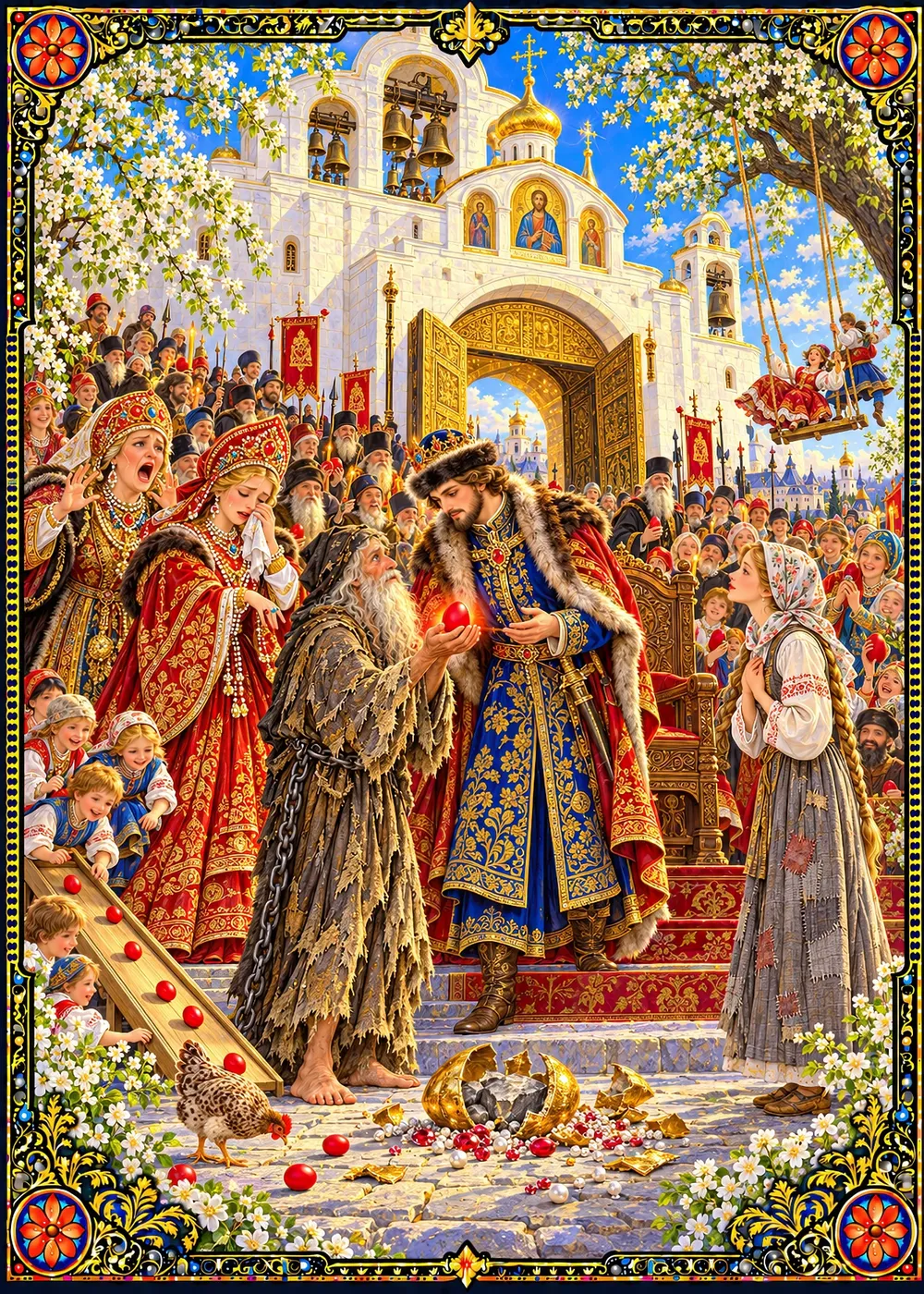
On the bottom step sat a man whom everyone in Vladimir knew. He was called Yasha the Fool. He was barefoot in every season, dressed in rags, with an iron chain around his waist and a matted gray beard. He talked to himself, laughed at nothing, wept in the market for no reason, and sometimes threw stones at the houses of the rich. The children mocked him, and the grown-ups either ignored him or crossed the street to avoid him. Some of the old women, however, whispered that he was a fool for Christ, one of those holy ones who hide their holiness under a mask of madness, and that his strange words often came true.
Yasha sat on the step with his hand stretched out, and, to everyone who passed, he said, “Christ is risen! Have you an egg for Yasha?”
The rich merchants passed him by. The boyars’ wives lifted their skirts so as not to touch him. Fekla, the merchant’s wife, tossed a crust of bread at his feet without looking. Milava laughed out loud. “An egg for a fool!” she said. “My egg is going to the prince.”
Then Irina came down the steps, carrying Milava’s cloak.
Yasha looked up at her with strange, clear blue eyes, like the eyes of a child. “Christ is risen, little daughter,” he said. “Have you an egg for Yasha?”
Irina stopped. Her hand went to her blouse, where her one egg lay wrapped next to her heart. It was the only egg she had. It was the only gift she had received in the whole year. If she gave it away, she would have nothing for the feast, and nothing to bring to the Golden Gate. Of course, she had never dreamed of going to the Golden Gate anyway.
Then she remembered her father, who had always said, “Whatever you give to the least of Christ’s brothers, you give to Him.”
She knelt on the step, drew out the little egg in its cloth, and placed it in the old man’s dirty hands. “Truly He is risen,” she said, and she kissed him three times on his rough cheeks, as the Orthodox do at Pascha.
Yasha held the egg up to the dawn light and looked at it for a long time. Tears ran down into his beard. “Thank you, little daughter,” he said. “You have given with nothing held back. The Lord will not forget it.”
Neither Irina nor anyone else noticed a young man in a plain dark cloak standing in the shadow of the cathedral porch, watching. It was Prince Dmitri. After the Liturgy, weary of the boyars, he had slipped out through a side door to breathe the morning air, and he had seen everything.
He did not know the girl’s name. He only saw her face as she knelt before the fool, and he did not forget it.
* * *
Copyright notice. Introduction and illustration © 2026 Laurent Cleenewerck. All rights reserved. The adapted Orthodox version of this tale is published in Twelve Russian Orthodox Fairy Tales (© 2026 Laurent Cleenewerck). No part of this page may be reproduced without written permission, except for brief quotations with attribution and a link to this page.
Buy the book on AmazonAbout the book