
A Story of Murom and the Feast of the Meeting of the Lord
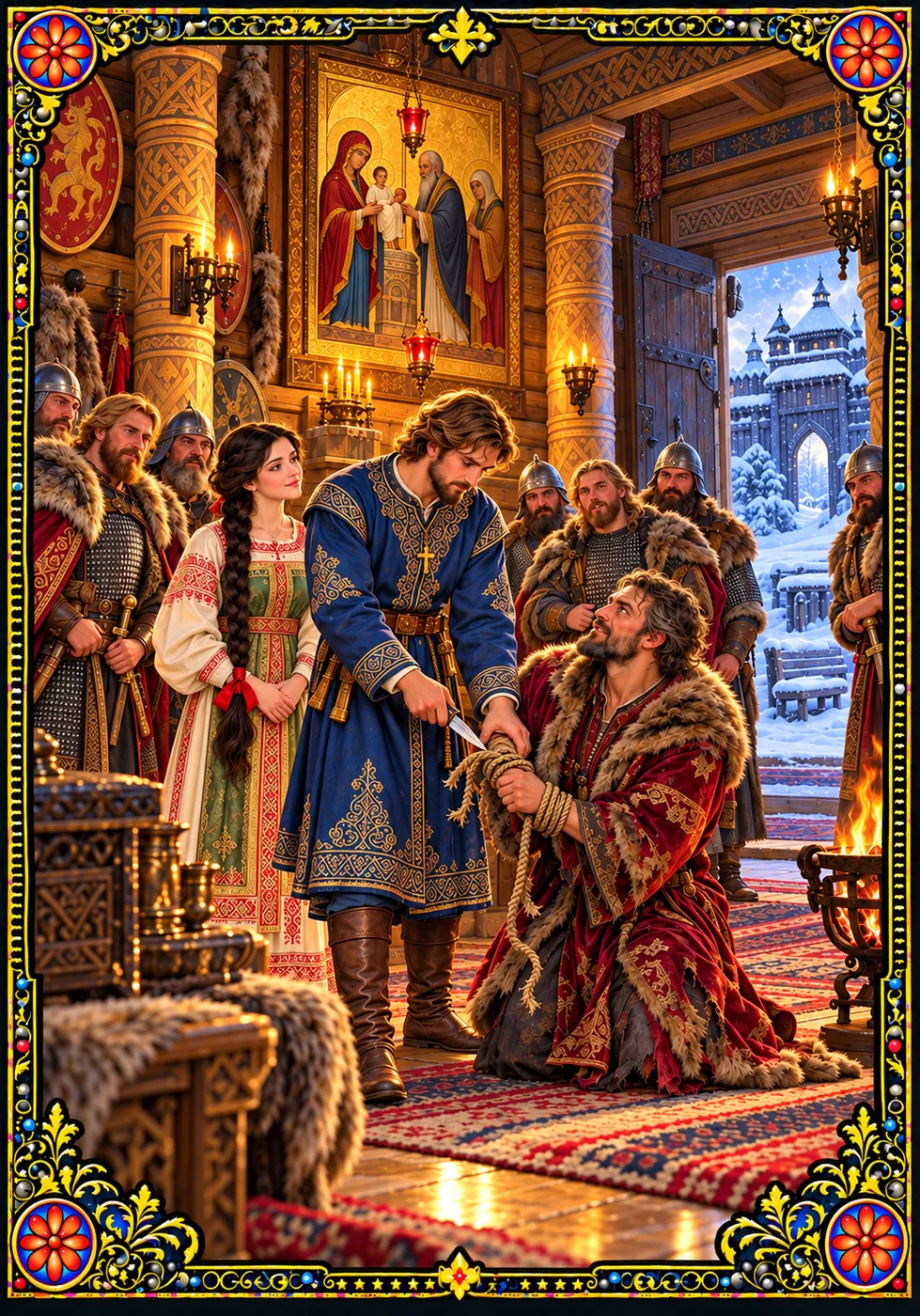
In the ancient lands of Rus’, where the Oka River bends wide and silver beneath the wooded hills, there stands the old city of Murom. It is the city of the holy Prince Peter and Princess Fevronia, who ruled it in holiness long ago, and whose relics rest together in its cathedral. Pilgrims come from all over Rus’ to venerate them and to ask their prayers for faithful marriages.
In the days of our tale, many years after Peter and Fevronia had gone to the Lord, an old monk named Simeon sat beside the great gate of Murom. No one remembered when he had first come there. The oldest grandmothers said he had already been old when they were girls. He sat on a wooden bench beside the gate in every season, in the heat of summer and the snows of winter, with a woolen cloak around his shoulders and a prayer rope in his hands.
Children asked him what he was doing there, and merchants asked, and soldiers of the gate asked. He always gave the same answer, with a smile: “I am waiting for the Lord to come through this gate.”
Some people thought he was a holy man. Others thought he was a little mad. All of them brought him bread and kvass, and many sat beside him on the bench to ask his counsel. His counsel, strangely, always came true.
In that year, the old Prince of Murom died, and his only son, Vadim, took the throne at the age of twenty.
Vadim was brave, handsome, and clever. He could ride any horse, win any argument, and outshoot any archer in his druzhina. His father had given him the best tutors in Rus’, and he had learned everything they could teach him except humility. He believed he needed no one’s advice, least of all the advice of old men.
Every day, as he rode out of the gate to hunt, he passed the old monk on the bench, and every day it irritated him more.
“Grandfather,” he said one morning, reining in his horse and laughing so that his companions could hear, “you have been waiting for your Lord for fifty years. He is very late. Perhaps, He has lost His way.”
“Perhaps, my prince,” said Simeon gently. “Or perhaps He is already on the road, and I must only wait a little longer.”
The young men of the druzhina laughed. Vadim laughed too, but the old man’s calm eyes troubled him, and that troubled him more than anything.
“It does not befit the dignity of Murom,” he declared, “for a beggar to sit at the main gate of the city like a dog at a door. Move your bench outside the walls, grandfather. You may wait for your Lord in the ditch.”
So the soldiers carried Simeon’s bench out through the gate and set it down beside the road, outside the walls, and the old monk sat down on it again without a word of complaint. Nearby, at the edge of the forest, he built himself a small hut of logs and bark.
In those same months, the boyars of Murom set about finding a wife for their young prince, for a city needs an heir.
They brought him the daughters of the greatest houses in the land. There was the daughter of the chief boyar of Murom, with a dowry of three villages. There was a merchant’s daughter from Vladimir, whose father owned ships on the Volga. There was a princess from Ryazan, whose beauty was praised in songs.
Vadim looked at them all, and he found fault with every one. The first was too plain. The second was too loud. The third was beautiful, but she looked at him the way a buyer looks at a horse at market, measuring his wealth and his lands. The maidens, for their part, found the young prince cold and haughty, and they were not sorry to go home.
“There is not a woman in Rus’ worthy of me,” Vadim said to his companions, half laughing, half bitter.
When the old monk heard of it, he said to a traveler on the road, “The prince seeks a wife with his eyes. He will find her only with his heart, and his heart is not yet ready.”
That winter, Simeon sent a message to the prince.
It came by a boy of the gate, who repeated it word for word: “The elder Simeon says: Beware of the boyar Zhiroslav. He sends secret letters to Prince Yaropolk of Pronsk, who covets your throne. Keep watch over your gates.”
Zhiroslav was the chief boyar of Murom, whose daughter the prince had refused. Vadim laughed. “Zhiroslav served my father for twenty years. The old man is dreaming.”
A second message came a week later: “The elder Simeon says: Zhiroslav has hired men from Pronsk and hidden them in the villages. Keep watch.”
Vadim waved it away.
A third message came on the eve of the Nativity: “The elder Simeon says: It will be on the night after Theophany. For the love of God, keep watch.”
“Tell the old man,” said Vadim, “that if he sends me one more of his dreams, I will have him driven out of the district altogether.”
On the night after Theophany, when the soldiers of Murom were sleeping off the feast, the boyar Zhiroslav opened the great gate from the inside. Prince Yaropolk of Pronsk rode in with three hundred men.
Murom was taken before dawn. Vadim woke to the sound of swords and fire. He fought bravely in the palace corridors, but his men were few and scattered, and, at last, his own steward pulled him away, threw a peasant’s cloak over his shoulders, and pushed him out through a postern door in the wall. “Live, my prince!” the steward cried. “Live, and come back to us!”
So Vadim fled alone into the snowy night with nothing but his sword and the peasant’s cloak. Before dawn, he had lost the sword in a snowdrift.
For three weeks, he wandered through the frozen forests and villages of the Oka. He knocked at the doors of boyars whose feasts he had attended, and their servants set the dogs on him, for they did not recognize the prince in the ragged, bearded vagabond at the gate. He knocked at the doors of merchants and was driven away. He begged at the doors of monasteries and received a crust of bread and was sent on his way, for many beggars wandered the roads that winter. He slept in haylofts and ditches. His boots split, and his feet froze. For the first time in his life, he knew what it was to be hungry, cold, despised, and alone.
At last, on a night of bitter frost, half dead with cold, he stumbled out of the forest near the walls of his own city and fell upon the threshold of a small hut of logs and bark at the edge of the road.
The door opened, and an old man stood there with a lamp.
It was Simeon.
The old monk looked down at the frozen beggar on his threshold, and, though the young man’s face was gaunt and bearded and black with dirt, Simeon knew him at once. He said nothing, however. He only lifted him with surprising strength, carried him inside, laid him down beside the little stove, rubbed his frozen feet with snow and then with warm oil, and fed him hot kasha with a wooden spoon, as a mother feeds a child.
When Vadim woke the next morning and saw who had saved him, he turned his face to the wall in shame.
“You know who I am,” he whispered.
“I know,” said Simeon.
“I mocked you. I drove you out of the gate. I laughed at your warnings. Because of my pride, my city is in the hands of a traitor. Why did you not leave me to die in the snow?”
The old man smiled. “Because I am still waiting for the Lord to come through the gate,” he said, “and the Lord often comes in the form of a beggar. Rest now. We will talk when you are stronger.”
So Vadim, Prince of Murom, stayed in the hut of the old monk through the rest of that winter.
At first, he was sullen and ashamed. Simeon, however, asked nothing of him except to chop the wood and carry the water, and so Vadim chopped and carried. His hands, which had known only the sword and the reins, blistered and bled. Each morning and evening, Simeon prayed, and, at first, Vadim only stood and listened. After some days, he began to repeat the prayers. After some weeks, he found himself kneeling.
In the evenings, by the light of the stove, the old man talked. He did not lecture. He told stories: of the Prophet David, who was a shepherd before he was a king; of the holy Prince Boris, who would not raise his sword against his brother; of Peter and Fevronia, the holy prince and princess of this very city. Above all, he told the story of the other Simeon, the old man in the Temple at Jerusalem.
“It had been revealed to him by the Holy Spirit,” said Simeon, “that he would not see death until he had seen the Lord’s Christ. So he waited. He waited through all his youth and all his middle years and into his old age. People must have thought him a fool, as they think me a fool. Then, one day, a poor young couple came into the Temple, carrying a baby, with two turtledoves for an offering, because they could not afford a lamb. The old man took the child in his arms, and he knew. He had waited his whole life, and, in the end, the Lord came to him not as a king in glory, but as a poor child in the arms of a humble mother.”
Vadim listened, and something in his proud heart began to melt, like the ice on the Oka at the end of winter.
Every Saturday, a young woman came along the forest road to the hut with a basket on her arm.
Her name was Svetlana. She was the daughter of Luka, a widowed potter who lived in a village beyond the ravine. Her father was poor, and she had no dowry but her own two hands. Every week, however, for as long as she could remember, she had brought bread, milk, and a little honey to the old monk, for her mother, before she died, had loved him and asked her to care for him.
She was not dressed in silk. She wore a plain linen sarafan, a woolen shawl, and bast shoes, and her dark braid was tied with a simple red ribbon. Still, there was a grace in her movements and a light in her face that Vadim had never seen in any of the princesses and boyars’ daughters who had been paraded before him.
She did not know who the young beggar was, and she did not ask. She only saw that he was thin, and she brought extra bread. She saw that his hands were torn from chopping wood, and she bound them with clean linen and a salve of her own making. She sang softly as she worked, the psalms and the hymns of the Church, and when she and the old monk prayed together, Vadim saw that her prayer was simple and pure, like water from a spring.
Once, when she was bandaging his hands, he asked her, “Why are you so kind to a beggar you do not know?”
She looked up at him with clear gray eyes. “Our Lord said that whatever we do for the least of His brothers, we do for Him,” she said. “So perhaps you are not a beggar at all. Perhaps, you are Christ, come to visit us in disguise.” She smiled, as though this were a small joke, and went back to her bandaging.
* * *
Copyright notice. Introduction and illustration © 2026 Laurent Cleenewerck. All rights reserved. The adapted Orthodox version of this tale is published in Twelve Russian Orthodox Fairy Tales (© 2026 Laurent Cleenewerck). No part of this page may be reproduced without written permission, except for brief quotations with attribution and a link to this page.
Buy the book on AmazonAbout the book