
A Story of Maramuresh and the Nativity of Saint John the Baptist
In the ancient lands of Maramuresh, where the mountains are covered with forests of beech and fir, and the villages hide in the green valleys along the rivers Iza and Mara, the people build everything of wood. Their houses are of wood, with steep roofs of shingles. Their great gates are of oak, carved with ropes and suns and trees of life. Their churches, too, are of wood, with roofs as steep as hands joined in prayer and spires so tall and thin that they seem to prick the clouds.
In one of those valleys, in the old days, there lived a young prince named Toader. He was the only son of the knez of the valley, the old prince who ruled all the villages along that river, and he was as handsome and quick as a young stag. He rode better than any man in Maramuresh, and he could hit a pine cone with an arrow at a hundred paces. He was also brave to the point of foolishness, and he laughed at the old women’s tales.
In the same village lived Ilinca, the daughter of the old priest who served the wooden church on the hill. She was not rich, and she was not a princess, but she was wise beyond her years. She knew every herb of the meadow and every hymn of the Church, and she had a way of looking at people with her clear green eyes that made them tell her the truth. Toader and Ilinca had loved each other since they were children, when he used to carry her across the river on his back. Toader’s father, the knez, did not like it at all. “A priest’s daughter,” he would grumble, “when the princesses of the greatest houses of Maramuresh are waiting.” Yet he loved his son, and so far he had said nothing more.
In Maramuresh, the night before the feast of the Nativity of Saint John the Baptist, on the twenty-third of June, is a night full of wonders. It is the night of the Sânziene. On that day, the girls of the villages go out into the meadows and gather the little golden flowers that bloom everywhere in the grass, and they weave them into crowns. In the evening, they throw the crowns up onto the roofs of their houses, and it is said that the girl whose crown stays on the roof will be married within the year.
It is also the night, the old women say, when the Iele dance in the forest.
“Never go into the forest on the night of the Sânziene,” the old women told the children. “The Iele dance there in the clearings, in white dresses, with bells on their ankles. They are as beautiful as the moon, and as cold. They will call you by your name, very sweetly. Do not answer them, whatever you do, for if you answer, they will take your voice and draw you into their dance, and you will never be whole again.”
Toader laughed at such tales. “I have ridden through every forest in Maramuresh by night,” he said, “and I have never met anything worse than a bear.”
On the evening of the Sânziene, Ilinca wove a crown of the little golden flowers and threw it up onto the roof of the priest’s house, and it stayed there. She laughed and blushed, and Toader, who was watching from the road on his horse, laughed too.
“You see?” he said. “Within the year. Now I must ride over the mountain to the next valley and bring my father’s message to the knez there. I will be back tomorrow for the feast.”
“Do not go through the forest tonight, Toader,” said Ilinca. “It is the night of the Sânziene.”
“I am not afraid of fairies,” he said, and he rode away, laughing, into the dusk.
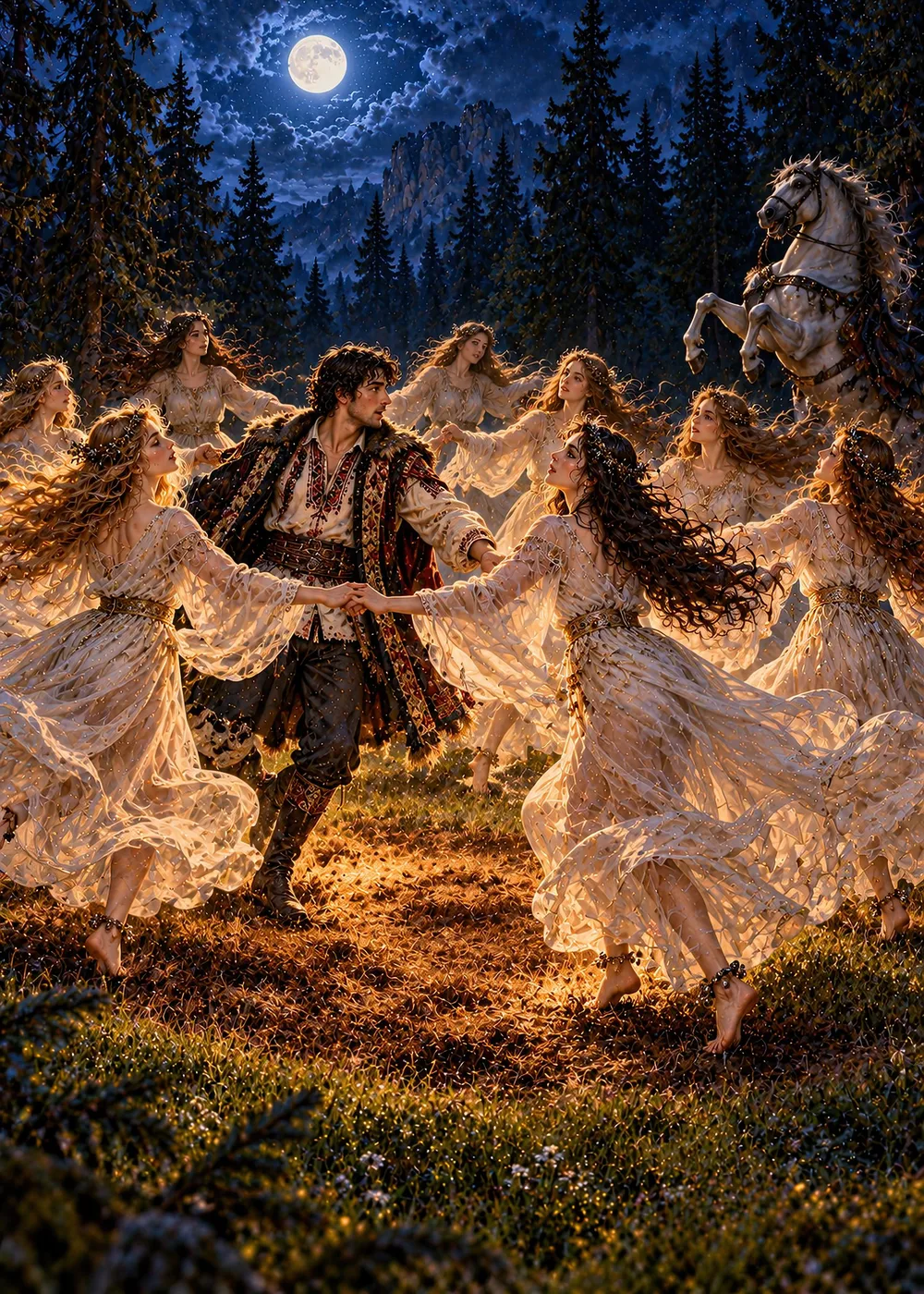
He rode through the dark forest, under the great firs, with the moon rising before him. Near midnight, as he came to the edge of a wide clearing, he heard music.
It was the most beautiful music that he had ever heard. It was like the sound of a hundred little silver bells, and like the wind in the reeds, and like the voices of girls singing far away. He reined in his horse. In the middle of the clearing, in the white moonlight, a ring of maidens was dancing. They were tall and slender and very pale, and their dresses were white as mist, and their long hair was loose, and their feet were bare, with little silver bells around their ankles. They danced so lightly that their feet did not seem to touch the grass, and they did not look at him.
Toader’s horse trembled and snorted and backed away. Toader sat still in the saddle, staring.
Then one of the dancers turned her pale, beautiful face toward him, and called softly across the clearing, “Toader.”
Another called, sweeter still, “Toader, come and dance.”
Then they all called, in one voice, like the bells, “Toader! Toader!”
He forgot everything that the old women had said. He forgot Ilinca, and the crown on the roof, and his father’s message. He slid down from his horse, and he answered, “Here I am!”
At once, the white maidens were all around him. They took his hands with their cold fingers, and drew him into their ring, and he danced. He danced as he had never danced in his life, round and round, faster and faster, in the white moonlight, to the music of the silver bells, and he could not stop. He danced until his heart was pounding and his breath was gone and his legs were burning, and still they whirled him round, laughing their cold, silvery laughter.
At the first cockcrow, far away in the valley, the Iele vanished like mist. Toader fell down on the grass in the middle of the clearing, and he did not move.
In the morning, his horse came home without him. The men of the valley searched the forest, and at last they found him, lying in the middle of a great ring of scorched brown grass in the clearing, where nothing would ever grow again. He was alive. His eyes were open. Yet he could not move his arms or his legs, and when they spoke to him, he could not answer. His voice was gone.
They carried him home to his father’s house on a litter of fir branches, and the whole valley mourned. The old prince sent for every healer in Maramuresh. The old women came with their herbs and their charms, and shook their heads. “He answered the Iele,” they said. “He is taken by the Iele. There is nothing we can do.”
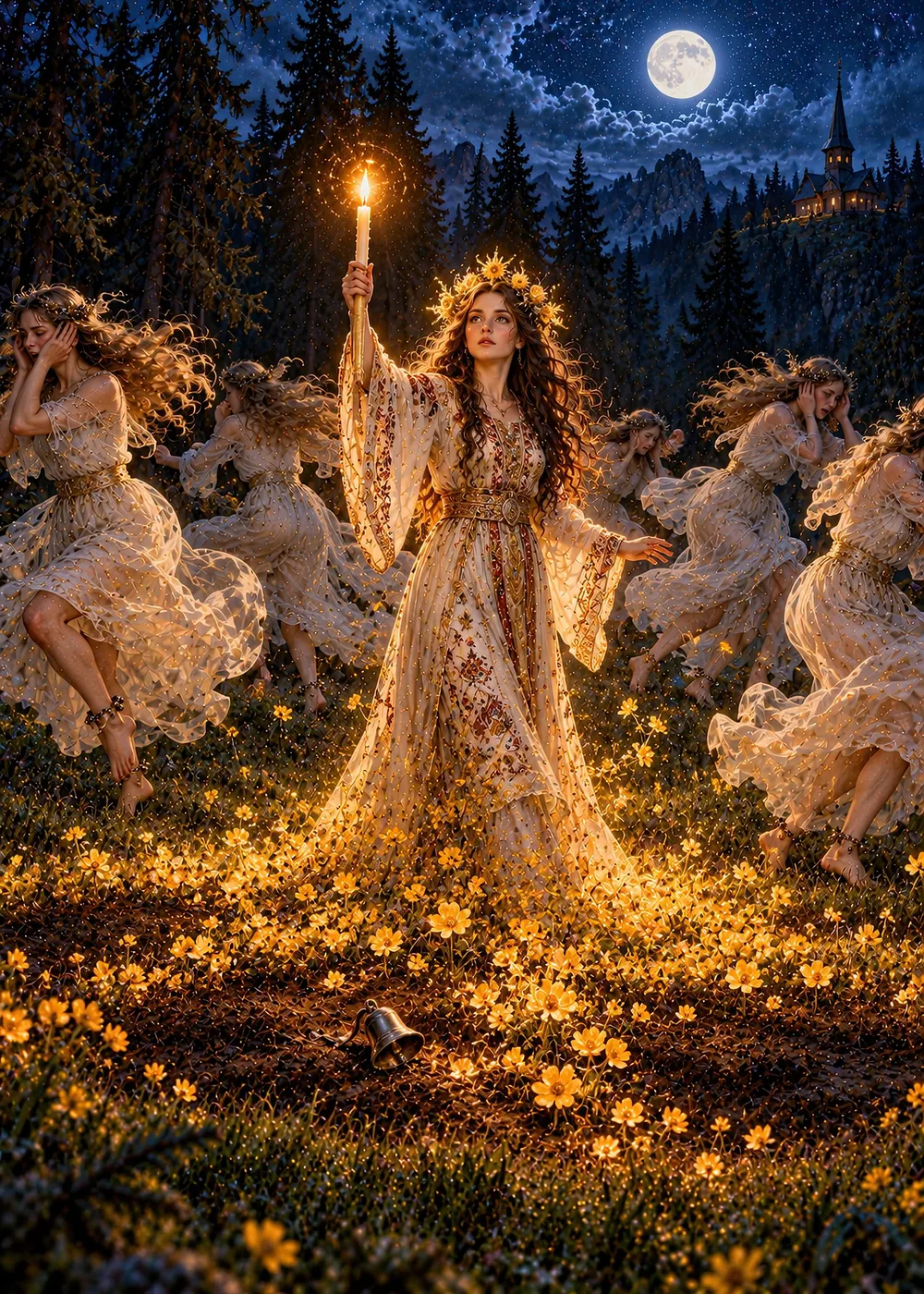
Ilinca sat beside his bed all that day, holding his cold hand. He looked at her with his dark eyes, and she saw that he knew her, and that he wanted to speak, and could not. Tears ran silently down his face.
The next morning was the feast of the Nativity of Saint John the Baptist. Ilinca went up to the wooden church on the hill, where her father, the old priest, was serving the Liturgy. She stood in the women’s place near the door, with the morning sun slanting through the little windows and the candles shining on the old painted walls. When her father read the Gospel of the feast, she listened as if she had never heard it before.
It was the story of the birth of the Forerunner. It told how the old priest Zechariah, John’s father, had not believed the angel who told him that his old wife would bear a son, and how the angel had struck him dumb, so that he could not speak a word for nine months. It told how, when the child was born, the neighbors wanted to name him Zechariah after his father, and how the old man asked for a writing tablet and wrote, His name is John. At that very moment, his mouth was opened and his tongue was loosed, and he spoke, praising God.
Ilinca’s heart leaped. When the people came out of the church, singing the troparion of the feast, she sang with them, and the words seemed to her to be written for her alone:
O Prophet and Forerunner of the coming of Christ,
at your glorious birth,
the barrenness of your mother was loosed,
and the dumbness of your father was loosed.
After the service, she went to her father and told him what she was thinking. The old priest listened, and then he sat down on the bench before the church and thought for a long time.
“The voices that called Toader into the forest were not the voice of God,” he said at last. “They called him by his name to draw him away from everything he loved, into a dance that never ends and leads nowhere. Saint John was a voice too. He was the voice of one crying in the wilderness. His voice called people to turn back, and to look at Christ. He said only one thing about himself: He must increase, but I must decrease. That is the difference between the voice of the Forerunner and the voices of the Iele. The Iele want to be looked at. The Forerunner points away from himself, to the Lamb of God.”
* * *
Copyright notice. Introduction and illustration © 2026 Laurent Cleenewerck. All rights reserved. The adapted Orthodox version of this tale is published in Twelve Romanian Orthodox Fairy Tales (© 2026 Laurent Cleenewerck). No part of this page may be reproduced without written permission, except for brief quotations with attribution and a link to this page.
Buy the book on AmazonAbout the book