
A Story of the Vrancea Mountains and the Feast of the Prophet Elijah
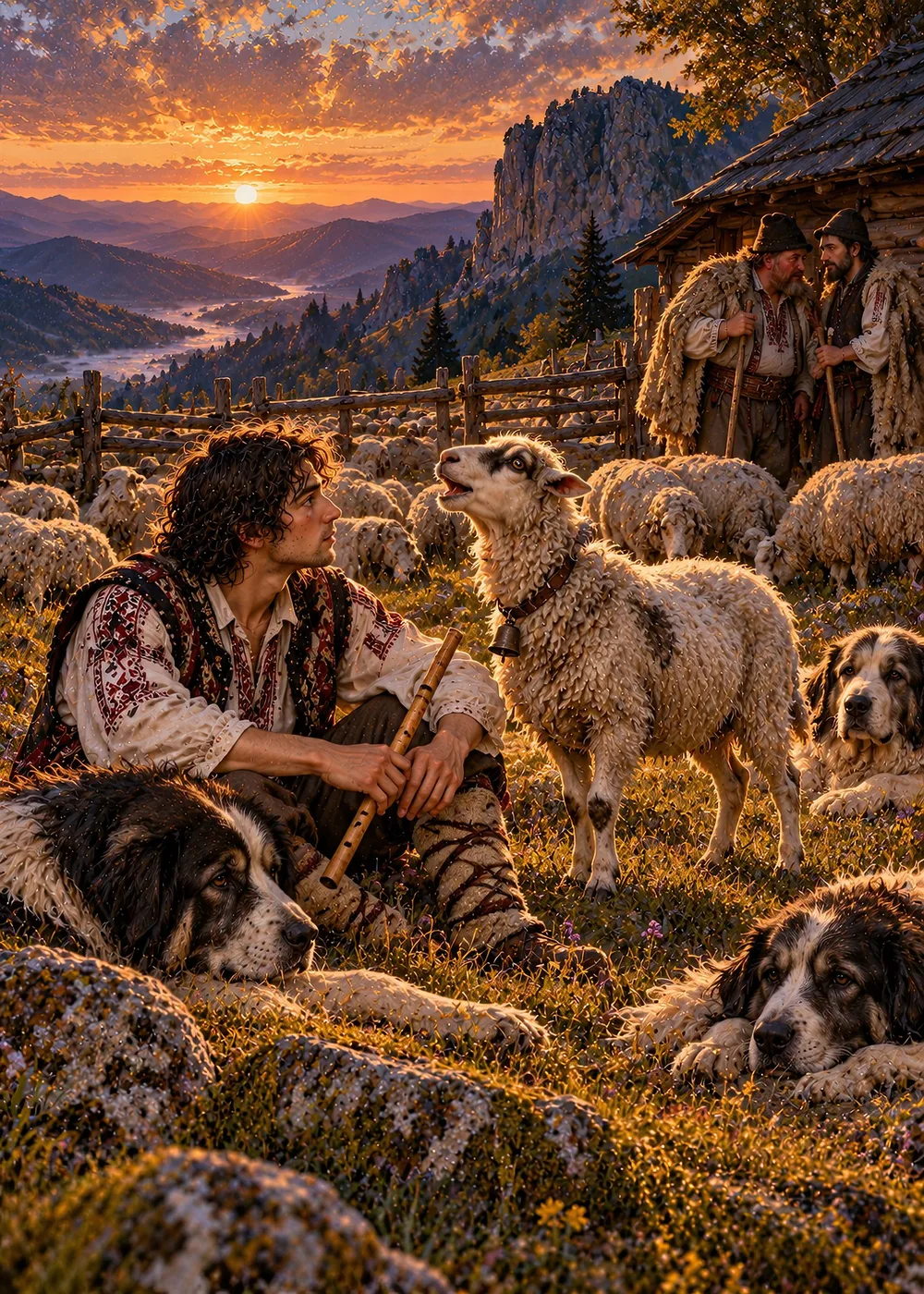
In the ancient lands of Moldavia, where the Carpathian Mountains bend like a bow toward the south, lie the green mountains of Vrancea, with their high meadows full of flowers, and their dark fir forests, and their deep ravines where the white streams leap from rock to rock. Every summer, the shepherds drive their flocks up from the valleys to the high pastures, and they stay there all summer long, living in huts of logs and sleeping under the stars, with their dogs and their flutes, until the first snow drives them down again.
One summer, long ago, three shepherds kept their flocks together on the high pastures of Vrancea. The first was a young man from the hills of Moldavia named Ionuts. The second was a big, red-faced man from Vrancea named Stan. The third was a lean, silent man from beyond the mountains named Gligor. The pastures belonged to the voivode of Moldavia himself, who came every summer to hunt in the forests of Vrancea and stayed at his hunting lodge in the valley below, and the three shepherds kept his sheep along with their own.
Of the three, Ionuts had the finest flock. He was not the oldest or the strongest, but he loved his sheep, and his sheep loved him. He knew every one of them by name. He found them the sweetest grass and the clearest water, and when a lamb was sick, he carried it inside his coat. His flock grew fat and white, and it doubled every year, while the flocks of the other two did not. Ionuts also had three great dogs, as big as wolves and as gentle as lambs with him, and a flute of elder wood, on which he played in the evenings so sweetly that even Stan and Gligor fell silent to listen.
Among all his sheep, Ionuts loved one most of all. She was a little ewe, gray and white, with black rims around her eyes as if someone had painted them with soot, and a small bell around her neck. She had been born in a snowstorm, and her mother had died, and Ionuts had raised her by hand, feeding her with milk from a horn and keeping her warm in his hut. She followed him everywhere like a dog. He called her Mioritsa, which means “little ewe.”
Every year, on the feast of the Holy Prophet Elijah, in the middle of the summer, the shepherds of all the mountains came together on the highest peak of Vrancea, where there was a little wooden chapel dedicated to the Prophet, for the feast and the great mountain fair. The old priest from the valley came up to serve the Liturgy, and after the Liturgy, there was dancing and feasting and trading of sheep and cheese, and the young men and women of all the valleys met and courted.
The voivode always came up to the fair with his household when he was in Vrancea, and with him came his daughter, the Princess Domnica. She had black hair and dark, laughing eyes, and she wore a white blouse embroidered with red and black, and a crown of wildflowers on the feast day. The summer before, at the fair, she had heard Ionuts play his flute, and she had stopped dancing to listen. Then she had asked him to teach her the song. That summer, too, she came often up the mountain with her father to see the flocks, and she always stopped at Ionuts’s hut, and the two of them talked by the sheepfold until her father called her.
Stan and Gligor watched all this, and envy ate at their hearts like a worm in an apple.
“He has the best flock,” said Stan to Gligor one night, when Ionuts was away at the spring. “He has the best dogs. Now he will have the voivode’s daughter too, and with her, who knows what lands and honors. What will be left for us? Nothing.”
“Unless he were gone,” said Gligor softly.
The two men looked at each other. Then they put their heads together and whispered. They agreed that on the evening of the feast of Elijah, at sunset, when everyone was at the fair and Ionuts came back alone to the sheepfold, they would wait for him at the edge of the ravine and kill him, and divide his flock and his dogs between them, and say that he had fallen into the gorge in the storm.
They thought that no one had heard them. Yet the little ewe Mioritsa was lying in the grass behind the hut, and she had heard every word.
From that night on, Mioritsa would not eat. She stood at the edge of the flock with her head down, and she bleated all day long, a thin, sad bleating that went to Ionuts’s heart. On the eve of the feast of Elijah, as the sun was setting, he sat down beside her in the grass and stroked her head.
“Little ewe,” he said, “what is the matter? Are you sick? Are you sad? For three days you have not eaten a mouthful of grass, and you cry all day long.”
Then the little ewe lifted her head, and looked at him with her soot-rimmed eyes, and spoke to him in a human voice.
“Master,” she said, “dear master, listen to me. Tomorrow at sunset, the shepherd from Vrancea and the shepherd from beyond the mountains will wait for you at the edge of the ravine to kill you, because you have the finest flock and the princess loves you. Take the bravest of your dogs, and go down by the other path, and hide, until they have gone.”
Ionuts sat very still in the grass. He did not doubt the little ewe for a moment. He knew that God, who opened the mouth of Balaam’s donkey, could open the mouth of a ewe to save a shepherd’s life. His heart grew cold and heavy within him, and for a long time he could not speak.
At last he said, “Little ewe, if it is God’s will that I die tomorrow, then do this for me. Tell them to bury me here, near the sheepfold, so that I can always hear my sheep. Put my flute of elder wood at my head, so that when the wind blows through it, it will play for the flock. If you see an old woman searching the mountains for a shepherd, my mother, do not tell her that I was killed. Tell her that I married a queen, the bride of the whole world, and that at my wedding a star fell from the sky, and the sun and the moon held the crowns over our heads. Tell her that I am happy.” His voice broke. “Tell the princess the same.”
The little ewe pressed her head against his knee.
“Master,” she said, “why do you speak of death as if it were the only road? You may run, or you may fight, or you may die. Yet there may be another road. Tomorrow is the feast of the holy Elijah. Go up to his chapel on the peak and ask him which road is yours.”
The next morning, on the feast of Elijah, Ionuts put on his white shirt and his embroidered vest, and he climbed to the little wooden chapel on the highest peak, with the little ewe trotting behind him. The meadow around the chapel was full of shepherds and villagers in their feast-day clothes. The voivode and the Princess Domnica were there, and Stan and Gligor too, standing at the back of the crowd and never meeting his eyes.
The old priest served the Liturgy under the great blue sky, and after the Gospel, he spoke to the people about the holy Prophet whose feast it was.
“The holy Elijah was a man of fire,” he said. “On Mount Carmel, he called down fire from heaven to burn up the sacrifice, and to show the people that the Lord is God. He was zealous, and he was angry at the wickedness of men. Yet listen to what God showed him afterward, on Mount Horeb. There came a great wind that broke the rocks in pieces, and the Lord was not in the wind. After the wind came an earthquake, and the Lord was not in the earthquake. After the earthquake came a fire, and the Lord was not in the fire. After the fire came a still, small voice, like a gentle breeze. That is where the Lord was.”
The old priest looked out over the crowd. “Many years later,” he said, “when a village of Samaria would not receive our Lord, two of His disciples said to Him, ‘Lord, do You want us to call down fire from heaven to burn them up, as Elijah did?’ The Lord turned and rebuked them. ‘You do not know what spirit you are of,’ He said. ‘The Son of Man did not come to destroy men’s lives, but to save them.’”
Ionuts listened, and his heart was troubled. He did not want to die. He did not want to run away and leave his flock. He did not want to fight Stan and Gligor and kill them, or be killed by them. He wanted another road. As he stood there, it came to him, quietly, like a gentle breeze, what that road was.
* * *
Copyright notice. Introduction and illustration © 2026 Laurent Cleenewerck. All rights reserved. The adapted Orthodox version of this tale is published in Twelve Romanian Orthodox Fairy Tales (© 2026 Laurent Cleenewerck). No part of this page may be reproduced without written permission, except for brief quotations with attribution and a link to this page.
Buy the book on AmazonAbout the book