
A Story of Mount Ceahlău and the Feast of Saint Eudokia
In the ancient lands of Moldavia, where the mountain called Ceahlău rises above the forests like a great stone altar, its cliffs and towers of rock glowing red at sunset, there lived long ago a rich old shepherdess whom everyone called Baba Dochia. Baba means “old woman,” and she was old indeed, with a face as brown and wrinkled as a walnut, and eyes as sharp as a hawk’s.
Baba Dochia owned the greatest flock of sheep in all the valleys around the mountain, a thousand white ewes and a hundred black ones, with bells around their necks and shaggy dogs to guard them. She had a great wooden house with a carved porch, and chests full of wool and cheese and silver coins, and twelve sheepskin coats, one for every month of the year, embroidered in red and black. Yet her heart was as hard and cold as the rocks of Ceahlău. She was never satisfied. She quarreled with her neighbors, and she cheated the merchants, and she drove the beggars from her door with her stick.
She had one son, whom she loved fiercely in her own hard way. His name was Dragobete, and he was as gentle as his mother was harsh. He was a tall, laughing young shepherd with black curls, and he played the shepherd’s flute so sweetly that the birds stopped singing to listen. Everyone in the valley loved him.
One day at the end of February, the day when, as the old people say, the birds choose their mates, Dragobete was walking in the woods below the mountain, looking for the first snowdrops. There, by a stream, he met a girl gathering firewood. She was poor and thin, with a patched shawl and bare red hands, but her eyes were the deep violet of the first wild violets of spring, and her name was Viorica. She was an orphan, and she lived with an old aunt in a hut at the edge of the village.
They talked by the stream until the sun went down. Before the snow had melted, Dragobete asked her to marry him. She said yes, and they were married in the little wooden church of the village, with the whole valley dancing at their wedding, all except Baba Dochia.
“A beggar girl!” she said, with her lips pressed thin. “With nothing but a patched shawl! You could have had the daughter of the richest shepherd in Moldavia.”
From the day Viorica came into her house, Baba Dochia made her life bitter. She gave her the hardest work and the poorest food. She found fault with everything she did. Viorica bore it all patiently, for she loved Dragobete, and she said nothing to him about it, so as not to set him against his mother.
On the last day of February, while Dragobete was away in the town selling cheese, Baba Dochia called Viorica to her and put into her arms a great skein of wool, as black as soot.
“Take this down to the stream,” she said, “and wash it until it is white. Do not come back until it is white, not if it takes you all winter.”
Viorica stared at her. “Mother,” she said, “black wool cannot be washed white.”
“Then do not come back at all,” said the old woman, and she shut the door in her face.
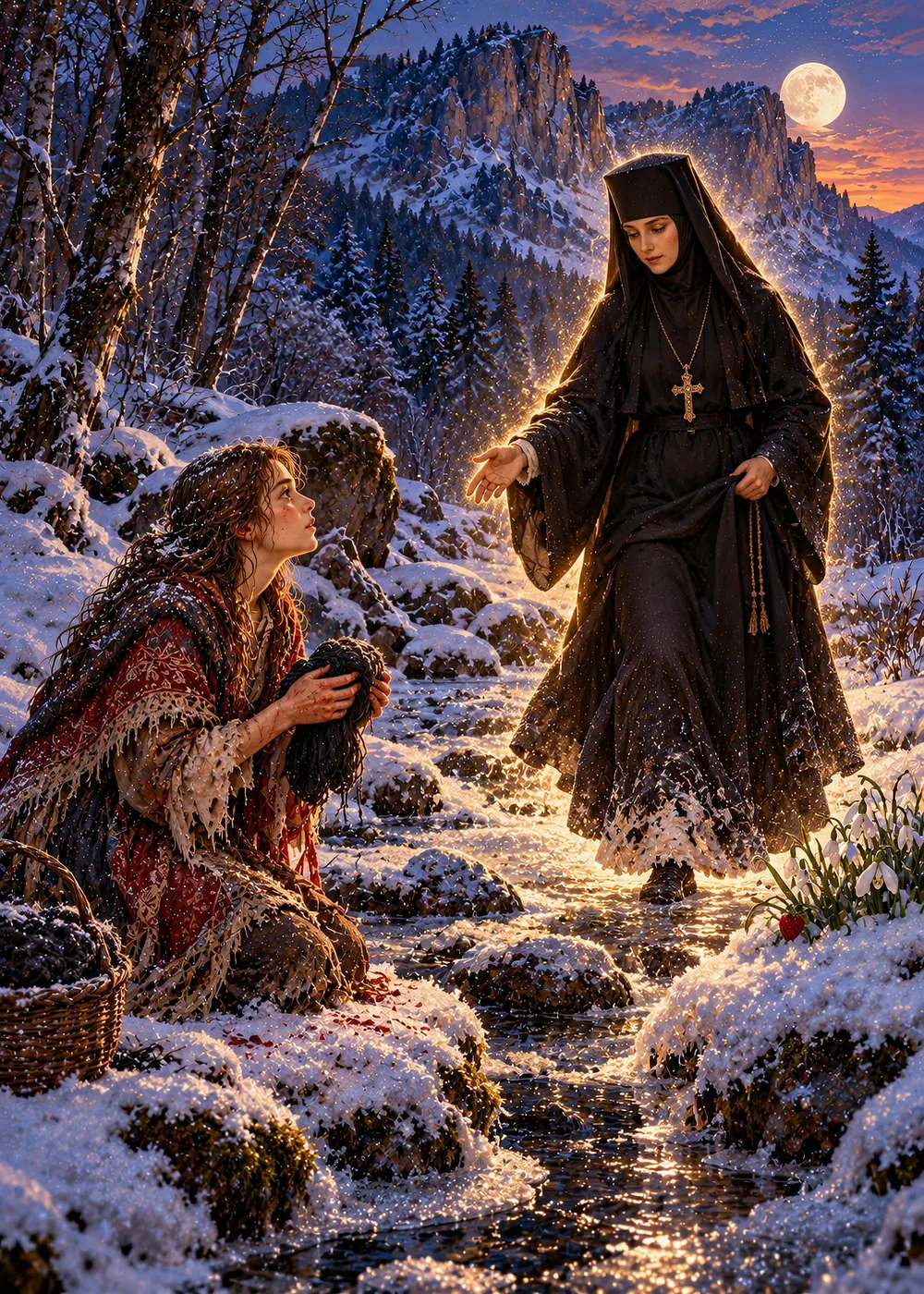
Viorica went down to the stream in the woods. It was bitterly cold. The snow lay deep on the banks, and the water ran black and freezing between edges of ice. She knelt on the frozen stones, and she put the black wool into the water, and she scrubbed it, and she scrubbed it. The water was so cold that it burned her hands like fire. She scrubbed until her fingers cracked and bled, and little drops of red blood fell on the white snow beside her. The wool stayed as black as ever.
At last, as the dark came down, Viorica bowed her head over the black wool, and she wept, and she prayed. “Lord Jesus Christ, have mercy on me. Tomorrow is the feast of the holy Eudokia. Holy Eudokia, pray to God for me, for I do not know what to do.”
Then she heard footsteps on the snow, and a gentle voice. “Why are you weeping, little sister?”
A woman was standing on the other side of the stream. She was dressed like a nun, in a plain black habit, with a black veil over her hair, and her face was calm and very beautiful, and a soft light seemed to shine around her in the dusk, so that the snow glittered. She stepped across the stream as if the water were a floor, and knelt beside Viorica on the frozen stones.
Viorica told her everything. The nun listened, and then she took the black wool from her hands.
“Long ago,” she said, “my own heart was as black as this wool. I loved riches and pleasures, and I thought only of myself. Then God in His mercy washed it white. What God can do for a heart, He can surely do for a skein of wool.”
She dipped the wool into the stream and lifted it out again. It was as white as the snow on the banks of the stream, white as the snowdrops, white as the moon that was rising over Ceahlău.
Then she looked at the little red drops of Viorica’s blood on the snow. She stooped and picked one white thread out of the skein, and she touched it to the red drops, and the white thread drank the red and became red. She twisted it together with a white thread from the skein, so that the red and the white wound around each other like two vines, and she tied it in a small knot and gave it to Viorica.
“Keep this,” she said. “The white is for the purity that God gives to those who repent, and for the snow of the winter that is ending. The red is for love, which bleeds and does not complain, and for the blood of Christ, which washes every heart. When spring comes, hang it on a tree in blossom. Now go home. Your mother-in-law will need you before long, more than she knows.”
“Who are you, Mother?” asked Viorica.
The nun smiled. “Tomorrow is my feast day,” she said. “Pray for me, as I pray for you.” Then she was gone, and there was nothing on the other side of the stream but the dark trees and the rising moon. Where she had knelt in the snow, a little clump of snowdrops had come up, and in the middle of them, a single tiny red wild strawberry, ripe out of season.
Viorica picked the snowdrops and the strawberry and went home through the woods with the white wool in her arms and the red and white thread around her wrist.
When Baba Dochia opened the door and saw the wool as white as snow, she went pale. She snatched it from the girl’s arms and turned it over and over, looking for the trick. She saw the snowdrops, and the red strawberry, and the red and white thread on Viorica’s wrist. Then her greedy old eyes began to shine.
“Snowdrops,” she said. “A ripe strawberry! Spring has come early this year, then. The grass will be growing on the high pastures of Ceahlău before anyone else knows it. If I take my flocks up the mountain tomorrow, I will have the best grass for myself before the other shepherds even leave their villages.” She cackled with delight.
“Mother,” said Viorica, “do not go. It is only the first of March. The winter is not over yet. The saint who helped me said that you would need me.”
“Saint, indeed!” said the old woman. “You found some trick to whiten the wool, and now you want to keep me from my grass. Out of my way.”
The next morning, on the first day of March, Baba Dochia set out to climb Ceahlău with her whole flock, the thousand white sheep and the hundred black ones, with all their bells ringing, and her shaggy dogs barking at their heels. To keep out the cold, she wore all twelve of her sheepskin coats, one on top of the other, so that she looked like a great walking haystack.
* * *
Copyright notice. Introduction and illustration © 2026 Laurent Cleenewerck. All rights reserved. The adapted Orthodox version of this tale is published in Twelve Romanian Orthodox Fairy Tales (© 2026 Laurent Cleenewerck). No part of this page may be reproduced without written permission, except for brief quotations with attribution and a link to this page.
Buy the book on AmazonAbout the book