
A Story of Curtea de Argesh and the Feast of the Dormition
In the ancient lands of Wallachia, where the river Argesh comes down out of the Carpathian Mountains through green hills and orchards of plums and walnuts, there reigned in the old days a wise and holy voivode named Neagoe Basarab. He loved God, and he loved learning, and he loved beauty, and he had a great desire in his heart: to build for the Theotokos a church more beautiful than any in the world.
His wife, the Lady Despina, shared his desire. “Build it in the valley of the Argesh,” she said, “near the old court of the princes, so that all who pass through our land may see it and give glory to God.”
So Neagoe sent for the greatest builder in all the Romanian lands, a master mason named Manole. With him came nine other master masons, the best that could be found, and a hundred workmen, and wagons of stone and lime and timber. They chose a hill above the river, where there was an old ruined wall among the brambles, and they cleared the ground and blessed it, and Manole drew out the plan of the church with a cord and pegs. It was to be a church such as no one had ever seen: carved all over with patterns of stone as fine as embroidery, with twisted towers like candles, and windows like jewels, and a roof that would shine in the sun.
Manole had a young wife named Ana. She was the daughter of a stonecutter from the hills, and she had grown up among chisels and mallets, and she could tell a good stone from a bad one by the sound it made. She was merry and clever and brave, with chestnut hair and quick brown eyes, and Manole loved her more than all the churches in the world. That summer, she was expecting their first child. Every day at noon, she climbed the path from the village to the hill with a basket on her arm, bringing her husband bread and cheese and cool water, and the whole building site brightened when she came.
The masons began the walls. They worked from dawn until dusk, and by evening, the walls stood waist-high, straight and strong. The next morning, when they came back to the hill, the walls had fallen down. The stones lay scattered on the ground as if a giant had kicked them over in the night.
They built the walls again. Again they fell in the night.
All that summer, it went on. Whatever the masons built by day fell down by night. They set guards around the hill with torches, and the guards saw nothing, but at midnight they felt the ground tremble under their feet, and heard a deep groaning from somewhere below, and in the morning the walls lay in ruins. The workmen began to whisper that the hill was cursed. The voivode grew grave and silent. Manole grew thin and gray with worry, and he could not sleep.
At last, one night, as he lay on his straw mattress in the masons’ hut on the hill, he had a dream.
In his dream, a voice spoke to him out of the darkness, a smooth, sweet, sorrowful voice, like a voice from under the ground. “Master Manole,” it said, “the walls will never stand on this hill unless a living soul is built into them. That is the old law of builders. Tomorrow, whichever of your wives first climbs the hill with food for her husband, wall her up alive in the foundations. Then the church will stand forever.”
Manole woke up trembling and drenched with sweat. He told the nine masons his dream. They looked at one another in silence, pale with fear. Then the eldest of them said, “It is the old law of builders. My grandfather spoke of it. We have no choice. Let us swear to one another that we will tell no one, not even our wives, and that whichever of them comes first, we will do what the dream commands.”
They swore. Manole, in his despair, swore with them.
All that night he could not close his eyes, and in the morning he climbed the scaffolding and stood at the top of the broken walls, looking down the path toward the village, and he prayed with all his soul. Lord, send a wind to stop her. Send rain to turn her back. Let her not come first. Let her not come at all.
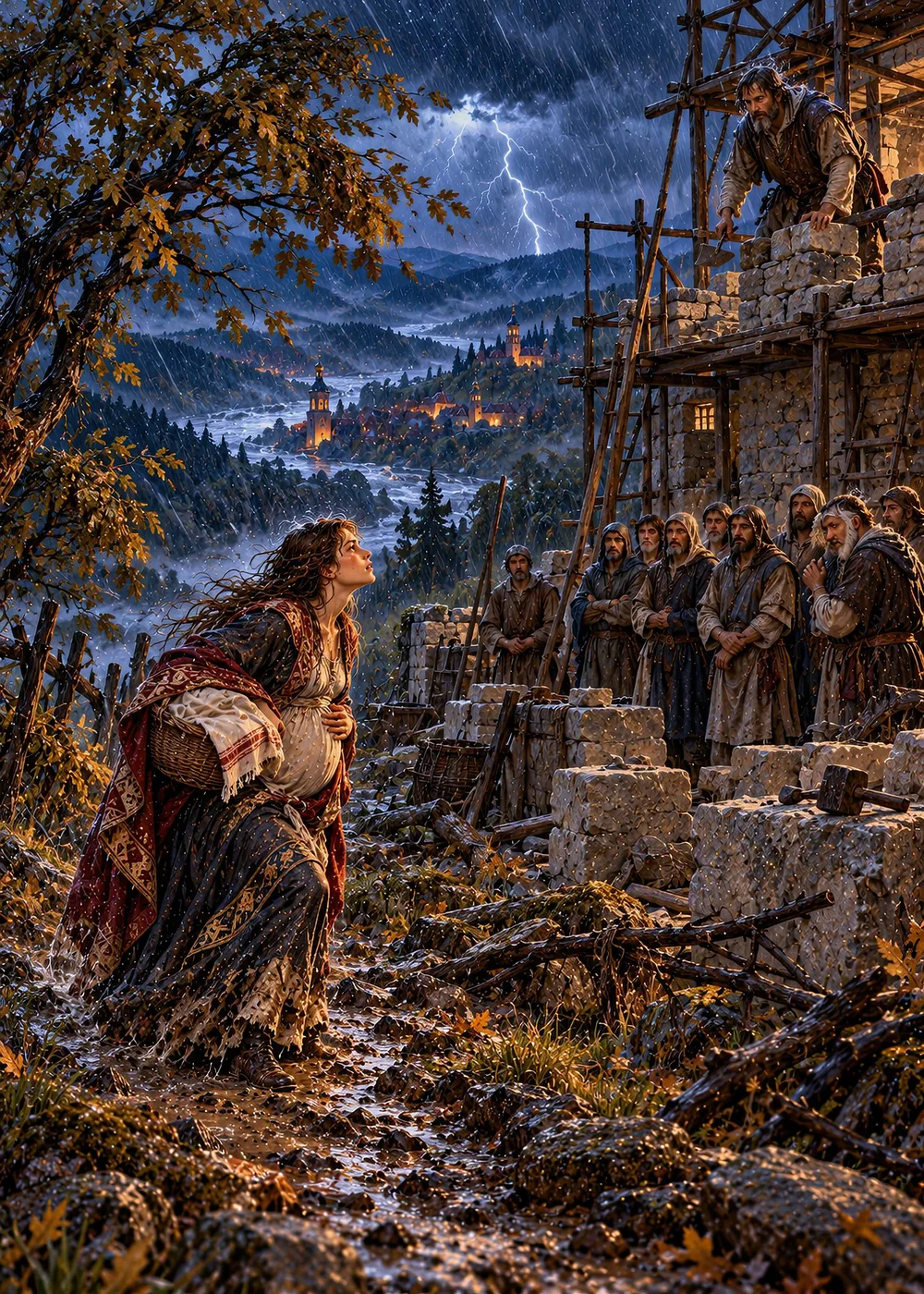
The sky darkened. A great wind came out of the mountains, bending the walnut trees and whipping the river into foam. Then a cold rain fell in sheets. Yet up the path from the village, through the wind and the rain, bent under the weight of her basket, came a small figure with chestnut hair. It was Ana. No other wife had come out in such weather. Only Ana, who loved him, and who did not want him to go hungry.
When Ana reached the top of the hill, soaked to the skin and laughing, she found the masons standing in a circle in the rain, staring at her with stricken faces, and her husband standing in the middle of them with a trowel in his hand and tears running down his face.
“Manole,” she said, setting down her basket, “what is it? What has happened?”
The nine masons looked at Manole. Manole looked at the trowel in his hand. He looked at the gap in the foundations where the dream had told him to build. He looked at his wife’s face, and at her hands, folded over the child she was carrying.
Then he threw the trowel down on the stones.
“I will not do it,” he said. “I swore an oath, and I was wrong to swear it. I will break my oath, and let God judge me for it, before I harm a hair of her head.”
“You swore!” cried the eldest mason. “If you break the oath, the walls will never stand, and we will all be disgraced!”
“Then let them never stand,” said Manole.
He told Ana everything: the falling walls, and the dream, and the voice from under the ground, and the oath. She listened, white-faced, holding his hand. When he had finished, she was silent a long moment. Then she looked at the nine masons, and her brown eyes flashed.
“What kind of God do you think you are building this church for?” she said. “Is He a god who drinks blood, like the idols of the heathen? Our God gave His own Son to die for us, so that no one would ever need to be sacrificed again. One Sacrifice was enough for the whole world. A voice that asks for a living woman in the wall of a church is not the voice of God. I do not know whose voice it is, but it is not His.”
The masons hung their heads. They were good men, and they had been frightened, and now they were ashamed.
At that moment, there was a sound of horses on the path, and the voivode Neagoe himself came riding up the hill through the rain, with the Lady Despina and the old abbot of the nearby monastery, for word of the masons’ strange behavior had reached the court. When he heard the whole story, the voivode’s face grew very stern.
“I would rather leave this hill bare forever,” he said, “than build the house of God on the bones of an innocent woman. You did right to break your oath, Master Manole. A wicked oath is better broken than kept.”
The old abbot had been listening with his eyes closed. Now he opened them. “The dream came from the one who was a liar from the beginning,” he said. “He has always loved blood. He hides under this hill, it seems, and he does not want a church built over his head. That is why your walls fall. He shakes them down in the night.”
“Then how can we build here?” asked Neagoe.
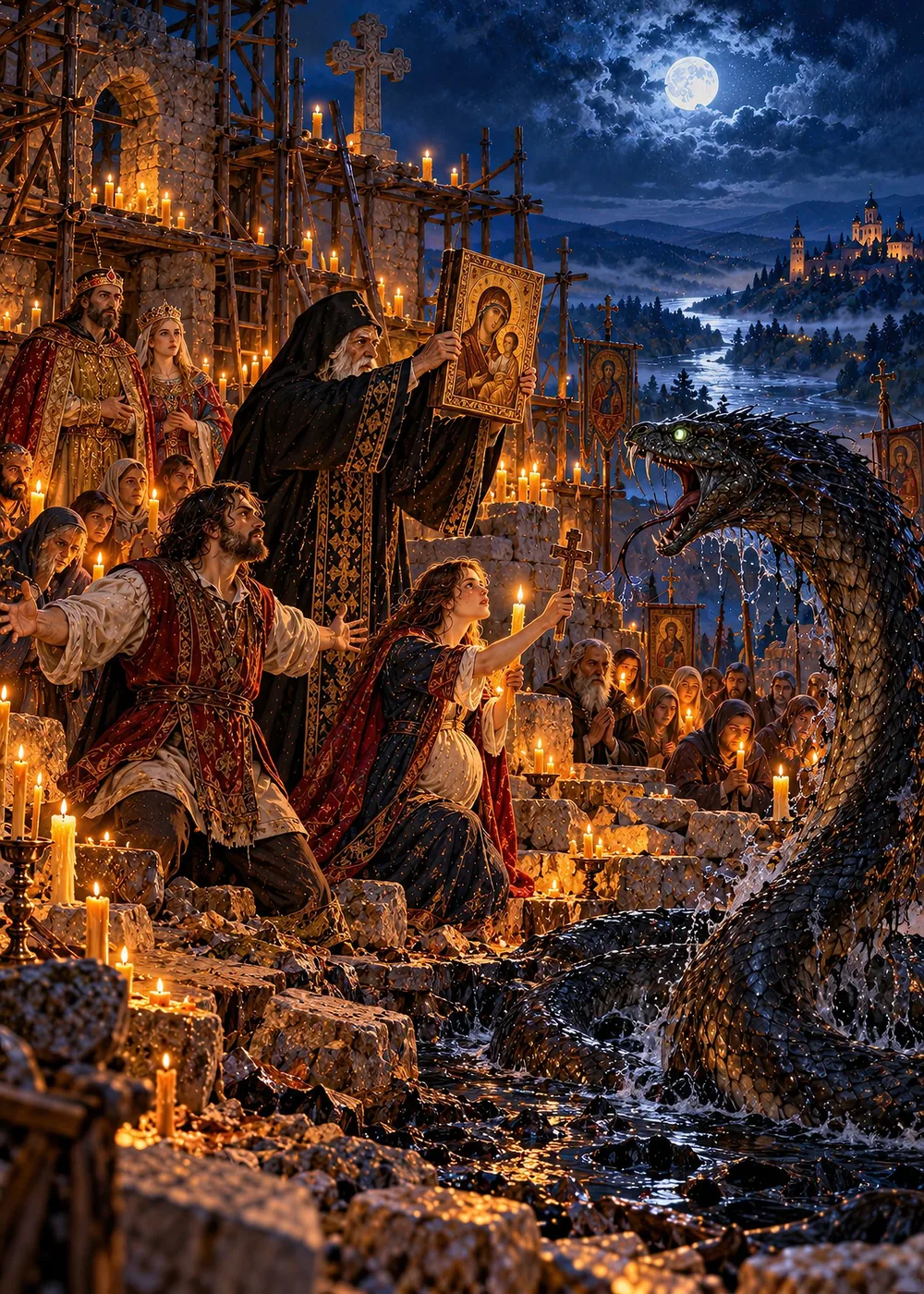
“Not with blood,” said the abbot, “but with prayer. Tomorrow is the first day of August, the beginning of the fast before the Dormition of the Theotokos. Tomorrow night, let us keep vigil here on this hill, before the icon of the Theotokos, and sing her Paraklesis, and ask her, for whom this church is built, to clear the ground of her enemy.”
* * *
Copyright notice. Introduction and illustration © 2026 Laurent Cleenewerck. All rights reserved. The adapted Orthodox version of this tale is published in Twelve Romanian Orthodox Fairy Tales (© 2026 Laurent Cleenewerck). No part of this page may be reproduced without written permission, except for brief quotations with attribution and a link to this page.
Buy the book on AmazonAbout the book