
A Story of Bucharest and the Feast of Saint Demetrius the New
In the ancient lands of Wallachia, where the wide plain stretches south from the Carpathians to the Danube, and the river Dâmbovitsa winds slowly through fields of wheat and sunflowers, stands the city of Bucharest. In the old days, it was a city of churches and gardens, of red-tiled roofs and wooden streets, where the bells rang from a hundred towers, and the sparrows chattered in a hundred thousand eaves.
On the highest hill of the city stands the great church of the Metropolis, and in that church rest the relics of a holy man whom the people of Bucharest love above all others, Saint Demetrius the New. Every child in Bucharest knows his story.
He was born, long ago, in a little village south of the Danube, and as a boy he kept his family’s cattle in the meadows by the river. One spring day, as he walked through the long grass, he stepped by accident on a bird’s nest hidden there, and he crushed the little birds inside it. The boy wept bitterly. It seemed to him that he had broken something that God had made with His own hands. In repentance, he took off his shoes, and for three years, in summer and in winter, through the mud and the snow and over the stubble of the fields, he went barefoot, so that he would never forget to walk gently on the earth. When he grew up, he became a monk, and he lived in a cave in the rocks above the river, praying for the whole world, and God glorified him.
In the time of our story, there lived in Bucharest a young boyar named Iordache. He was the only son of a rich family, with a fine house on the street called the Bridge of Mogoshoaia, which was paved with oak planks, and he had everything a young man could want: horses, servants, embroidered coats, and boots of the finest red leather from Constantinople. He was handsome, and he knew it. He was also idle and cruel, and he did not know it.
He spent his days riding through the streets with his friends, laughing at the poor and splashing mud on the beggars. His favorite sport was to throw stones at the sparrows that hopped about on the planks of the streets and in the courtyards of the churches. He was a very good shot. “They are only sparrows,” he would say, when anyone scolded him. “There are thousands of them. Who cares about a sparrow?”
In the prince’s palace, not far from the Hill of the Metropolis, lived the voivode of Wallachia, and with him his only daughter, the Princess Catinca. She was the most beautiful girl in Bucharest, with brown hair and brown eyes and a laugh like water in a fountain, and every young boyar in the city wanted to marry her. She was kind to everyone, but she had a strange habit: every morning, after the service, she sat on the steps of the great church and fed the sparrows with crumbs of bread from her own table. They knew her, and they came to her by the hundreds, perching on her shoulders and on her hands and on the hem of her dress.
Iordache fell in love with her the first time he saw her. He sent her gifts, which she sent back. He sang under her window, and she closed the shutters. At last he went to the church steps one morning, in his finest coat and his red leather boots, and he bowed before her.
“Princess,” he said, “why do you refuse me? There is no richer or handsomer young man in Bucharest.”
Catinca looked at him without smiling. “I have seen you throw stones at my sparrows,” she said. “A man who is cruel to a sparrow will be cruel to a wife. I will not marry you, Iordache, not for all the gold in Wallachia.”
Iordache went red, then white. He turned away from her in a rage. Under the eaves of the porch of the great church, a pair of sparrows had built their nest, and the little ones were chirping inside it. In his anger, Iordache reached up, tore the nest down, threw it on the stones, and stamped on it with his red leather boot.
Catinca cried out. Iordache, ashamed and furious at the same time, strode away down the hill without looking back.
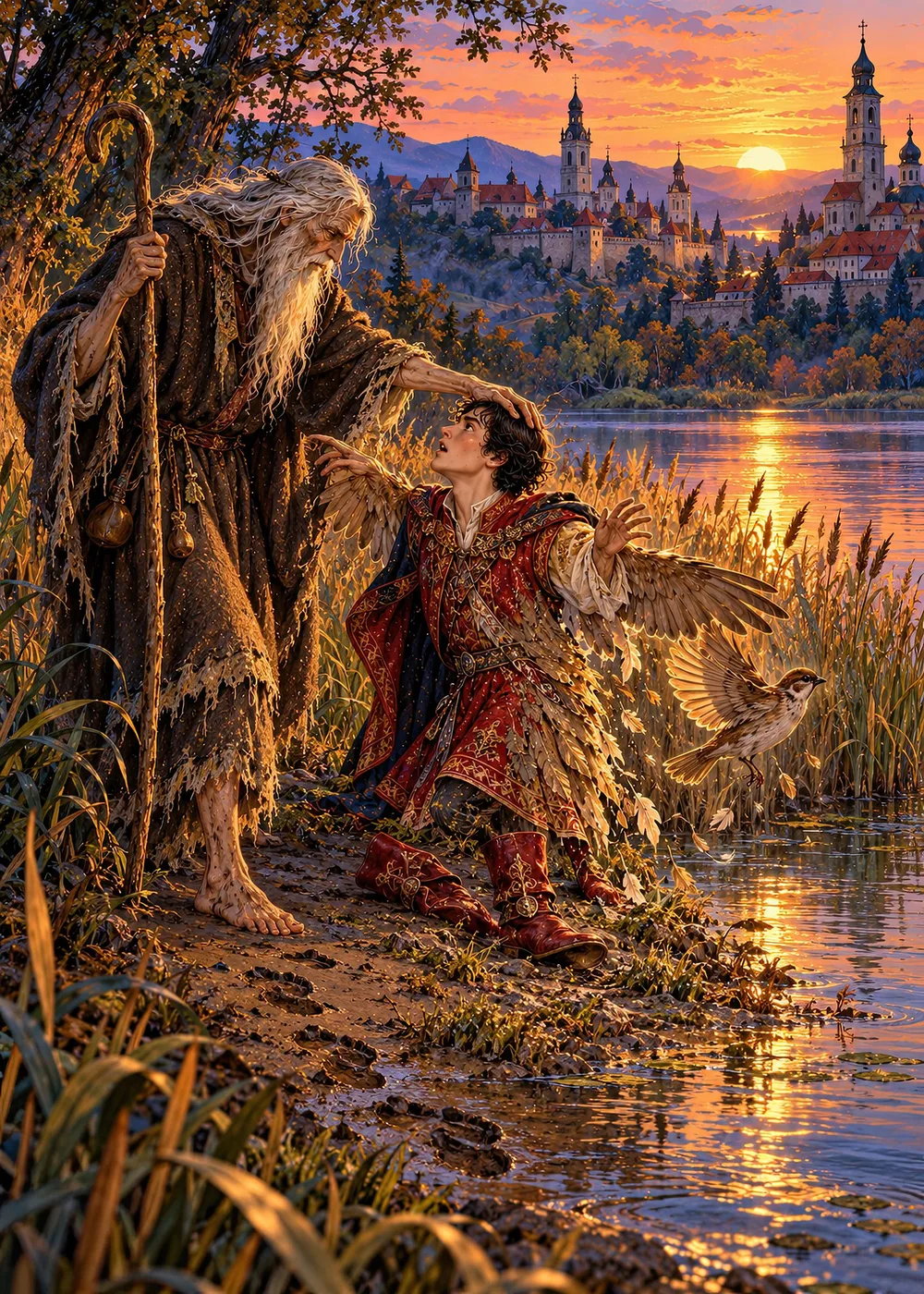
He walked, he did not know how long, until he found himself on the bank of the Dâmbovitsa, below the city, among the reeds. There, sitting on a stone by the water, was an old man in the rough clothes of a shepherd, with a shepherd’s crook across his knees. His hair and beard were long and white, and his face was brown and lined from the sun, and his feet were bare. Iordache noticed that they were scarred and calloused, as if he had walked barefoot for a very long time.
“You walk heavily, young man,” said the old shepherd.
“What business is it of yours?” snapped Iordache.
“I once walked heavily too,” said the shepherd, “and I crushed a nest of little birds in the grass. I have never forgotten their crying. Have you?”
Iordache stared at him. He heard again, in his mind, the chirping of the little sparrows as he stamped on them, and a strange cold feeling came over his heart.
“She will not have me,” he said at last, and his voice cracked. “She says I am cruel. Perhaps I am. I do not know how to be anything else.”
“Would you learn?” asked the old man. “It is a hard lesson, and a long one.”
Iordache hesitated. Then he said, “Yes.”
The old shepherd rose and laid his brown, scarred hand on the young man’s head. “Then you shall learn what it is to be a sparrow,” he said, “until you have learned to love what is small. When you are ready to give your life for another, you will come home.”
Iordache felt himself shrinking. His fine coat became brown feathers, and his arms became wings, and his red leather boots fell away empty onto the riverbank. In a moment, where the proud young boyar had stood, a little brown sparrow sat on the stone, trembling, with its feathers ruffled and its black eyes full of fear.
The old shepherd was gone. Only his footprints remained, the marks of two bare feet in the mud by the river, and they too were slowly filling with water.
Iordache tried to cry out, and only a thin chirp came from his beak. He tried to walk, and he could only hop. He beat his wings in a panic, and to his astonishment he rose into the air, and flew, clumsily, over the reeds and the roofs, back toward the city.
That was the beginning of the hardest year of his life.
He learned that a sparrow is always hungry. He searched for seeds and crumbs in the dust of the streets from dawn until dusk, and there were never enough. He learned that a sparrow is always afraid. The cats of Bucharest crept after him in the courtyards with their green eyes. The hawks circled high over the city, and when their shadows passed, he dived under the eaves, his little heart hammering. Worst of all were the boys. They ran through the streets with their slingshots, laughing, and once a stone whistled past his head so close that he felt the wind of it. He crouched in a gutter, shaking, and thought of all the sparrows he had killed for sport, and he was ashamed.
He also learned other things. He learned that the sparrows of Bucharest were not stupid and mean, as he had thought. They warned one another when a cat was near. They shared their crumbs with the old and the weak. In the evenings, they gathered in the trees around the churches and chattered together like neighbors on a bench, and when the bells rang, they fell silent, as if they too were listening. An old gray sparrow with a crooked wing let him sleep beside her in a hole under the roof of a church, out of the wind, and taught him where to find the best seeds.
Every morning, he flew to the steps of the great church on the Hill of the Metropolis, and there, every morning, the Princess Catinca came out after the service and scattered crumbs for the sparrows. Iordache came with the others, and he hopped as close to her as he dared, and he ate the bread from her hand. She did not know him. Sometimes, though, she would look at him curiously, at the little brown sparrow who always came closest and never flew away. “You are a brave one,” she said to him once, and she smiled. No one had ever spoken so kindly to Iordache in his life.
He heard her speak of him too. One morning, she said to her old nurse, “No one knows what became of young Iordache. They found his boots by the river. They say he drowned.” She was silent a moment. “I was too hard with him, perhaps. I pray for him every day.”
* * *
Copyright notice. Introduction and illustration © 2026 Laurent Cleenewerck. All rights reserved. The adapted Orthodox version of this tale is published in Twelve Romanian Orthodox Fairy Tales (© 2026 Laurent Cleenewerck). No part of this page may be reproduced without written permission, except for brief quotations with attribution and a link to this page.
Buy the book on AmazonAbout the book