
A Story of Iashi and the Feast of Saint Paraskeva
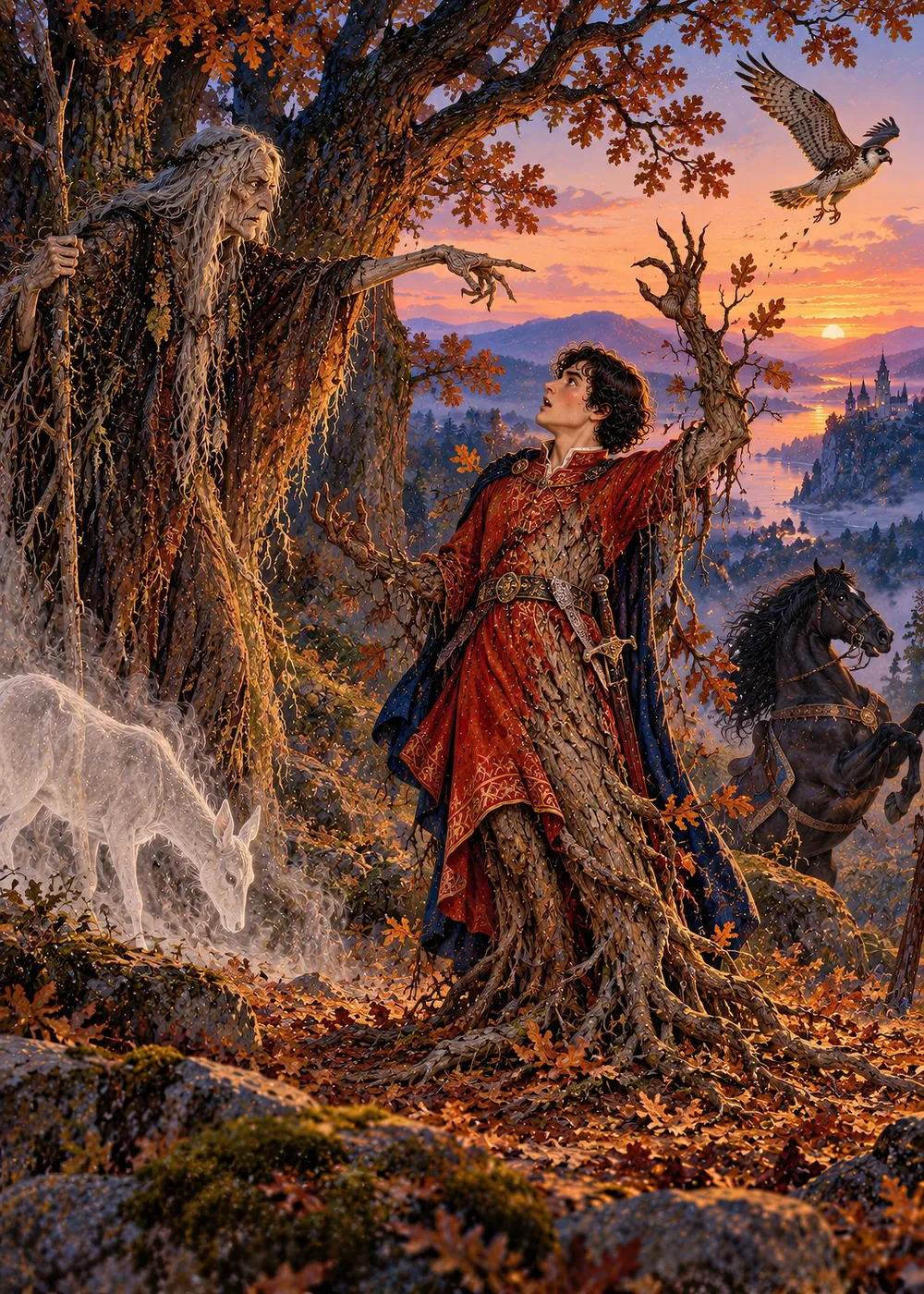
In the ancient lands of Moldavia, on seven green hills above the river Bahlui, stands the city of Iashi, the city of churches, where the bells of a hundred towers answer each other across the valleys on feast days. In the days of the voivode Vasile Lupu, there lived in a narrow street below the princely court a candle-maker named Pavel and his daughter Smaranda.
Pavel was a widower, and he was poor, but his candles were the best in Iashi. He made them of pure beeswax, which smells of honey and summer meadows, and not of tallow, like the cheap candles of the market. Smaranda had helped him since she was a little girl, dipping the wicks again and again into the warm wax, and she had learned to say a prayer for every candle she made. “A candle is a prayer that keeps praying after you have gone home,” her mother had told her, before she died.
Every morning, Smaranda sat with her tray of candles on the steps of the church of the Three Holy Hierarchs, the voivode’s new church, whose walls were carved all over with stone patterns as fine as lace. The rich ladies of the court bought her candles, and the poor women, who could not pay, received them for nothing when her father was not looking.
One morning, a young prince came riding up to the church on a black horse, with a falcon on his wrist and two hunting dogs at his heels. His name was Matei, and he was the nephew of the voivode Vasile Lupu himself, the son of his widowed sister, a proud young man with a quick laugh and a fine red coat. He tossed Smaranda a silver coin without looking at her and reached for a candle.
“Not that one, my lord,” said Smaranda. “That one is for the old woman who sits by the door. She has no money, and she is praying for her son, who is a prisoner of the Tatars.”
Matei looked at her for the first time. Then he looked at the old woman by the door, in her black shawl. He laughed, a little ashamed, and he dropped a whole handful of silver coins onto the tray. “Then give a candle to every poor soul who comes to this church today,” he said, “and say that it is from Matei, who needs their prayers more than they need his money.”
After that, Matei came to the church of the Three Hierarchs every morning, though he had hardly ever gone to church before, and he always stopped to buy a candle from Smaranda. They talked about many things. She told him about the saints of the church, and he told her about the forests and the hunts. Before long, he found that he liked to talk to her more than to all the fine ladies of the court together, and she found that she prayed for him with every candle she made.
His mother, the Princess Safta, heard about it, and she was furious. “A candle-maker’s girl!” she cried. “You are a prince of the voivode’s house. Forget her at once.”
In that same year, the whole city of Iashi was full of great news. The voivode Vasile Lupu had obtained from the Patriarch of Constantinople a treasure greater than any gold: the holy relics of Saint Paraskeva, the holy woman who as a young girl had given her fine clothes to the beggars and gone into the desert to pray. Her relics were coming to Iashi, to rest in the new church of the Three Hierarchs.
On the day the relics arrived, the whole city went out to meet them. The voivode himself walked bareheaded in the procession, with the metropolitan and the bishops and all the clergy, and the boyars in their furs, and the merchants and the craftsmen with their banners, and the peasants from the villages, and the beggars. The bells rang until the hills seemed to rock. Smaranda walked with her father, carrying the largest candle they had ever made, and she wept for joy when the silver reliquary passed by.
Matei was not there.
He had meant to go. On that morning, however, as he was dressing in his finest coat, a huntsman came to tell him that a white doe had been seen at the edge of the great forest north of the city, a doe as white as milk, which no hunter had ever caught. The young man’s eyes shone. “There will be other processions,” he said. “There will never be another doe like that.” While all Iashi went out to meet the saint, Matei rode out the other way, into the forest, with his dogs and his falcon.
He chased the white doe all day, deeper and deeper into the forest, where the oaks grew so thick and old that they shut out the sky. His dogs lost the scent and ran home whimpering. His falcon flew away. At last, as the sun went down, his horse stumbled and threw him, and the white doe stopped in front of him, in a clearing among the oaks, and looked at him.
Then it was not a doe any longer. It was an old woman, very tall and very thin, with skin like the bark of a tree and hair like gray moss and fingers like twigs. Her eyes were two knots in old wood.
“Do you know who I am, little prince?” she said, in a voice like wind in dry leaves.
Matei knew. Every child in Moldavia knew. “You are Muma Pădurii,” he whispered, “the Mother of the Forest.”
“I am,” said the old woman. “You love my forest more than your saints, little hunter. Today, while your whole city went out to meet a holy woman, you came here to kill my doe. Very well. Stay in my forest forever.”
She pointed one long, twiggy finger at him. Matei felt his feet grow heavy and sink into the earth, and his arms stretch up toward the sky, and his fine red coat turn rough and gray. He tried to cry out, and his voice became the creaking of branches. In a moment, where the young prince had stood, there stood a young oak tree in the middle of the clearing, with its leaves trembling in the evening wind.
His black horse found its way home in the night, without its rider. The Princess Safta sent all her servants into the forest with torches. They searched for nine days and found nothing but his hat, lying at the foot of a young oak in a clearing, and they did not think to look at the oak.
When Smaranda heard the news, she did not weep. She took the finest candle she had made, a tall candle of pure white beeswax, and she went to the church of the Three Hierarchs, where the relics of Saint Paraskeva lay in their silver reliquary, and she lit it before the saint, and she prayed all night.
Toward dawn, she was so tired that she sat down on the floor against a pillar. A young woman came and sat beside her. She was dressed like a poor pilgrim from the villages, in a plain dark dress and a brown shawl, and she was barefoot, and her feet were dusty, as if she had walked a very long way. Her face was thin and pale, and her eyes were very gentle.
“Why are you praying so hard, sister?” asked the pilgrim.
Smaranda told her everything: about Matei, and the white doe, and the forest, and how no one could find him. The pilgrim listened in silence.
“I know where he is,” she said at last. “Muma Pădurii has taken him. She has made him into an oak, in the heart of the forest, because on the day the saint came to Iashi, he chose to go hunting instead.”
Smaranda went white. “Can he be saved?”
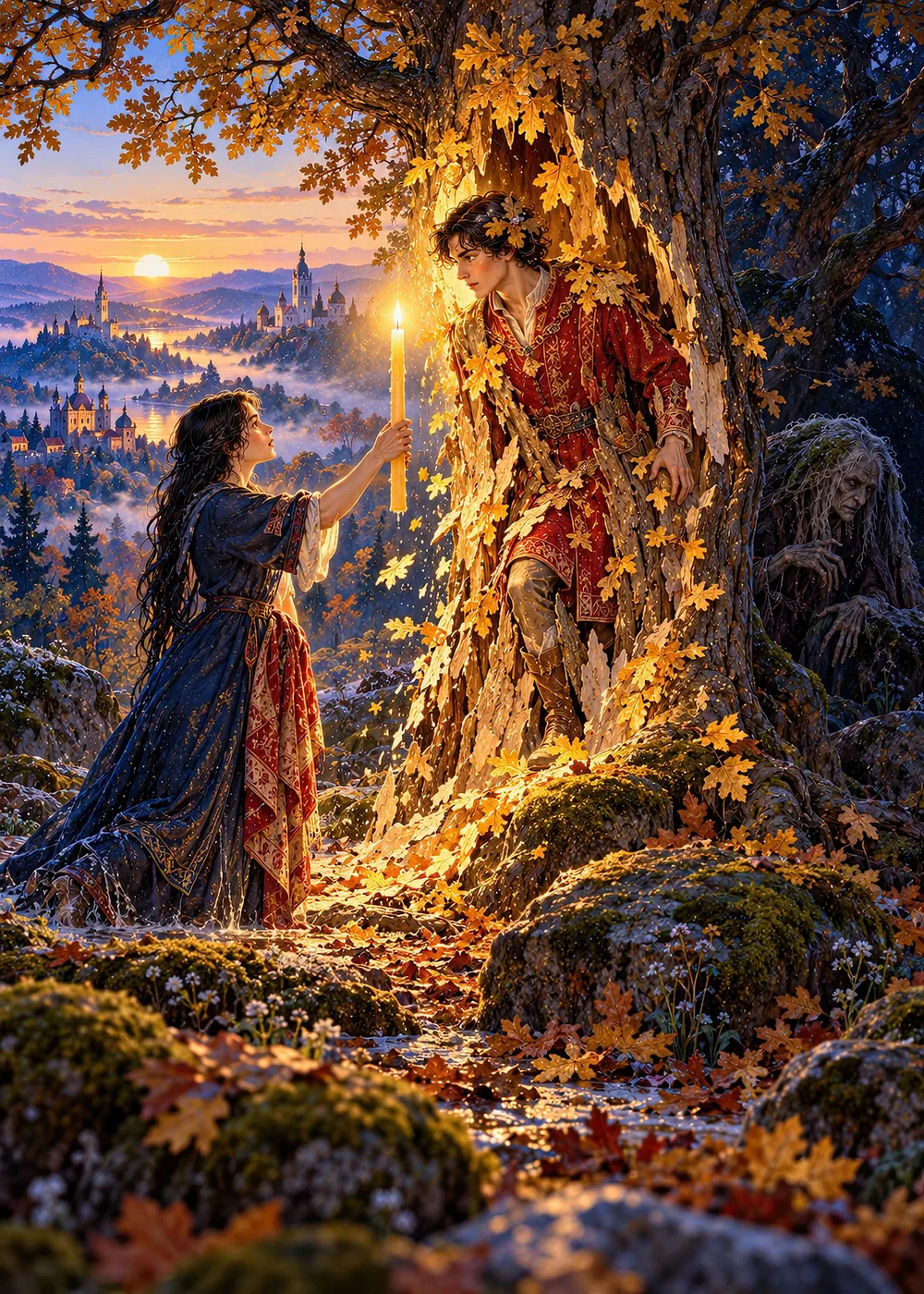
“He can,” said the pilgrim. “On the night of the saint’s feast, someone who loves him must carry a candle lit before the saint’s relics into the heart of the forest, to the oak that he has become. The candle must not go out on the way. Whoever carries it must not ask anything for herself, and must not turn back, whatever she sees or hears. If the light of the candle touches the oak at dawn, he will be free.” She looked at Smaranda gravely. “It is a long way, and Muma Pădurii will do everything she can to put out the flame.”
“I will carry it,” said Smaranda.
The pilgrim smiled. She took Smaranda’s hands in her own. Her hands were thin and cool, and they smelled of wax and flowers, like the church. “You have prayed for many people with your candles,” she said. “Now others will pray for you.” Then she rose and went away among the pillars, and Smaranda, though she looked for her everywhere, did not see her again.
The feast of Saint Paraskeva came on the fourteenth of October. All day long, the pilgrims passed in a long line before the relics, from the villages of Moldavia and from far beyond, kissing the silver reliquary and lighting candles until the whole church glowed like a furnace. Smaranda waited until evening. Then she lit a tall candle of pure beeswax from the lamp that burned before the relics, sheltered it with her hand, and went out of the city, through the gates, up the dark road toward the forest.
* * *
Copyright notice. Introduction and illustration © 2026 Laurent Cleenewerck. All rights reserved. The adapted Orthodox version of this tale is published in Twelve Romanian Orthodox Fairy Tales (© 2026 Laurent Cleenewerck). No part of this page may be reproduced without written permission, except for brief quotations with attribution and a link to this page.
Buy the book on AmazonAbout the book