
A Story of Bucovina and the Feast of Saint George
In the ancient lands of Moldavia, in the green hills that are now called Bucovina, where the beech forests are so thick that they are dark at noon, and the monasteries shine in the valleys like jewel boxes left in the grass, there once reigned a great voivode named Stephen. His people called him Stephen the Great, for he had fought the armies of the sultan for many years and defended his land like a lion, and after his battles he built churches to give thanks to God.
Not far from Suceava, in a narrow valley beside a little river, lived a holy old monk named Daniel the Hermit. Once, after a terrible defeat, it is said, the voivode came to him in despair and knocked at the door of his cell. “Father,” said Stephen, “my army is broken. Should I surrender my land to the sultan?”
“Do not surrender,” said the old man. “Fight on, and the victory will be yours. When God has given it to you, build a church here in honor of the holy Great-martyr George, who fights against the dragon.”
Stephen fought on, and God gave him the victory. In thanksgiving, he built the church of Saint George at Voronets, beside the hermit’s valley, in only three months and three weeks, and it stood on its stone foundations as slender and graceful as a candle.
Then the voivode looked for painters to cover its walls with saints.
Among the painters who came to Voronets was a young man named Toma. He was the son of a poor icon painter from Suceava, and he had learned to grind colors and lay gold leaf before he could read. He had a gift that his father had never had, and everyone knew it. When Toma painted a face, it seemed to breathe. When he painted a horse, it seemed about to gallop off the wall.
Toma knew it too. That was his trouble.
At Voronets, he met the Lady Irina, the daughter of Costea, the voivode’s treasurer, who often came with her father to watch the work. She had the bluest eyes that Toma had ever seen, as blue as the sky over the beech woods on a summer morning. She liked to stand at the foot of the scaffolding and ask him the names of the saints he was painting, and she always remembered them. Before long, Toma painted every saint with her in his mind, and she came to the church every day, whether her father came or not.
The treasurer noticed, and he did not like it. One day, he came before the voivode with Toma beside him.
“My lord,” he said, “this young painter has dared to ask for my daughter’s hand. He has no lands and no name. I would send him away, but he says that you value his work.”
The voivode looked at Toma for a long time. Stephen was a short man, but there was something in his gaze that made tall men feel small. “I do value his work,” he said. “Listen, young man. The church is finished, but its walls are still bare. Above the altar, I want the sky of heaven, and over the door, I want the holy George slaying the dragon. Paint them with a blue that will not fade, a blue as deep as heaven itself, so that men will come from the ends of the earth to see it. If you can do that, you shall marry the Lady Irina, and I myself will hold the crowns. Is that agreeable to you, Costea?”
“It is, my lord,” said the treasurer, who knew that no painter in Moldavia had such a blue.
Toma bowed low, and his heart was on fire. He would show them all. He would paint something that no painter had ever painted before.
Before beginning, every icon painter in those days would go to his spiritual father to confess his sins, and he would fast and pray, for he knew that the saints he painted were not his own work, but windows opened by God. Toma’s father had always done so. Toma meant to, but he was in a hurry, and he was proud, and he thought that his gift was enough. He did not go to Daniel the Hermit. He did not fast. He climbed the scaffolding that very night and began to paint by lamplight.
He began with the dragon.
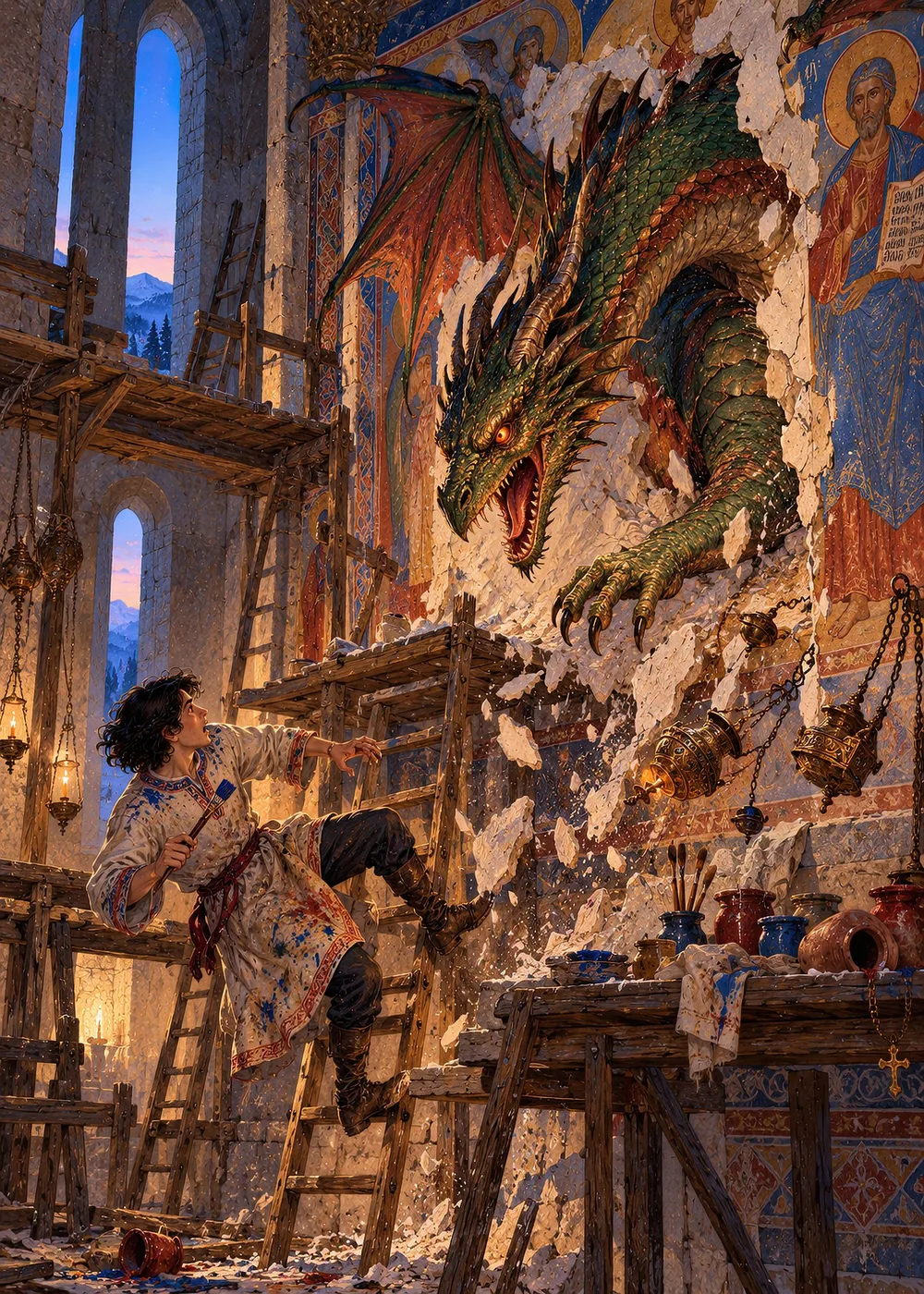
He painted it beneath the place where the holy George would ride, coiled on the rocks of a mountain: a great green balaur with scales like copper and wings like a bat’s and eyes like burning coals. He painted it with all his skill, and with all his pride, all night long, and he thought only of how everyone would admire it. When the first light came through the window, he climbed down and looked at what he had made, and he was amazed at himself. It was the most terrible, most beautiful dragon that had ever been painted. It looked as if it were alive.
As he looked, one of its burning eyes blinked.
Toma stumbled backward off the last rung of the ladder. The painted dragon stretched its painted neck, slowly, like a cat waking up. It shook its wings, and flakes of plaster fell from the wall. Then, with a sound like a wet sheet tearing, it pulled itself off the wall and slithered down into the church, huge and green and hissing, and its tail swept the lamps from their stands.
The dragon looked around the bare church, and it looked at the sky through the windows, and it smiled a terrible smile.
“You made me well, little painter,” it said, in a voice like stones grinding together. “You made me out of your pride, and pride is always hungry. Do you know what I hunger for? I hunger for the color you need. I want the blue.”
It thrust its head out through the door of the church and opened its jaws and breathed in, a long, long breath, like the wind before a storm. Toma, running after it, saw the blue of the morning sky stream down into its mouth like water into a drain. The sky turned gray, as gray as ashes. The little river beside the monastery turned gray. The cornflowers in the meadow turned gray. The blue mantles of the women going to the well turned gray. Even the blue in the old icons of the monastery faded to the color of dust.
Then the dragon spread its wings, beat them twice, and flew off over the forest toward the high mountains, and the gray morning closed behind it.
All over Moldavia, people came out of their houses and stared at the colorless sky in fear. In the treasurer’s house at Suceava, the Lady Irina woke up and went to her window, and when she saw the gray sky, she cried out and fell down as if dead. Her maids ran to lift her up. She was breathing, but she would not wake, and when they opened her eyelids, her eyes, which had been the bluest in Moldavia, were as gray as ash.
Toma knew at once what he had done. He ran down the valley in the gray light, past the new church, to the rock where the cell of Daniel the Hermit was cut into the hillside, and he fell on his knees at the door.
“Father,” he cried, “I have done a terrible thing!”
The old hermit came out, leaning on his staff. He was very old now, and his beard was as white as frost, and his eyes were as quiet as a forest pool. He listened to the young painter’s story without a word.
“You painted without prayer,” he said at last, “and your pride gave the dragon life. Pride is like that, my son. It is a little thing in the heart, and then one day it comes out and swallows the sky.”
“How can I get the blue back?”
“You cannot,” said the hermit. “That dragon is stronger than you, for it is made of the worst part of you. Only one who has already conquered such a dragon can conquer it again.” He pointed with his staff to the church. “The holy George, to whom this church belongs, fought the dragon long ago. Ask him to fight it for you. First, though, you must do what you should have done before you ever lifted a brush. Kneel.”
Toma knelt on the stone, and he confessed his sins to the old hermit: his pride, and his hurry, and his scorn for the other painters, and every proud thought he could remember. When he was done, the hermit laid his stole over the young man’s head and read the prayer of forgiveness over him.
“Now go,” said Daniel. “Fast and pray as you go, and follow the one who knows the way.”
“Who is that, Father?”
The hermit smiled and pointed to the little gray river. On a willow branch over the water sat a small bird, no bigger than a sparrow, with a long, sharp beak. In all that gray world, it was the only thing that was still blue: a blue so bright and pure that it seemed to burn on the branch like a flame.
“The kingfisher,” said the hermit. “Our people call him the little blue fisherman. When the dragon breathed in the blue of the world, he dived under the water, and the dragon could not take his. He has come to show you the road.”
The kingfisher flew off upstream, low over the water, like a spark of blue fire, and Toma ran after it. He followed it all that day and all the next, eating nothing but a little dry bread and drinking only from the streams. He followed it up the valleys and through the beech forests, which were gray now instead of green-gold, over ridges and across rivers, higher and higher into the mountains. As he walked, he prayed the prayer that his father had taught him to say while he painted: Lord Jesus Christ, Son of God, have mercy on me, a sinner. At first he said it with his lips only. By the second day, he was saying it with his whole heart.
* * *
Copyright notice. Introduction and illustration © 2026 Laurent Cleenewerck. All rights reserved. The adapted Orthodox version of this tale is published in Twelve Romanian Orthodox Fairy Tales (© 2026 Laurent Cleenewerck). No part of this page may be reproduced without written permission, except for brief quotations with attribution and a link to this page.
Buy the book on AmazonAbout the book