
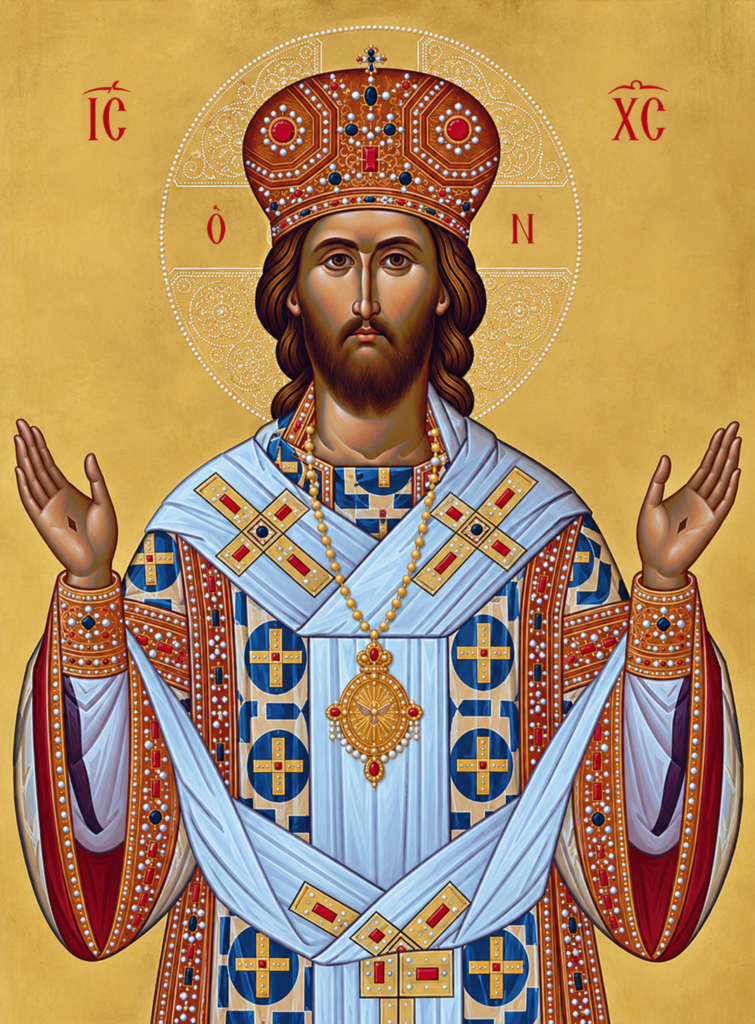
To Pray, to Intercede, to Commemorate: The Directions of Prayer in the Orthodox Tradition
Fr. Laurent Cleenewerck
Introduction
When Protestant Christians ask why the Orthodox “pray to the saints,” the question usually contains a hidden assumption: that there is only one kind of prayer, and that it can only be addressed to God. Scripture and the Tradition of the Church do not speak this way. The Bible uses a rich vocabulary of asking, entreating, pleading and interceding, and it shows us a whole community engaged in these acts: the Son before the Father, the Spirit within our hearts, angels before the throne, believers on earth for one another, the living for the departed, and the departed for the living.
Our purpose in this study is to set these relationships in order. We will begin with the words themselves, since much of the misunderstanding is linguistic. We will then show that in the ultimate sense all Christian prayer ascends to God the Father, through the Son and in the Holy Spirit, and that every other form of intercession takes place within this one movement. We will then consider, one by one, the directions in which intercession flows: from Christ, from the Spirit, from the angels, from the living for the living, from the living for the departed, and from the departed for the living. We will close with a question that Scripture leaves largely open, namely whether the departed faithful pray for one another, and with the rule of proportion that the Divine Liturgy gives the Church.1
1. The Language of Prayer
“To pray” means “to ask”
In older English, “to pray” simply meant “to ask.” The King James Version has Abraham say to Sarah, “Say, I pray thee, thou art my sister” (Gen 12:13), and Paul urge the sailors, “I pray you to take some meat” (Acts 27:34). No one imagines that Abraham worshiped his wife or that Paul worshiped the crew. When older Orthodox and Anglican texts speak of “praying to the saints,” they use the word in this ordinary sense. In modern English, “pray” has narrowed to mean addressing God, and the older usage now sounds like a claim that the saints receive divine worship. It is not. The content of the Church’s address to the saints shows this at once: “Holy N., pray to God for us.” The very formula names God as the One to whom prayer properly goes.
The Hebrew vocabulary
The usual Hebrew verb for prayer, hitpallel, comes from a root that has to do with arbitration and judgment. Its sense appears in Eli’s words to his sons: “If a man sins against a man, God will mediate for him; if a man sins against the Lord, who will intercede for him?” (1 Kgdms [1 Sam] 2:25). Prayer in this sense is pleading a case before the Judge, and it is very often a plea on behalf of someone else. A second verb, pagaʿ, “to meet” or “to fall upon,” is used for intercession: the Servant “made intercession for the transgressors” (Isa 53:12), and the Lord tells Jeremiah not to intercede for the people (Jer 7:16). A third, ʿatar, “to entreat,” appears when Pharaoh asks Moses to entreat the Lord for him (Exod 8:8 [8:4 LXX]). Each of these verbs describes an approach to God; several of them are naturally used of one person approaching God for another.
The Greek vocabulary
The New Testament is even more precise. We may distinguish the following families of words:2
| Greek term | Meaning | Who is addressed in the New Testament | Examples |
|---|---|---|---|
| proseuchomai, proseuchē | To pray, prayer | Almost always God | Matt 6:9; Acts 12:5; Phil 4:6 |
| deomai, deēsis | To ask, beg; petition | God, and also other people | Luke 22:32; 2 Cor 5:20; Gal 4:12 |
| aiteō, erōtaō | To ask, request | God, Christ, and other people | John 16:23; 17:9; 1 John 5:16 |
| parakaleō | To entreat, appeal, comfort | Fellow believers, and the Lord | Rom 12:1; 15:30; 2 Cor 12:8 |
| entynchanō, enteuxis | To approach on behalf of; intercession | God, on behalf of others | Rom 8:27, 34; 11:2; Heb 7:25; 1 Tim 2:1 |
| hyperentynchanō | To intercede on behalf of | The Spirit, for us | Rom 8:26 |
| mesitēs | Mediator, go-between of a covenant | Christ, uniquely | 1 Tim 2:5; Heb 8:6; 9:15; 12:24 |
| presbeia, presbeuō | Embassy; to act as ambassador | Apostles for Christ; in liturgy, the saints | 2 Cor 5:20; Eph 6:20 |
Two observations follow. First, the word Paul uses for his own appeals to the churches, parakaleō, is the same word he uses for his threefold plea to the Lord concerning the thorn in his flesh (2 Cor 12:8). The verb itself does not distinguish divine worship from human request; the person addressed and the content of the request do. Second, the word the Church uses in its liturgy for the intercession of the saints is presbeia, the embassy or representation of an ambassador: “Through the intercessions (presbeiais) of the Theotokos, O Savior, save us.” The saints are ambassadors before the King, not the King.
Worship and veneration
Alongside the vocabulary of asking stands the vocabulary of worship. The Seventh Ecumenical Council (Nicaea, 787) distinguished latreia, the adoring service that belongs to God alone, from honorable veneration (timētikē proskynēsis), which may be shown to the saints, to holy images and to holy things.3 The distinction is biblical. Proskynēsis, bowing down, is given in Scripture to God, and also to human persons without any suggestion of idolatry: Abraham bows to the Hittites (Gen 23:7), Abigail to David (1 Kgdms 25:23), and the Lord promises that the false brethren will come and bow before the feet of the faithful in Philadelphia (Rev 3:9). Latreia is never given to anyone but God (Matt 4:10). Asking a saint for prayer belongs to the order of honor and fellowship, not to the order of latreia.
2. In the Ultimate Sense, Prayer Is Addressed to the Father
The Lord taught His disciples to pray, “Our Father, who art in the heavens” (Matt 6:9). On the night before His Passion, He told them, “Whatever you ask the Father in My name, He will give it to you” (John 16:23). The apostolic writings consistently describe prayer in the same direction: “Through Him we both have access in one Spirit to the Father” (Eph 2:18); “I bow my knees before the Father” (Eph 3:14); “giving thanks always for all things to God the Father, in the name of our Lord Jesus Christ” (Eph 5:20; cf. Col 3:17; Rom 1:8). The Father is the source and cause of the Son and of the Spirit, and all prayer returns to Him as its final term.
The Divine Liturgy follows this order exactly. The great eucharistic prayers of St John Chrysostom and St Basil the Great are addressed to the Father, offered through the Son and completed by the invocation of the Holy Spirit. The African councils of the late fourth century made this a canonical rule: when the priest stands at the altar, the prayer is always to be directed to the Father.4 This is what we mean when we say, with the catechism, that the Eucharistic sacrifice and latreia are offered to the Father, through the Son who intercedes, in the Spirit who intercedes.
Two qualifications keep this principle from being misunderstood. First, the Son and the Spirit are not excluded from receiving worship. The Creed confesses that the Holy Spirit “with the Father and the Son together is worshiped and glorified,” and the Council of Constantinople of 1156-57 affirmed that the sacrifice is offered to the whole Trinity, and also by the incarnate Son, as the priest prays during the Cherubic Hymn: “Thou art the One who offers and is offered, who receives and is distributed.” Origen had argued that prayer in the strict sense should be made to the Father alone;5 the Church did not follow him on this point. Second, Scripture itself shows prayer addressed to Christ: Stephen’s “Lord Jesus, receive my spirit” (Acts 7:59), Paul’s plea concerning the thorn (2 Cor 12:8), and the cry of the Church, “Maranatha,” “Our Lord, come!” (1 Cor 16:22; Rev 22:20). The Church also invokes the Spirit directly: “O Heavenly King, Comforter, Spirit of truth, come and abide in us.”
We may therefore state the principle precisely. All prayer ascends to the Father as source, through the Son and in the Holy Spirit, and the one God, Father, Son and Holy Spirit, receives it, since the Three share one Name (Matt 28:19). Every other form of intercession we will discuss happens inside this movement and never alongside it or in competition with it.
3. Christ Intercedes for Us
The Epistle to the Hebrews presents the risen and ascended Christ as our High Priest, who “always lives to make intercession (entynchanein) for them” (Heb 7:25), and who has entered heaven itself “to appear in the presence of God on our behalf” (Heb 9:24). Paul writes in the same sense: “Christ Jesus is the One who died, more than that, who was raised, who is at the right hand of God, who indeed intercedes for us” (Rom 8:34). John calls Him our Advocate (paraklētos) with the Father (1 John 2:1).
This heavenly intercession continues what Christ did on earth. He prayed for Peter, that his faith would not fail (Luke 22:32); He prayed for His disciples and for all who would believe through their word (John 17:9, 20); on the cross, He prayed for those who crucified Him (Luke 23:34). St Gregory the Theologian explains that the Son’s intercession does not mean that He falls at the Father’s feet as a suppliant, which would be unworthy of the Spirit and of the Son alike. It means that by His very humanity, which He has taken up and which He presents to the Father, He pleads for our salvation.6 Christ’s intercession is His priesthood: the eternal presentation of our humanity, healed and glorified, before the Father.
Here we must address the verse most often cited against the intercession of the saints: “There is one God, and one Mediator (mesitēs) between God and men, the man Christ Jesus” (1 Tim 2:5). We should notice its context. Only four verses earlier, Paul commands that “petitions, prayers, intercessions (enteuxeis) and thanksgivings be made for all people” (1 Tim 2:1). The uniqueness of Christ’s mediation does not exclude intercession by others; it is the very reason Christians can intercede at all. Christ is the one Mediator of the covenant, the one in whom God and humanity are united. Christians intercede as members of His Body, and their prayers are heard only because they are offered in Him.
4. The Holy Spirit Intercedes for Us
Paul writes that “the Spirit helps us in our weakness; for we do not know what to pray for as we ought, but the Spirit Himself intercedes for us (hyperentynchanei) with groanings too deep for words. He who searches the hearts knows what is the mind of the Spirit, because He intercedes for the saints according to God” (Rom 8:26-27). The same Spirit cries “Abba, Father” in our hearts (Gal 4:6), and the apostles exhort us to pray “in the Holy Spirit” (Jude 20; Eph 6:18).
The Fathers understood this intercession in a way that guards the Spirit’s divinity. The Spirit does not stand before the Father as a petitioner distinct from us; the Spirit intercedes by moving our own hearts to pray, by teaching us to groan and to ask rightly. St Augustine puts it simply: the Spirit is said to intercede because He makes us intercede.7 We therefore have two Paracletes, as the Lord Himself promised (John 14:16): the Son, who intercedes for us at the right hand of the Father, and the Spirit, who intercedes within us. Our prayer is caught up between them, and in this way it reaches the Father.
5. The Angels Intercede
Scripture shows the Lord surrounded by His heavenly council (3 Kgdms [1 Kgs] 22:19-22; Job 1:6; Ps 81 [82]:1), and the members of this council are not idle. In Zechariah’s vision, the angel of the Lord pleads, “O Lord of hosts, how long wilt Thou have no mercy on Jerusalem and the cities of Judah?” (Zech 1:12). Raphael tells Tobit that when he and Sarah prayed, he brought the remembrance of their prayer before the Holy One, and that he is one of the seven holy angels who present the prayers of the saints (Tob 12:12-15). In the Apocalypse, an angel offers incense with the prayers of all the saints on the golden altar before the throne (Rev 8:3-4). Eliphaz’s question to Job, “To which of the holy ones will you turn?” (Job 5:1), assumes that turning to the holy ones for help was a recognized practice.
The early Church knew this ministry. In the Shepherd of Hermas, the angel who guides Hermas promises to stay with him and to ask the angel of punishment to afflict him more lightly.8 The Orthodox Church therefore asks the angels, and especially our guardian angel, to pray for us, within the same order of honor that governs our address to the saints.
6. The Living Intercede for the Living
No Christian disputes this direction of intercession, and it provides the pattern for the others. In the Old Testament, God Himself appoints intercessors. He tells Abimelech that Abraham “is a prophet, and he will pray for you, and you shall live” (Gen 20:7), and He tells Job’s friends to go to Job, “and My servant Job shall pray for you, for I will accept him” (Job 42:8). Abraham pleads for Sodom (Gen 18:22-33); Moses stands in the breach for Israel after the golden calf (Exod 32:11-14, 30-32; Ps 105 [106]:23); Samuel tells the people, “Far be it from me that I should sin against the Lord by ceasing to pray for you” (1 Kgdms 12:23); the remnant asks Jeremiah, “Pray for us to the Lord your God” (Jer 42:2 [49:2 LXX]).
The New Testament commands intercession for all people, including rulers (1 Tim 2:1-4), for our enemies and persecutors (Matt 5:44), for the sick (Jas 5:14-16), and “for all the saints” (Eph 6:18). The church in Jerusalem prays without ceasing for Peter in prison (Acts 12:5). Paul constantly asks the churches to pray for him (Rom 15:30; Eph 6:19; Col 4:3; 1 Thess 5:25; 2 Thess 3:1), and he commends Epaphras as one who is “always struggling on your behalf in his prayers” (Col 4:12). James gives the principle: “The prayer of a righteous person has great power” (Jas 5:16), and he immediately cites Elijah, a man of like nature with us, whose prayer shut and opened the heavens (Jas 5:17-18). John adds that if anyone sees a brother committing a sin not leading to death, “he shall ask, and God will give him life” (1 John 5:16).
These texts establish three points that will matter for everything that follows. Asking another believer for prayer is apostolic practice. The prayer of the righteous carries particular weight before God. Intercession by members of the Body does not detract from the mediation of Christ; it is one of the ways His mediation is lived in His Body.
7. The Living Intercede for the Departed
The clearest Old Testament witness is 2 Maccabees. After a battle, Judas Maccabeus finds that some of his fallen soldiers had worn idolatrous amulets. He and his men pray that the sin be wholly blotted out, and Judas sends money to Jerusalem for a sin offering, “acting very well and honorably, taking account of the resurrection. For if he were not expecting that those who had fallen would rise again, it would have been superfluous and foolish to pray for the dead” (2 Macc 12:39-45). The deuterocanonical books belong to the Old Testament received by the Church, and the Epistle to the Hebrews itself counts the martyrs of 2 Maccabees among the heroes of faith: “Others were tortured, refusing to accept release, so that they might obtain a better resurrection” (Heb 11:35; cf. 2 Macc 7).
In the New Testament, Paul writes of Onesiphorus: “May the Lord grant mercy to the household of Onesiphorus, for he often refreshed me…. May the Lord grant him to find mercy from the Lord on that Day” (2 Tim 1:16-18). Paul speaks of Onesiphorus only in the past tense, prays for his household separately, greets that household without greeting Onesiphorus himself (2 Tim 4:19), and asks mercy for him at the Last Judgment. Many commentators, including some with no interest in defending Orthodox practice, have concluded that Onesiphorus had died and that this is a prayer for the departed.9
The witness of the early Church is abundant and unanimous. The epitaph of Abercius of Hierapolis, from the late second century, asks every fellow believer who reads it to pray for him.10 Tertullian describes offerings for the dead on the anniversary of their death, and a widow praying for the soul of her husband and offering on the anniversary of his falling asleep.11 In the Passion of Perpetua and Felicity, the martyr Perpetua prays in prison for her young brother Dinocrates, who had died unbaptized, and sees him refreshed in a vision.12 St Cyril of Jerusalem explains to the newly baptized that at the Eucharist we remember those who have fallen asleep, believing that their souls are greatly helped by the prayers offered while the holy and awesome Sacrifice lies before us.13 St John Chrysostom affirms that it was not without reason that the apostles ordained the remembrance of the departed in the awesome mysteries,14 and St Epiphanius counts the rejection of prayer for the dead among the errors of Aerius.15 St Monica, dying, asked Augustine for only one thing: that he remember her at the altar of the Lord.16
The Orthodox Church continues this practice in every Divine Liturgy, in the memorial services (panikhida, trisagion), on the third, ninth and fortieth days, on the anniversary of death, on the Saturdays of the Souls, and in the kneeling prayers of Pentecost, which pray even for those held in Hades. The Church does not understand these prayers in terms of satisfaction or a purifying fire; St Mark of Ephesus rejected that teaching at the Council of Florence while firmly defending prayer for the departed.17 Prayer for the departed is an act of love within the one Body, which death does not divide (Rom 8:38-39; 14:8-9). We entrust the outcome entirely to the mercy of God, and we do not claim to know how He applies our prayers.
One nuance is worth noting. Augustine taught that it would be an insult to pray for a martyr, since we ought rather to be commended to the martyr’s prayers.18 The Byzantine anaphoras nevertheless offer the Eucharist “for” the forefathers, patriarchs, prophets, apostles, martyrs and all the saints, “especially for our most holy, most pure… Lady, Theotokos and ever-virgin Mary.” This offering “for” the saints is not a petition for their forgiveness; it is thanksgiving for them and communion with them, since every gift of grace they have received comes from the one Sacrifice of Christ.
8. The Departed Intercede for the Living
Scripture gives us several witnesses to the prayer of the departed for the living. In the vision of Judas Maccabeus, the late high priest Onias appears with outstretched hands, praying for the whole people of the Jews, and with him appears the prophet Jeremiah, described as “a lover of the brethren, who prays much for the people and for the holy city” (2 Macc 15:12-14). When the Lord tells Jeremiah, “Even if Moses and Samuel stood before Me, My heart would not turn toward this people” (Jer 15:1), He assumes that the great intercessors of the past, long dead, could still stand before Him on behalf of Israel. At the Transfiguration, Moses and Elijah converse with Christ about His “exodus” which He was about to accomplish in Jerusalem (Luke 9:30-31), so the righteous dead are aware of the work of salvation. In the Apocalypse, the souls of the martyrs under the altar cry out to God about events on earth (Rev 6:9-10), and the elders offer golden bowls of incense, “which are the prayers of the saints” (Rev 5:8).
The parable of the rich man and Lazarus (Luke 16:19-31) offers an unexpected confirmation. The rich man, though in torment, retains memory, knowledge and concern for the living. He pleads with Abraham on behalf of his five brothers, asking that someone be sent to warn them (Luke 16:27-28). The request is refused, since the brothers “have Moses and the prophets,” yet the Lord does not present the very idea of a departed person interceding for the living as absurd or forbidden. If even a man in Hades cares for his brothers, how much more do the righteous, who are with Christ and whose love has been made perfect? Love “never fails” (1 Cor 13:8).
The Epistle to the Hebrews describes the Church as surrounded by “so great a cloud of witnesses” (Heb 12:1) and as having come to “the spirits of the righteous made perfect” (Heb 12:23). The Lord teaches that God “is not the God of the dead but of the living, for all live to Him” (Luke 20:38). If the prayer of a righteous person on earth has great power (Jas 5:16), the prayer of the righteous made perfect cannot have less.
The early Church drew this conclusion explicitly. Origen teaches that the saints who have fallen asleep pray together with those who pray on earth.19 St Cyprian of Carthage, writing to Pope Cornelius during persecution, asks that they remember one another in prayer, and that whichever of them departs first should continue to pray for the brethren in the presence of the Lord.20 The Christian inscriptions in the Roman catacombs ask the departed to pray for the living, and the hymn Sub tuum praesidium, preserved on an Egyptian papyrus of the third or fourth century, already seeks refuge under the intercession of the Theotokos. St Jerome replies to Vigilantius that if the apostles and martyrs could pray for others while still in the body, they can do so much more after their victory.21 When the Lutheran theologians of Tübingen questioned the invocation of the saints, Patriarch Jeremiah II of Constantinople answered by appealing to this same continuous witness of Scripture and the Fathers.22
9. Do the Departed Pray for the Departed?
Here we must be honest about the limits of what has been revealed. Scripture does not tell us directly whether the faithful departed pray for others who have died, and the Church has never defined the matter. We can, however, gather several indications.
First, the parable of the rich man shows that communication among the departed is possible. The rich man addresses Abraham as “Father Abraham” and begs him to send Lazarus to cool his tongue (Luke 16:24). This is a petition from one departed soul to a departed saint, and Abraham answers him as “child.” The request is refused, not because such a request is meaningless, but because “a great chasm has been fixed” (Luke 16:26). Second, Christ Himself, having died, went and preached to the spirits in prison (1 Pet 3:19; 4:6). The descent into Hades is the supreme act of the Righteous One on behalf of the departed, and the icon of the Resurrection shows Him raising Adam and Eve with the righteous of the Old Covenant gathered around Him. Third, the liturgical practice of the Church implies an answer. In the memorial services, after praying that God give rest to the departed “with the saints,” the Church turns to the Theotokos, who has herself passed through death in her Dormition, and asks her to pray to her Son for the salvation of the soul of the departed. The Church thus asks one who has died to intercede for another who has died.
We may therefore say, with appropriate humility, that the departed saints very probably pray for the departed, since love does not cease and the saints share the love of Christ, who descended into Hades for the sake of the dead. We do not know how this prayer operates, nor what limits the “great chasm” may set, and we should not speculate beyond what the Church’s worship expresses.
10. A Summary of the Directions of Intercession
| Who intercedes | For whom | Principal witnesses | Status in Orthodox teaching |
|---|---|---|---|
| Christ, our High Priest | All who draw near to God through Him | Heb 7:25; 9:24; Rom 8:34; 1 John 2:1; John 17 | Revealed and certain; unique as Mediator of the covenant |
| The Holy Spirit | The faithful, from within | Rom 8:26-27; Gal 4:6; Jude 20 | Revealed and certain |
| The angels | The faithful and the nations | Zech 1:12; Tob 12:12-15; Rev 8:3-4; Hermas | Revealed; part of the Church’s daily prayer |
| The living | The living, all people, rulers, enemies | 1 Tim 2:1-4; Matt 5:44; Jas 5:14-18; Job 42:8 | Revealed and certain; commanded |
| The living | The departed | 2 Macc 12:39-45; 2 Tim 1:16-18; Abercius; Tertullian; Cyril | Apostolic and universal practice of the Church |
| The departed | The living | 2 Macc 15:12-14; Jer 15:1; Luke 16:27-28; Rev 5:8; 6:9-10; Origen; Cyprian | Apostolic and universal belief and practice of the Church |
| The departed | The departed | Luke 16:24-26; 1 Pet 3:19; memorial services | Implied by the liturgy; not defined; probable |