
Introduction: two half-truths on one stage
The debate between Jay Dyer and Dr. David Wood at DebateCon 9, staged under the title “Icon Veneration on Trial,” ended without a winner because each man was right about the half of the question his opponent neglected. Jay Dyer, the well-known Orthodox apologist, defended the theology of the image and argued that the honor of holy objects runs from Genesis through the apostolic church. David Wood, a Protestant apologist with a doctorate in philosophy from Fordham, argued that the veneration of painted images is a late development, that it collides with the biblical polemic against idols, and that the Second Council of Nicaea (787) made a debatable practice a condition of communion.
We have a personal stake in this exchange. In his opening statement, Dr. Wood quoted us by name, alongside Bishop Kallistos Ware and Fr. Richard Price, as an Orthodox scholar who wrote that the pre-Nicene era offers no clear exposition of the present Orthodox theology of icons.1 The quotation is accurate, though today we would phrase it more precisely: the pre-Nicene era offers no clear exposition of the present Orthodox veneration of icons. That distinction is the burden of this review. The theology of the image runs through Scripture and the early Fathers; what is late is the developed practice and its articulation. What we contest is the conclusion Dr. Wood drew from our sentence.
Our recent book, A Universe of Icons and Idols: Debating Iconoclasm and the Theology and Practice of Icon Veneration in the Orthodox and Catholic Churches, was written for precisely this kind of debate.2 Its working thesis can be stated in two sentences. The theology of the image is continuous from Genesis to Nicaea II, while the practice of venerating painted images was contested and only gradually received. Honor given through a legitimate image always passes to God (Wisdom 16:7; Matthew 23:21), and finally to the Father through Christ, “the image of the invisible God” (Colossians 1:15).
Read in that light, Jay Dyer won most of the theological exchanges and lost most of the historical ones, while David Wood did the reverse. In what follows, we take the debate in the order of the book: first the terms, then Scripture, then the early church, then Nicaea II itself.
The terms: icon, idol, and the “image slave” pun
Much of the debate turned on words, and here Dr. Wood scored points that do not survive examination. He argued that the Septuagint and the New Testament use eikōn almost interchangeably with eidōlon, citing Deuteronomy 4:16 and Romans 1:23. Both texts do use eikōn for a forbidden likeness.3 The same word, however, names Adam in Genesis 1:26-27 and Christ in Colossians 1:15 and 2 Corinthians 4:4. The word itself is neutral; what condemns an image is the qualifier attached to it: “a likeness of corruptible man,” a carved form offered to a false god. An argument that makes eikōn suspect by itself would make the Son suspect as well.
The same is true of proskynēsis. Dr. Wood was right that the Septuagint repeatedly forbids the proskynēsis of carved images, and right again that the word also covers bowing to kings. Jay Dyer had the better text, though: 1 Chronicles 29:20 in the Septuagint reads that the assembly “bowed down to the Lord and to the king” with a single verb, prosekynēsan.4 Dr. Wood’s proposed criterion, that bowing is permitted in “non-religious” contexts only, cannot carry this verse, since the anointed king was a religious figure in the strictest sense. The distinction the Bible actually requires is not between religious and secular gestures. It is between honor that terminates on a creature and honor that passes through a creature to God.
That is exactly the criterion we adopt in the book: an object becomes an idol when the intent of worship stops at the object, or is not offered in reference to the ultimate prototype, God the Father.5 Nicaea II expresses the same idea with its own vocabulary. It grants to images a “relative,” honorific proskynēsis (timētikē proskynēsis) and reserves latreia, “which befits the divine nature alone,” to God.6 The Latin West later mapped this onto Augustine’s distinction between latria and dulia.7
This brings us to Dr. Wood’s most quoted line: that an “iconodule” is an “image slave.” The pun is clever, and it is wrong on two counts. First, the Fathers of Nicaea II did not call themselves iconodules; they called themselves Orthodox, and the label is largely a modern convenience. Second, doulos is the word Paul uses for himself as the “servant of Jesus Christ” (Romans 1:1), and douleia in the later technical sense means the honor of service given to the friends of God, not the subjection of a person to an object. A rhetorical device that would make Paul a “slave” in a degrading sense proves too much. The pun drew laughter from the hall, though it did no real work in the argument.
Scripture: the ark, the footstool and the temple
On the biblical texts, the exchange was more even than either side admitted. Dr. Wood was right about Joshua 7:6. Joshua falls before the ark in order to speak to God, the One who promised to meet Israel “above the mercy seat, between the two cherubim” (Exodus 25:22), and the Lord answers him. Jay Dyer’s insistence that no visible theophany is mentioned does not change the direction of the act. The ark was the appointed place of encounter, not the object of the prayer.
Dr. Wood was also right that Psalm 98:5 (99:5 in the Hebrew numbering) is ambiguous. The Septuagint reads proskyneite tō hypopodiō, a dative that can mean “bow down to the footstool” or “bow down at the footstool,” and the Hebrew la-hădōm raglāw allows both.8 Psalm 98:9 uses the same verb with “his holy mountain,” and Psalm 131:7 has “the place where his feet stood.” Neither side can prove its reading from the syntax alone.
Dr. Wood’s own illustration, however, gives the game away. If God announced that He would be present at a podium at midnight, he said, he would bow before the podium, though he would be bowing to God rather than venerating the podium. We agree. The only question is whether, once God has bound His presence to a place or an object, that object remains a mere coordinate. Our Lord answered that question directly: “Whoever swears by the altar swears by it and by everything on it; whoever swears by the temple swears by it and by Him who dwells in it” (Matthew 23:20-21). The altar “sanctifies the gift” (23:19). The honor does not stop at the altar, though it does not bypass it either. It passes through the hallowed object to the One who hallows it. That is the iconophile principle in the words of Christ, and it is the reason we placed Matthew 23:21 at the center of our book.9
The same logic applies to Dr. Wood’s appeal to Acts 10:25-26 and Revelation 19:10 and 22:8-9, where Peter and an angel refuse the proskynēsis offered to them. In both cases, the gesture was misdirected as to its terminus: Cornelius received Peter as a heavenly visitant, and John, overwhelmed by the revelation, fell before the messenger instead of the Sender. The correction is “worship God,” not “never bow before a creature.” Christ Himself promises the church of Philadelphia that its enemies will come and proskynēsousin before its feet (Revelation 3:9, echoing Isaiah 60:14). If every bow before a creature were idolatry, the Lord would be promising to make men sin. Jay Dyer made this point, and Dr. Wood never answered it.
We should also note what Dr. Wood conceded. The tabernacle and temple were full of carved cherubim, palms and pomegranates, by divine command. His reply was that God may make exceptions to His own rule. True enough, though it means that Exodus 20:4-5 was never understood in Israel as a prohibition of all religious images, which is what an absolute reading requires. The commandment forbids the making of images to serve as gods (“you shall not bow down to them nor serve them”), and the temple shows that the Lord Himself can sanctify images that point beyond themselves to Him.
The bronze serpent and Nehushtan
The sharpest moment of the debate came over the bronze serpent, and here Jay Dyer overreached. He claimed that Hezekiah destroyed the serpent because it had become a “snake god” named Nehushtan, and that Dr. Wood had suppressed this detail. The Hebrew text of 2 Kings 18:4 does not say so. It says that Hezekiah “broke in pieces the bronze serpent that Moses had made, for until those days the children of Israel burned incense to it, and it was called Nehushtan.”10 The name is a play on nāḥāš (serpent) and nĕḥōšet (bronze), something like “the bronze thing.” Some scholars connect the object with Canaanite serpent cult, though that is a hypothesis about its later use, not the reason the text gives. The reason given is incense. On this point, Dr. Wood read the passage correctly.
The deuterocanonical Wisdom of Solomon, however, supplies the key that neither speaker used, and it cuts in both directions. Commenting on Numbers 21, it calls the serpent “a symbol of salvation” (symbolon sōtērias) and explains: “he who turned toward it was saved, not by what he saw, but by You, the Savior of all” (Wisdom 16:6-7).11 Here, in the Old Testament itself, is the iconophile principle in its purest form. An image commanded by God becomes the occasion of a saving turning, and the grace passes through what is seen to the One who saves. Our Lord adopts the same image for His own cross (John 3:14-15).
Against Dr. Wood, this means that “just looking” at the serpent was more than looking. It was an act of faith directed through a material image, and the Israelite who turned toward it in hope did what an Orthodox Christian does before an icon of the Crucifixion. Against Jay Dyer, it means that a legitimate image can still become Nehushtan. The same object, given by Moses at God’s command, became an idol when the incense stopped at the bronze. The difference between icon and idol is not in the material, nor even in the subject depicted, but in the terminus of the act.
Hezekiah’s reform also gives us a precedent for reading Nicaea II, and we return to it below. A king of Judah, acting for the purity of worship, made a hard and bounded decision about one object in one historical situation. He did not abolish the memory of the serpent, which the Gospel later raised as a type of Christ. The church in 787 faced the inverse case: whether images that had come to be honored should be destroyed, and it judged that right honor, rightly ordered, was to be kept.
The historical question: images early, veneration late
On the history, Dr. Wood was closer to the evidence, and we say so plainly. His central distinction was sound: the existence of Christian images is one question, the practice of venerating them is another. Jay Dyer answered the first and treated it as the second.
The images are early. The synagogue of Dura-Europos (c. 244) and the Christian house church in the same city, with its painted baptistery (c. 232-256), show that neither Jews nor Christians of the third century were uniformly aniconic.12 The catacombs of Rome contain biblical scenes from the third century onward, including the Theotokos with a prophet in the Catacomb of Priscilla. The material piety around them is early too. The Martyrdom of Polycarp (c. 155) calls the martyr’s bones “more precious than costly stones,” and the Eucharist, the cross and the Gospel book were honored from the beginning.13
The veneration of painted images, however, is not attested as an accepted church practice before the late fourth century, and it becomes general only in the sixth and seventh, as Ernst Kitzinger argued long ago; the passage Dr. Wood read under Bishop Kallistos’s name follows the same chronology.14 Several of Jay Dyer’s citations need correction:
- The Lycomedes portrait in the Acts of John (second or third century) does show a believer crowning a portrait of the apostle with garlands and setting lamps before it, though the apostle in the story rebukes him for acting like a pagan.15 It proves the practice existed at the margins; it does not prove that the church approved it.
- Irenaeus reports that the Carpocratian Gnostics crowned painted images of Christ, and he presents this as a mark of heresy.16
- Eusebius saw painted images of Christ, Peter and Paul, though he attributed them to “pagan custom.”17 His letter to Constantia is not “considered a forgery”; its authenticity is debated, and many scholars accept it.18
- Origen, far from describing a universal practice of images on Christian altars, concedes to Celsus that Christians have no altars, images or temples in the pagan sense.19 We were unable to verify the passage from the Homilies on Joshua that Jay Dyer attributed to him.
- The apostles’ portraits discovered in 2010 in the Catacomb of Saint Thecla date from the late fourth century, not from the age of the apostles.
- The Council of Elvira (c. 305) forbade pictures on church walls, “lest what is worshiped and adored be painted on the walls.”20 Elvira was a local synod, though its canon shows that the question was already alive.
Dr. Wood is therefore right that the iconophile historiography of the eighth century, which projected icons back to the apostles through legends such as Luke’s portrait of the Theotokos, does not survive critical scrutiny. Fr. Richard Price’s judgment, which he quoted, is fair on that narrow point.21
The historical silence, however, does not mean what Dr. Wood takes it to mean. The same early writers who refused images also refused altars, incense, vestments and temples, because Christianity had to distinguish itself from both the Jerusalem Temple and the pagan cults that surrounded it.22 We read this avoidance as a transitional phase of differentiation, not as permanent theology. Once the Temple was gone and paganism receded, the church progressively took up again the temple language it had never renounced in principle: the altar of Hebrews 13:10, the incense of Revelation 8:3-4, the heavenly liturgy of Revelation 4-5. Images returned by the same road. Dr. Wood cannot treat the early absence of icons as decisive without treating the early absence of church buildings, altars and incense the same way, and few Protestants would follow him that far.
Jay Dyer’s comparison with the four Gospels was weaker than it needed to be. Dr. Wood rightly answered that the four Gospels are first-century texts. The better analogy is the homoousios of Nicaea I: a word absent from Scripture, contested for half a century, defined by a council, and received because the church recognized in it the faith it already held. That is development, not invention, and it is the category in which we place the veneration of icons.
Nicaea II: what it defined, and what it did not
Dr. Wood’s strongest argument was not historical but moral: it is one thing to permit icons, another to anathematize those who refuse them. That objection deserves a serious answer, and his narrative of the council deserves a few corrections first.
The council’s history. Most of what Dr. Wood said about Empress Irene and Patriarch Tarasius is accurate. Tarasius was a layman raised to the patriarchate within days in December 784; a first attempt to hold the council in Constantinople in 786 was broken up by iconoclast troops; and the representatives of Alexandria, Antioch and Jerusalem were monks whose mandate was irregular, since those sees lay under Muslim rule.23 Dr. Wood did not mention that the Council of Hieria (754), which he treated as the legitimate verdict, was far weaker on his own criteria. It had 338 bishops, though no pope, no legate, and no patriarch at all; the throne of Constantinople was vacant. It was followed by the persecution of monks under Constantine V, including the martyrdom of Saint Stephen the Younger (765). If imperial pressure disqualifies a council, Hieria falls first.
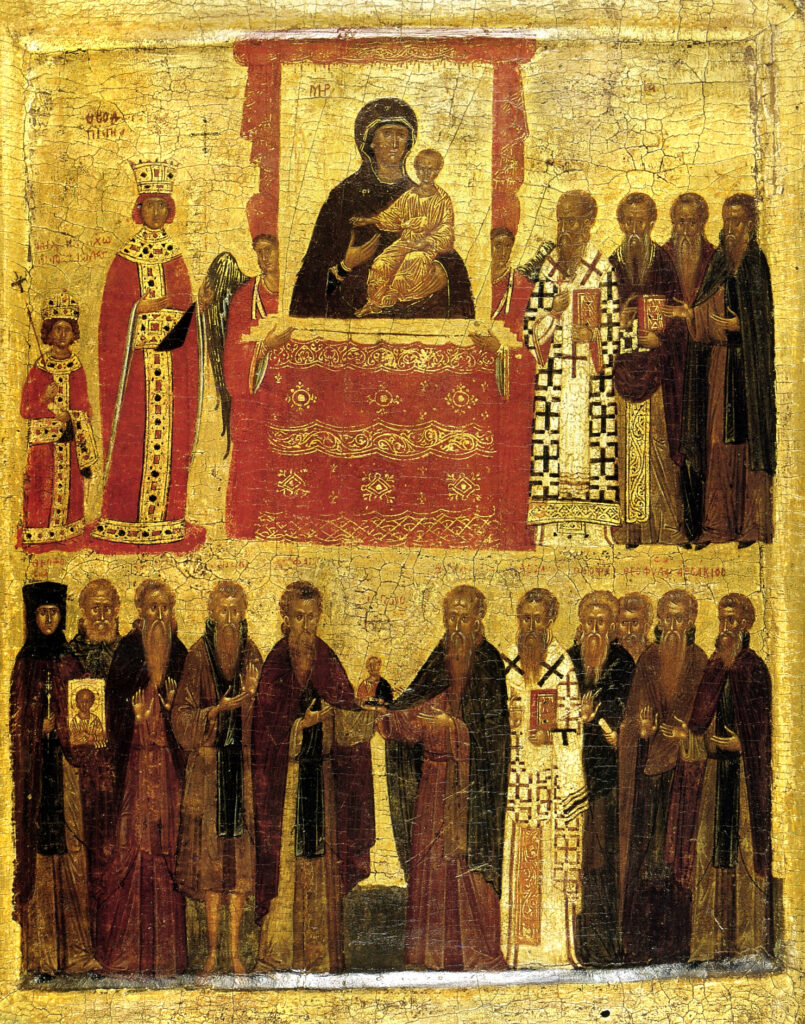
The reception. Nicaea II was not received at once. The Frankish church rejected it at Frankfurt in 794, partly because of a faulty Latin translation, and the second iconoclast period (815-843) reopened the question in the East until the Triumph of Orthodoxy in 843. This is exactly what our thesis predicts. The practice was contested and gradually received, and the council should be read as a bounded and difficult decision, comparable to Hezekiah’s, rather than as the recovery of a rite the apostles had always practiced.24
The anathemas. Dr. Wood read the anathemas as making icon veneration “part of the gospel” and a condition of salvation. The definition itself is more precise. It declares that images are to be set up and honored with relative proskynēsis, “not the true latreia of our faith, which befits the divine nature alone,” because “the honor given to the image passes to the prototype.”25 The anathemas were directed at a party that called images idols, destroyed them and persecuted those who honored them. We do not minimize the severity of the language, and we discuss it at length in the book. The target, however, was a doctrine: the claim that matter cannot carry honor to Christ without becoming an idol. A Christian who lacks icons out of inherited custom is not in the position of a bishop who preaches that the Theotokos’s image is a pagan idol and orders it smashed.
Gregory the Great. For the same reason, Dr. Wood’s claim that Nicaea II anathematized Saint Gregory the Great is mistaken. In his letters to Serenus of Marseilles (599-600), Gregory praised Serenus for forbidding the adoration of images, though he rebuked him sharply for breaking them, and defended images as the books of the unlettered.26 What Gregory forbade under adorare is what Nicaea calls latreia. What he condemned, the destruction of images, is what Nicaea condemned. Gregory sits closer to the iconophiles than to Hieria.
Saint Basil. Dr. Wood called the council’s use of Basil’s maxim a “massive distortion.” Basil’s context in On the Holy Spirit 18.45 is Trinitarian, as he said. The analogy Basil chose, however, was the imperial portrait, and the analogy works only because honor given to the emperor’s image was understood to pass to the emperor.27 Saint Athanasius used the same comparison.28 Saint John of Damascus did not distort Basil; he took Basil’s illustration at its word.
The icon of Christ. The most instructive exchange of the evening came when Dr. Wood asked whether, if honor passes to the prototype and Christ is owed full worship, the icon of Christ should not receive full worship too. Jay Dyer answered yes. On this point, Dr. Wood exposed a real error, though not in Orthodoxy. Nicaea II explicitly denies latreia to images, including images of Christ. Saint Theodore the Studite explains that there is one proskynēsis of Christ and His image, though it belongs to the image only “relatively” (schetikōs), by reference, and to Christ by nature.29 The view that the image of Christ receives latria is Thomas Aquinas’s, not the council’s.30 The Orthodox answer is that the believer offers one act of adoration that terminates on the person of Christ and, through Him, on the Father; the wood and paint receive only the relative honor of the place where that act passes.
The irony is that Dr. Wood had already given the right answer without noticing it. When Jay Dyer pressed him on whether he worships the humanity of Christ, he replied: “I worship the person.” That is the Orthodox position. Adoration terminates on the hypostasis of the Word, with His flesh, not on a nature taken apart from Him.31 Jay Dyer’s suggestion that this answer was Nestorian was unfair. It was, in fact, the very principle on which Saint Theodore the Studite built his defense of icons: the icon depicts the hypostasis, and the honor goes to the hypostasis.
Verdict: the theology holds, the history must be told honestly
If we score the debate question by question, the result is a split decision.
| Question | Better argued by | Our assessment |
|---|---|---|
| Is eikōn a suspect word in Scripture? | Dyer | No. It names Adam and Christ; only the qualifier condemns. |
| May creatures receive proskynēsis? | Dyer | Yes (1 Chronicles 29:20; Revelation 3:9). Honor that passes to God is not idolatry. |
| Joshua before the ark (Joshua 7:6) | Wood | Joshua addresses God at the place of meeting. |
| The bronze serpent and Nehushtan | Wood on the text, neither on the theology | Incense, not a snake god, was the stated reason; Wisdom 16:7 states the iconophile principle. |
| Were there Christian images before Nicaea I? | Dyer | Yes, from the third century. |
| Was image veneration an accepted practice before c. 380? | Wood | No clear evidence; it spreads in the sixth and seventh centuries. |
| The legitimacy of Hieria (754) against Nicaea II (787) | Neither addressed it fairly | Hieria is weaker on Wood’s own criteria. |
| Does the icon of Christ receive full worship? | Wood (by exposing Dyer’s answer) | No. Relative honor to the image, latreia to Christ, through Him to the Father. |
| Did Nicaea II anathematize Gregory the Great? | Neither (Dyer let it pass) | No. Gregory condemned both the adoration and the destruction of images. |
We would put the result this way. Dr. Wood is right that the veneration of icons is not an apostolic rite recovered intact, and Orthodox apologists who claim otherwise harm the very cause they defend. Jay Dyer is right that the principle of veneration is biblical from beginning to end: God sanctifies matter, binds His presence to places and objects, and receives through them the honor that is His alone. What neither speaker articulated is the category that reconciles both truths. Nicaea II is a faithful development, received slowly and painfully, of a theology of the image as old as Genesis 1:26.
That category matters for apologetics. A Protestant who hears “the apostles venerated icons” and then reads Origen and Eusebius will conclude that Orthodoxy rewrites history. A Protestant who hears instead that the church, having distinguished itself from the Temple and from pagan idols alike, gradually recovered the Temple’s own logic of hallowed space and hallowed image, may still disagree, though he will have to engage the argument on its merits.
We should add a word about tone. The format of the debate rewarded speed and ridicule: the “image slave” pun on one side, the cry of “liar” and the charge of heresy on the other. Such moments please a crowd and persuade no one. The question at stake, how the honor we give to what we see reaches the God we cannot see, deserves better. Saint John of Damascus put it in one line: “I do not worship matter; I worship the Creator of matter, who became matter for my sake.”32
The book
A Universe of Icons and Idols
Debating Iconoclasm and the Theology and Practice of Icon Veneration in the Orthodox and Catholic Churches
Laurent Cleenewerck de Kiev (2026)
The full argument behind this review, from the terms of the debate through Genesis, the Second Temple period, the early church and the crisis of 550-843, to the Orthodox and Catholic receptions of Nicaea II. It was written for exactly the audience that watched this debate: Christians who take Scripture seriously and want an account of the icons that is both faithful and honest.
Notes
- David Wood, opening statement, in “Icon Veneration on Trial: Jay Dyer vs. Dr. David Wood,” DebateCon 9, video recording, at approximately 36:40.
- Laurent Cleenewerck de Kiev, A Universe of Icons and Idols: Debating Iconoclasm and the Theology and Practice of Icon Veneration in the Orthodox and Catholic Churches (2026).
- Deuteronomy 4:16 LXX: glypton homoiōma, pasan eikona; Romans 1:23: en homoiōmati eikonos phthartou anthrōpou.
- 1 Chronicles 29:20 LXX: kai kampsantes ta gonata prosekynēsan tō kyriō kai tō basilei.
- Cleenewerck de Kiev, A Universe of Icons and Idols, part 1.
- Second Council of Nicaea, Horos, in Norman P. Tanner, ed., Decrees of the Ecumenical Councils, vol. 1 (London: Sheed & Ward; Washington, DC: Georgetown University Press, 1990), 135-36.
- Augustine, City of God 10.1.
- Psalm 98:5 LXX (Hebrew 99:5); compare Psalm 98:9 and Psalm 131:7 LXX.
- Cleenewerck de Kiev, A Universe of Icons and Idols, introduction and part 2.
- 2 Kings (4 Kingdoms) 18:4. The Hebrew wayyiqrāʾ-lô nĕḥuštān may be read “he called it” or impersonally “it was called.”
- Wisdom 16:6-7 LXX: ho gar epistrapheis ou dia to theōroumenon esōzeto, alla dia se ton pantōn sōtēra.
- Carl H. Kraeling, The Synagogue, The Excavations at Dura-Europos, Final Report 8, pt. 1 (New Haven, CT: Yale University Press, 1956); Carl H. Kraeling, The Christian Building, The Excavations at Dura-Europos, Final Report 8, pt. 2 (New Haven, CT: Dura-Europos Publications, 1967); Michael Peppard, The World’s Oldest Church: Bible, Art, and Ritual at Dura-Europos, Syria (New Haven, CT: Yale University Press, 2016).
- Martyrdom of Polycarp 18.2.
- Ernst Kitzinger, “The Cult of Images in the Age before Iconoclasm,” Dumbarton Oaks Papers 8 (1954): 83-150.
- Acts of John 26-29, in J. K. Elliott, ed., The Apocryphal New Testament (Oxford: Clarendon Press, 1993).
- Irenaeus, Against Heresies 1.25.6.
- Eusebius, Ecclesiastical History 7.18.4.
- Stephen Gero, “The True Image of Christ: Eusebius’ Letter to Constantia Reconsidered,” Journal of Theological Studies, n.s., 32 (1981): 460-70.
- Origen, Against Celsus 7.64-66 and 8.17-20.
- Council of Elvira, canon 36: Placuit picturas in ecclesia esse non debere, ne quod colitur et adoratur in parietibus depingatur.
- Richard Price, trans., The Acts of the Second Council of Nicaea (787), Translated Texts for Historians 68 (Liverpool: Liverpool University Press, 2018).
- Minucius Felix, Octavius 29.6-7 and 32.1; Origen, Against Celsus 8.17; Cleenewerck de Kiev, A Universe of Icons and Idols, part 4.
- Theophanes the Confessor, Chronographia, AM 6277-6279; Price, Acts of the Second Council of Nicaea, introduction.
- Cleenewerck de Kiev, A Universe of Icons and Idols, part 5.
- Second Council of Nicaea, Horos, in Tanner, Decrees, 1:136: hē gar tēs eikonos timē epi to prōtotypon diabainei.
- Gregory the Great, Registrum epistularum 9.209 and 11.10, in John R. C. Martyn, trans., The Letters of Gregory the Great, 3 vols. (Toronto: Pontifical Institute of Mediaeval Studies, 2004).
- Basil of Caesarea, On the Holy Spirit 18.45.
- Athanasius, Orations against the Arians 3.5.
- Theodore the Studite, On the Holy Icons, trans. Catharine P. Roth (Crestwood, NY: St Vladimir’s Seminary Press, 1981), esp. the third refutation.
- Thomas Aquinas, Summa Theologiae III, q. 25, a. 3.
- Cyril of Alexandria, Third Letter to Nestorius, anathema 8; Second Council of Constantinople (553), canon 9.
- John of Damascus, On the Divine Images 1.16, in Three Treatises on the Divine Images, trans. Andrew Louth (Crestwood, NY: St Vladimir’s Seminary Press, 2003).
Featured image: The Triumph of Orthodoxy, icon, Constantinople, c. 1400. British Museum, London. Public domain, via Wikimedia Commons.