
A tale of Holy Evening near Poltava
In the heart of Ukraine, where the Vorskla River winds through white-walled villages and cherry orchards, there lies the old town of Poltava, and around it, scattered over the gentle hills, many small villages of whitewashed cottages with thatched roofs, blue shutters and sunflowers by the gates. In winter, when the snow lies deep over the fields and the orchards stand black and bare, the smoke rises straight up from every chimney into the cold blue sky.
In one of those villages, at the very end of the lane, near the frozen stream, stood the smallest cottage of all. There lived a woman named Paraska with her three children.
Paraska’s husband, Mykhailo, was a Cossack, tall and broad-shouldered, with a black mustache and a laugh like thunder. Seven years before our tale, he had ridden out with his regiment to guard the southern steppe, and the raiders from the Wild Field had fallen upon them at night. Many Cossacks were killed, and many more were carried away as captives to be sold in the slave markets beyond the sea. Mykhailo was among those who never came back. No one knew whether he was alive or dead.
Paraska did not give up hope. Every morning, she prayed for him before the icon in the corner of the cottage. Every evening, she set a candle in the window so that he could find his way home in the dark. She worked from dawn to dusk to feed her children, spinning and weaving and hiring herself out to richer neighbors at harvest time, and the little family was very poor.
Her eldest child was Halya, seventeen years old, with dark eyes and a long dark braid, gentle and quiet and hardworking. When Halya sang, even the village dogs stopped barking to listen. Her voice was so sweet and clear that the old women said the angels must have taught her. The second child was Petrus, twelve years old, a sturdy, serious boy who did a man’s work in the fields and missed his father more than he would say. The youngest was little Hanusia, seven years old, round-cheeked and curious, who had been only a baby when her father rode away and did not remember his face.
At the other end of the village, on the hill by the church, lived Kharyton, the richest farmer for miles around. He had a great house with a tiled roof, a barn full of cattle, granaries full of wheat, and a purse full of silver. He had wanted Paraska’s little field by the stream for years, for it was the best land in the village, with rich black soil.
“Your husband is dead,” he told her every autumn. “Everyone knows it. Stop waiting for a ghost. Sell me the field, and you will have silver for your children.”
Every autumn, Paraska answered the same way. “My husband is alive until God tells me otherwise. The field is his. I will keep it for him.”
Kharyton would scowl and stamp away.
In the year of our tale, the winter was harsh, and Paraska’s family had very little. Yet as Holy Evening drew near, the eve of the Nativity of Christ, she was determined to keep the feast properly, as her mother and grandmother had kept it.
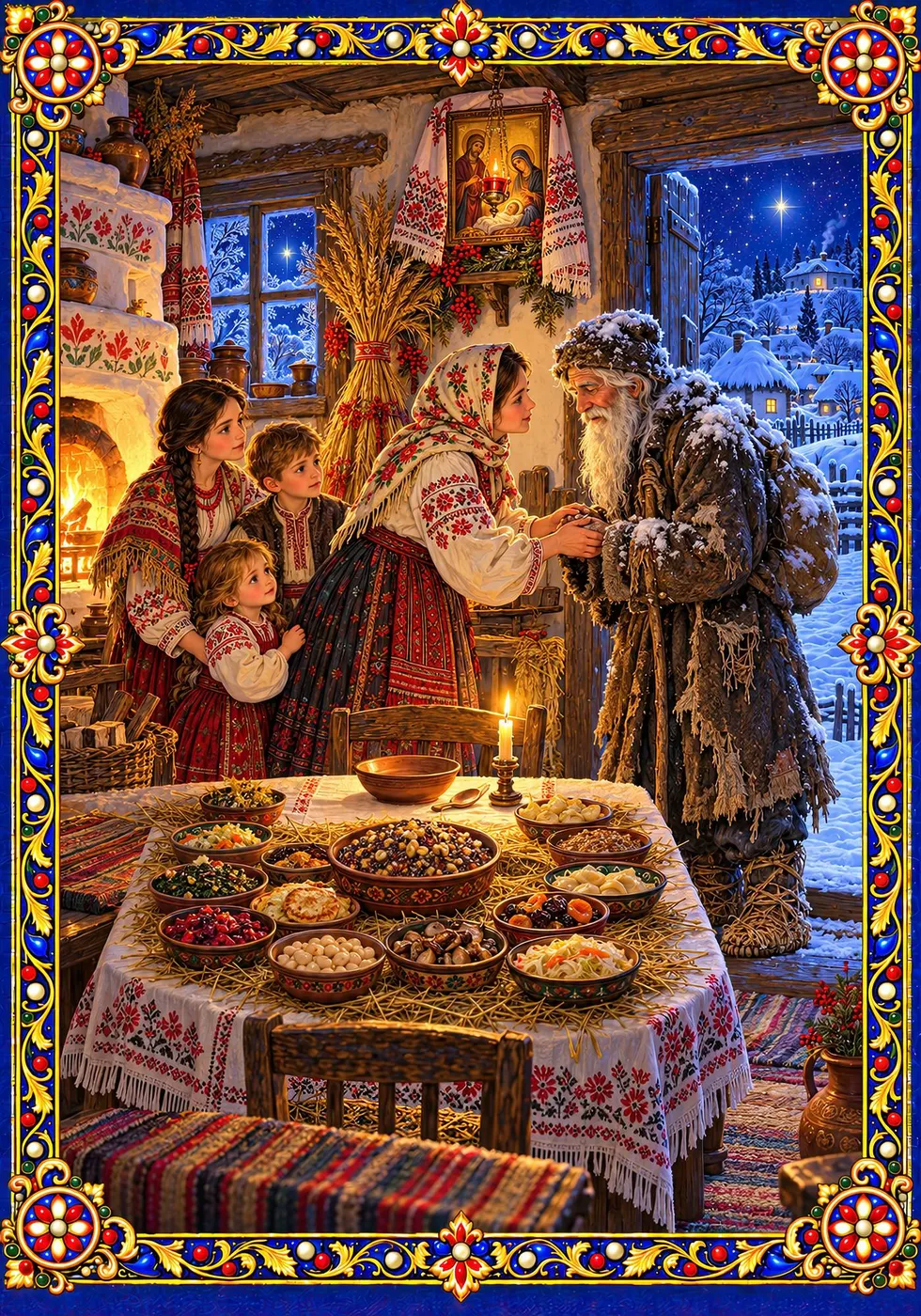
All through the Nativity Fast, she saved every coin. For weeks, she and her children prepared. Halya ground the wheat for the kutia and soaked the poppy seed. Petrus cut hay from the barn and carried in the didukh, a great sheaf of the last wheat from their field, bound with a ribbon, to stand in the corner of the cottage in honor of their ancestors. Little Hanusia scrubbed the table and strewed fresh hay across it, in memory of the manger in Bethlehem, and helped her mother lay the white embroidered cloth on top.
On the morning of Holy Evening, they began to cook the twelve dishes, one for each of the twelve apostles, all of them lenten, without meat or milk or eggs, for the fast was not yet over.
There was the kutia, the most important of all, boiled wheat with honey and poppy seed and walnuts. There was red borscht with little mushroom dumplings, and varenyky stuffed with potato and with cabbage and with cherries. There were holubtsi of rice wrapped in cabbage leaves, and fried fish from the stream, and pickled mushrooms from the autumn forest, and beans with garlic, and peas, and little pampushky, sweet round buns with poppy seed. Last of all, there was uzvar, a drink of dried apples, pears and plums, simmered with honey. They could not afford much of anything, so each dish was very small, but there were twelve of them, and the cottage smelled of honey and garlic and baking bread.
At last, as the winter sun set red over the snow, Paraska set the table. She placed a bowl and spoon for herself, for Halya, for Petrus, and for Hanusia. Then, at the head of the table, as she did every year, she laid one more bowl and one more spoon, and she set a candle before it.
“Father’s place,” whispered Hanusia.
“Father’s place,” said Paraska. “So that wherever he is tonight, he knows he has a home.”
By old custom, no one may eat on Holy Evening until the first star appears in the sky, in memory of the star of Bethlehem. The children pressed their noses to the frosty window and watched the darkening sky.
“There it is!” cried Hanusia at last. “The first star!”
At that moment, there was a knock at the door.
Paraska opened it. On the threshold stood an old man, half frozen, covered with snow. He was very old, with a long white beard, and he wore only a thin, ragged coat and bast shoes stuffed with straw. He was shaking with cold, and his eyes, deep and dark and gentle, looked at her with a kind of patient sorrow.
“Good woman,” he said, and his voice was weak, “I have walked a long way through the snow. I have knocked at every door in this village, and every door has been shut. The rich man on the hill shut his door in my face. They all said that Holy Evening is for family, and there is no room for a stranger. Have you a corner where an old man may warm himself?”
Paraska looked at her little table with its twelve small dishes. She looked at her four places, and at the fifth place at the head of the table, with its candle burning. It was the only empty seat in the cottage.
The children looked at her. Petrus’s face tightened. “Mother,” he whispered, “that is Father’s place.”
Paraska was silent for a moment. Then she said, “Children, on this very night, long ago, the Mother of our God knocked on every door in Bethlehem, and there was no room for her in the inn. The Son of God was born in a stable and laid in a manger, because no one would open a door to them. If we shut our door tonight, how are we better than the people of Bethlehem?”
She took the old man’s frozen hands in hers and drew him inside. “Come in, grandfather,” she said. “Christ is born!”
“Glorify Him,” answered the old man, and his eyes filled with tears.
She led him to the head of the table and seated him in her husband’s place, before the candle.
The old man looked around at the hay on the table, the didukh in the corner, the icon with its lamp, and the four children’s faces. He raised his hand and blessed the table with the sign of the cross. As he did so, little Hanusia, sitting beside him, saw something that she never forgot. In the palms of his hands were two old scars, round and white, as though a nail had once passed through each of them.
Before they could begin to eat, there was a second knock at the door.
This time, when Paraska opened it, a young man stood on the threshold. He was tall and fair-haired, about twenty years old, with a strong, pleasant face and clear gray eyes. He wore a plain gray traveling cloak, wet with snow, and high boots, and he was leading a lame horse.
“Forgive me, good woman,” he said courteously. “I was traveling to Kiev for the feast with my companions, and the blizzard separated us on the steppe. My horse has gone lame, and I have been walking for hours. I knocked at the big house on the hill, but the master shut the door on me and said he had no room for vagrants. May I shelter here until morning? I can pay you.”
“We take no payment on Holy Evening,” said Paraska. “Come in. Christ is born.”
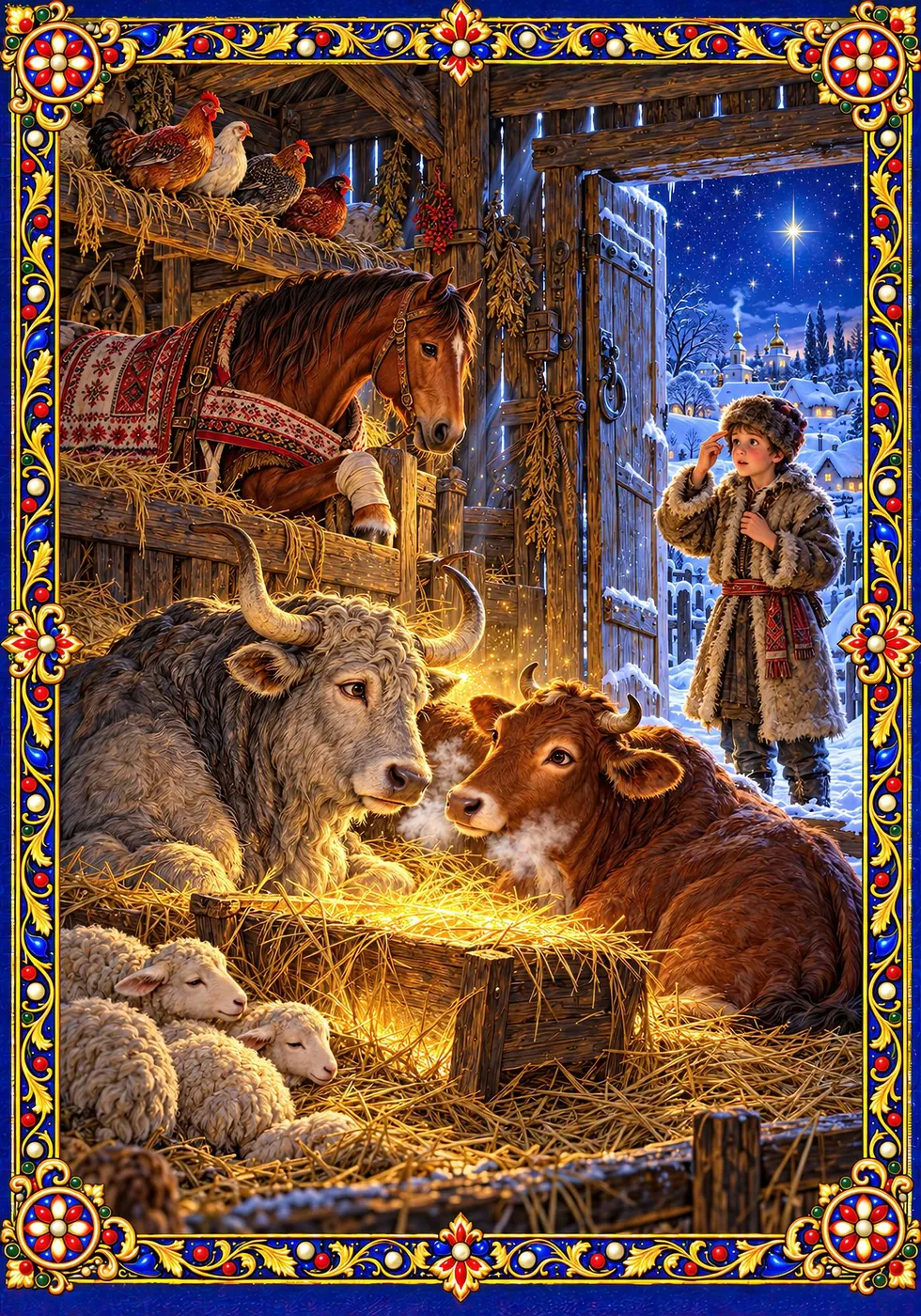
“Glorify Him,” said the young man, and he came in, stamping the snow from his boots, while Petrus led his horse into the little barn beside the ox and the cow.
Now there was no seat left at the table. The old man sat in the father’s place, and there were only four other stools. Without a word, Halya rose from her own stool and set it before the young traveler. She placed her own bowl of kutia before him and handed him her own spoon.
“Please,” she said, “sit here.”
“Then where will you sit?” asked the young man.
“I will stand by the stove,” said Halya, with a shy smile. “It is warmer there anyway.”
The young man looked at her for a long moment, and something changed in his face. He sat down on her stool.
So the Holy Supper began. Paraska took the first spoonful of kutia, and then the others, and the old man ate with them, and the young traveler too. The dishes were very small, and there were seven people to feed from them now, yet a strange thing happened. However much they ate, the dishes did not run out. The kutia bowl stayed full. The varenyky kept appearing on the plate. The uzvar in the jug was always to the brim. Paraska glanced at the old man, and he only smiled.
The young traveler ate hungrily, but he could not stop watching Halya, standing by the stove with her bowl, eating a little and serving everyone else, refilling his cup before he could ask, slipping an extra pampushka onto little Hanusia’s plate. He saw how the family shared everything they had without complaint, and he thought of the great hall he had left behind, with its long tables heaped with food, where no one had ever given up a seat for anyone.
When the supper was nearly over, they heard singing outside, and a knock at the door. It was the carolers of the village, young men and women in sheepskin coats, carrying a great star on a pole, lit from inside with a candle, and they sang the old koliadky of Holy Evening:
A new joy has come to the world,
a bright star has risen over Bethlehem,
the Son of God is born tonight
in a manger among the beasts.
Paraska invited them in, and Halya went to the door and sang with them. When her voice joined theirs, the whole room seemed to grow brighter. The old man at the head of the table closed his eyes and sang with them in a deep, soft voice, and his voice made the children’s hearts leap inside them, though they could not say why.
The young traveler did not sing. He only listened to Halya, and when the carol was over, he found that his eyes were wet.
When the carolers had gone on to the next house, the old man rose from the table.
“Thank you, daughter,” he said to Paraska. “You gave me the only seat you had, the seat of the one you love most. It will not be forgotten.” He laid his scarred hand on her head in blessing. Then he said, “Keep his place set until morning. Do not take away the bowl, and do not let the candle go out. The one who is far away is nearer than you think.”
“You are leaving?” cried Paraska. “Grandfather, it is freezing outside, and the snow is falling. Stay the night by the stove.”
“I cannot,” said the old man, smiling. “There is someone else lost in the snow tonight, and I must find him.” He wrapped his ragged coat around him, opened the door, and stepped out into the night. By the time Petrus ran to the door after him, there were no footprints in the snow, and the old man was gone.
The young traveler stayed the night. Paraska made him a bed on the bench by the stove, and the family lay down on the great warm stove-top, as Ukrainian families do in winter. Yet neither the young man nor Halya could sleep. When the fire burned low, Halya got up quietly to add a log, and the young man sat up on his bench, and they began to talk in whispers so as not to wake the others.
* * *
Copyright notice. Introduction and illustration © 2026 Laurent Cleenewerck. All rights reserved. The adapted Orthodox version of this tale is published in Twelve Ukrainian Orthodox Fairy Tales (© 2026 Laurent Cleenewerck). No part of this page may be reproduced without written permission, except for brief quotations with attribution and a link to this page.
Buy the book on AmazonAbout the book