
A Story of Kiev and the Feast of Theophany
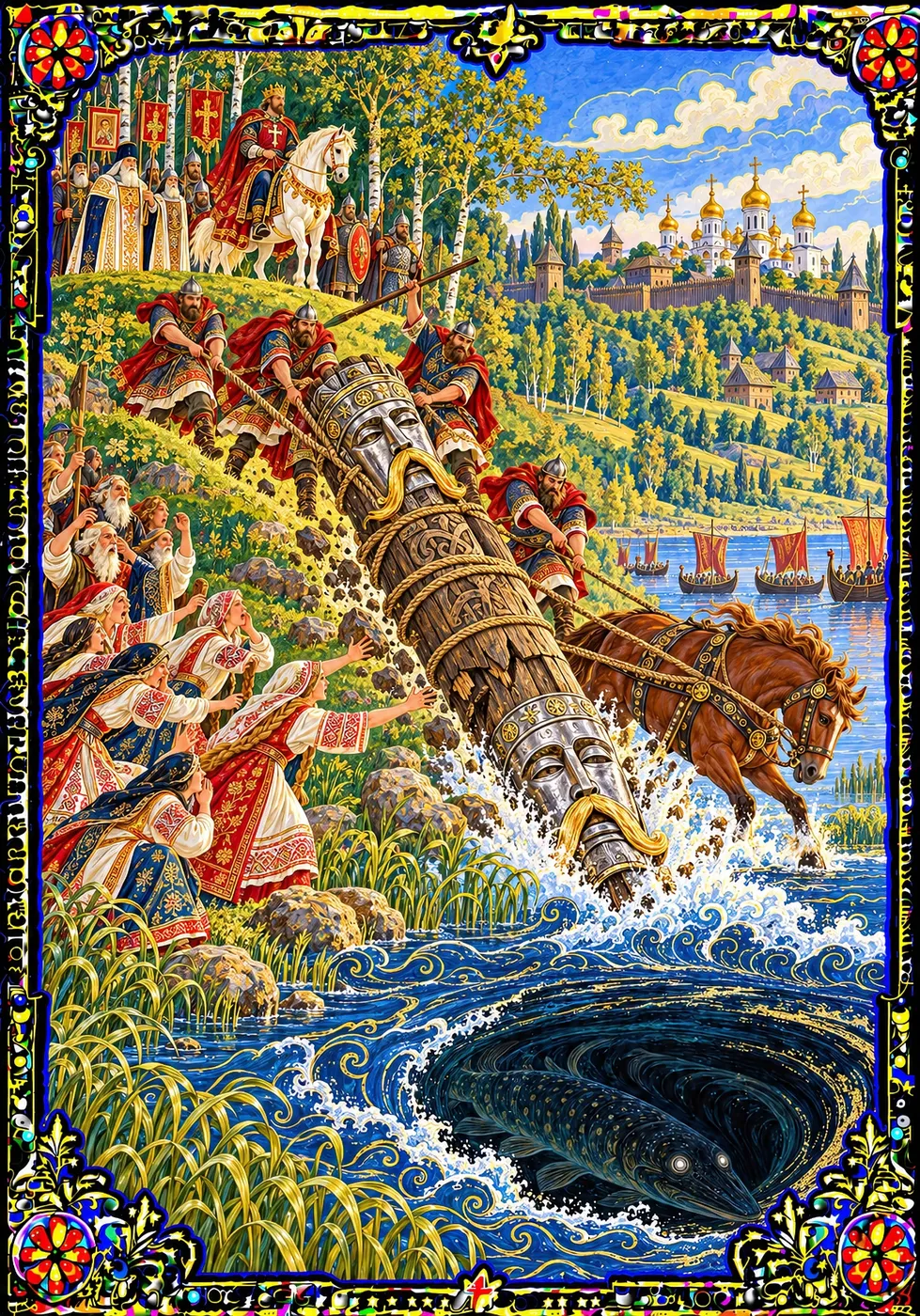
In the ancient lands of Rus’, where the Dnieper rolls broad and strong beneath the green hills of Kiev, there came a day that the people never forgot. Holy Prince Vladimir, who had once served the old gods, was baptized and turned the whole land to Christ. He commanded that Perun, the god of thunder, be pulled down from his hill.
Perun was a great idol of oak, with a head of silver and a mustache of gold. The prince’s men tied him to the tail of a horse and dragged him down to the river, beating him with rods, and threw him into the Dnieper. The people who still loved the old god ran along the bank weeping and crying, “Swim ashore, Perun! Swim ashore!” The idol did not swim ashore. The current carried him away, and he sank into the deepest pool of the river, far below the city, where the water is black even at noon.
There he lay for many years, half buried in mud. He was only wood and metal, but the evil spirit that had lived in him for so long did not leave. In the dark water, it whispered and plotted, and the creatures of the river began to listen. The first to listen, and the most faithful, was a great black pike, long as a man and old as the idol itself, with eyes like two cold coins.
In those years, there lived below the hills of Kiev a poor fisherman named Foma. He had been the best fisherman on the Dnieper until the glare of the sun on the winter ice had slowly taken his sight, and now he sat by the stove in his hut and mended nets by touch. He had three sons.
The eldest was Bogdan, strong and quick with his hands, whose heart was set on silver. The middle son was Mikula, handsome and clever with his tongue, whose heart was set on power. The youngest was Ivanko, a quiet, gentle boy whom his brothers called the Simpleton, because he talked to the fish as he pulled them from the nets and often threw the smallest ones back into the river, saying, “Grow a little more, little sister, and come back to us next year.”
In the same years, a Varangian jarl named Hakon came down the great river road from the northern sea with six longships and three hundred warriors, to serve Prince Vladimir as captain of his guard. With him came his daughter, Astrid.
Astrid was tall and proud, with braids the color of new copper and eyes as gray as the northern sea. She could ride and shoot a bow as well as any of her father’s men. Her father had received baptism to please the prince, but Astrid had refused. Around her neck, on a leather cord, she wore a small silver hammer, the sign of Thor, the thunder god of her people. “Your Perun and our Thor are the same,” she told the Kievan maidens, laughing. “Your prince threw him in the river, but a god of thunder does not drown.”
Something dark followed Astrid, however. Three young men of Kiev had asked the jarl for her hand, one after another. The first fell through the ice of the Dnieper on the way home from her father’s house and was never seen again. The second was dragged under while watering his horse. The third was pulled from his boat in a sudden whirlpool on a calm summer day. Some fishermen swore that, each time, they had seen a long black shape moving beneath the water. The people began to call her the Drowning Bride, and no one else dared to court her.
Then came the hardest winter anyone could remember.
The Dnieper froze so thick that carts could cross it. Worse, the fish vanished. The fishermen cut their holes and lowered their nets, and the nets came up empty, day after day, week after week. The poor of Kiev began to go hungry, and the house of Foma was among the poorest.
One gray morning, as the fishermen stood around an empty hole in the ice, the water stirred, and the great black pike rose to the surface. It opened its mouth full of needle teeth and spoke in a voice like the creaking of frozen timber.
“Fools,” it hissed. “You threw your god into the river, and now the river is angry. Raise Perun from the deep. Give him back his honor and his offerings, and the fish will return. If you do not, you will starve.”
Then it sank back into the black water.
The fishermen fled in terror, and most of them ran straight to the churches to pray. Bogdan and Mikula, however, looked at each other, and each saw the same thought in his brother’s eyes.
That night, Bogdan took ropes and hooks and a sledge and went out on the ice alone. He knew the old stories of the silver head and the golden mustache, and he thought, “Whether the idol is a god or not, silver is silver.” He cut a hole above the deep pool, and the black pike rose and guided his hooks. Before dawn, he had dragged the great oaken idol up through the ice. It was black with slime, but its silver head and golden mustache still gleamed.
Mikula found him there. “Brother,” said Mikula, “do not break it up for metal. Listen.” In the silence of the frozen river, they both heard a voice coming from the idol, low and rumbling like distant thunder.
“Raise me up again,” said the voice. “Give me a grove and a fire and men to serve me, and I will make you rich, Bogdan, richer than any merchant of Kiev. You, Mikula, I will make a prince. Vladimir’s God is weak. See how your people starve.”
So the two brothers hauled the idol away on the sledge to a dark grove of oaks in a ravine outside the city, where the old worship had once been held. There they set it upright, lit a fire before it, and began to gather hungry and bitter men who still remembered the old gods. Each night, more men came, for hunger makes even brave men foolish.
Ivanko knew nothing of this. He was the only one of Foma’s sons who still went out every day to fish, though he caught nothing, because he could not bear to sit in the hut and watch his blind father go hungry.
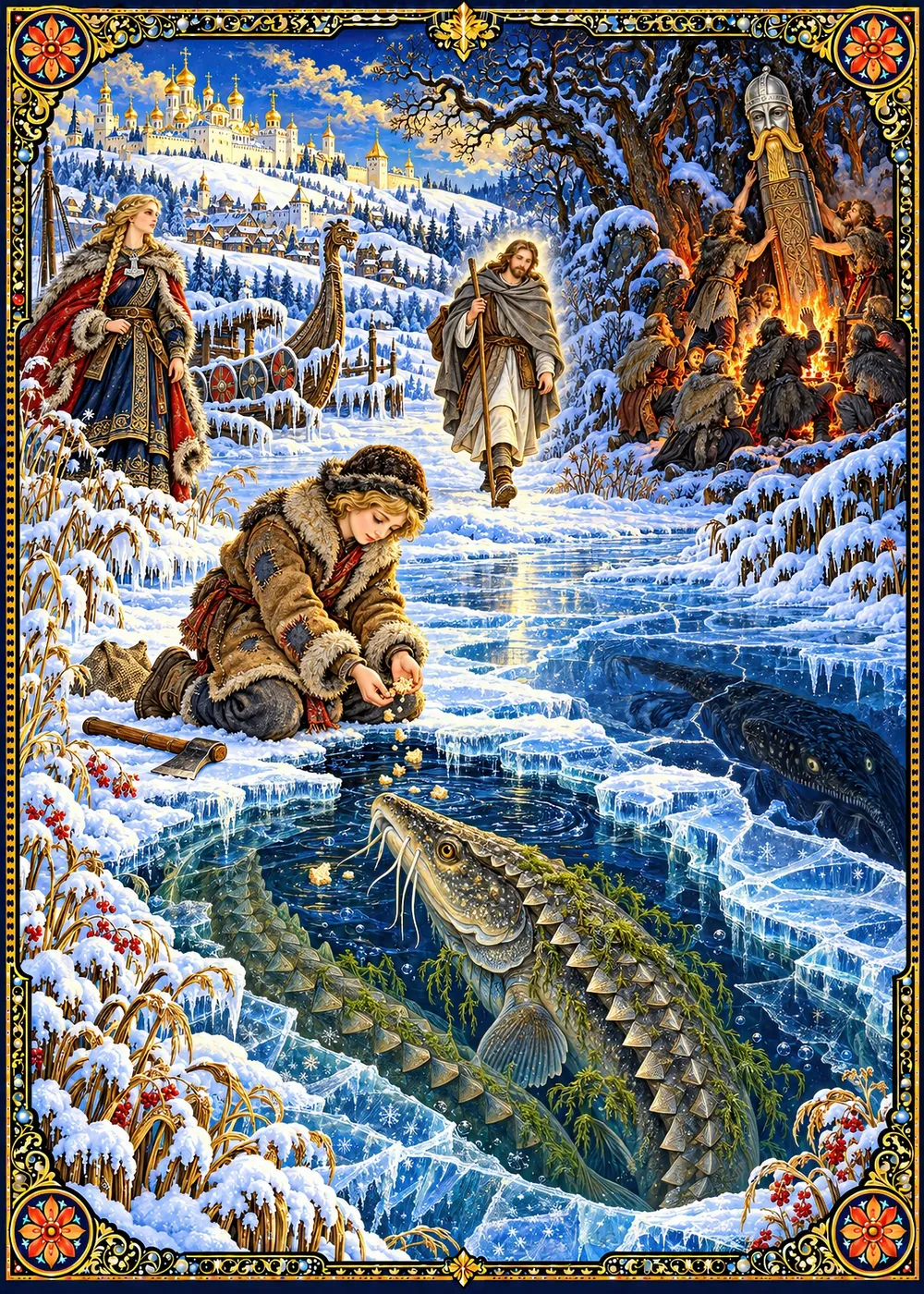
One afternoon, walking far downstream along the ice, he found an enormous old sturgeon trapped in a shallow pool where the water was freezing solid around it. It was covered in bony plates like armor, its snout was long and whiskered, and it was so old that moss grew on its back. It was gasping and nearly dead.
Ivanko had only one crust of bread in his pocket, which he had been saving for his father. He looked at it for a long time. Then he broke the ice around the sturgeon with his axe, cut a channel to the open water, and pushed the great fish through it. Before it swam away, he crumbled the crust into the water for it.
The sturgeon turned its old eye upon him and spoke, in a slow, deep voice like water flowing over stones.
“Thank you, Ivanko, son of Foma. You have given away your last bread to a fish. That is a rare thing. Listen to me, for I am older than the city of Kiev, and I know the truth of this river. The fish have not vanished because Perun is angry. They have fled because his evil spirit poisons the deep water, and the black pike drives them away and devours them. The river will not be healed by honoring the idol. It will be healed only when the river itself is blessed by the Cross of Christ.”
At that moment, Ivanko heard footsteps crunching on the snow behind him. He turned and saw a young man in a traveler’s cloak, with a staff in his hand and a pack on his back. His face was fair and calm, and his eyes were full of light.
“Peace be with you, brother,” said the stranger. “I am a traveler, and I know the roads of this land well. My name is Azarias. Your father, Foma, will need a guide for his son in the days ahead. If you will have me, I will walk with you.”
Ivanko did not know why, but he trusted the stranger at once. He took him home to his father’s hut, and the blind old fisherman welcomed him and gave him a place by the stove, though there was nothing to eat.
In the days that followed, word spread through the city of the idol in the ravine and the men who gathered there at night. Some said the idol’s worshippers would soon march on the churches. Prince Vladimir sent his guard to find the grove, but a snowstorm rose each time they searched, and they found nothing.
Astrid heard the rumors too. One night, she slipped out of her father’s hall and went alone to the ravine, drawn by something she could not explain. When she saw the great idol standing in the firelight, with its silver head gleaming, her heart leapt. “Thor,” she whispered, and touched the hammer at her throat.
Mikula saw her, and he smiled his handsome smile. “The Varangian princess has come to her god,” he said. “Stay with us, lady. Be the priestess of Perun. When I am prince of Kiev, you will be my wife, and no black pike will dare to touch you.”
From the idol came a low rumble of laughter.
Astrid stood still in the snow. The fire was warm, and the idol was splendid, yet she felt suddenly cold to the marrow, and she saw in Mikula’s eyes that he did not see her at all. He saw only a Varangian jarl’s daughter and three hundred Varangian swords. She turned and fled back through the forest without a word, and, all the way home, she thought she heard something following her beneath the frozen river.
Meanwhile, Azarias said to Ivanko, “In three days, it will be the Feast of Theophany, when the Church blesses the waters in memory of the Lord’s baptism in the Jordan. The Metropolitan and the prince will come down to the Dnieper to bless it. The ice is too thick to break in one morning. Someone must cut the Jordan.”
The Jordan is the cross-shaped opening cut in the ice where the waters are blessed on Theophany. No one in Kiev had yet dared to cut it that year, for the idol’s men had threatened anyone who tried.
“I will cut it,” said Ivanko.
So on the eve of Theophany, while the city slept, Ivanko went out onto the Dnieper with his axe and his ice saw, and Azarias went with him. They chose the place just below the hill where the idol had once been thrown down. All night long, they worked. Ivanko’s hands blistered and bled, and his arms ached until he could hardly lift them, yet, whenever he faltered, Azarias laid a hand on his shoulder, and new strength flowed into him.
Just before dawn, as the last block of ice slid away and the black water of the cross lay open beneath the stars, the water churned, and the great black pike burst out of the Jordan and leapt at Ivanko’s throat, its needle teeth bared.
“Do not be afraid!” cried Azarias. “Seize it by the gills!”
Ivanko seized the monstrous fish by the gills with both his bleeding hands and wrestled it onto the ice, where it thrashed and hissed and at last lay still.
“Now,” said Azarias quietly, “cut it open, and take out its heart, its liver, and its gall, and keep them safe. They will be useful. Throw the rest back into the river.”
Ivanko did as he was told, though he did not understand why.
When the sun rose on the Feast of Theophany, the bells of every church in Kiev began to ring. Down the hill came the great procession: the Metropolitan in his golden vestments, the priests with censers and banners, Prince Vladimir with his boyars, Jarl Hakon and his Varangians, and behind them all the people of Kiev, hungry and cold but singing.
When they reached the river, they stopped in wonder. There lay the Jordan, cut clean in the thick ice in the shape of a great cross, and beside it stood Foma’s youngest son with bleeding hands, and a stranger no one knew.
* * *
Copyright notice. Introduction and illustration © 2026 Laurent Cleenewerck. All rights reserved. The adapted Orthodox version of this tale is published in Twelve Russian Orthodox Fairy Tales (© 2026 Laurent Cleenewerck). No part of this page may be reproduced without written permission, except for brief quotations with attribution and a link to this page.
Buy the book on AmazonAbout the book