
A Story of Tver, Kargopol, and the Feast of the Nativity
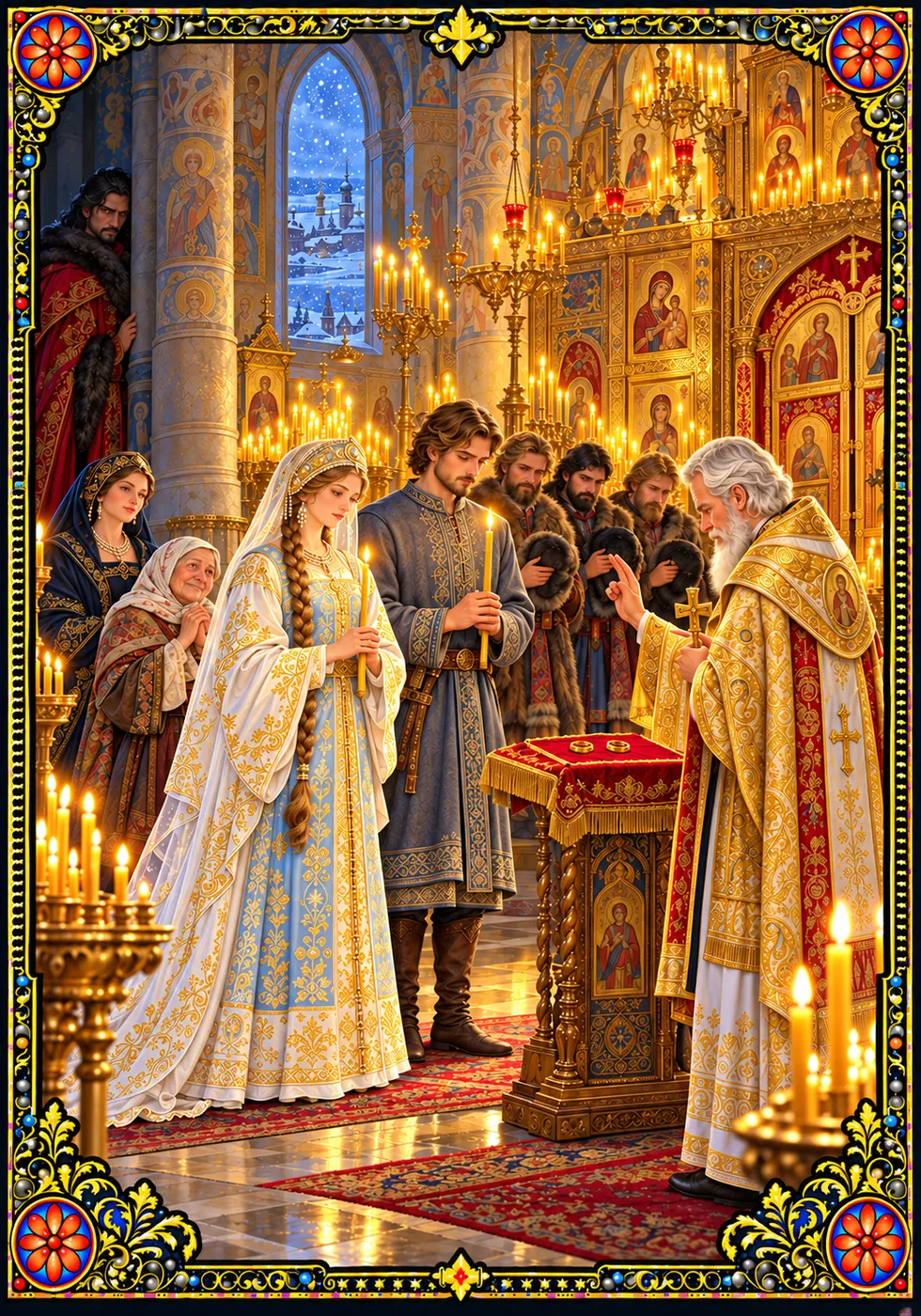
In the ancient lands of Rus’, where the Volga flows wide and slow past the walls of Tver, and the bells of the Savior Cathedral ring across the frozen meadows in winter, there lived a young princess named Ulyana. She was the only daughter of Prince Konstantin of Tver and his wife, Princess Anna.
From the time she could sit upon her nurse’s knee, Ulyana had been raised on holy stories. Her nurse, an old widow from a village on the Tvertsa, told her of Saint Barbara in her tower, Saint Catherine before the emperor, and Joseph, who fled from the house of Potiphar rather than betray his God. On winter nights, by the stove, the nurse told holy fairy tales of firebirds and wise elders, of princesses who waited and princes who were faithful. Ulyana loved them all, and she grew up gentle, clear-eyed, and steadfast, with a heart that knew the difference between gold and glitter.
When she was seventeen, her father betrothed her to Prince Timofei of Kargopol.
Kargopol was a very small principality far in the north, on the shore of Lake Lacha, at the edge of the great forests that stretch toward the White Sea. It had no stone walls and no stone churches. Its houses were built of pine logs, its church was crowned with wooden domes shingled like the scales of a fish, and around the whole town ran a simple wooden palisade. Its people were fishermen, trappers, and salt-makers, poor in silver but rich in faith.
Prince Timofei was like his town: plain, strong, and true. He was not tall or dazzling, yet his gray eyes were kind, and he prayed the whole Psalter every week. He had come to Tver with his father to pay homage to Prince Konstantin, and there he had seen Ulyana singing in the choir of the cathedral on the Feast of the Ascension. They had spoken only three times, always in the presence of her mother, and yet each had recognized in the other something they had read about in the holy stories. Before he returned north, the two were betrothed before the altar, and he placed on her finger a plain iron ring, blessed by the bishop, promising to return and marry her after the harvest of the following year.
On an evil day in October, when the first snow was falling on the Volga, a visitor came to Tver.
He was Prince Izyaslav of Pereyaslavl, a rich and powerful principality far to the south, near Kiev, with high white walls of stone and cathedrals gilded from dome to door. He arrived with a hundred horsemen in scarlet cloaks, twenty wagons of gifts, and a train of musicians. He was tall and dark and handsome, with black eyes that glittered like polished jet, and when he smiled, everyone in the hall seemed to feel warmer.
He had heard of the beauty of the Princess of Tver, and he had come to take her for himself.
For three days, he feasted with Prince Konstantin. He spoke of the wealth of the south, of trade with Constantinople, of the Polovtsian nomads on the steppe and the protection his armies could offer Tver. He hinted, too, at what might happen to a small principality that refused the friendship of a great one. He heaped gifts upon the old prince: sable furs, Greek wine, a silver chalice, and a Frankish sword with a hilt of gold.
“What is Kargopol?” Izyaslav said on the third evening, laughing. “A village of fishermen behind a fence of sticks. Your daughter deserves a throne, not a log cabin. Give her to me, and Tver and Pereyaslavl will stand together forever.”
Prince Konstantin was not a wicked man, but he was a weak one, and he was dazzled. He looked at the gold, and he looked at the hundred horsemen, and he gave way.
He did not, however, give way completely. A last flicker of conscience stirred in him, and he laid down a condition.
“My daughter is betrothed,” he said, “and I will not force her into marriage. You may take her to Pereyaslavl as your guest, and you may court her as you please. She must agree to marry you of her own free will. If she has not agreed within three years, you must send her home to me unharmed.”
Izyaslav laughed again. “Three years? I will not need three months.”
Ulyana wept and begged her father not to send her, but he would not change his mind. Her mother wept, too, but she had no power to stop it. Only the old nurse whispered to the princess as she kissed her goodbye: “Remember the stories, my dove. Remember the ones who waited.”
So the Princess of Tver was carried south in a covered sleigh lined with fur, and the iron ring of Kargopol was hidden on a cord beneath her gown, next to her baptismal cross.
In Pereyaslavl, Izyaslav gave her a tower of white stone to live in, with windows of Venetian glass and floors covered in Persian carpets. He gave her twelve maidservants dressed in silk. Every morning, a new gift was brought to her door.
On the first morning, it was a necklace of pearls from the Black Sea. On the second, it was a gown of Byzantine brocade, stitched with golden eagles. On the third, it was a pair of peacocks for her garden. After that came gifts beyond counting: a jeweled mirror, a lute inlaid with ivory, a golden cage of singing birds, a crown of amethysts and rubies.
Then Izyaslav himself would come, handsome and smiling, and speak to her of all she could have.
“Look out of your window, Princess,” he said one day. “Everything you see could be yours: the cathedral, the markets, the river filled with ships. You would sit beside me on a throne of carved ivory. Ambassadors from Constantinople would kneel before you. Why would you want a fisherman’s prince in a wooden house at the end of the world?”
Ulyana was always courteous to him, for her nurse had taught her that courtesy is owed even to those who wrong us. However, she was never deceived.
“My lord,” she said, “you have shown me many beautiful things. When I look into your eyes, however, I see that you love them more than you love me. You love your gold and your walls and your crown, and you would like me to be one more jewel in your treasury. I remember the story of Saint Catherine, whom the emperor offered to make his empress, and she answered that she was already betrothed to a heavenly Bridegroom. I, too, am betrothed. My promise was made before the altar of God. I will keep it.”
Izyaslav’s face darkened, but he only smiled and went away. The next day, there was a new gift at her door.
So it went, month after month. Izyaslav tried feasts and music and dancing. He tried flattery. He tried sulking. Once, in anger, he tried threats, and told her that Prince Timofei had surely forgotten her and married another. Ulyana only touched the iron ring beneath her gown and said, “Then I will pray for his happiness. I will still keep my vow.”
Each night, she knelt before a small icon of the Nativity that her mother had slipped into her baggage, and she prayed for her betrothed, for her father, for her mother, and also for Prince Izyaslav, that God would open his eyes to what is truly precious.
Far away in the north, at the edge of the frozen forests, Prince Timofei had heard the news.
A trapper brought it to Kargopol in November, and when the young prince heard it, he went into the wooden church and lay face down on the floor before the altar until the candles burned out. He did not rage or curse. He only grieved, as the saints grieve, with his whole heart.
His parents grieved with him at first. Then, as the months passed, they began to press him.
“My son,” his father said, “the princess is gone. By now, she will have yielded. What maiden could refuse such riches? You are our only heir. You must not waste your youth waiting for a bride who will never return. Let us find you another wife.”
They began to bring maidens to Kargopol: the daughters of boyars from Svetlograd and Vologda, and even a merchant’s daughter from Novgorod with golden braids down to her knees. They were beautiful, every one of them, and they laughed and blushed and sang for him at feasts. Timofei was courteous to each of them, as a prince should be, yet he found their hearts shallow and their eyes empty. They spoke of dresses and dowries and who would sit where at the wedding table. None of them spoke of God.
In the corner of his chamber, Timofei kept an icon of the holy Prince Peter and Princess Fevronia of Murom. He knew their story well. Fevronia had been a peasant maiden, the daughter of a beekeeper, who healed Prince Peter of a terrible sickness. When Peter married her, his boyars were ashamed of her low birth and demanded that he put her away. Peter chose instead to leave his throne and go into exile with his wife rather than break his vow. In the end, the boyars begged them to return, and they ruled Murom together in holiness. When they grew old, they prayed to die on the same day, and so they did, and, even after death, their bodies were found lying together in one tomb.
* * *
Copyright notice. Introduction and illustration © 2026 Laurent Cleenewerck. All rights reserved. The adapted Orthodox version of this tale is published in Twelve Russian Orthodox Fairy Tales (© 2026 Laurent Cleenewerck). No part of this page may be reproduced without written permission, except for brief quotations with attribution and a link to this page.
Buy the book on AmazonAbout the book