
A Story of the Silver Lake and the Feast of the Protection
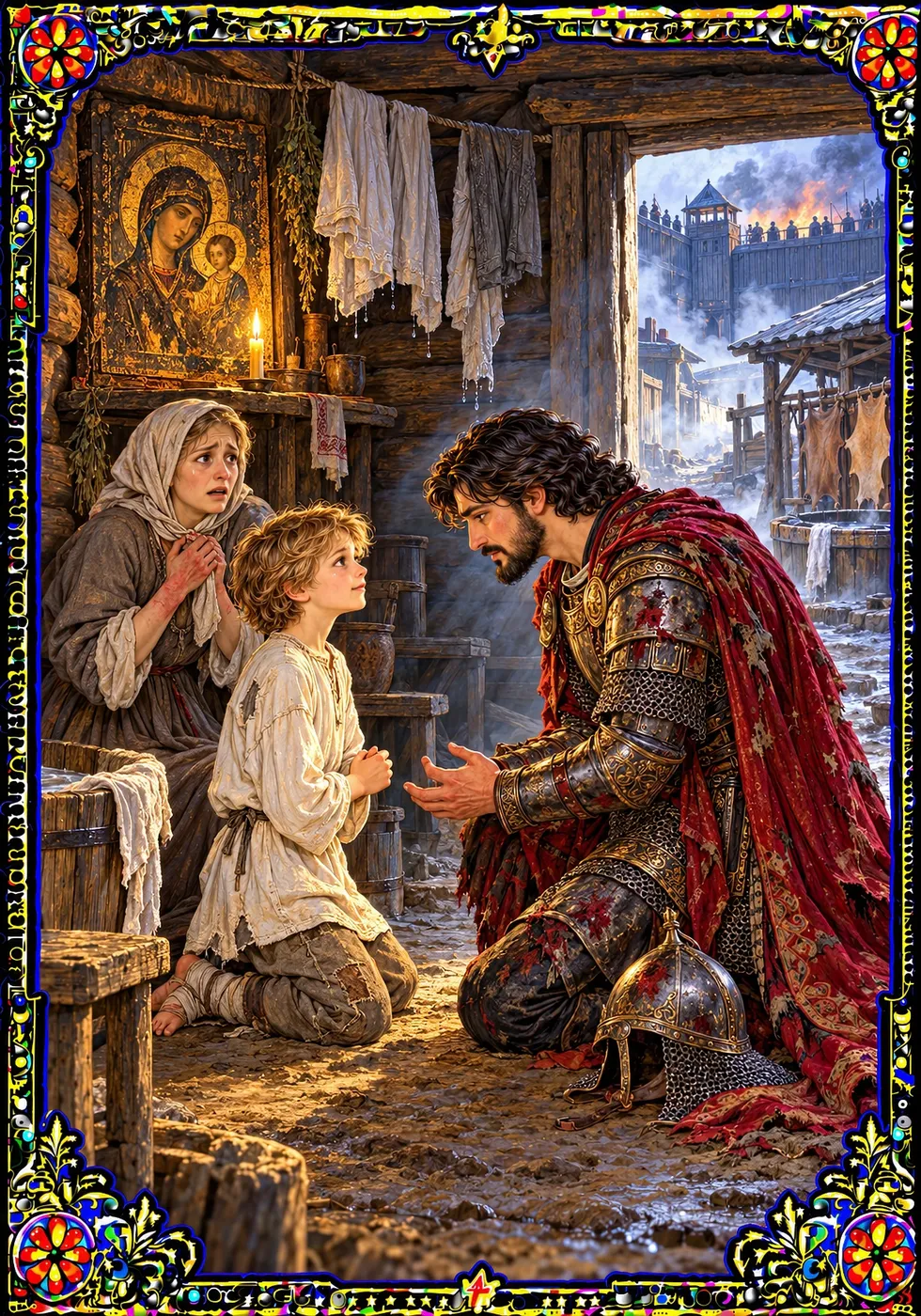
In the ancient lands of Rus’, far to the north, where the forests grow thick and the Silver Lake lies still and shining like a mirror of silver, there stood the city of Svetlograd. Its walls were of oak and earth, its churches crowned with wooden domes, and its people were fishermen, hunters, and honest traders who crossed themselves at every church they passed.
The city was ruled by Prince Vsevolod, a brave warrior with a black beard and a stern face, and by his wife, Princess Evdokia, who was known through all the land for her kindness to widows and orphans.
In the year of our tale, in the last days of September, when the birches had turned to gold, a great host of Tatars came out of the south. They had burned Rostov’s villages and plundered the monasteries of the north, and now they surrounded Svetlograd with ten thousand horsemen, their tents spreading over the meadows like a field of gray mushrooms after rain.
Their leader was the Murza Bekbulat, a man as cruel as a winter wolf and far less honest. Each morning, his soldiers hurled themselves against the walls with ladders and battering rams. Each night, his archers shot burning arrows over the palisade. Each day, the defenders of Svetlograd drove them back, and, each day, there were fewer defenders.
The Tatars were cruel not only to men. They set the forests on fire to smoke out anything that lived there. They hunted the elk and the deer for sport, leaving the carcasses to rot. They slaughtered the herds of the villages, far more than they could ever eat, and shot at the birds for practice. So it happened that, in those terrible days, the animals of the forest came to Svetlograd seeking refuge.
They came through the water gate at night, and the people, who had never seen such a thing, let them in. There came a great brown bear with a burned paw, a family of foxes, a gray wolf and his mate, an old elk with one broken antler, hares and badgers and squirrels beyond counting. Above them came the birds: sparrows and swallows, storks and cranes, owls and crows, and many others that nested now in the church towers and under the eaves of the houses. The people of Svetlograd shared what little bread they had, and the beasts, for their part, were gentle and did no harm to anyone.
On the second night of the siege, when the moon was high, the animals gathered in the old orchard behind the Monastery of the Savior to hold a council.
The old elk stood in the middle, for he was the eldest and the wisest. “Friends,” he said, “these people have taken us in when we had nowhere else to go. They are good people, but they are losing. The walls will not hold much longer. Every day, the prince fights, and, every day, the bishop prays with all his clergy in the cathedral, and yet the enemy grows bolder. What can we do to help them?”
“I can fight,” growled the bear. “I will break a hundred Tatar heads.”
“You are one bear,” said the elk gently, “and they are ten thousand men. No, my friends. The strength of this city is not in its walls or its warriors. It is in its prayers. There must be a reason why heaven has not yet answered them.”
Then the old owl spoke from a branch above. “Perhaps heaven is waiting for the right prayer,” she said. “Among all the people of this city, there must be one soul whose prayer is dearest to God. Let the birds fly through the city tonight and look in every window. Let them find out who is the holiest person in Svetlograd.”
The council agreed. The birds took wing in the darkness, the swallows and the sparrows, the owls and the swifts, and they flew in and out of every street and alley, peering through every shutter and every crack in every wall.
At dawn, they returned to the orchard and made their report.
The swallows had looked into the cathedral. “The bishop is praying,” they said. “He prays long and well, and so do his priests. Yet they also worry about the cathedral treasure, and whether it has been hidden well enough, and whether the Tatars will find the silver icon covers.”
The sparrows had looked into the houses of the boyars. “The boyars are praying too,” they said, “but mostly for their own houses and their own storerooms.”
The owls had looked into the palace. “The prince prays,” they said, “but he prays like a general giving orders to God. The princess prays with tears, and her prayer is good, but she is afraid, and her fear is louder than her faith.”
Then a small wren, the smallest of all the birds, hopped forward. “I found someone,” she said in her tiny voice. “In a little hut against the eastern wall, beside the tannery, there lives a widow who washes linen for the monastery. She has a son, a boy of ten years named Artemius. He is thin and pale, and he coughs in the night. He has knelt on the dirt floor of that hut before a small, smoky icon of the Theotokos every night of the siege. He prays for the prince. He prays for the soldiers on the wall. He prays for his mother, and for the bishop, and for the animals who have come into the city. He even prays for the Tatars, that God would turn their hearts and send them home in peace. When he prays, a light shines on his face that is not from the candle.”
The animals were silent. Then the old elk bowed his broken antler. “That is the one,” he said.
“The prince will never listen to beasts,” said the fox. “Who will tell him?”
“Not the prince,” said the owl. “The princess. Her heart is open. Let the most beautiful of all our birds go to her, so that she will know the message comes from heaven and not from some common creature.”
So they chose the Firebird.
She had come to Svetlograd with the others, fleeing the burning forests, and had hidden herself in the monastery bell tower, for her feathers shone so brightly that she feared the Tatar archers would see her by night. Her plumage glowed red and gold like the embers of a hearth fire, her tail streamed behind her like a comet, and her eyes were like two drops of amber.
That night, the Firebird flew to the window of Princess Evdokia’s chamber. The princess was kneeling before her icons, weeping, when the whole room filled with a warm golden light. She turned, and there on the windowsill sat the Firebird, glowing like the sunrise.
“Do not be afraid, Princess,” the Firebird said, in a voice like a harp. “The creatures of God who have found shelter in your city have sent me. Heaven has heard your prayers, but it is waiting for one prayer above all. In a hut against the eastern wall, beside the tannery, lives a boy named Artemius. He is the holiest soul in Svetlograd. Let the prince go to him, and let the boy pray for the city, and the city will be saved.”
Then the Firebird spread her wings and was gone, leaving behind on the windowsill a single golden feather that glowed softly in the dark.
At once, the princess ran to her husband, who was sitting in his armor with his captains, studying a map of the walls by candlelight. She told him everything and showed him the glowing feather.
Prince Vsevolod listened with a frown that grew darker with every word.
“My dear wife,” he said at last, “you are exhausted, and you are frightened. You have had a dream. That feather came from the peacock fan in the treasury, and it is only the candlelight that makes it shine. Birds do not speak, and they do not carry messages from heaven.”
“My lord,” she pleaded, “at least go and see the boy.”
The prince stood up, and his pride flashed in his eyes. “Shall the Prince of Svetlograd go begging to a washerwoman’s hut for a child’s prayers? I have already asked the bishop himself and all the clergy of this city to pray day and night for our deliverance. If God will not hear the bishop, why should He hear a tanner’s neighbor? Go to bed, Evdokia. Tomorrow, I will need all my strength on the walls.”
The princess went away in tears, and she hid the golden feather beneath her pillow.
The next day was worse than any before. The Tatars brought up a great battering ram with an iron head shaped like a wolf’s skull, and, all day, it pounded against the southern gate. The prince fought on the walls from dawn until dark, and many of his best men fell. That night, the princess did not speak of the Firebird, but she prayed with the golden feather clasped against her heart.
On the third day, the southern gate began to crack. Burning arrows set fire to the roofs near the market. The Tatars raised their ladders against the eastern wall, and, for the first time, their warriors reached the top and fought hand to hand with the defenders. By midafternoon, the prince’s captains came to him with ashen faces. “My lord, the gate will not last until nightfall. We cannot hold them.”
Prince Vsevolod looked out over his burning city. He looked at his wounded men. He thought of his wife and of the golden feather, and something in his proud heart finally bent.
* * *
Copyright notice. Introduction and illustration © 2026 Laurent Cleenewerck. All rights reserved. The adapted Orthodox version of this tale is published in Twelve Russian Orthodox Fairy Tales (© 2026 Laurent Cleenewerck). No part of this page may be reproduced without written permission, except for brief quotations with attribution and a link to this page.
Buy the book on AmazonAbout the book