
A Story of Novgorod and Yaroslavl, from the Transfiguration to the Dormition
In the ancient lands of Rus’, where the Volkhov River flows dark and slow beneath the walls of Novgorod the Great, and the silver domes of the Cathedral of Holy Wisdom rise above the markets and the merchants’ wharves, there lived a young princess named Anya.
She was the only daughter of Prince Rostislav of Novgorod, a wise and pious ruler who judged his people fairly and kept the feasts of the Church with a glad heart. Her mother had died when Anya was small, and the girl had been raised by her father, by her old nurse Agafia, and by the priests of the cathedral, who taught her the Psalms and the lives of the saints.
Anya loved all these things, yet, from her earliest days, she loved one thing more than was wise: the wolves of the northern forest. When the old huntsmen came to the palace in winter, she would sit at their feet and beg for stories of the gray packs that roamed the pinewoods beyond the river, of their loyalty to one another, of the she-wolf who would starve rather than abandon her cubs, and of the long howls that rose under the moon like the chanting of monks at Matins. On summer evenings, she would climb the high tower of the Detinets, the old fortress of Novgorod, and gaze at the dark line of the forest until the first stars came out.
“Child,” her nurse would scold, “the forest is not a church. There are more things in it than wolves.”
Anya would only laugh and kiss the old woman’s wrinkled hands.
In the year of our tale, Anya’s sixteenth birthday fell upon the Feast of the Transfiguration, in the month of August, when the Church remembers how the Lord went up Mount Tabor with Peter, James, and John, and shone before them with a light brighter than the sun. On the eve of the feast, the prince and his household stood at the All-Night Vigil in the cathedral, and afterward he gave Anya her birthday gifts: a bolt of blue silk, a silver bracelet, and a little icon of the Transfiguration painted by the monks of the Yuriev Monastery.
Anya slept little that night. Before dawn, while the city was still dark and the bells had not yet rung for the Divine Liturgy, she slipped out of her chamber and climbed the tower alone.
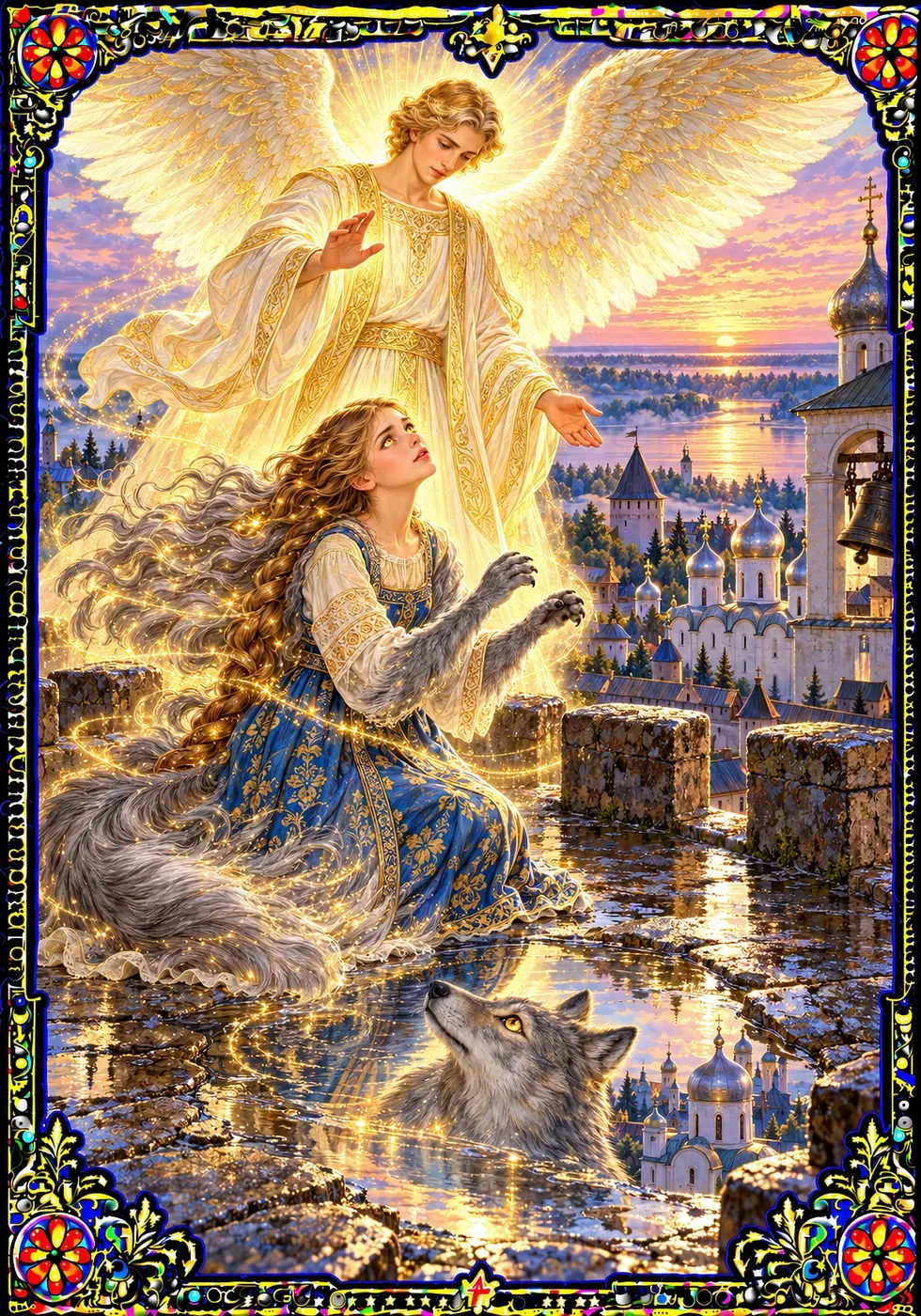
The sky over the forest was turning from gray to rose. The river below gleamed like a ribbon of pale copper. Suddenly, the whole top of the tower was filled with light, and before her stood a being of such brightness that she had to shield her eyes. It had the form of a youth with great shining wings, and its voice was like the tinkling of little bells.
“Anya, child of light,” it said, “I know the desire of your heart. You long to run with the wolves of the forest. Today is your birthday, and I have come to give you a gift. For one day, you may become a wolf and roam wherever you wish. Only heed this: return before the sun sets, lest the shadows claim you.”
Whether the shining one was an angel of the Lord or some other spirit of the air, the chronicles do not say. Anya did not stop to wonder. She did not think to make the sign of the cross, nor to ask her father’s leave, nor to seek the counsel of her confessor. Her heart leaped at the promise, and she said at once, “Yes, I will!”
The light swirled around her like a wind of sparks. Her hands became paws, her long braid became a thick gray coat, and when she caught sight of herself in a pool of rainwater on the stones, she saw the golden eyes of a young wolf looking back at her.
At that very moment, the great bell of Holy Wisdom began to ring for the Liturgy of the feast. Anya heard it, and, for an instant, she hesitated. Then she turned her back on the bell, bounded down the tower stairs, and ran out through the gate past the sleepy watchmen, who took her for a stray dog.
Never had she known such joy. She crossed the bridge and plunged into the forest. She ran through groves of pine where the sunlight fell in golden shafts. She splashed through cold, clear streams and chased the dragonflies over the meadows. At midday, she came upon a pack of wolves drinking at a forest lake, and the old she-wolf who led them, a gray mother with a torn ear, sniffed her carefully and allowed her to run with them.
“You are not one of us,” said the she-wolf, for in her wolf’s form Anya understood the speech of beasts. “Your eyes are a wolf’s eyes, but your heart is a maiden’s. Run with us if you like. Only do not go east, past the oak that the lightning split. That is the land of the prince of Suzdal. What goes in there does not come out.”
Anya promised, and, for many hours, she kept her promise. She hunted mice in the tall grass and lay panting in the shade with the cubs. When the pack lay down to sleep in the heat of the afternoon, however, she grew restless and wandered off alone. A white hare leaped up in front of her, and she gave chase. Over fallen trees and through thickets, she followed it, deeper and deeper into the forest, until the hare vanished beneath the roots of a great oak split down the middle by lightning.
Anya stopped. The air had grown cold. The birds had fallen silent. Through the branches, the sun hung low and red, dim as a coal seen through smoke, and she realized with horror that it was already touching the tops of the trees.
She turned and ran back the way she had come. She had not gone a hundred paces when she struck something that she could not see, something as hard and cold as an iron wall. She threw herself against it again and again, until her paws bled on the frozen air. It would not yield.
She had crossed into the realm of Prince Vyshata of Suzdal, whom the people of the borderlands called the Dark Prince. He envied Novgorod its wealth and its freedom, and he had taken into his service the volkhvs, the pagan sorcerers of the old gods, who still lurked in the deep forests of Suzdal long after the rest of Rus’ had been baptized. At his command, they had woven around his borders a dome of darkness. No eye could see it. It let in the unwary, and it let none out. Many a hunter and many a pilgrim had strayed into it over the years, and none had ever returned.
The sun sank. Night fell. Anya tried with all her will to become a girl again, but the spell of the gift and the spell of the dome were at war within her, and her form only flickered between maiden and wolf like a candle flame in a draft. At last, she crept under a thorn bush and lay there shivering, and, for the first time that day, she remembered to pray.
“Lord Jesus Christ, Son of God,” she whispered in her heart, “have mercy on me, a sinner.”
Not far from that cursed border, on a wooded hill that the peasants of the region called the Holy Mountain, lived an old hermit named Zosimas. As a young man, he had been a monk of the Kiev Caves, and, in his old age, he had come north to live alone in a cave dug into the side of the hill. He ate bread and wild berries, drank from a spring, and prayed the Psalter day and night for the peace of the Russian lands.
He was not entirely alone. Many years before, after a great storm, he had found an eaglet lying in the grass with a broken wing. He had splinted the wing with two twigs, fed the bird with his own hands, and prayed over it every night until it could fly again. The eagle never left him. It grew into a magnificent bird, and its head was crowned with feathers as white as fresh snow. The few pilgrims who climbed the Holy Mountain said that a soft light hung about that white head, like the light around the heads of the saints in the icons.
On the evening of the Transfiguration, the eagle flew far beyond the mountain, as it often did. It passed over the dome of darkness unharmed, for darkness has no power over what belongs to God, and, with its keen eyes, it spied a young wolf beneath a thorn bush, whose form flickered between beast and maiden as she paced in despair. The eagle flew home and alighted on the elder’s arm, and, through signs that only a pure heart could understand, it told him what it had seen.
“A human soul in a wolf’s form,” the old man murmured, “caught in the snare of Suzdal. Lord, have mercy. Who can go where even my eagle can only look?”
Above them, on a branch of an ancient oak, sat a snow-white owl, and the owl had heard every word.
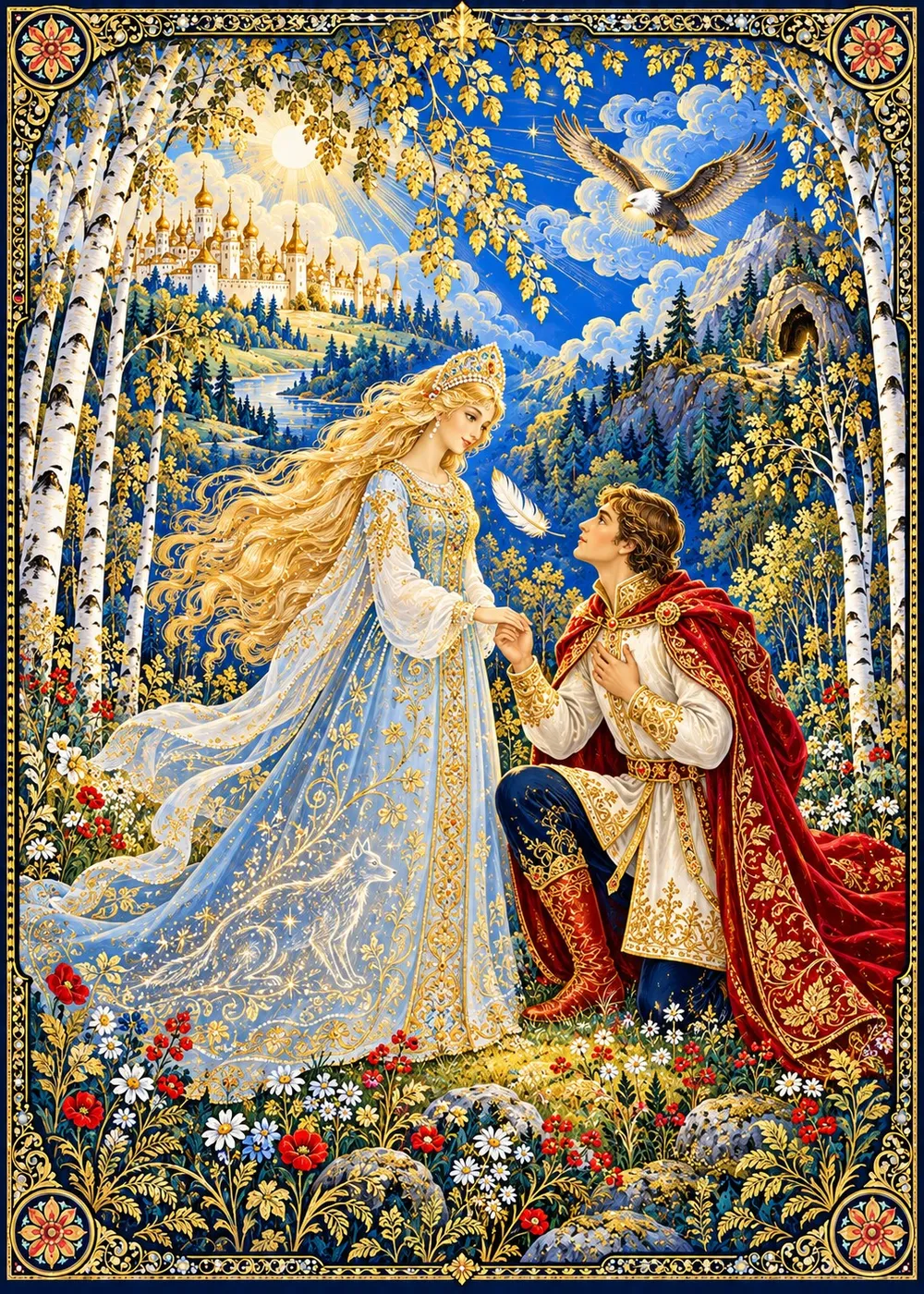
This was no common owl. He was Prince Ivan, the son of the Prince of Yaroslavl, whose city stood on the high bank of the Volga among golden-domed churches. From the night of his birth, Ivan had borne a mystery that no physician could cure and no priest could explain: each evening, when the first star appeared, he became a white snow owl, and, each morning at sunrise, he became a man again. His parents had wept over it for years. Ivan himself had come to accept it as both his cross and his calling. Each night, he flew over Yaroslavl, watching over its sleeping streets and praying for its people, and, many times, he had warned the watchmen of fire or of thieves. On his nightly flights, he often rested on the oak outside the elder’s cave, for the old man was the only soul besides his parents who knew his secret.
* * *
Copyright notice. Introduction and illustration © 2026 Laurent Cleenewerck. All rights reserved. The adapted Orthodox version of this tale is published in Twelve Russian Orthodox Fairy Tales (© 2026 Laurent Cleenewerck). No part of this page may be reproduced without written permission, except for brief quotations with attribution and a link to this page.
Buy the book on AmazonAbout the book