
A Story of Bucovina and the Feast of the Nativity
In the ancient lands of Moldavia, in the green hills of Bucovina, where the painted monasteries stand in the valleys like jewel boxes left in the grass, the last and greatest of them all was built by a family of great boyars called the Movilă. It is called Sucevitsa. Its church stands in the middle of a great courtyard, with thick stone walls and towers all around it like a fortress, and its outer walls are painted from the ground to the roof with saints and angels and prophets, in green and red and gold, glowing under the wide eaves.
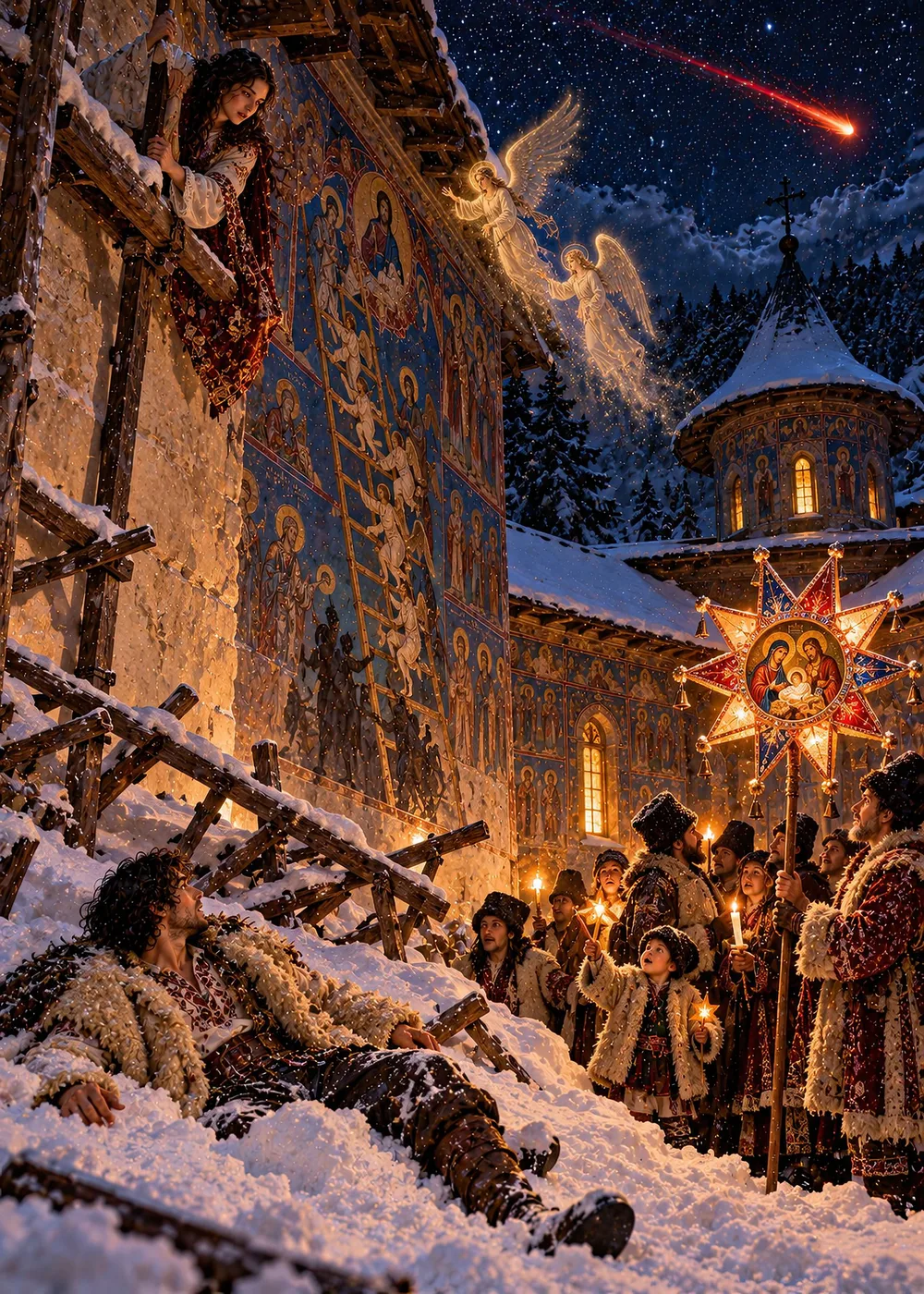
On the north wall of that church, the painters made a picture like no other. It is a great ladder, stretching from earth to heaven, from the lower left corner of the wall to the upper right. On it, monks in black are climbing, rung by rung, toward Christ, who leans down out of heaven at the top to receive them. On the right side of the ladder, in rows upon rows, stand the angels of God in white and gold, cheering the climbers on. On the left side, little black demons with hooks and ropes try to pull the climbers down, and some of them fall, tumbling headfirst into the open jaws of a great dragon at the bottom of the wall. It is called the Ladder of the Virtues, and when children see it for the first time, they never forget it.
In the days when the paint on that wall was still fresh, there lived in a village near Sucevitsa an old peasant woman whom everyone called Granny Vasilca. It was said that when the monastery was being built, she had spent thirty years carrying stones for it in her ox cart, a load every day, in summer and winter, to make up for some old sin that she never spoke of. She lived with her grandson Vasile, a tall, poor, cheerful young man who worked as a woodcutter in summer, and in winter, every Christmas, led the carolers of the village.
Vasile had the finest voice in all Bucovina. When he sang the old carols in the snow under the windows, with his breath steaming in the cold air, people opened their doors and stood listening with tears in their eyes. Every Christmas Eve, he carried the Star, a great star of wood and colored paper with a candle burning inside it and a little icon of the Nativity in the middle, and the boys of the village followed him from house to house, singing.
That year, the voivode Ieremia Movilă came to keep the Christmas feast at Sucevitsa with all his household, and with them came his niece, the Princess Anastasia. She was the daughter of his sister, who had died when the child was small, and the voivode had raised her in his court at Suceava like his own daughter. She was seventeen, with dark hair and dark eyes and a face as gentle as an icon, and until that autumn, she had been the merriest girl at the court.
That autumn, however, something had happened to her.
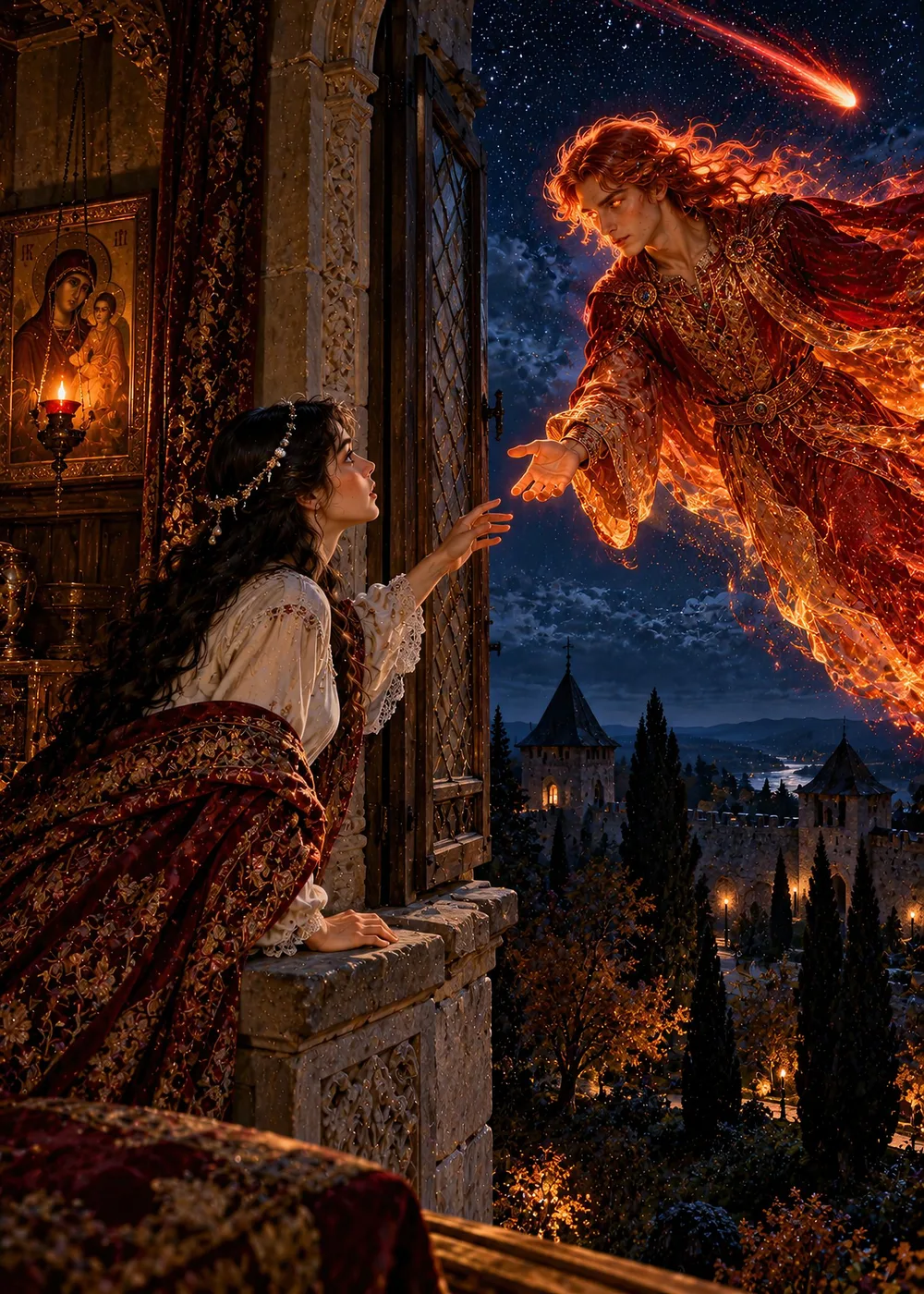
One night in October, as she stood at her window in Suceava, she had seen a falling star. It was not like other falling stars. It came down slowly out of the sky, glowing red and gold, and it fell into the garden beneath her window, and lay there burning softly in the grass. As she watched, the star rose up from the grass and became a young man.
He was the most beautiful young man that she had ever seen. His hair was like flame, and his eyes were like coals, and his clothes shone like the sunset, and he floated in the air outside her window as if he were standing on the ground.
“Princess Anastasia,” he said, in a voice like music, “I have watched you from the sky for a long time. Do you not want to fly? Come with me, and I will take you up above the stars, where no one ever grows tired or old, and you will never have to set foot on the dull earth again.”
It was the Zburător.
Anastasia did not go with him that night. Yet every night after that, the Zburător came back. He floated outside her window in his shining clothes, and he spoke to her of the stars, and of flying, and of a heaven that could be reached in a single night, without any effort at all. “Why should you kneel in cold churches?” he would say. “Why should you fast and pray and climb, step by step, all your life? I can take you to heaven tonight, on my wings.”
Every night, she listened a little longer.
By day, she grew pale and thin and silent. She stopped eating. She stopped laughing. She would not go to church, for the prayers seemed long and dull to her now. She sat all day long at her window, staring at the sky, waiting for the night. The voivode sent for physicians from Poland and from Constantinople, and they shook their heads and could not tell what was wrong with her. He hoped that the feast of Christmas, at the quiet monastery among the hills, would bring her back to herself, and so he brought her with him to Sucevitsa.
On the first evening after they arrived, Vasile was bringing a load of firewood into the courtyard of the monastery, and he saw her. She was standing alone before the north wall of the church, in the snow, looking up at the painted Ladder, pale as a ghost. He had never seen anyone so beautiful or so sad. He put down his wood and stood beside her.
“It is a long way to the top, Princess,” he said.
She did not look at him. “Too long,” she said in a dull voice. “Why should anyone climb? There is a quicker way.”
That evening, Vasile told his grandmother about the pale princess from the court who stared at the sky. Old Granny Vasilca listened, and her face grew grave.
“The Zburător has come to her,” she said. “I have seen it before, when I was young. He comes as a falling star, and he promises heaven without the ladder. Heaven without humility, without prayer, without love. Every girl who follows him falls, as the falling stars fall.”
“Can she be saved, Granny?”
The old woman was silent for a long time. Then she said, “The Zburător hates two things more than anything: the songs of Christmas, and the light of the Star. On Christmas Eve, he will come for her, for it is one of the longest nights of the year, and his power is greatest then. That is the night when you must sing as you have never sung before.”
On Christmas Eve, the snow lay deep on the hills of Bucovina, and the stars were sharp and bright in the frozen sky. In the village below the monastery, the carolers gathered at Granny Vasilca’s door: a dozen boys in sheepskin coats and tall fur caps, with bells and little drums, and Vasile at their head with the great Star, its candle burning red and gold through the colored paper.
As they were about to set out, a little boy came running down the hill from the monastery, wrapped in a fur coat, with a small paper star of his own in his hand. He was about five years old, with bright, eager eyes. He was Petru, the son of Simion Movilă, the voivode’s brother, and he had slipped away from his nurse.
“Let me come with you!” he begged. “I want to carry the Star too!”
The boys laughed, and Vasile lifted the little boyar onto his shoulders. “Come, then, little lord,” he said. “Tonight, we are all carolers.”
They went from house to house in the village, singing under the windows, and the people opened their doors and gave them ring-shaped breads and red apples and walnuts. Last of all, near midnight, they climbed the hill to the monastery and came into the great courtyard, where the voivode and all his household were waiting by the church, with torches, to hear the carols.
The Princess Anastasia stood among them, pale and silent, wrapped in furs, staring up at the sky.
Vasile lifted the Star high and began to sing, and all the boys sang with him:
Rise up, rise up, good people, white flowers, apple blossoms,
the Star has stopped above your house, white flowers, apple blossoms,
for Christ is born in Bethlehem, white flowers, apple blossoms,
and comes to meet us down the ladder, white flowers, apple blossoms.
As they sang, a light appeared in the sky over the hills. At first, it looked like a star, red and gold. Then it began to fall, slowly, toward the monastery, growing larger and brighter as it came, until it was no longer a star but a young man in clothes of fire, with flaming hair, floating in the air above the courtyard.
* * *
Copyright notice. Introduction and illustration © 2026 Laurent Cleenewerck. All rights reserved. The adapted Orthodox version of this tale is published in Twelve Romanian Orthodox Fairy Tales (© 2026 Laurent Cleenewerck). No part of this page may be reproduced without written permission, except for brief quotations with attribution and a link to this page.
Buy the book on AmazonAbout the book