
A Story of the Iron Gates and the Feast of Saint Nicodemus
In the ancient lands of Wallachia, where the Danube forces its way between the Carpathian Mountains and the Balkan Mountains through a long and narrow gorge, there is a place called the Iron Gates. There, the great river, which is wide and slow everywhere else, becomes narrow and deep and furious. It roars between cliffs of gray stone, and in its narrowest part, where the cliffs almost touch, it boils and spins in great whirlpools, which the people call the Cauldrons. In the old days, no boat could cross the river there and live.
Below the gorge, on the northern bank, stood the stone fortress of Severin, where the Ban of Severin kept watch over the river for the voivode Vladislav. Not far from the fortress, the old stone pillars of a great Roman bridge still rose out of the water, though the bridge itself had fallen a thousand years before.
In that fortress lived the voivode’s only daughter, the Princess Tudora. Her mother had died when she was small, and her father, who was often at war, had sent her to grow up at Severin under the care of the old Ban, who was her godfather. She had copper-colored hair and green eyes and a laugh that rang through the fortress like a bell, and she loved the river. She loved to stand on the walls at sunset and watch the light turn the water to gold. She was betrothed to a young knight named Mihu, who was captain of the Ban’s guard, and who loved her so much that he could not look at her without smiling. Their wedding was set for the autumn, and the whole of Severin was preparing for it.
There was something else in the river, though, that loved Tudora too.
Deep in the gorge of the Iron Gates, below the whirlpools of the Cauldrons, in a palace hidden in the rocks under the river, lived a zmeu. He was huge and strong, with a man’s body and a dragon’s tail, and scales of copper on his arms, and a great iron mace that he could throw farther than the eye could see. He was very old and very rich, and his palace was full of treasures that the river had swallowed over a thousand years: Roman gold, and the swords of drowned knights, and the cargoes of sunken ships. Yet he was never satisfied. He had everything except what he could not take, and he wanted that most of all.
He had watched the princess from the depths of the river for a long time, as she stood on the walls of Severin at sunset, and he had decided that she would be his bride.
On the eve of her wedding, a terrible storm came up the gorge. The wind howled, and the rain fell in sheets, and the Danube rose and roared against the walls of the fortress. In the middle of the storm, a great wave came up out of the river, higher than the walls, and in the wave was the zmeu. He seized Tudora from the tower where she was sleeping, and he plunged back with her into the black water, and the wave fell, and they were gone.
In the morning, the river was calm again, and the sun shone, and Tudora had vanished. On the wall of her tower, written in mud, were these words: Whoever wants her back, let him cross the river at the Cauldrons, where no boat can go, and come to my palace under the rocks. No one will.
The old Ban wept and tore his beard, and he sent riders galloping to the voivode with the terrible news. Mihu did not weep. He took the strongest boat in Severin and the six best oarsmen, and he rowed up the gorge to the Cauldrons. The whirlpools caught the boat like a leaf, and spun it round, and smashed it against the rocks. Mihu and the oarsmen were thrown into the water. By some miracle they were washed up alive on the northern bank, bruised and half drowned. Mihu tried again the next day, with another boat, and again it was smashed.
For a whole week he tried, until there were no more boats in Severin and no more men willing to row them. Then he sat on a rock above the Cauldrons, where the river roared below him, and he buried his face in his hands.
On the evening of the seventh day, he looked up, and saw a monk standing on the other side of the river.
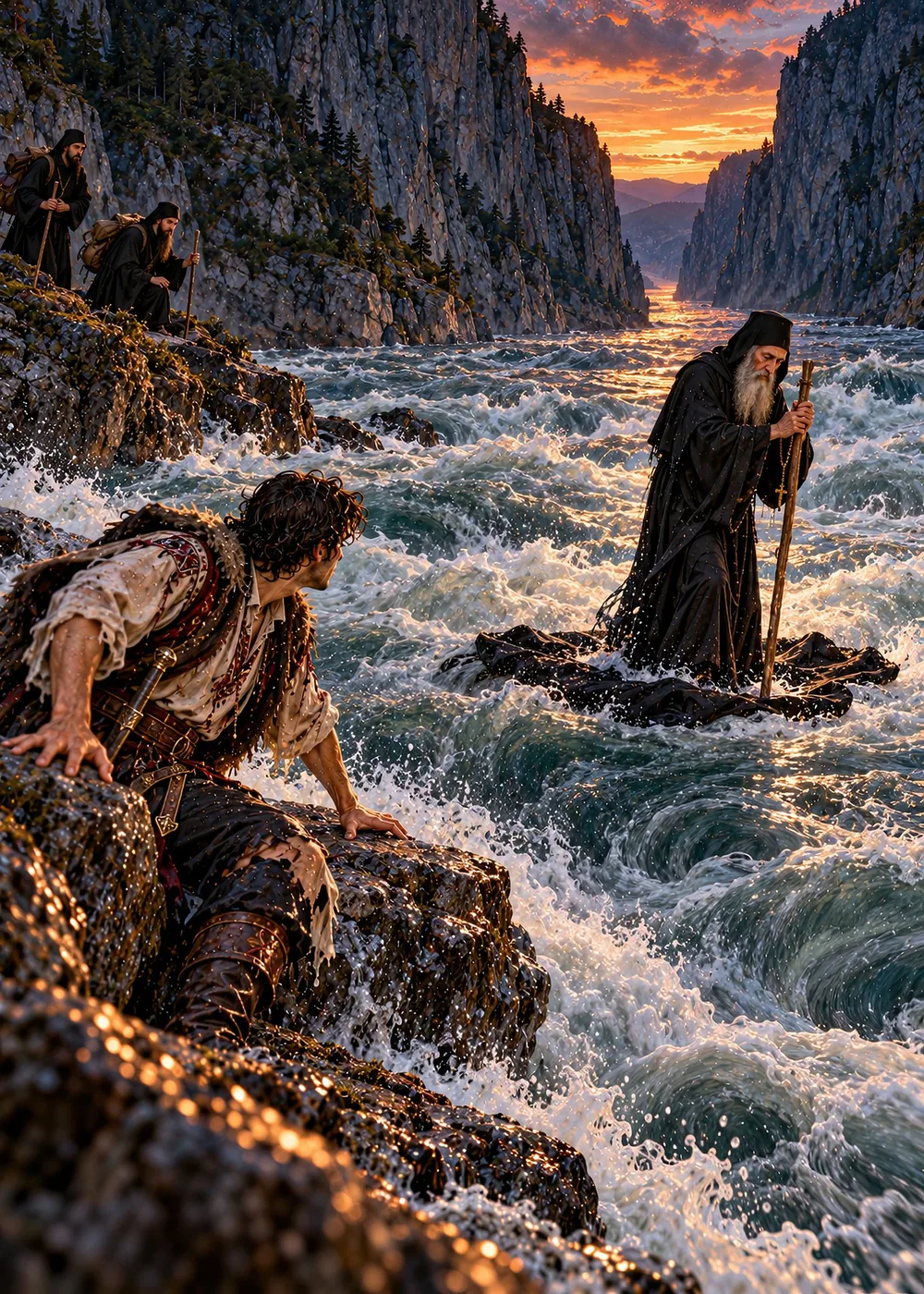
He was an old man, thin and stooped, in a black habit and a black mantle that reached to his feet, with a long gray beard and a wooden staff in his hand. Behind him, on the southern bank, stood two young monks with bundles on their backs. The old monk looked at the raging water for a long time, as if he were measuring it. Then he did something that made Mihu leap to his feet.
He took off his black mantle, spread it out on the water at the edge of the river, and made the sign of the cross over it. Then he stepped onto it.
The mantle did not sink. It floated on the boiling water like a raft of oak. The old monk stood on it, leaning on his staff, with his lips moving in prayer, and the mantle carried him straight out into the river, across the whirlpools of the Cauldrons, as calmly as a boat on a pond. The whirlpools spun around him, and the waves leaped and roared, but not one drop of water touched the old man’s feet.
The mantle came to rest against the rocks below Mihu, and the old monk stepped off it onto the northern bank. He picked up his mantle, shook it, and put it back on his shoulders. It was perfectly dry.
Mihu fell on his knees before him. “Father,” he said, “who are you?”
“A sinful monk,” said the old man. “My name is Nicodemus. I have come from the Holy Mountain of Athos to build a house of prayer in this land, and I was in a hurry to cross the river.” He looked at Mihu’s bruised face and his torn clothes. “Why do you weep, my son?”
Mihu told him everything: the Princess Tudora, and the zmeu, and the storm, and the words written in mud, and the smashed boats. The old monk listened in silence, leaning on his staff.
“The zmeu is very strong,” he said at last. “He is strong as all proud things are strong, and weak as all proud things are weak. He has taken a great many things that do not belong to him, and he thinks that because he is strong, he can keep them. Come. Let us go and visit him.”
“Father,” said Mihu, “how will we find his palace?”
“The river will show us,” said Nicodemus. He spread his mantle on the water once more, and he stepped onto it, and he held out his hand to the young knight.
Mihu looked at the boiling whirlpools, and his heart failed him. Then he remembered the Gospel story of the holy Apostle Peter, who walked on the water toward the Lord, and sank only when he began to doubt. He took the old monk’s hand, and he stepped onto the mantle.
It held him.
They floated up the gorge together, over the whirlpools, between the towering cliffs, with the old monk praying and the young knight holding his breath. At the narrowest part of the Cauldrons, where the cliffs almost met over their heads, the mantle turned of itself toward the southern cliff, and there, just above the water, was the dark mouth of a cave. The mantle carried them into it, and set them down on a ledge of rock, and the old monk picked it up and put it on again.
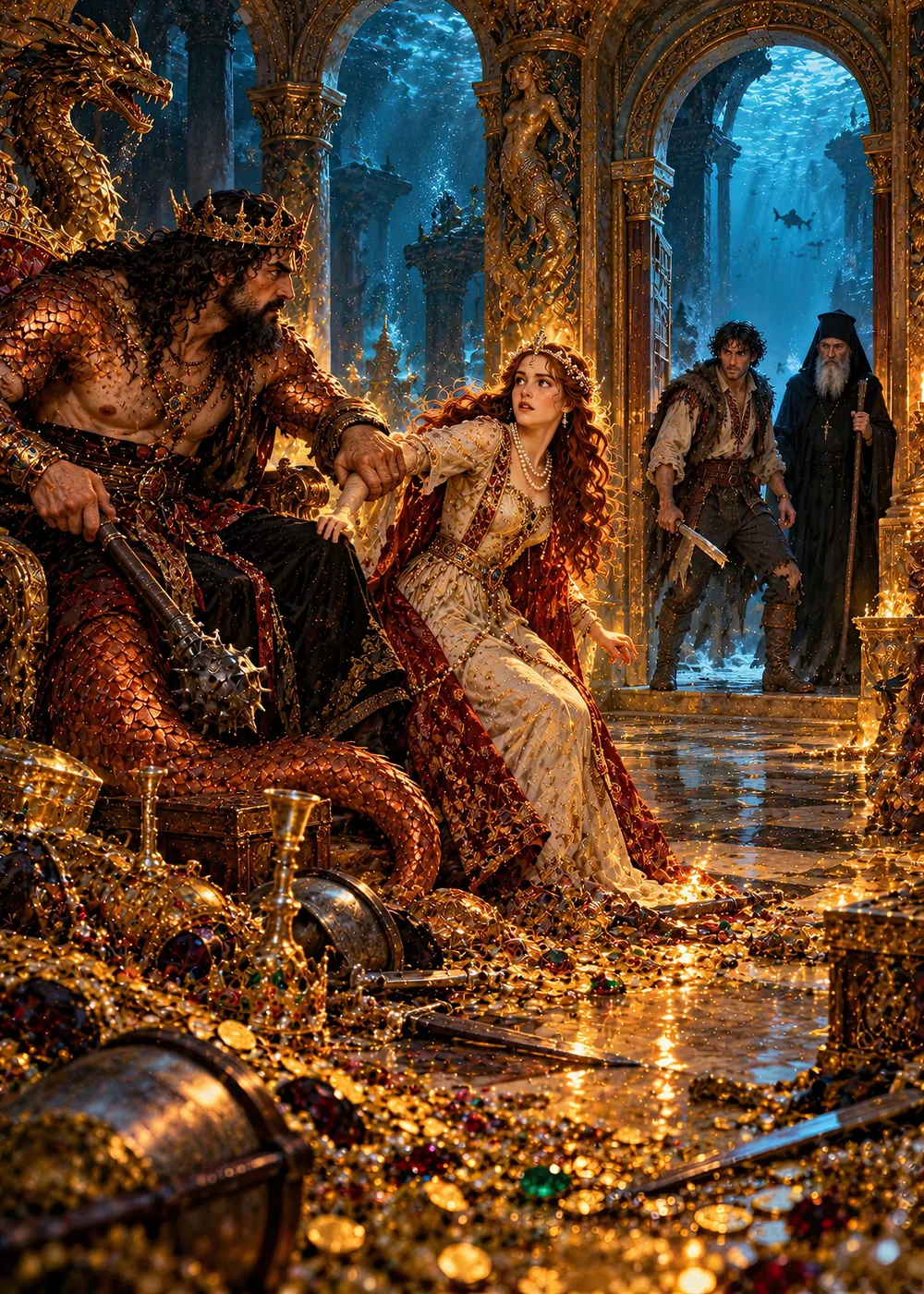
They went down into the cave, deeper and deeper, under the river. The air was cold and wet, and they could hear the Danube roaring over their heads. At last they came to a great door of copper, and behind it a palace of copper, with copper halls and copper columns. Beyond it was a palace of silver, and beyond that, a palace of gold, all glowing with a strange cold light, and piled with the treasures of the river.
In the great hall of the golden palace, on a golden throne, sat the zmeu. Beside him, on a smaller throne, sat the Princess Tudora, pale and silent, with a crown of drowned pearls on her copper hair, and tears on her cheeks.
When she saw Mihu, she cried out and tried to run to him, but the zmeu caught her by the wrist.
The zmeu looked at his visitors, and he laughed until the golden walls shook.
“A knight with a broken sword,” he said, “and an old monk with a stick. Is this all the world could send against me? How did you cross the river?”
* * *
Copyright notice. Introduction and illustration © 2026 Laurent Cleenewerck. All rights reserved. The adapted Orthodox version of this tale is published in Twelve Romanian Orthodox Fairy Tales (© 2026 Laurent Cleenewerck). No part of this page may be reproduced without written permission, except for brief quotations with attribution and a link to this page.
Buy the book on AmazonAbout the book