
A Story of the Argesh Valley and the Feast of Saint John the New
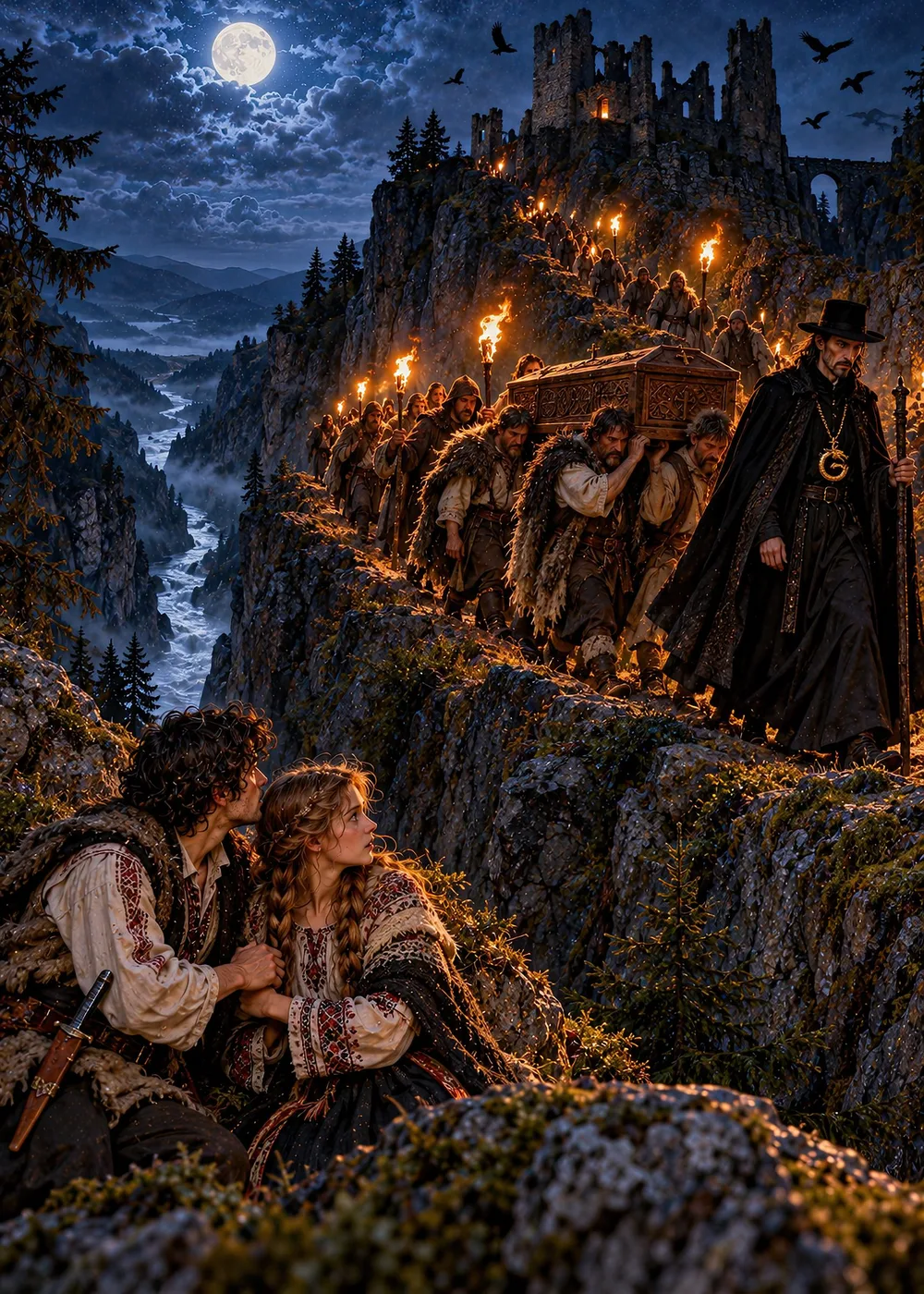
In the ancient lands of Wallachia, where the river Argesh rushes down from the high Carpathians through a deep and narrow gorge, there stands on the top of a sheer cliff the ruin of an old stone castle. Its towers are broken, and its walls are black with age, and the ravens wheel around it day and night, crying. Far below it, in the valley, there lies a village of wooden houses and orchards, with a little white church in the middle.
In the days of our story, the castle was already old, and the people of the village did not like to speak of it. Long before, it had belonged to a fierce and terrible prince whom the people called the Son of the Dragon. He had fought bravely against the armies of the sultan, and he had been so stern with thieves and traitors that, it was said, a man could leave a golden cup by a fountain in his day and find it still there a year later. He had also been cruel, and many people had died by his hand, and when he was gone, the people of the valley were glad to let his castle crumble on its cliff. The old women told their grandchildren that on stormy nights, lights could still be seen moving in its windows.
In that village lived an old boyar named Bratu. In his youth, he had been a captain in the Dragon prince’s army, and he had grown rich in the wars, and he lived in the biggest house in the village with his granddaughter, Sanda, whose parents had died when she was small. Bratu was proud and hard, like the prince he had served. He had quarreled long ago with his own brother over a field by the river, and the two had never spoken again. Even when his brother lay dying, old Bratu would not go to him. “Let him ask my pardon first,” he said. The brother died, and his widow and children were left poor, and Bratu kept the field.
Sanda was nothing like her grandfather. She was gentle and quiet, with long fair braids and gray eyes, and she loved the little white church, and the poor of the village loved her. Among those who loved her most was Ilie, the son of the village priest, Father Stoica. Ilie was a woodcarver. He carved the crosses that stood at the crossroads and over the graves, and the little wooden spoons and bowls that the women used, and he could carve a vine on a gatepost so well that the birds tried to perch on its leaves. He and Sanda had grown up together, and everyone in the village knew that one day they would marry.
Then, one winter, old Bratu died. He died suddenly in the night, without a priest and without confession, and with his old grudge against his brother still in his heart. They buried him in the churchyard, under a heavy stone, and Sanda wept for him, and the village was quiet.
Soon after that, strange things began to happen.
The dogs of the village howled every night at the churchyard. A cow died, and then another. A fever came and went in some of the houses. One night, a shepherd coming home late swore that he had seen a pale light floating over old Bratu’s grave. Before long, the whole village was whispering one word, and whispering it with fear: strigoi.
“Old Bratu was a hard man,” they said, “and he died without confession. He is a strigoi. He is rising from his grave at night. That is why the cattle die.”
When spring came, the men of the village gathered in the churchyard with spades and stakes and torches, and before Father Stoica could stop them, they lifted the stone and opened old Bratu’s grave.
The coffin lid came off. A cry of terror went up from all of them. Old Bratu lay in his coffin as if he had died the day before. His face was pale and calm, his hands were folded on his chest, and he had not returned to dust at all.
“Strigoi!” cried the men. “Strigoi!” They lifted their stakes.
“No!” cried Sanda, running between them and the coffin. “Leave him alone! He was my grandfather!”
At that moment, a voice spoke from the churchyard gate, a deep, rich, smooth voice. “She is right. Leave him alone. You do not know what you have found.”
A stranger stood at the gate. He was tall and thin, dressed all in black, with a black cloak and a black hat, and a pale, handsome face, and his eyes were as dark as wells. On his breast hung a heavy golden chain, and on the chain was the golden image of a dragon, curled in a ring with its tail around its neck.
“I am Dragomir,” he said, “and I am the keeper of the Order of the Dragon. Your boyar was a captain of the Son of the Dragon. Do you not see? He has not decayed because he has conquered death. He is not a strigoi. He is one of the Dragon’s chosen. Bring him up to the castle of his old prince, and honor him there, and bring him gifts, and he will protect your village and give you a life that does not end.”
The men stood with their stakes in their hands, not knowing what to do. They were afraid of the strigoi, but they were even more afraid of the stranger’s dark eyes, and something in his smooth voice made them want to obey.
That night, the men of the village carried the coffin of old Bratu up the long, steep path to the castle on the cliff, by the light of torches, with the stranger in black walking before them. Sanda and Ilie followed at a distance, hand in hand, their hearts pounding. They saw the coffin carried in through the broken gate of the castle, and they saw the lights moving in its windows, as the old women had said. Then the door closed, and they could see no more.
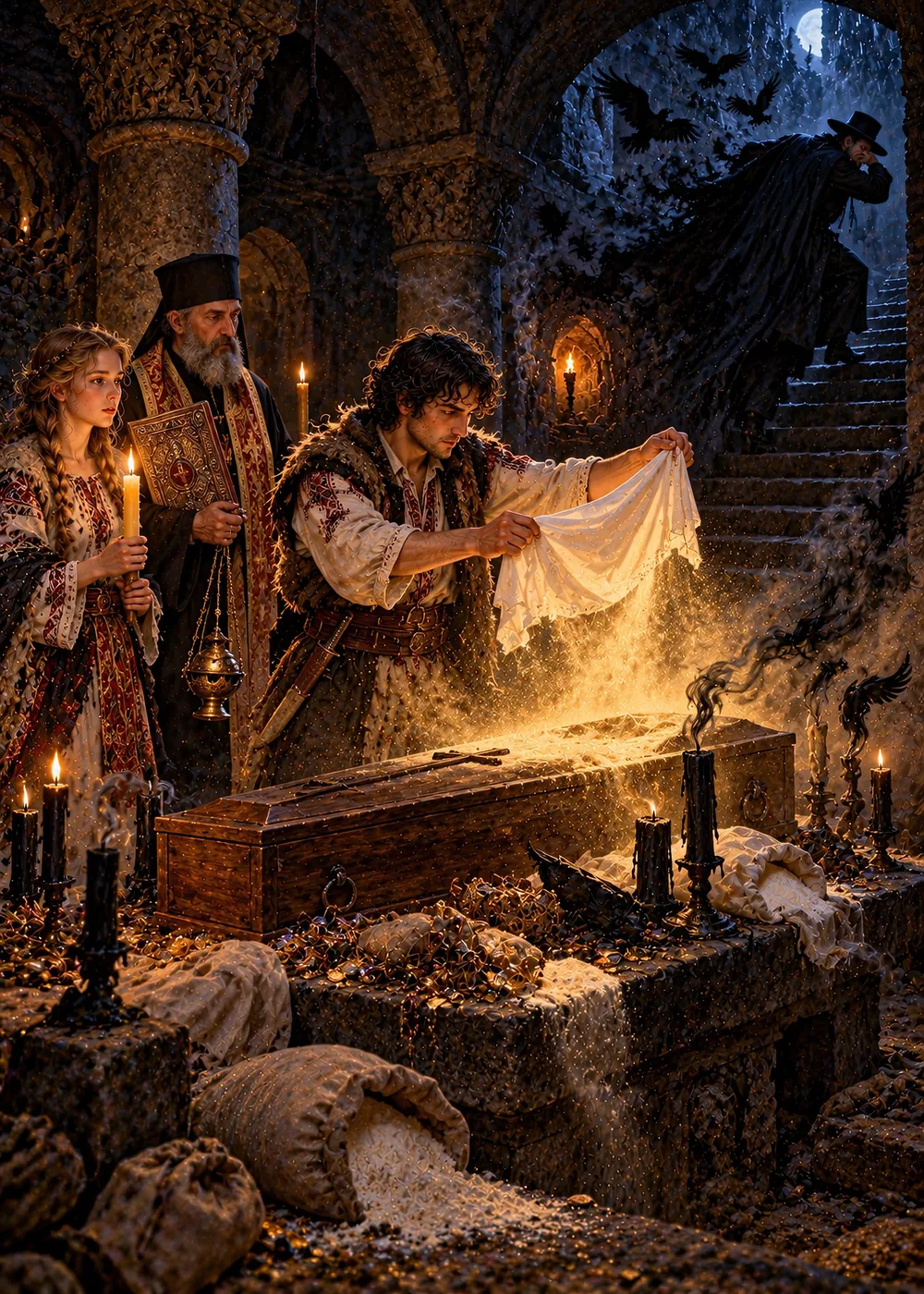
From that night on, a shadow lay over the village. Every week, Dragomir came down from the castle and told the people what the “chosen one” required: a lamb, a sack of flour, a purse of coins, a golden ring. Every week, the frightened villagers carried their gifts up the cliff and laid them before the coffin in the crypt of the castle, where black candles burned around it, and they bowed down before the dead man, while Dragomir chanted strange words over him. Fewer and fewer of them came to the little white church. Some of them began to whisper that perhaps Dragomir was right, that perhaps old Bratu would protect them, and that perhaps, if they served him well, they too would never die.
Father Stoica was very old, and he grieved. “My children,” he said to them on Sunday, to the few who still came, “we must not fear the dead, and we must not worship them either. We must pray for them. That is all the Church has ever asked.”
Sanda had dreams every night. In her dreams, her grandfather stood at the foot of her bed. He did not look frightening. He looked sad and tired and cold, and he held out his hands to her as if he were asking for something, but he could not speak.
“He is not a monster,” she told Ilie, weeping. “He is asking for help. I know it. Yet what help can we give?”
Ilie thought for a long time. Then he said, “Across the mountains, in Moldavia, in the city of Suceava, lie the relics of a holy martyr, Saint John the New. His body has rested there for many years, and the pilgrims say that it is fragrant and brings healing. My father says that the monks there know more about such things than anyone. I will go to Suceava and ask them what to do.”
He set out the next morning, on foot, with a little bread in his bag and his carving knife in his belt.
It was a long road, over the high passes of the mountains, through forests and across rivers, and it took him many weeks. He arrived in Suceava on the eve of the first day of June, the eve of the feast of Saint John the New, when the city was full of pilgrims. He joined the long line of them going into the church, and when his turn came, he knelt before the silver reliquary of the martyr and kissed it.
At once, he noticed the fragrance. It was a sweet, soft, gentle smell, like flowers and honey and incense all at once, and it filled him with a peace that he had not felt since the day they opened old Bratu’s grave. Near him, a mother lifted a sick little boy to kiss the reliquary, and Ilie saw the boy’s pale face grow pink, and saw him smile, and heard his mother weep for joy.
After the service, an old monk with a long white beard came and found him sitting on the steps of the church. “You have come a long way, my son,” he said. “I can see it on your shoes. What troubles you?”
Ilie told him the whole story: about old Bratu, and the open grave, and the stranger in black with the golden dragon, and the black candles in the crypt of the castle, and the villagers bowing down before the dead man.
The old monk listened, and his face grew grave. When Ilie had finished, he said, “There are two kinds of bodies that do not return to dust, my son. Learn to tell them apart. The bodies of the saints bring peace, and they are fragrant, as you have smelled today. They heal the sick, and they never ask for anything for themselves. They point away from themselves, to Christ, who is risen from the dead. Even so, many saints have returned to dust, and they are no less holy for that. Holiness is not in the body. It is in the life.”
* * *
Copyright notice. Introduction and illustration © 2026 Laurent Cleenewerck. All rights reserved. The adapted Orthodox version of this tale is published in Twelve Romanian Orthodox Fairy Tales (© 2026 Laurent Cleenewerck). No part of this page may be reproduced without written permission, except for brief quotations with attribution and a link to this page.
Buy the book on AmazonAbout the book